Most of my ancestors have been labourers. Many of them did a lot of digging as part of their work, especially since a lot of them were agricultural workers. Some may have only deep enough to plant crops, while others may have dug a little deeper.
I’ve already speculated about my 4x Great Grandfather, Petrus Pieterszoon “Pieter” van der Fluit and the possibility that the reason he relocated from Zuid Holland to Noord Holland was to work digging canals and other work related to polder construction and waterworks. Unfortunately, the timing does not seem quite right. Furthermore, and of greater importance, I’ve yet to discover any real evidence to support the theory.
Turning to my mother’s side of the family, my great grandfather Milton Leo Burgess was a man of many occupations over his working life: farmer; plumber; and woolen mill worker (where he lost a finger of his left hand due to a work injury). Unique amongst the labouring jobs held by my ancestors, apparently Milton spent a short period of time sometime around 1950 working as a gravedigger. The only source I have for this is my mother. While she knew her grandfather well, if he was a gravedigger in the early 1950s she would have been too young to have had any memories of the time he held that job. It is something he likely told her when she was older.
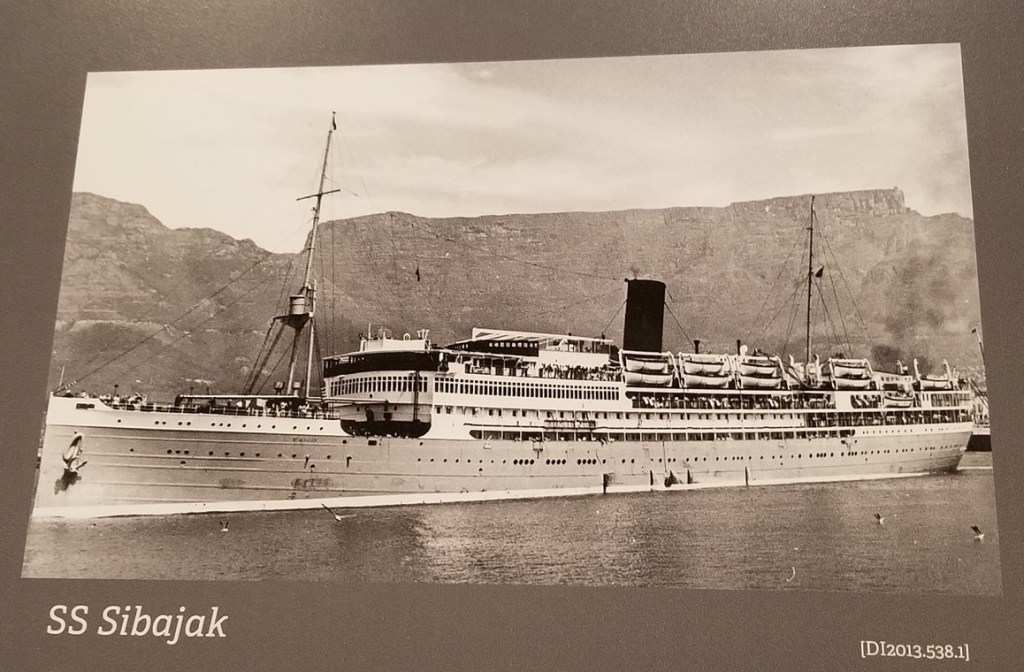
This week’s theme for the week’s 52 Ancestors Challenge is “Flew The Coop”. I’m making a real stretch of the phrase to write about my recent visit to Pier 21, where my father and his family arrived in Canada after emigrating from the Netherlands. They arrived on board the Sibajak in early 1954. My father’s aunt and uncle had arrived at Pier 21 four months earlier, in January 1954 on the Groote Beer, while another aunt and uncle followed in late May 1954, on board the Castel Felice.
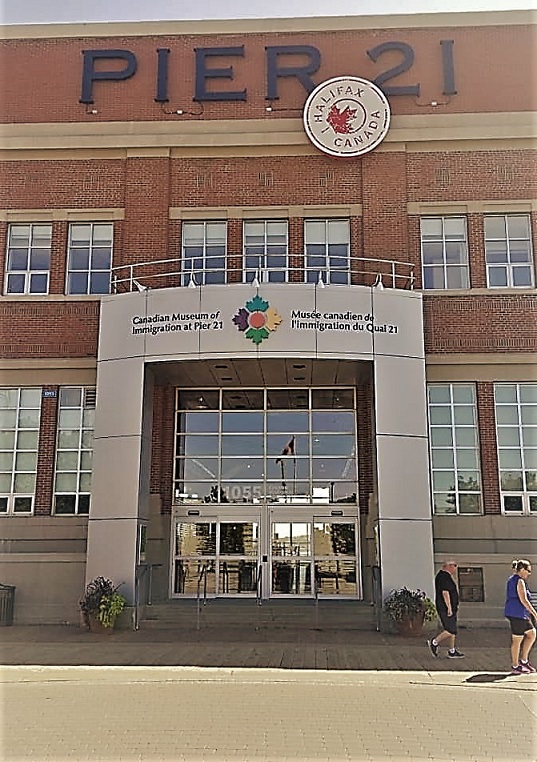
Entrance to Pier 21
This was not my first visit to Pier 21 (analogous to Ellis Island in the United States), but it had been many years since my last visit. The displays are significantly different; moreover, the museum has strictly implemented privacy rules that means they don’t display ship passenger lists like they used to. I find their policy a little illogical, because the researchers on site will happily use other sources for the same information that aren’t subject to the same rules.
We began with watching in Canada/au Canada. It’s an excellent and moving short film weaving together the stories of many immigrants from countries all around the world and who have settled in all sorts of places, big and small, across Canada. We then participated in a guided tour. The tour was available in English and French. I felt bad for the fellow offering the tour in French – he had no takers at that time. I told him that my wife and kids would have gone with him if it weren’t for my lack of proficiency in French.
Our tour guide began by asking if anyone had family or friends who had come through Pier 21. Most of us on the tour raised our hands. One woman in our group had come through herself, at 18 months old, with her mother who was a war bride. The tour guide immediately welcomed her back and gave her a gold “Alumni” sticker to wear.
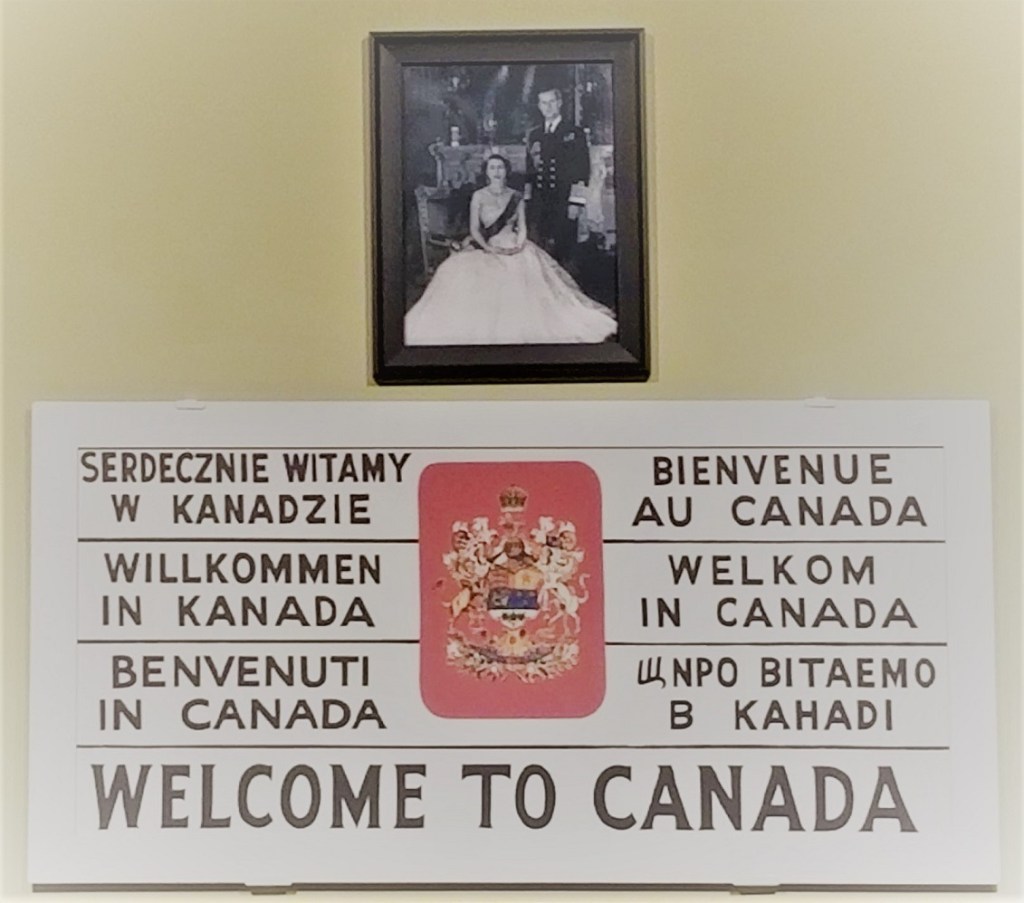
This hangs on the wall in front of the seating area where immigrants waited to be interviewed by immigration officials.
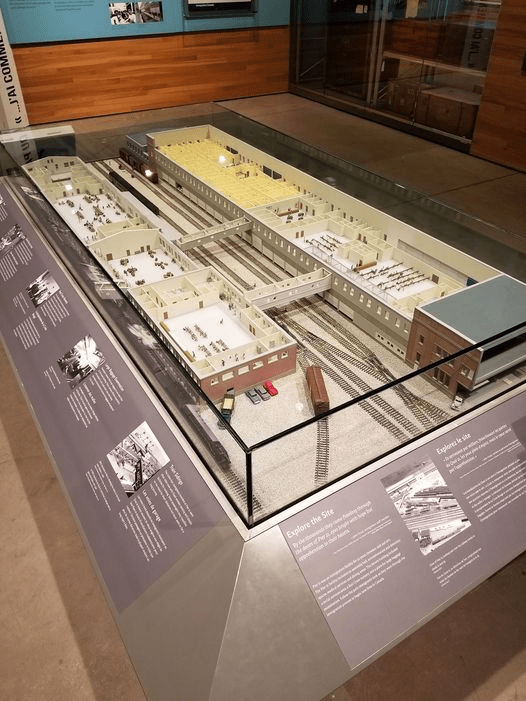
The tour began with at this model of Pier 21 as it was at the time it was in operation. The building on the left no longer exists. The guide showed the path of the immigrants as they disembarked from the ship and the steps they went through before being able to leave. We were told that if everything went without a hitch, people could be off the ship and on the train in four to six hours. However, most people were usually in and out within a day.
There were many displays recreating the immigrant experience. One was of the interior of typical tourist class accommodations and amenities. On the opposite wall were photos of many of the immigrant ships that landed at Pier 21.
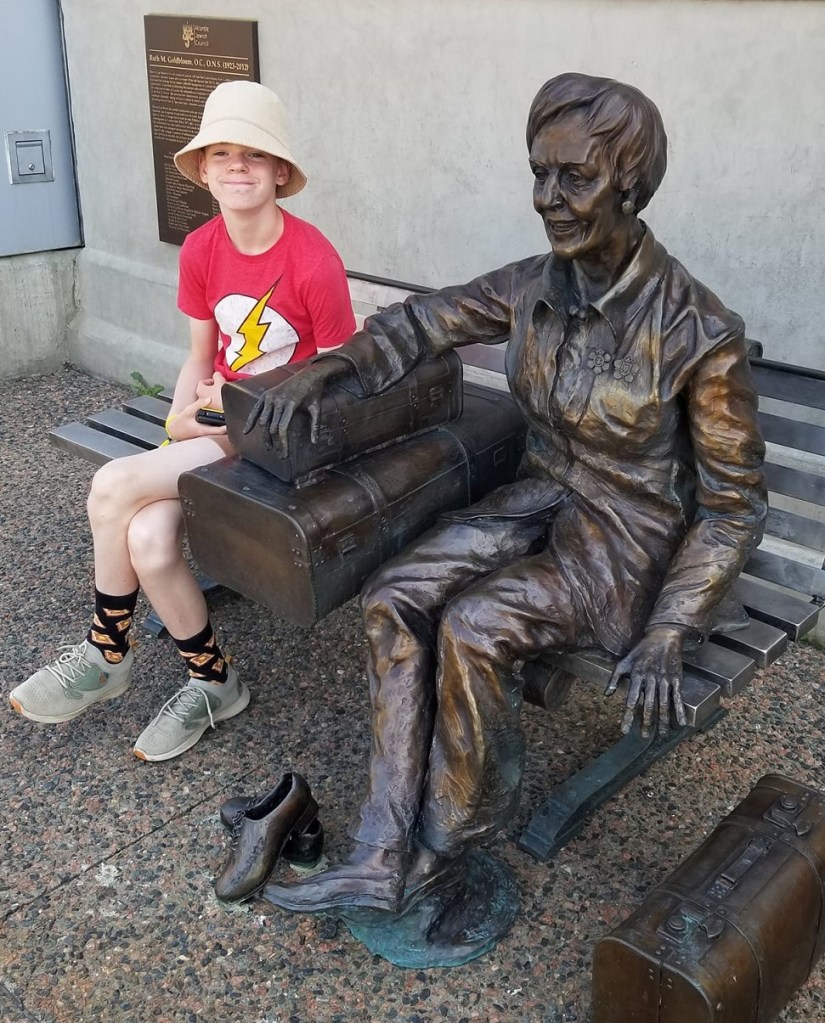
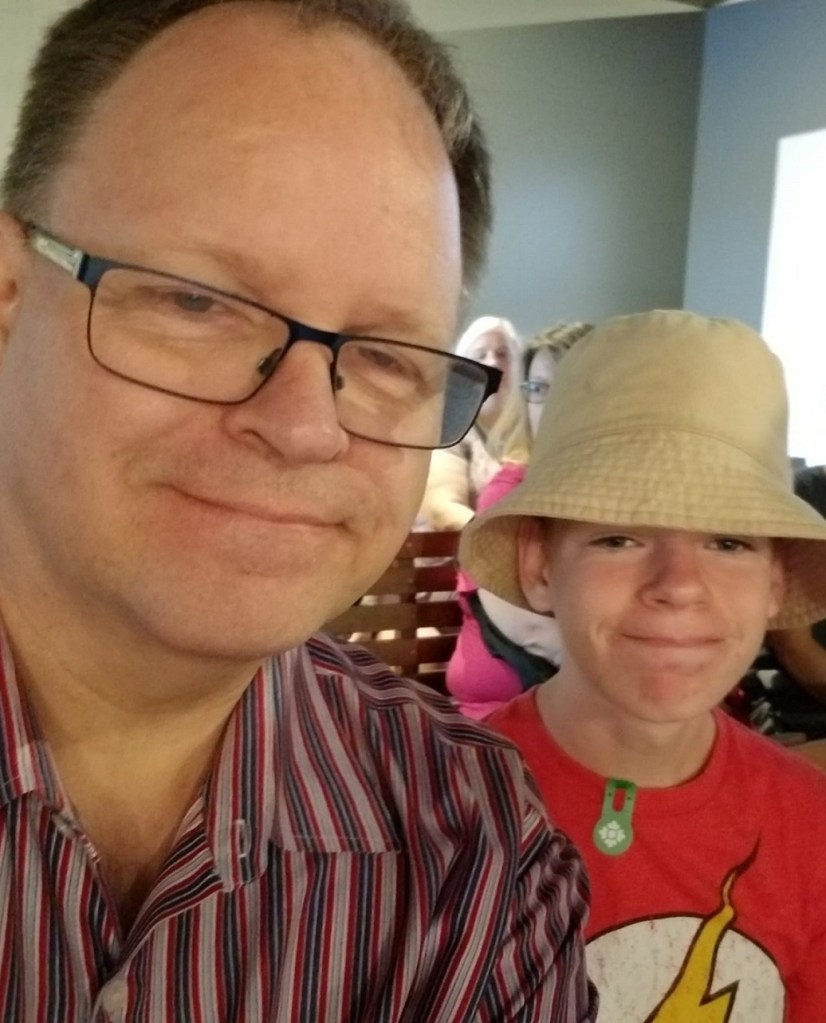
My son and I sitting on the benches in the waiting room where my father would have sat with his family upon arriving in Canada almost 70 years ago.
The museum has something for visitors of all ages, with lots of interactive and immersive displays. I think our youngest must have watched every video that accompanied the exhibits. There were also lots of crafting and other hands-on activities for the kids.
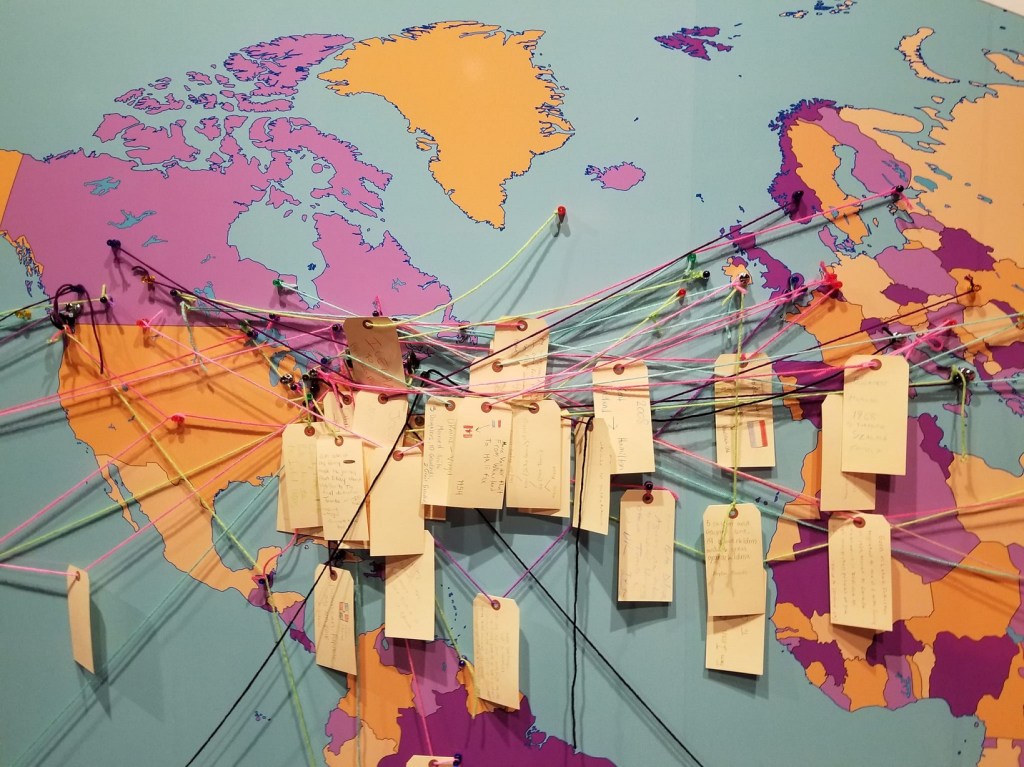
One of the activities was to decorate a baggage tag showing the name of your immigrant family member and stringing it from their point of origin to their destination. Our youngest made one honouring his grandfather.
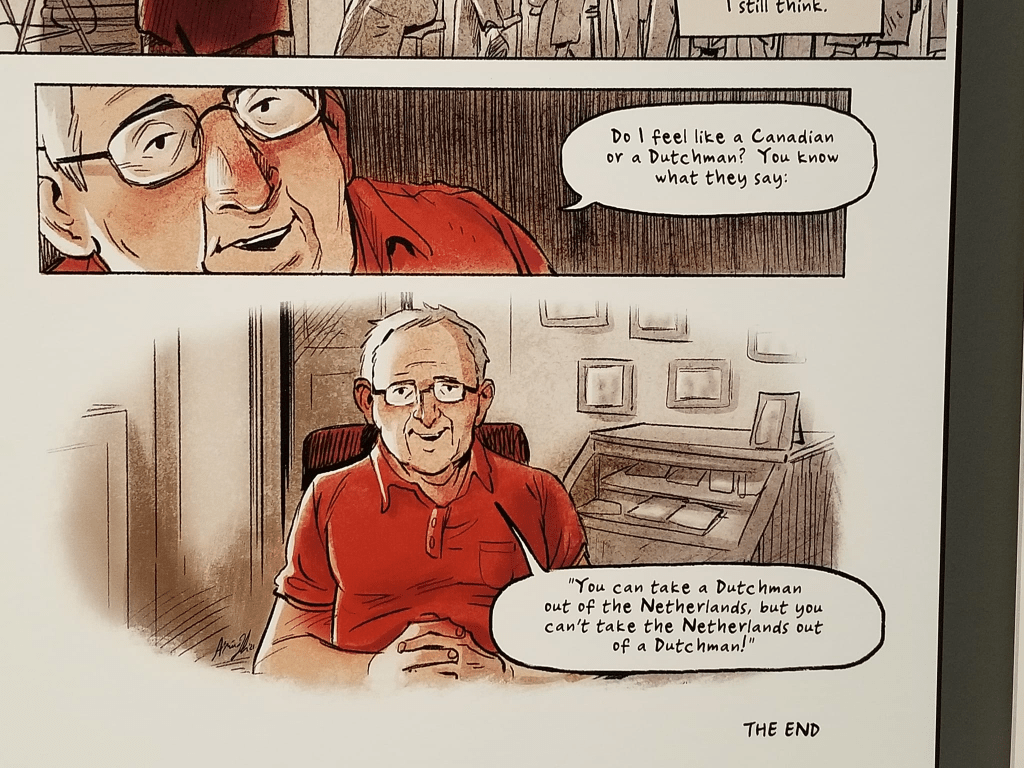
A temporary exhibit we were lucky to see was “Destination: Canada”:
In 2022, the Consulate General of the Kingdom of the Netherlands published a graphic novel called “Destination: Canada”, telling the story of ten Dutch immigrants, illustrated by ten comic book artists. The Museum has adapted two of these stories for a special exhibit, presenting the story of George Zwaagstra, a Pier 21 immigrant and volunteer, and Tayebeh Farooqi-Wahedi, a refugee from Afghanistan and immigrant from the Netherlands.
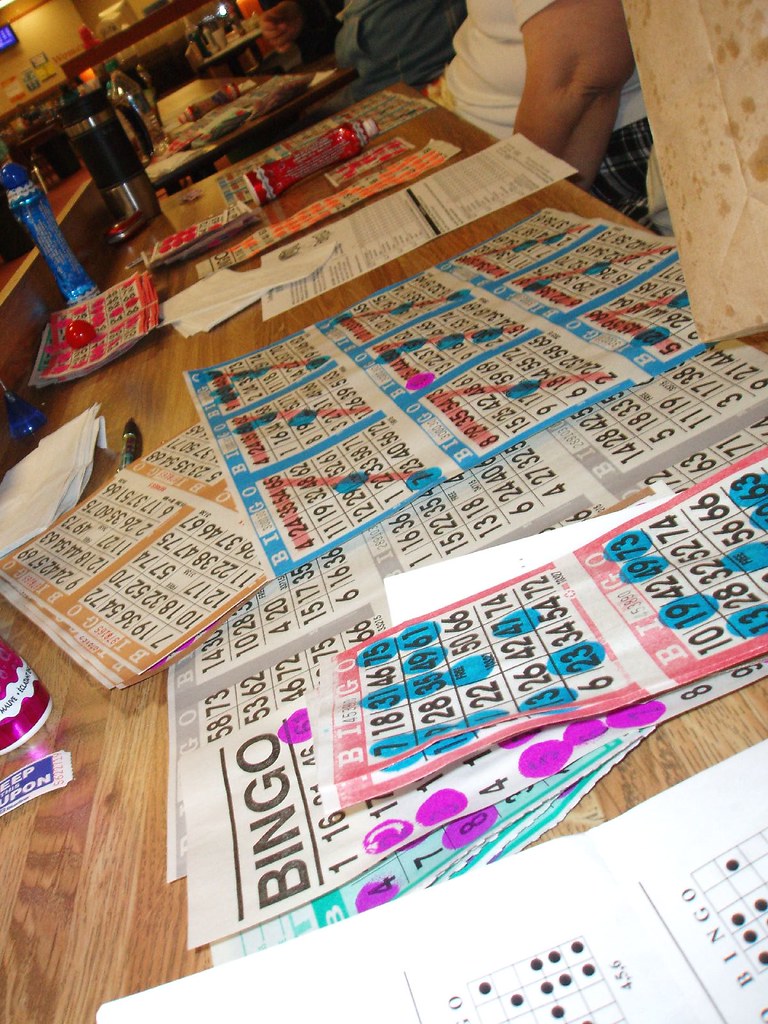
Beginner’s luck! The first time my wife joined me and my parents at bingo, she won several hundred dollars.
With the theme of “Free Space” for this week’s 52 Ancestors Challenge, I can’t help but think of bingo. Bingo was a big part of my mother’s side of the family. Moreover, bingo is one of the many games that are a huge part of both sides of my family.
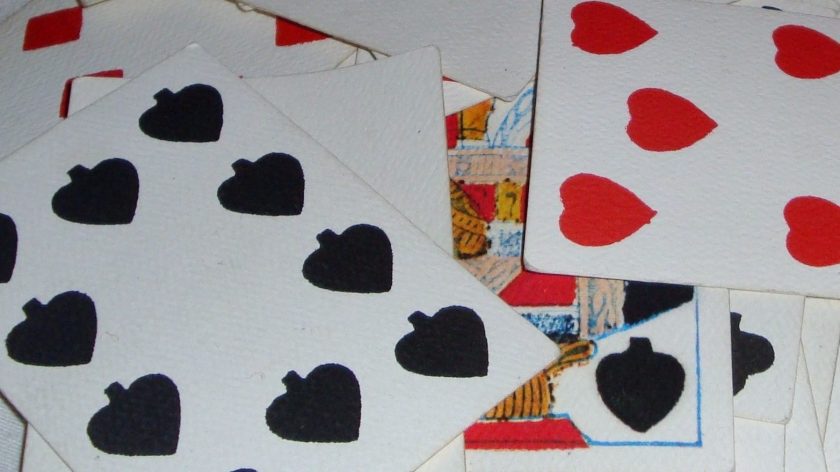
Cards were, and remain, a huge part of our extended family’s gaming traditions. As you may recall if you have been with this blog since the beginning, part of the inspiration for its name was my family’s affinity for cards.
My maternal grandmother, Helen Lerner, and her mother, Emelia Anton, were both bridge players. Into her 90s, my great grandmother took great pride in the fact she still had the mental acuity for the game, but complained that her peers were getting too slow for her. Bridge is the one card game that has eluded me. I just never developed an interest in it and, despite my familiarity with many other card games, it still strikes me as unnecessarily convoluted.
However, there were a myriad of other card games that always seemed to be at play. Canasta, Oh Hell, Smear, and Hearts were frequent games of choice on my mother’s side of the family, while huge group games of Crazy 8s were popular with my paternal grandparents and my father’s siblings. Most Christmases, my siblings and I usually converge at my parents. In addition to the extended family who drop in during the holidays, our spouses have also become part of the card-playing tradition. Almost every evening there is a card game that goes into the wee hours of the night.
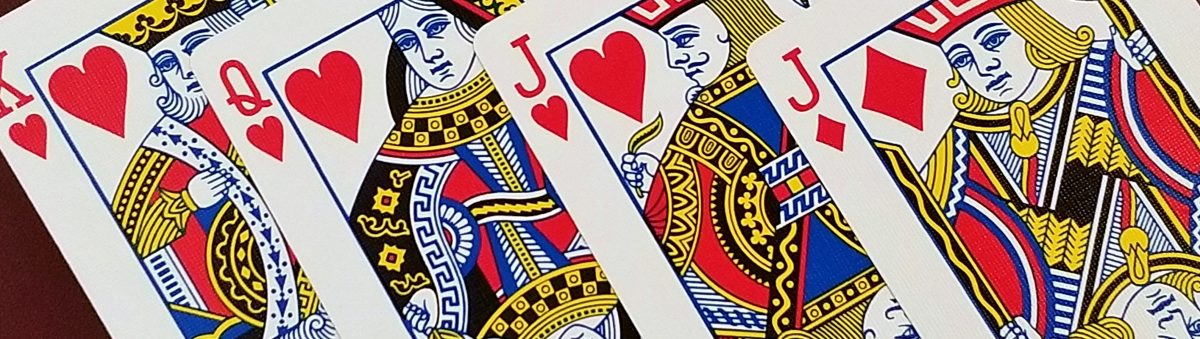
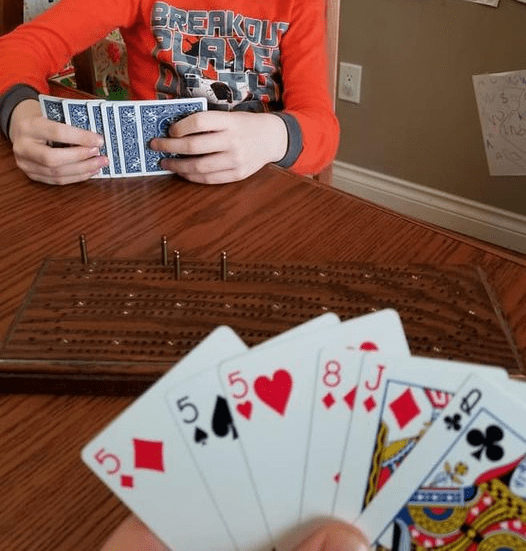
After decades of playing crib, of course it’s the day I teach the game to my eldest that I got dealt a hand like this.
The king of games with my maternal grandfather, Leo Burgess, was cribbage. When I was little, I was mesmerized by the cadence of the game and the cryptic chanting involving the counting of fifteens. My grandfather and my father taught me how to play when I was seven or eight, and I still play to this day.
My grandfather was a real stickler for the way people played cards. There were all sorts of arcane rules, traditions, and habits that had to be followed. Heaven help you if you cut the deck the wrong way. I still wince whenever one of his customs are breached, despite the fact my grandfather died over 25 years ago. Even worse was if you dared take “his” trick or – god forbid – you beat him at a game. In my case, there was little risk of that happening. I happen to be a good crib player, but my grandfather often seemed unbeatable.
The last day I spent with my grandfather, about a month before he passed away, was spent playing crib and watching The Price is Right. It was clear my grandfather’s advancing age and deteriorating health was starting to affect him, because out of the score of games we played that day, I managed to beat him twice. My grandfather was such an avid card player that – don’t tell anyone – my mother and uncle slipped a fresh deck of cards in the pocket of the suit he was buried in.
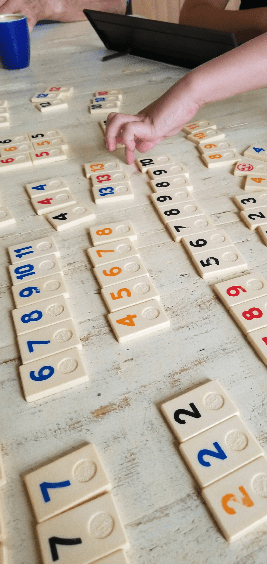
It seems that the only time I play Rummikub is when I visit family in Holland.
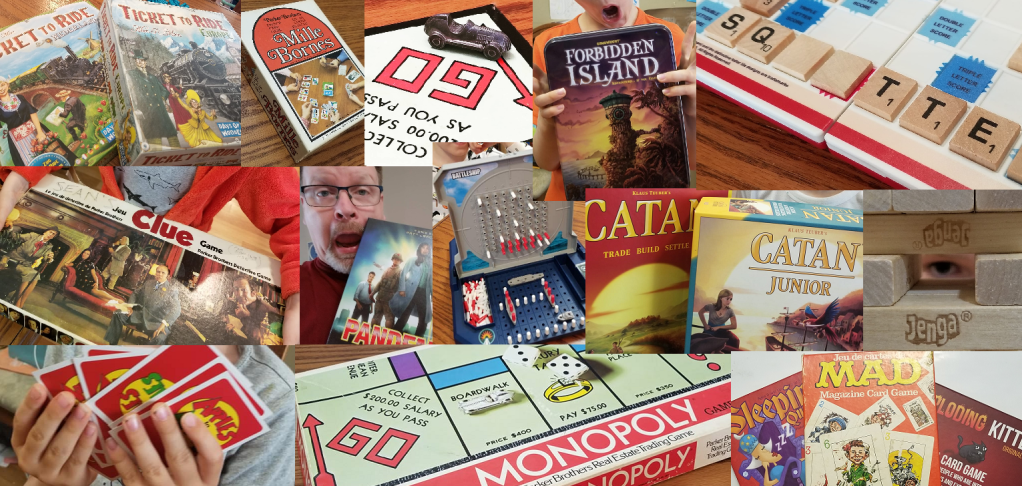
Board games were – and remain – popular as well. One of my uncles had a collection of now-obscure games that we nibblings enjoyed playing, even though we didn’t know the rules or have all the pieces. Nothing made us feel more like a big kid when our parents invited us to play a board game, such as Stock Ticker, with them. Board games were a common birthday and Christmas gift. With five kids in my family, we had a lot of Board games! I still have some of them, although it seems one of my brothers absconded with a lot of them.
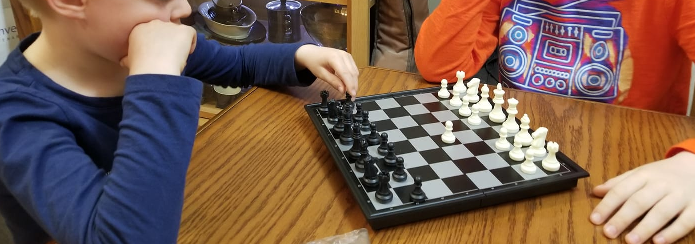
Our sons are also very keen on board games, and do well with games that one might think are well above their age level. Hardly a weekend goes by in our house without several games being played. It is also common for us to play on some weeknights as well.
We love board and card games in our family. These are but a few of the games we have.
Before ending this examination of our family’s tradition of game play, I return to the game of bingo. It was extremely popular on my mother’s side of the family. My mother’s parents, aunts, and grandmother were all devoted bingo players. I remember the first time I got to go to bingo with my mother, two of her aunts, and my grandmother. My great grandmother might have been there that same evening. As I was in my teens, I definitely threw off the demographic curve of the crowd in the bingo hall. While the majority of the crowd in attendance that night struck me as rather old, they were amazingly spritely and quick with their cards. The speed at which my great aunts and grandmother marked the many cards they each were playing at one time. I found it difficult enough to keep up with the few cards I was playing each time.
My maternal grandfather also loved playing bingo and often went with my grandmother. My grandmother passed away in her early 60s, so after she died my grandfather would often go with my great grandmother. The two of them seemed to squabble quite often and my grandfather once complained about being in his 70s but still having mother-in-law problems. Nevertheless, he and my great grandmother shared their love of bingo. In fact, my grandfather passed away while doing something he loved, while out one night playing bingo with his younger brother.
With a long weekend coming up, I expect that we will be playing a lot of board games over the next many days!
Addendum: Clearly I’ve generated a lot of content in 35 weeks that I’ve already forgotten about. A week after posting this, I discovered I had already written about this on Week 18 (Social), albeit in less detail. C’est la vie!
Further Addendum: Every week, Amy Crow Johnson sends an email summarizing two or three items that have caught her eye, along with a description of the next week’s 52 Ancestors theme. In her email looking back at Week 35, Amy highlighted this post, saying “Sean shared how much his family has enjoyed card games and board games over the years. (I have to admit that I was secretly hoping someone would write about bingo. My mom used to be an avid player, and my family has a Christmas bingo party every year!)”
The greatest genealogical help I received began 26 years ago this summer. It started with a simple invitation I spotted on a message board. Someone was planning a visit to a Dutch archive later in the week and was offering to do a lookup for anyone who might be interested.
Two things immediately came to mind when I saw this week’s 52 Ancestors Challenge theme, “Help”. First was the earworm that has resulted in the Beatles’ song bouncing around in my head all day. Second was my friend Nol, who over the years has provided me with an incredible amount of help in researching the Dutch side of my family.
Back in the early days of online research in the 1990s, there wasn’t the variety or depth of resources that we now enjoy today. One source I found said that as of 1996, there were only 10 million users of the internet world-wide. While many libraries, archives, and genealogical societies had begun to stake out a presence, they weren’t yet able to provide the scope of digital materials that are so easily accessible today. It was still often necessary to obtain documents the old-fashioned way, by using the mail. Bulletin boards and Usenet were still a common way of connecting with other genealogists.
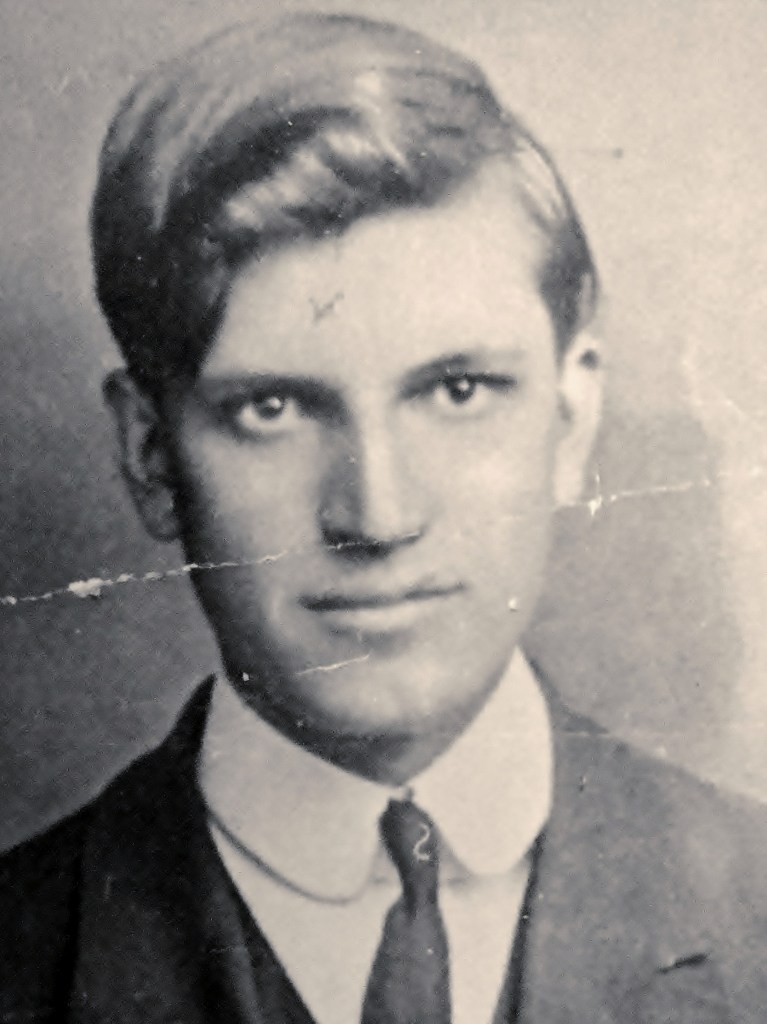
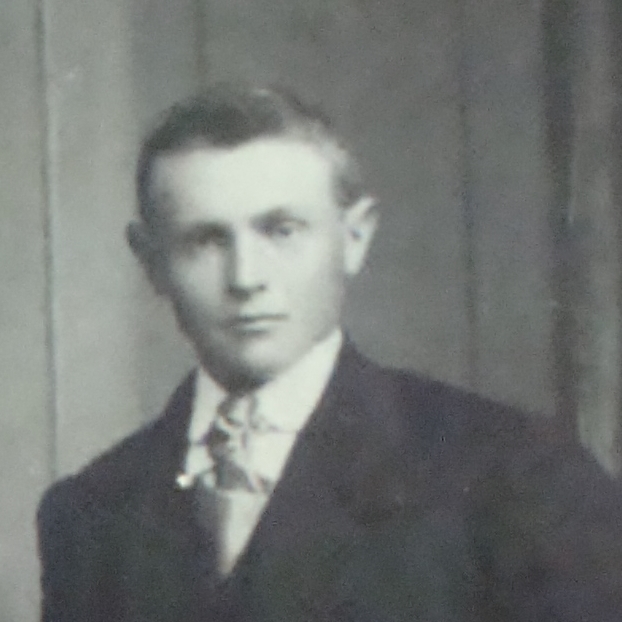
Johannis Albertus van der Fluit (1894 – 1932), the subject of my first query to Nol.
While I know it was sometime in early September 1996, I can’t remember where I first saw the original post I saw by Nol (short for “Arnoldus”), or whether it was a message board or something else. It was just a brief statement saying that he was going into a local archive the next day and asking whether he could look anything up for anyone while he was there. I contacted him and asked him if he’d be willing to look up one name for me, my great grandfather Johannis Albertus van der Fluit.
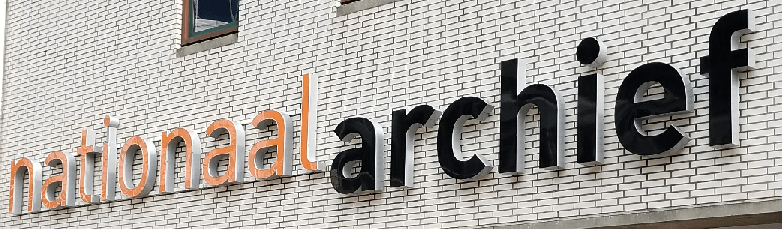
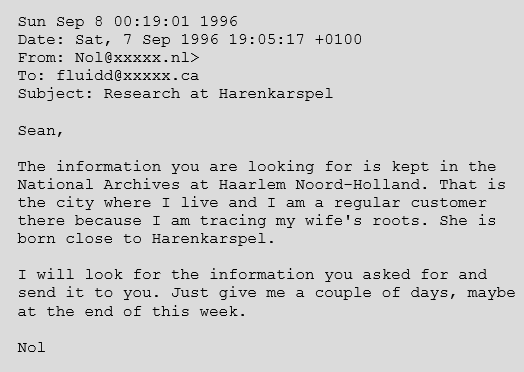
Nol emailed me the next day, telling me that the information I needed was held in the Noord Holland Archives in Haarlem (Noord-Hollands Archief). To my good fortune, Nol lives in Haarlem. He said he would be going into the archive sometime later in the week and he would get back to me.
My first email from Nol after we moved off the message boards. Later in our correspondence, I learned that the family line of Nol’s wife intersected with mine.
Nol followed up less than a week later. Not only had he looked up my great grandfather, but he looked up all four of my father’s paternal great grandparents (my great great grandparents). Furthermore, Nol took it further and looked up several of my great great great grandparents. The email he sent me set out a summary of the birth records for each of them, including the record numbers, dates and places of birth, each person’s parents’ names, the names of the witnesses, and the occupations of the persons named in the records.
While I had some prior knowledge, my early exchanges with Nol provided a significant introduction to the nomenclature with which I am now so familiar, including the types civil institutions and records sources (such as the “Burgerlijke Stand” – civil register), the municipal system of local governance (“gemeente”), population registers, and the Dutch words and phrases associated with genealogical research. So not only has Nol been a mentor in Dutch genealogy, I have often relied upon him as a language coach as I tried to teach myself Dutch. No Duolingo back then!
Over the next two years and over fifty emails, Nol provided me with countless records summaries: births, marriages, and deaths of ancestors and cousins from all over Noord Holland. I still have a copy of each and every one of them. I originally converted each email into a WordPerfect document. Over the years I have updated the format in which they’re saved and made sure that they remain accessible. I still go back to them often. One time several years ago I went through them again, one by one from the beginning, to ensure that I squeezed them for every drop of information I could gather.
The timing during which our paths crossed online resulted in a much longer and deeper relationship than what might have resulted had we met online nowadays. Dutch archives are amazing in how much they’ve scanned and made available online for free. Nowadays, over the course of a week I could probably find scanned online images of everything Nol found for me over that two-year period of in-person archival visits. In fact, over the last many years, I pretty much have found and downloaded digital images of all those records. So while we might still have become acquainted online, I would not have been as reliant on Nol as I might have been in the present.
Unfortunately, I’ve been unable to reciprocate Nol’s incredible kindness. He needs more Canadian relatives! Despite that, what makes me particularly happy is that our connection has evolved into much more of a friendship, particularly given that he and I connected in the early days of Facebook. Our connection has reached a point that I often forget the genealogical origins of our relationship.
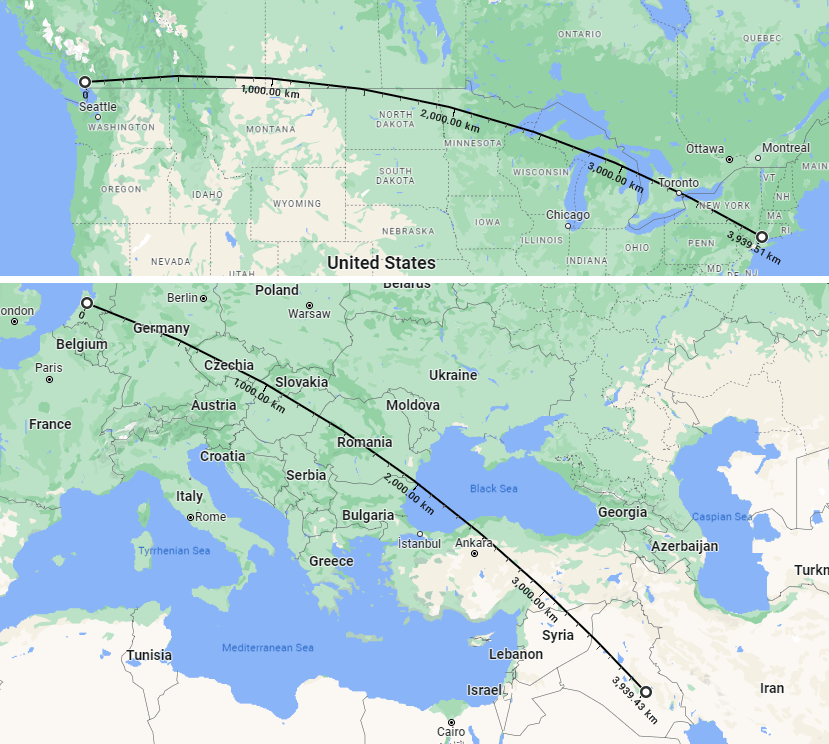
My only regret is that in the 26 years I have known Nol, we have never met in person. Pre-COVID, he often visited the United States, but his travels mainly took him to the east coast. From where I am on the west coast of Canada, the eastern seaboard of the United States is about as far as Baghdad is from Amsterdam. Not exactly a trip down the street. It’s also why I don’t know your cousin in Toronto. 😂
This is why my Dutch relatives and I have such different points of view about long road trips.
I have only been to the Netherlands twice. The first time was before I met Nol. My last trip there occurred in 2017. I had hoped that I could meet Nol at that time, as I was literally going to be in Haarlem during part of my trip. Unfortunately, at the same time I was in the Netherlands, Nol was in the United States. Wat jammer, as you might say in Dutch.
I am still hoping that one day our paths might cross in real life. Nevertheless, I am grateful for all the help, mentoring, and friendship Nol has provided to me over the years. The depth of my gratitude is profound. Dank je wel, Nol!
 A Deck of Ancestors