Many times over the years, I did something like this for my maternal line for my sisters and my niece for Mother’s Day. Only more recently did I think of doing it for my paternal line. Happy Father’s Day!
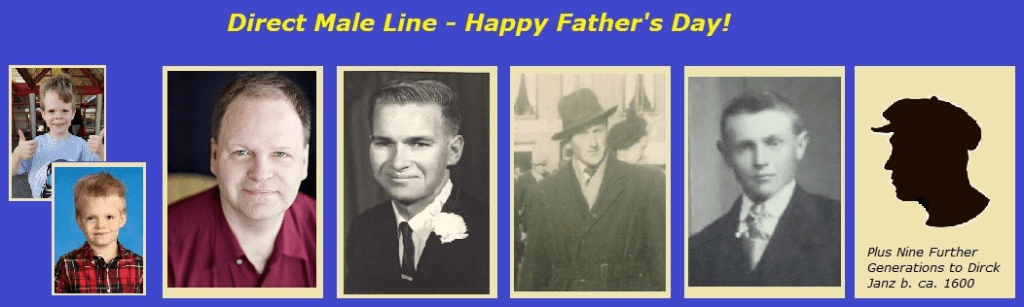
Many times over the years, I did something like this for my maternal line for my sisters and my niece for Mother’s Day. Only more recently did I think of doing it for my paternal line. Happy Father’s Day!
Week 15 of the 52 Ancestors Challenge!
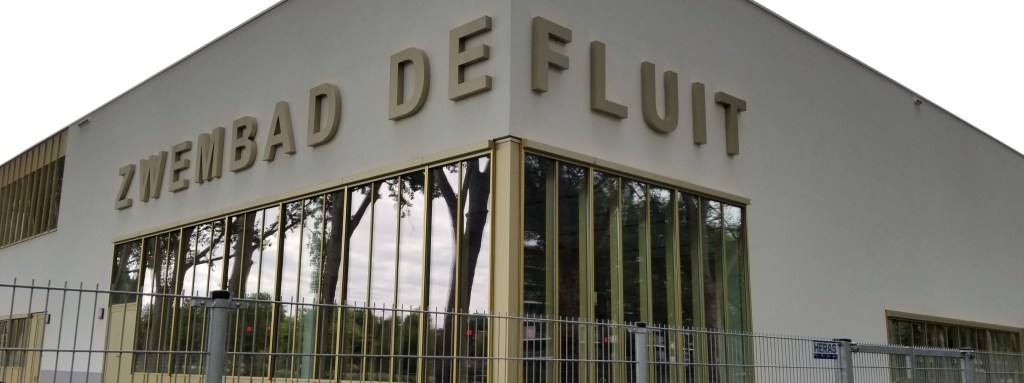
When I was in elementary school, the principal always asked me if I was Belgian. One day I asked my mom why he kept asking that. “Because you have a Dutch last name”, she answered.
That was no help.
While I had already started working on my family tree, and knew that my dad was Dutch, I had no idea that surnames had any ethnic or cultural significance. We lived in a small prairie town with lots of Ukrainian and Francophone surnames, all of which seemed to be unintelligible jumbles of letters. I included my surname in that regard, as it too seemed to be a meaningless concoction of letters. I had no idea that they had meanings in other languages. To add to my confusion, at the time I thought that they only spoke French in Belgium. I had not yet learned that more than half the country spoke Dutch.
Like many surnames, mine has undergone many changes over the generations: van der Fleuyt, van der Fluijt, van der Fluit, and for many of us in Canada, Vanderfluit. For a while people would misspell my name as Vander Fluit, following the pattern used by a prominent Dutch-Canadian politician in British Columbia named Bill Vander Zalm. In addition, in the Netherlands, the tussenvoegsel (the “van der” part) is often disregarded when sorting names alphabetically, such as for a directory. You might also see it abbreviated as “vdFluit”.
Before proceeding further, there is a myth to address. For Dutch genealogy, it’s one that’s as common as the one that would have you believe that immigration officials changed your surname at Ellis Island: people in what is now the Netherlands did not have a surname until forced to do so by Napoleon in 1811. On the contrary, while some people did not have one, surnames were common in many places well before 1811, although in some provinces patronymics and farm names prevailed until that time. Every branch of the Dutch side of my family tree that I have traced into the 18th century had well-established hereditary surnames by that time. The big change that occurred in 1811 was mandatory civil registration, requiring everyone to register a fixed surname.
That said, my direct ancestors tried out a few surnames for size before settling on the general “v d F”. My great x10 grandfather, who was likely born in the 16th century, does not appear to have a hereditary surname. Rather, his name – Dirck Jansz – is suggestive of a patronymic (“Jansz” = “Jan’s son”). Dirck and his wife, Maritgen, had at least two sons. The elder son, Jan, adopted the surname “Sieren”, which he passed on to his children. The younger son, my great x9 grandfather Johannes, adopted the surname “Goeman” or “Goetman”, which he passed on to all his children. I like to think that I am descended from John Goodman.
However, one of Johannes’s sons, Pieter, chose not to retain the surname his father bestowed upon him. Notarial and judicial records show a number of land transactions showing that Pieter was using the surname “van der Fleuyt” by the end of the 1660s. A land transaction after Pieter died involving some of his sons and his second wife used the surname van der Fleuyt.
So how did the name “Fleuyt” originate?
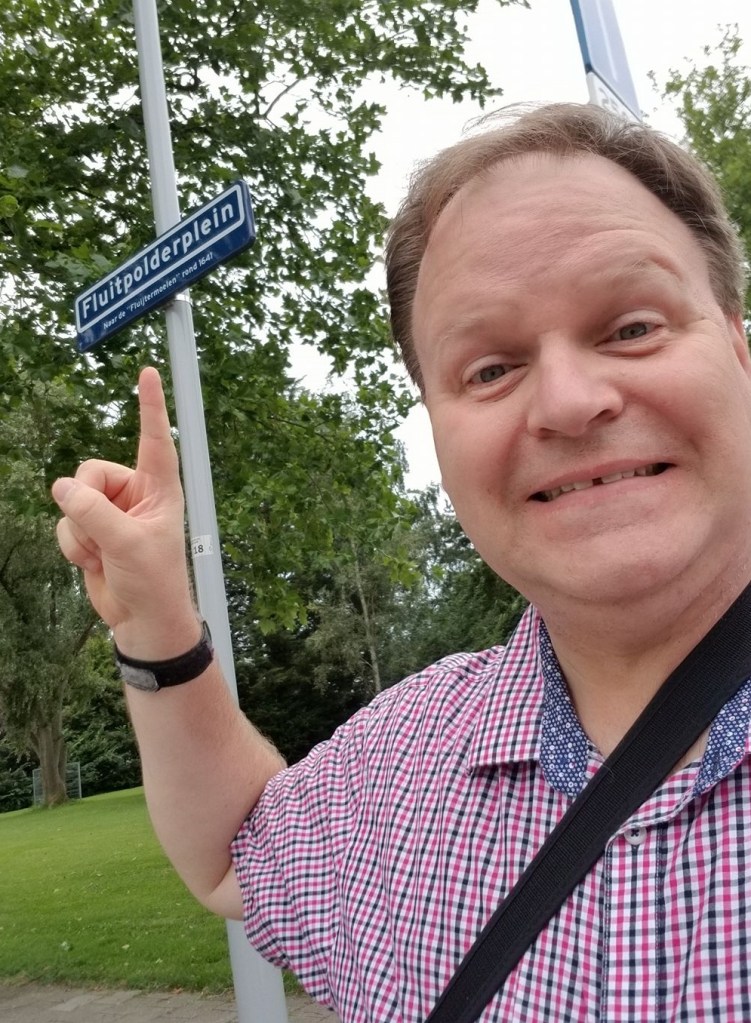
There is a street in Leidschendam, Zuid Holland named Fluitpolderplein, in an area that was a once a separate village called Veur. The website for the municipality of Leidschendam-Voorburg used to have information about all the street names in the community. It is no longer on the municipal website, but it is still accessible through the Wayback Machine/Internet Archive. The old municipal website provides this explanation, which I have translated from the Dutch:
The square and adjacent street between Prinsensingel, Noordsingel, de Amstelweg, and de Graaf Willem de Rijkelaan is called Fluitpolderplein. This was decided in 1970. But where does the “fluit” in “Fluit Polder” come from anyway? According to a historian of Veur, Hendrik Brouwer Schut, it may have something to do with the whistle of the grinding mills, or possibly the “fluitenkruid” (“cow parsley” or “Queen Anne’s lace” in English). [The Dutch name of the plant refers to the fact a flute or whistle can be made from the stem.] However, there may be a better explanation. In 1648 a large part of the territory of the polder already belonged to a certain Jan Dirckxz, who also went by the name “Fluijt”.
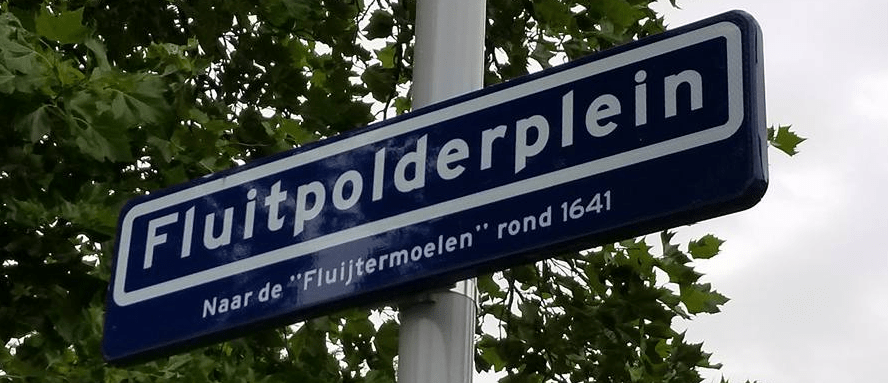
According to the street sign for Fluitpolderplein, the polder was located alongside the “Fluijtermolen” (Fluit Windmill), which was built around 1641. So the question I have is: what was named first, and for what? Were the windmill and polder named for Jan Dirckxz, or the other way around? Was the whistle the sound of the mill or the wind through the foliage?
With the next generation, the name became “van der Fluijt”. The spelling remained that way until the time of my great x3 or x4 grandfathers, Dirk and Pieter. Interestingly, that was around the time of mandatory civil registration. I have not yet found a “naamsaanneming” (“name taking”) record for the name that would have been completed at the time of mandatory civil registration. However, given that the family had used the surname for generations, it is unlikely that Pieter had to register. I also note that the change in spelling coincided with Pieter’s curious move from South Holland to North Holland. The family he left behind continued with the “Fluijt” spelling.
When my grandparents came to Canada with my father and his sisters, they initially used the traditional Dutch spelling, with lower case letters for the tussenvoegsel and the spaces in between. Over time, the name came to be Canadianized, with it written as one word with a capital “V”. However, the spelling remained fluid for many years.
As for me, both my first name and surname pose problems and are frequently misspelled and mispronounced. Many of my relatives in the Netherlands have difficultly pronouncing my clearly not Dutch first name, with the alien “sh” sound at the beginning. To be fair, I find the Dutch pronunciation of my surname difficult, as the “ui” sound in Dutch doesn’t quite exist in English. In fact, I never heard it pronounced in proper Dutch until I started university and had a Dutch-Canadian history professor who used it my first day of class. What I find mindboggling is how my name is continuously misspelled by people who have only ever seen it in writing. I have a fun collection of the most amusing misspellings I gathered from correspondence I received in the course of the job I had many years ago.
I have to say, it is both really cool and very strange to visit a place where people can spell your surname without asking or being corrected.
I’m starting to realize that when I choose a topic for the theme of the week for the 52 Ancestors Challenge, I should look ahead to see what other topics are coming up. That way I can avoid getting to a topic like this week’s, “Landed”, and seeing that I’ve written on the topic before. Then again, a little repetition here and there won’t hurt.
If I had approached this topic a few hours ago, I would probably be sitting here casting about in my mind as to what “landed” means to me. Fortunately, our eldest son inadvertently gave me a focus to write about. During dinner, out of the blue, he asked “besides Opa, did any of our ancestors come to Canada on steamships?”
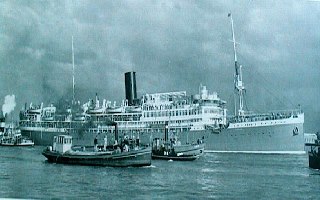
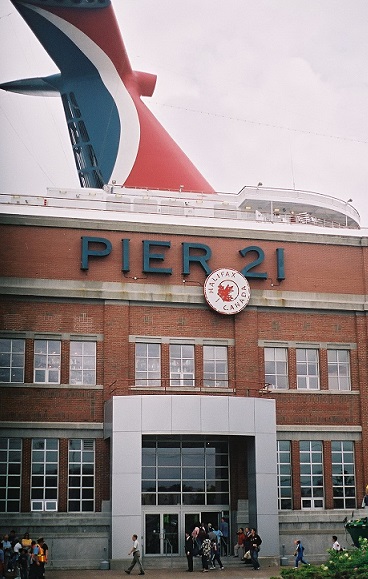
Opa is my father, the Dutch side of my family. I’ve already written about his coming to Canada on the Sibajak. He and his family came in early May 1954, travelling from Rotterdam to Halifax. They landed at Pier 21, which could be described as the Canadian equivalent of Ellis Island. My father’s aunt and uncle came over four months earlier, in January 1954 on the Groote Beer, while another aunt and uncle followed in late May 1954, on board the Castel Felice.
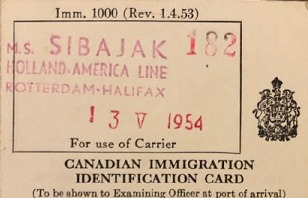
While it was a Holland America ship during his crossing, built and originally operated by Rotterdam Lloyd, along with other ships that they mainly used to go to the East Indies. Built in 1927, the Sibajak served as a troop ship during World War II. After the war, the Sibajak was one of a number of ships operated by Holland America that were used almost entirely for Dutch emigrants, along with the Grote Beer, Waterman, and Zuiderkruis. It was sold and scrapped in Hong Kong in 1959. When I was in Hong Kong in 1996, while travelling around the harbour and between its islands, I wondered how close I might have come to what scraps of it might remain.
In the late 1990s, my parents went on an Alaskan cruise on a Holland America ship. During the trip, my father, who loves to talk to people, fell into a conversation with one of the older hands on deck. My father mentioned having come to Canada on the Sibajak. After a few questions from the crew member, my dad learned that the man had been on the Sibajak during my father’s trip, in his first year or two of service.
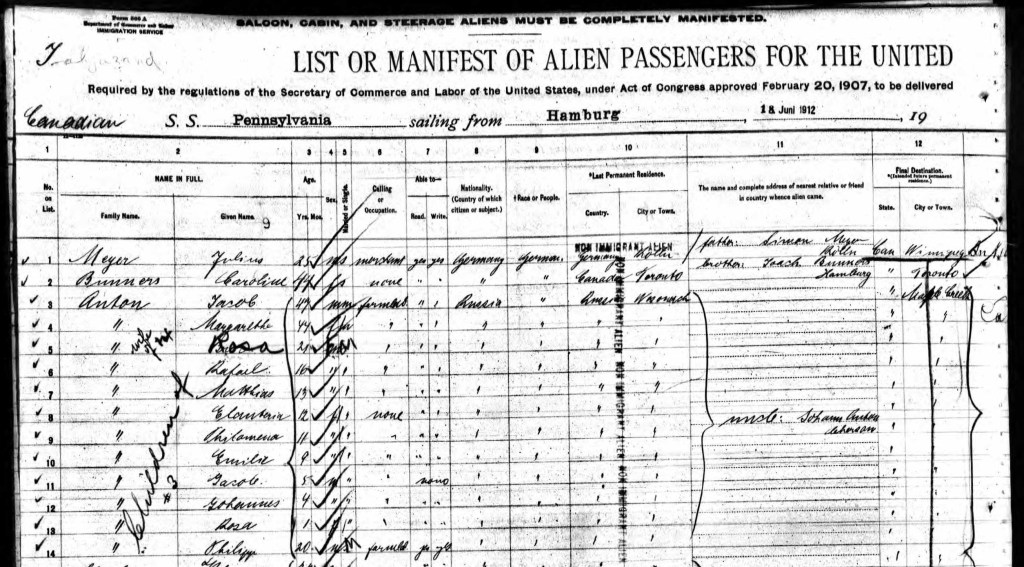
On my mother’s side, the most recent ancestor to arrive by steamship was my great grandmother, Emelia Anton. She came to Canada at the age of nine, with several of her siblings and her parents, Jacob Anton and Margaretha “Margaret” Heck. They were Germans from Russia. The family sailed out of Hamburg on June 18, 1912 aboard the S.S. Pennsylvania. They arrived at the Port of New York (Ellis Island) on July 1, 1912. Their declared destination was Maple Creek, Saskatchewan, to join Emelia’s older brother, Rochus. The passenger manifest stated that Jacob paid for the entire family’s transport, other than that of one of his daughters-in-law, whose passage had been paid by her father.
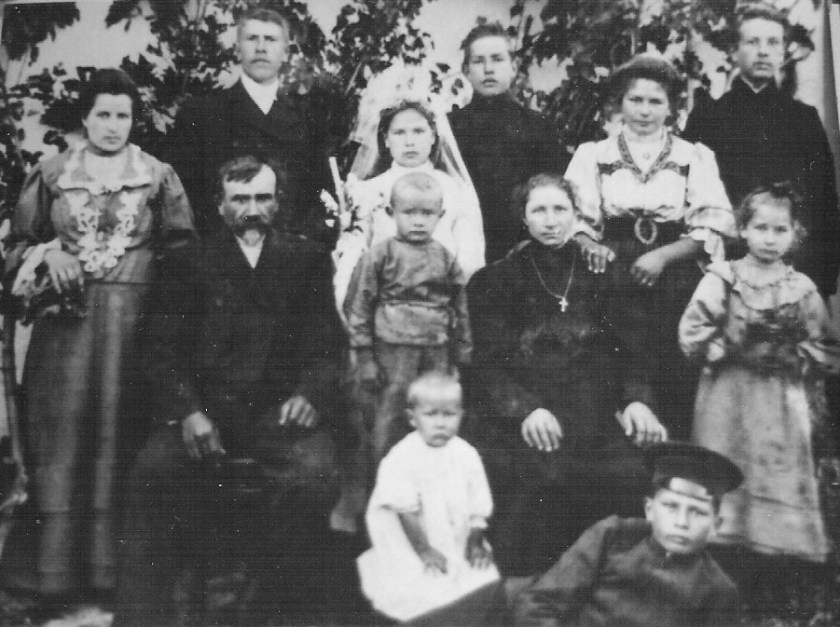
Emelia had not had much schooling before coming to North America, but was very religious. She said that she was frightened and nervous during the journey, as she did not know anything about where she was going and did not fully understand what was going on. However, on reaching New York, she said her fears subsided when she saw “the Madonna”. When she saw that, she knew she would be safe and all would be well. Of course, the “Madonna” was the Statue of Liberty. As she had never heard of it before, she thought it was a statue of the Virgin Mary.
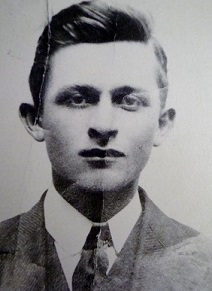
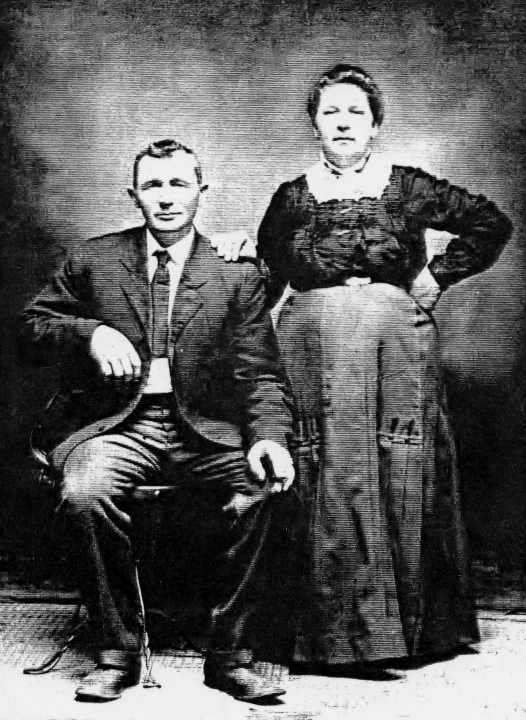
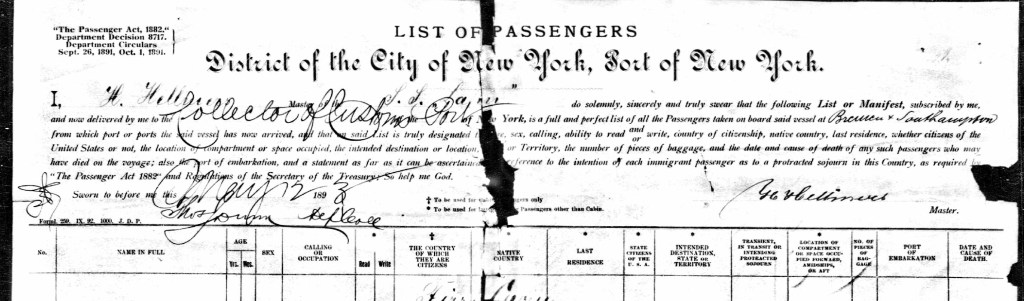
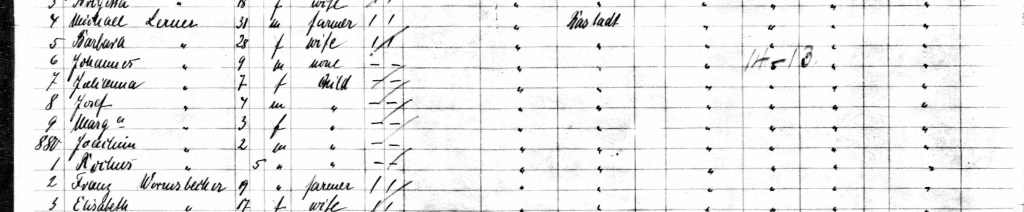
Emelia’s husband, Heronimus “Jerome” Lerner, was born to parents who were also Germans from Russia, Michael Lerner and Barbara Schmidt. Michael and Barbara came to the United States in May 1893 aboard the S.S. Lahn, with the five children they had at the time. They landed at Ellis Island and made their way to Clay County, Texas. Jerome was the first child born to Michael and Barbara in the United States. They had seven other children in Texas after Jerome was born. Jerome moved to Saskatchwan in 1917, preceded by an older brother. Jerome’s parents followed a year later. Other siblings came north at other times.
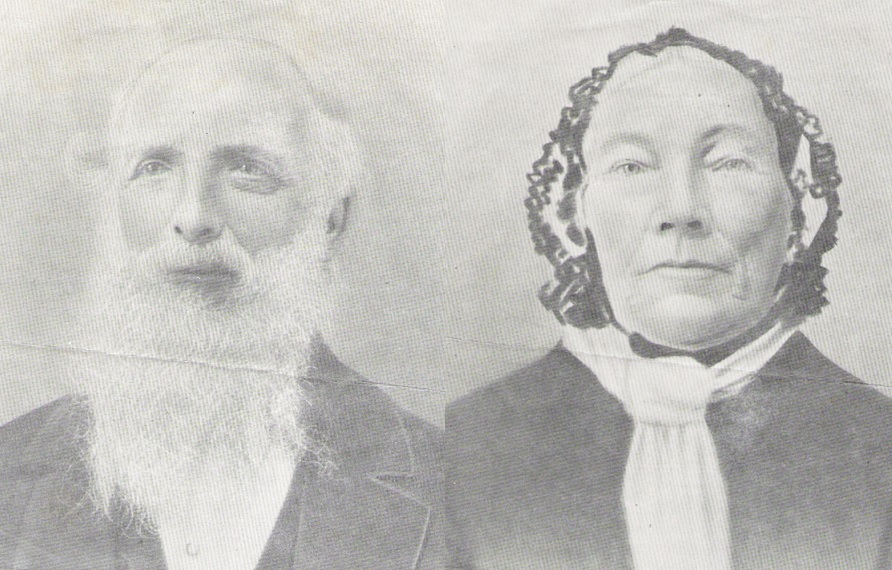
The ancestors furthest back in time that I can find who came to North America on a steamship were my great x3 grandparents, Robert Nelson and Elizabeth Joseph. They were both born in Muff, Donegal, Ireland in 1818 and married there in 1842.
Sometime in the early 1840s they had moved to Linwood, Renfrew, Scotland. They were there at least by January 1844, when their first son, Samuel, was born. By 1850, Robert was working at Brown’s Sugar House, on Roxburgh Street in Greenock, Scotland as a sugar baker. Sugar bakers usually refined muscovado sugar, an unrefined brown sugar imported from Barbados.
On September 3, 1850 Robert and Elizabeth, along with their three children, departed Liverpool on board the ship “North Atlantic” bound for New Orleans. For a long time I had been confused by references I had seen to them coming over on “the north Atlantic”, thinking it meant the route they travelled. It wasn’t until I came across the passenger list that I realized that “North Atlantic” was the name of the ship. Having a name like that makes it difficult refine a search to distinguish the ship from where it sailed. However, while I have not found very good sources, it appears that the North Atlantic was a steam powered ship.
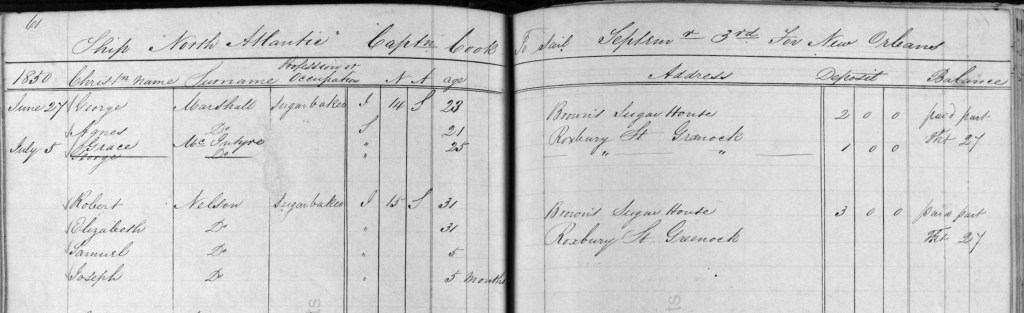
The records show that there was at least one other family headed by a sugar baker from Brown’s on the same voyage. Robert and Elizabeth were part of a company of Latter Day Saints (Mormon) converts travelling from the United Kingdom to Utah. The family spent a short period of time in Missouri, where in 1852 Elizabeth had her first child born in America. By late 1854 they were in Farmington, Utah, where my great great grandfather John Alexander Nelson was born.
Looking at my pedigree for this post, I realized I might have one other ancestor who might have travelled from the United Kingdom to the United States by means of a steam powered ship. That would be my great x3 grandmother, Maria Hadlond, who was born in Cheltenham, Gloucester, England in 1838 and who emigrated sometime in the 1850s. I have not really researched this branch of my family beyond collecting names and basic vital stats. For whatever reason, it has never caught my interest.
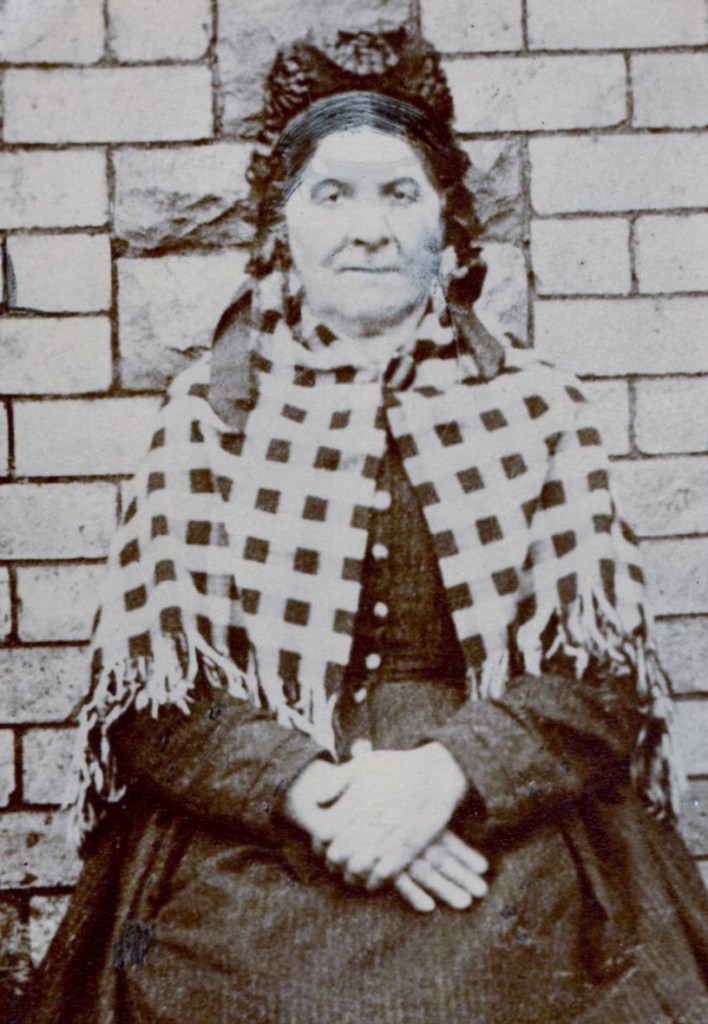
I also have a great x3 grandmother, Susan Turple, whose family had been in Nova Scotia since the 18th century, who would have travelled by means of a ship with sails. In 1849, Susan joined the Mormon church in 1849. In 1852, she went from Halifax to Boston to join a westward migration of Mormons. It is most likely that the initial part of Susan’s travels was by means of steam powered ship.
Before these people, any ancestors I have who crossed the Atlantic would have done aboard ships with sails.
Speaking of looking ahead, I see that next week’s theme is “Courting”. Since I am writing this on February 14, I wonder if that should have been this week’s theme!
The theme for this week’s 52 Ancestors Challenge is “curious” – a term that has been left up to our own interpretation!
There are many things that keep me curious about my family history. They say you are never finished your family tree – because you aren’t. However, if I ever ran out of questions, my family tree would be done, and not in a good way.
For decades I’ve been curious about my maternal grandmother’s first marriage. Last year I was finally able to get their marriage record because it was finally old enough for public disclosure. Despite that, I still have a lot of unanswered questions.
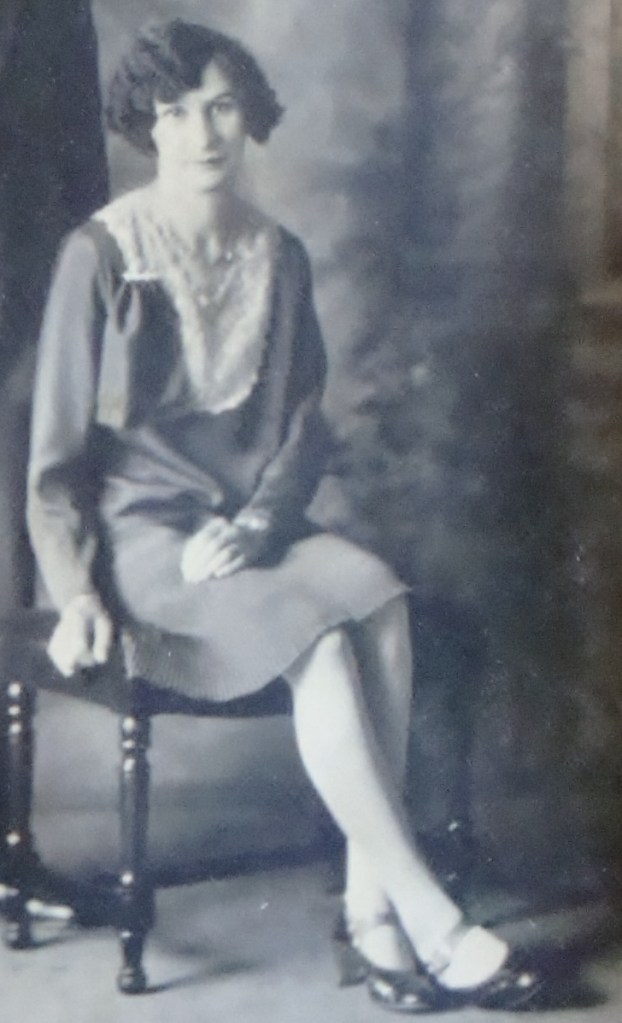
I’ve previously mentioned my great grandmother, Emelia Anton, who was a German from Russia. She was born on New Year’s Day, but I’ve never been able to confirm whether it was by the Julian or Gregorian calendar. Another mystery: I have a copy of the passenger ship on which Emelia and her family came to Ellis Island. The family came straight to Canada from there; however, despite scouring countless records, I’ve never found where they crossed into Canada.
Come to think of it, my Germans from Russia are the most mysterious branch of my family tree, given how little I know about it compared to other lines!
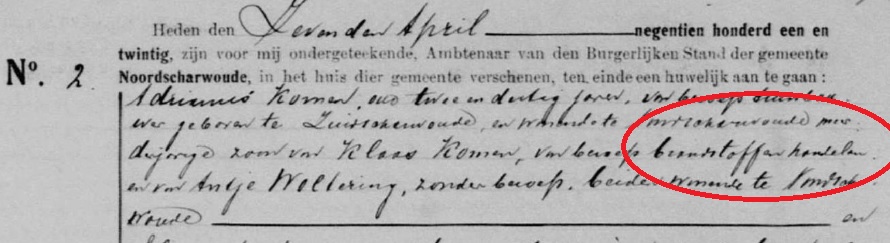
Another mystery that intrigued me for years was an occupation my great great grandfather, Nicolaas “Klaas” Komen held in the 1920s, “brandstoffelhandelaar”. It literally translates as “fuel dealer”, although it took me a long time to figure that out. Here’s a helpful tip. I’ve found that when trying to translate a difficult foreign word, type it into Google Image Search. Sometimes a photo really is worth a thousand words. However, what kind of fuel was Klaas selling? How and where was he selling it, and to whom? As far as I’ve been able to figure out, it likely involved hauling peat or coal on a wagon or truck.
My most recent discovery was learning the sailing on which my father’s aunt came to Canada. I’ve pretty much always known the date on which my father and his family left the Netherlands and the ship he came on, the Sibajak. His aunt, Anny van der Fluit and her husband Jac Beers came on the Groote Beer a few months earlier, but I never knew when. Less than a fortnight ago, the Rotterdam Archives posted Holland America Lines passenger lists up to 1969 on its website. I finally learned that my great aunt and uncle left Rotterdam for Halifax on January 20, 1954. I then realized that I was missing information about one of my father’s uncles, Johannes “Joop” van der Fluit, who came to Canada a couple of weeks after my father. I knew the date on which he sailed, but it crossed my mind that I didn’t know the name of the ship. Ta da, there he is, in the archive, sailing to Canada with his family on the Castel Felice.
However, the greatest curiosity to me revolves around my 4x Great Grandfather, Petrus Pieterszoon “Pieter” van der Fluit, who was born in Voorhout, which is just outside of Leiden. His direct ancestors had been in what is now Zuid Holland (South Holland) for several generations, mostly around Leiden, although the surname traces to a village outside of The Hague.
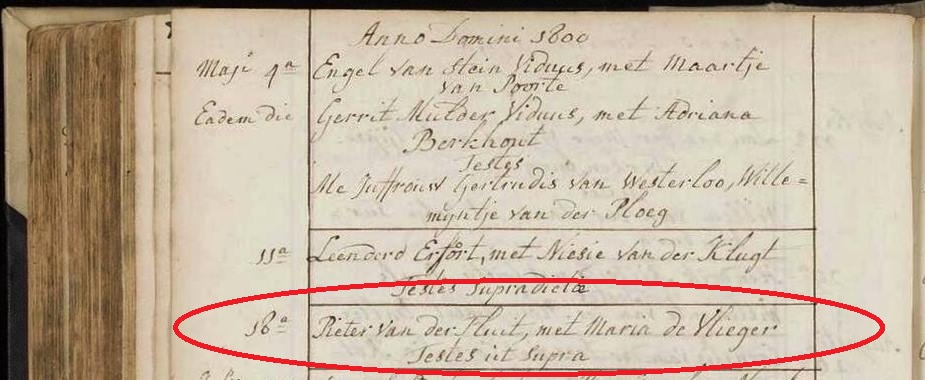
Pieter was the oldest of 11 children, four boys and seven girls. He was still in Voorhout in May 1800, when he married Maria Woutersdr (“Maartje” or “Marijtje”) de Vlieger, who was born in nearby Lisse. Pieter and Maartje have their first child, Elisabeth, in Voorhout in 1801. The next time I see Pieter and Maartje, it’s in November 1804, in Nieuwe Niedorp, in what is now Noord Holland (North Holland), where they have their second child, Pieter.
What has always had me curious is why Pieter and Maartje moved almost 70 kilometers to start a new life away from their family. Based on the time I’ve spent in the Netherlands, a trip of seven kilometers seems overwhelming for the locals. For most of my Dutch family lines, the generations never strayed far, so this strikes me as an astonishing move. After Pieter and Maartje moved to Nieuwe Niedorp, the next five or six generations were all located within a very short distance. My father was born less than four kilometers from Nieuwe Niedorp.
Almost all of Pieter’s siblings stayed in Voorhout. One adventurous sister moved all the way to Leiden, less than seven kilometers away. Pieter’s youngest sister ended up in Antwerp after moving to what is now Belgium with her husband. There are many descendants of the original van der Fluits still in the Zuid Holland area.
It is not only the distance of the move that has me curious. Usually it was the younger siblings who move away from home, with the eldest staying behind. I have nothing more than speculation as to what drew Pieter and Maartje north.
My working theory was based upon the fact that by 1800, what is now the Netherlands was essentially a French puppet state known as the Batavian Republic. In the time leading up to its creation and during its existence, the Dutch economy was in dire straits. Between it being wartime in Europe and a poor economy, perhaps Pieter went north looking for work. Many years ago, someone suggested that during the time Pieter moved north there was a great deal of work going on with the construction of new polders and waterworks. However, my investigations indicate that most of the polders of the area were constructed well before and well after Pieter arrived on the scene.
This concludes the January 52 Ancestors theme of “Foundations”. February’s theme is “Branching Out”. In the meantime, don’t worry about the cat, it’ll be okay, stay curious!
 A Deck of Ancestors