I have photos of thirteen of my sixteen great great grandparents. Maartje Veldman (1862-1904) is one of three for whom I don’t.
Maartje Veldman was the mother of Johannis Albertus van der Fluit and my father’s great grandmother. She was also the second wife of Jan Dirksz van der Fluit. Maartje was born on December 22, 1862 in Nieuwe Niedorp, Noord Holland, the third child of Jan Veldman and Trintje Stoop.
Like many unmarried Dutch women of her social status, and several of my other female ancestors, Maartje worked as a dienstbode (domestic servant) before she was married. Fortunately for genealogists, many gemeenten (plural of gemeente, a form of municipality usually comprised of several communities) kept a Dienstboderegister as part of their Burgerlijke Standregisters (Civil Registration Registers). This was due, in part, because many domestic servants lived with the families they served.
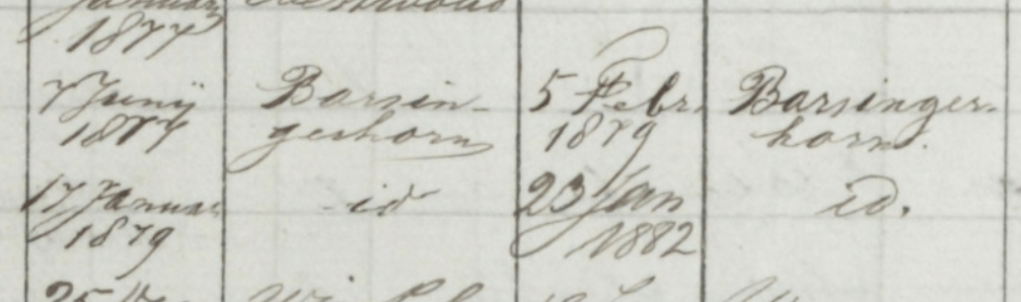
What caught my eye about Maartje’s registration is that she started work as a domestic servant much younger than my other ancestors. She was 14 years old when she began her first job on June 7, 1877. Her family was resident in Barsingerhorn, but her work was for a family that lived about 7.5 kilometers south, in Oude Niedorp. Maartje remained with that family until February 5, 1879, a couple months after she turned 16.
Another thing that caught my eye was that two weeks before Maartje left Oude Niedorp, her older sister Elizabeth (1861-1935), moved to Oude Niedorp to work as a domestic servant. Elizabeth is directly below Maartje in the Dienstboderegister. Elizabeth was 17 years old at the time. Elizabeth remained there until January 23, 1882, when she returned home to Barsingerhorn. Elizabeth married her first husband, Arie Zut, three months later, on April 21, 1882.
Maartje and Elizabeth in the Oude Niedorp Dienstboderegister (Servant Register) 1860-1889.
I haven’t found any indication that Elizabeth had worked as a domestic servant prior to this posting. What seemed odd is that the younger sister left home for work before the elder sister.
Coming and going. The top line is Maartje, the one below is Elizabeth.
There was no rest for Maartje when she left Oude Niedorp and returned home to Barsingerhorn. She immediately began work for a new family that was also resident in Barsingerhorn, which meant that Maartje was able to live at home with her parents during this job.
The Dienstboderegister does not indicate how long Maartje worked as a domestic servant in Barsingerhorn. All I know is that she was no longer working when she married Jan.
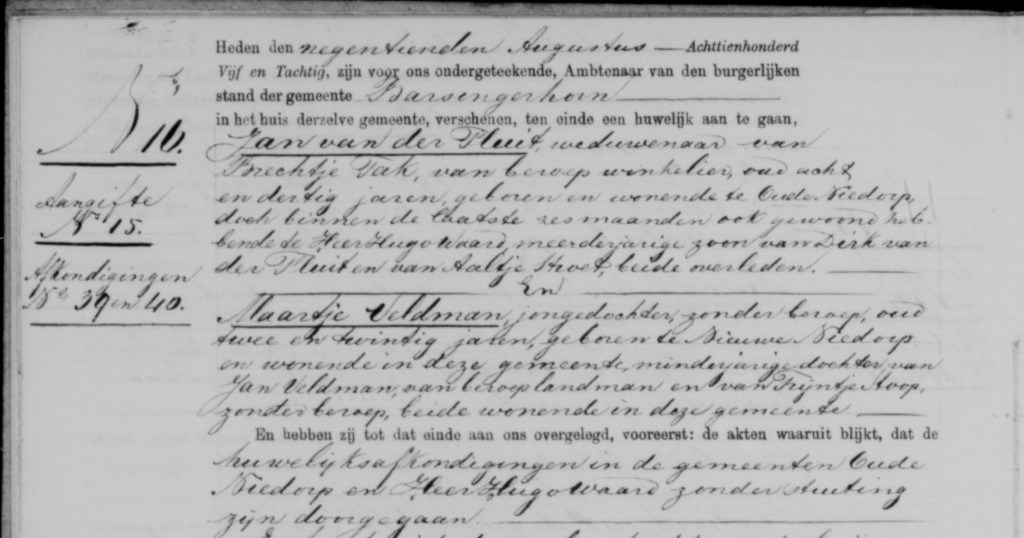
Top of the entry for the registration of Jan and Maartje’s marriage.
Jan and Maartje had seven children together, but the first two died shortly after birth. The rest survived to adulthood and married. The youngest child, a daughter named Brigettha Maria, was born on July 4, 1904. Maartje died one month later, on August 5, 1904, in Oude Niedorp. She was 41 years old. While I do not have a cause of death, I cannot help but wonder if it had been related to childbirth.
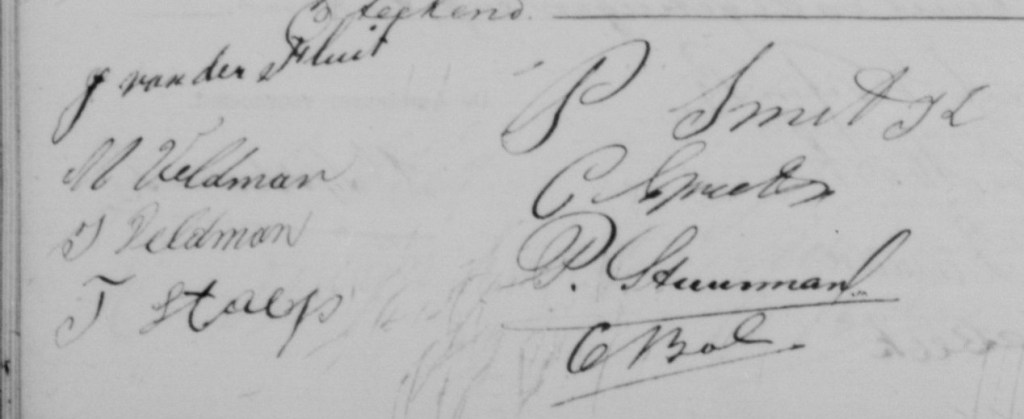
The signatures of Jan, Maartje, and the witnesses on the marriage registration.
UPDATE!
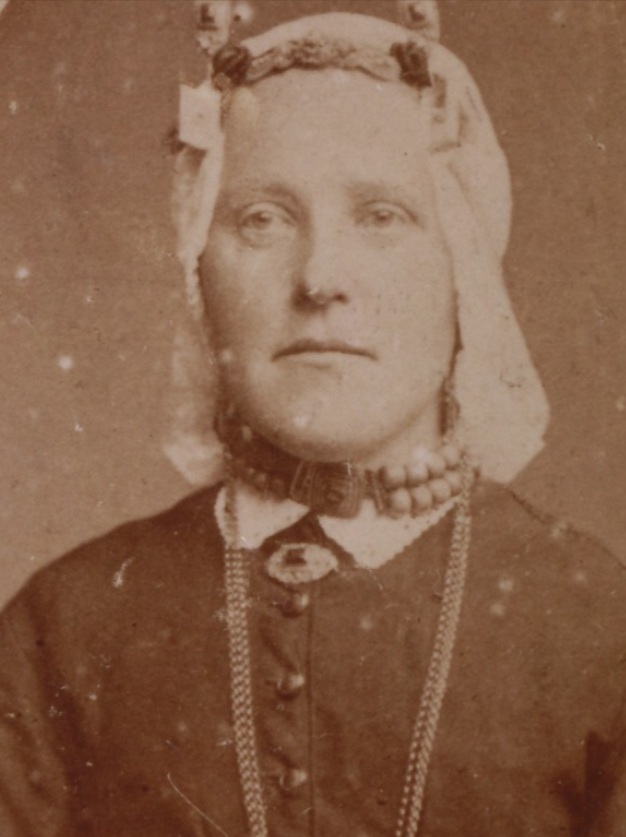
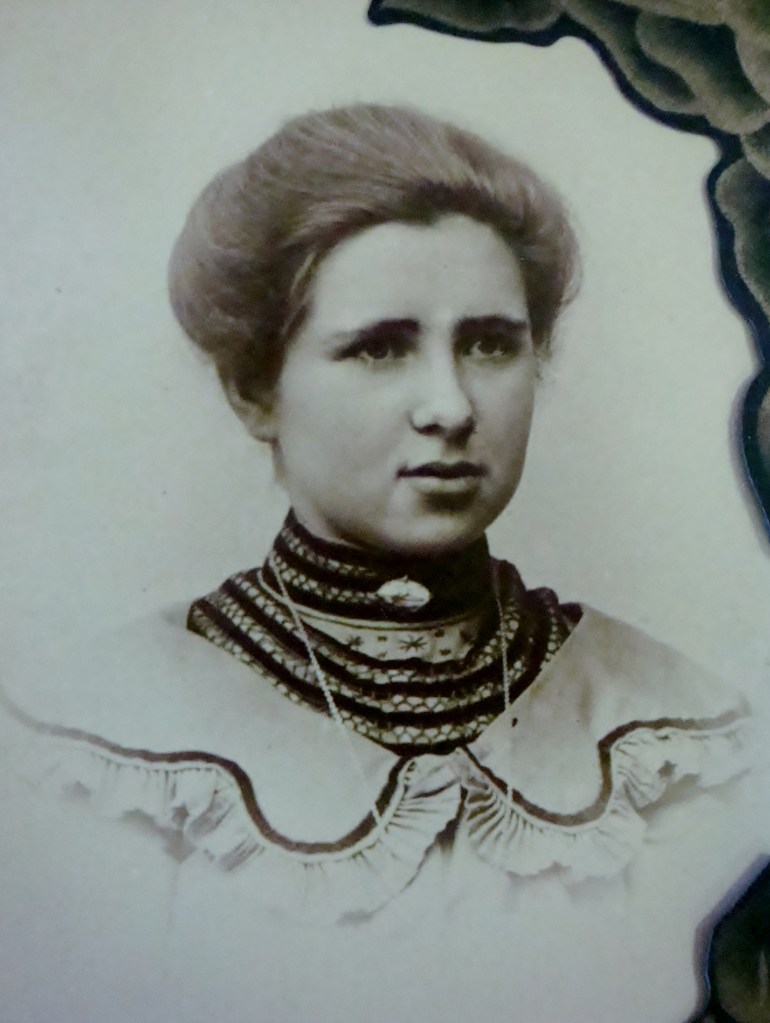
February 15, 2025: Eureka, I’ve found a photo of Maartje!
Jan Dirksz van der Fluit was born in Oude Niedorp, Noord Holland, Netherlands on September 14, 1846 to Dirk Pietersz van der Fluit and Aaltje Klaasse Stroet.
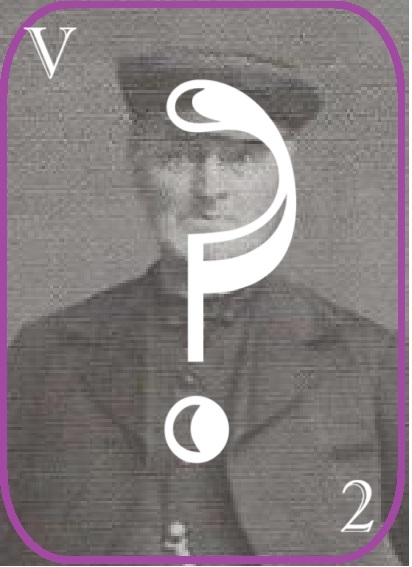
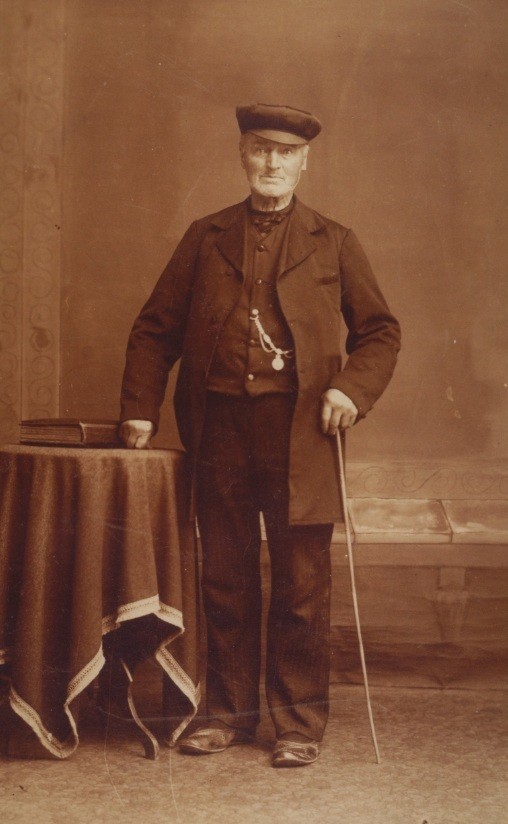
While I have a significant amount of information and source material for Jan, the one great mystery is whether the man seen in the image above is, in fact, Jan Dirksz van der Fluit. In an email, the person who provided it to me questioned whether he had correctly identified Jan as the person in the photo. He indicated that it is possible that the man is actually Jan’s brother-in-law, Klaas Dekker (1832 – 1912). Klaas was married to Jan’s sister Geertje (1841-1928). My correspondent did not indicate where he acquired the image. So this card is either Jan van der Fluit or Klaas Dekker.
The other mystery about Jan is how he spent his life between the day he was born and his first marriage to his first wife, Bregtje (also “Brechtje” or “Brigetta”) Tak, who he married on April 9, 1880. That’s a 33 year gap in time for which I have no information. At most, at the time of his marriage to Bregtje, Jan had been a farmer and a labourer, most likely in Oude Niedorp or Niuewe Niedorp.
[UpdateFebruary 20, 2025: Today I found a Bevolkingsregister for Oude Niedorp for 1860-1885, with an entry for Jan’s mother, Aaltje Stroet and all her children. This was after Jan’s father had died. It indicates that up to age 15, Jan was most likely living with his mother in ‘t Veld. From age 15 to 18, Jan lived in Heerhugowaard. I will have to look for a Bevolkingsregister for Heerhugowaard to see if I can learn more. In February 1865, Jan moved back home with his mother and siblings in ‘t Veld.]
Bregtje was born in Oude Niedorp in May 20, 1855. She was 24 when she married Jan, who was 33 at the time. Jan and Bregtje had three children: Dirk, Geertruida, and Petrus. It was not a long marriage, as Bregtje died on December 8, 1884, nine days after Petrus was born. Given the close connection in time, it may be that it had been a difficult childbirth that ultimately resulted in Bregtje’s demise.
Jan married for a second time nine months later, to Maartje Veldman (1862-1904), in Barsingerhorn, Noord Holland on August 19, 1885. Maartje was 22 when she married Jan, who was then 38. I am descended from Maartje, who is Card V3 – so more on her next week. Jan’s marriage to Maartje lasted almost 20 years, ending when Maartje passed away.
Heldersche en Nieuwedieper Courant, September 9, 1885, page 4. “Engaged and Married: Jan van der Fluit, widower of Brechtje Tak, 38 years old, and Maartje Veldman, never married, 22 years old.
Jan and Maartje had seven children together, although the first two did not survive infancy. Their fourth child was my great grandfather, Johannis Albertus van der Fluit. Jan outlived Johannis by three years. Maartje passed away on August 5, 1904, exactly one month after the birth of her youngest child, Brigettha.
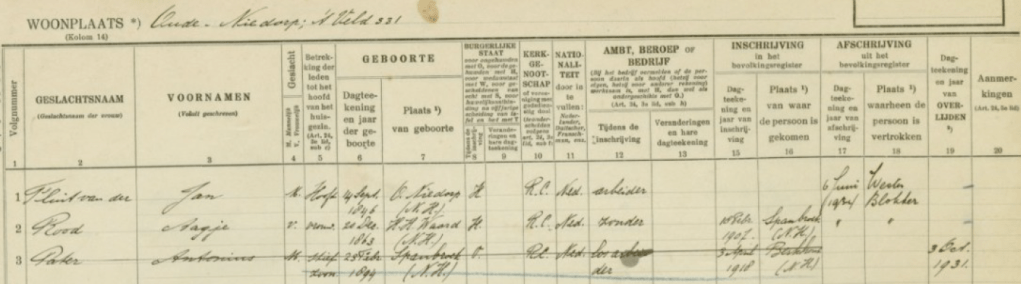
Jan married for a third time, to Aagje Rood in Oude Niedorp on January 24, 1907. Aagje was born on December 20, 1863, in Heerhugowaard, Noord Holland, making her 43 when she married Jan. Aagje was a widow at the time she married Jan, having been previously married to Arie Pater. I have not done much research into Arie, but would not be surprised if he is somehow related to me given that my father’s maternal line is Pater. However, to date I have yet to find any connection between Arie and my Paters. Unlike Jan’s previous wives, Aagje outlived Jan – by two and a half months. She died on May 4, 1935.
Bevolkingsregister for Oude Niedorp for 1931 to 1938
At the time of his second marriage, Jan was a merchant and shopkeeper. I know he was involved in that line of work until at least 1894, but I do not know the extent or details of that occupation. By 1904, he had returned to work as a labourer, which he apparently did until a year before he died. Since he died in 1935, that would mean he was still working when he was 87. The Bevolkingsregister(population register) for Oude Niedorp for 1910 to 1930 shows that he was a labourer during that entire time. The Oude Niedorp Bevolkingsregister for 1931 to 1938 indicated that he was still a labourer, at least until June 1934 when he moved to Westerblokker, which is about 16 kilometers from Oude Niedorp.
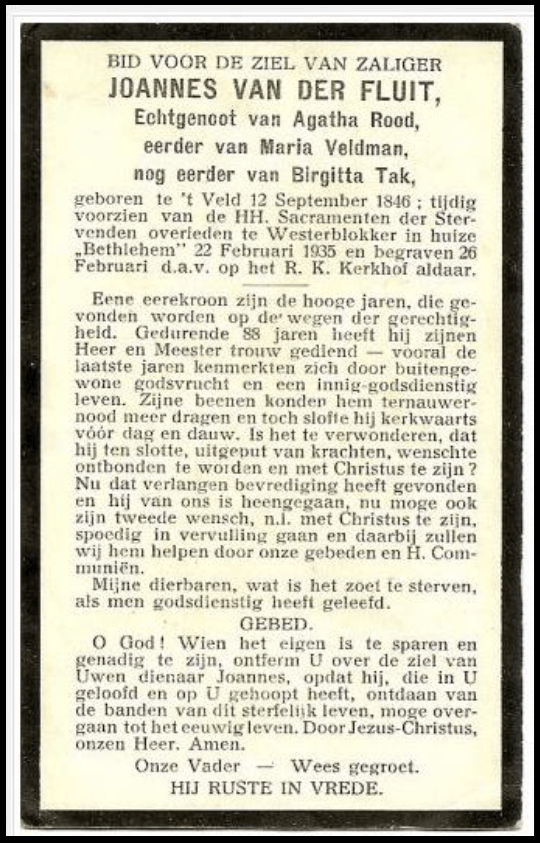
Jan’s bidprentje
However, I doubt that was so. It seems unlikely that he would still be working as a labourer in his mid-80s. The bidprentje (prayer card or in memoriam card) given out when he died. It indicated that in his last years “his legs could barely carry him”, yet he was still able to “shuffle” or “trudge” to church every day before dawn. His death registration also clearly indicated he was no longer working at the time he died.
Jan’s work was not limited to being a labourer during this period. In 1907, he was also working as a milkman; in July 1917 he was once again doing some form of work as a merchant.
On June 6, 1934, Jan and Aagje moved to Westerblokker. I still have to find the Bevolkingsregister for Westerblokker from that time. It’s on my to-do list; however, it is not yet available to the public because it includes a time period that is restricted under privacy laws. Jan died seven months later, on February 22, 1935. His bidprentje says that he passed away in “Bethlehem” house. Bethlehem was a monastery, which must have had some sort of palliative or care home. Jan was buried in Westerblokker.
UPDATE!
February 15, 2025: Late last week I was able to verify that yes, indeed, this is a photo of Jan Dirksz van der Fluit! Not only that, but it resulted in finding a photo of his wife Maartje Veldman!
My wife and I dread December. Not only is the whole month a whirlwind of activity leading up to Christmas, both our children have December birthdays. My brother-in-law is Jewish, and we’re always welcomed into the Hannukah festivities. The worst year was when a birthday, Christmas, and first night of Hannukah all occurred on the same day – something that is happening again this year. Plus, of course, we celebrate Sinterklaas.
Sinterklaas is a traditional holiday generally celebrated in the Netherlands and its former colonies, Belgium, and parts of Germany and France. It takes its name from its central figure who, like Santa Claus, has his origins in St. Nicholas, an early Christian bishop who lived in what is now Turkey. In fact, Santa Claus owes much of his origin to Sinterklaas.
Sinterklaas has much in common with Christmas. However, unlike Christmas, Sinterklaas is celebrated on December 6, the feast day of St. Nicolas in the Christian calendar. Both Sinterklaas (also called “Sint”) and Santa deliver gifts the night before their respective holidays, Sinterklaas often arrives in the Netherlands in mid-November and travels around the country visiting children, participating in parades, and handing out treats and gifts.
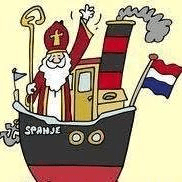
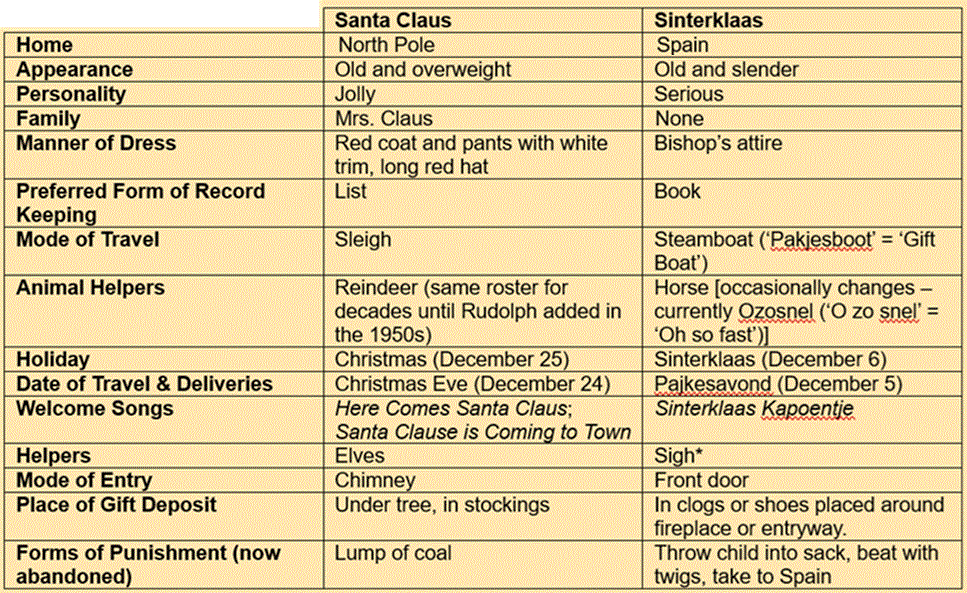
While Sint and Santa have much in common, they have many differences. Sint lives in Spain (probably rooted in the fact that the Netherlands was part of the Spanish empire until the 16th century), travels by steamboat, and rides a horse. As well, Sint’s appearance is rooted in his church origins, so he is dressed like a bishop.
A Few Differences Between Santa and Sint
Elizabeth Bakker
Since only my father is Dutch, we did not observe many of the Dutch cultural traditions, and definitely not in the way they do in the Netherlands. My great grandmother, Elizabeth Bakker (1888 – 1976), always sent us a package of goodies for Sinterklaas. However, at the time I didn’t know it was for Sinterklaas. I never even heard of Sinterklaas until well after my great grandmother died. I thought the package was for Christmas and that she sent it early in the month so it would get to us in time.
I loved those packages – they always contained many of the traditional Sinterklaas treats: pepernoten, kruidnoten, taai taai, and speculaas (all forms of spiced cookies, somewhat like gingerbread, although the former two are quite small); marzipan; borstplaat; and, of course, chocoladeletters (“chocolate letters”)!!
The letters originated centuries ago as baked goods, but are now almost exclusively made of chocolate. It is traditional to receive a chocolate letter of the initial of your first name. When we were kids, there was always an argument that some letters were bigger than others so they had more chocolate. The truth is that, while the surface area of each letter might differ, they are manufactured in different thicknesses so that every letter contains the same amount. The other problem is finding letters that are uncommon initials for names in the Netherlands, although that is less of a problem than it used to be.
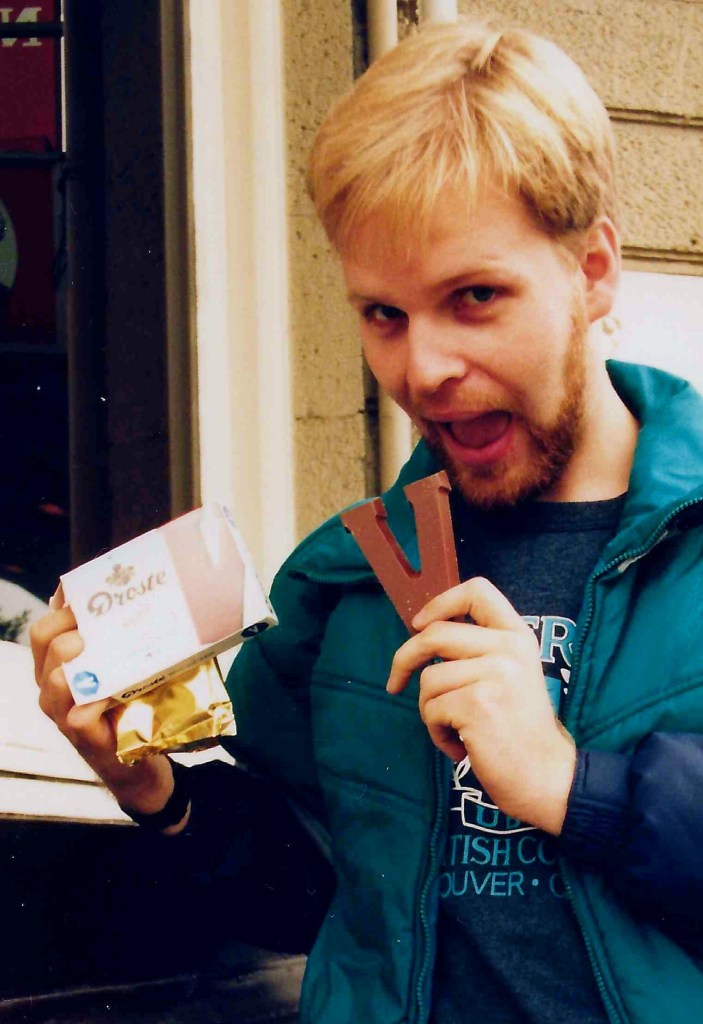
I found a Droste store in Amsterdam!
Chocolate letters are another item for which, outside the Netherlands, the availability seems to change over time. When I was a kid, they seemed to be available everywhere. Purdy’s made their own for a while, but I haven’t seen them there in a long time. In recent years, the only place I could find them were in Dutch stores. Even then, I could not find Droste letters – the absolute best ones, bar none – anywhere. You could only find the secondary brands. I once asked a vendor if Droste no longer shipped to Canada, and was told they were simply too expensive to carry. Luckily, a couple years ago I found Droste chocoladeletters in a Dutch store in Lethbridge.
Fortunately, chocolate letters seem to be getting easier to find again, as I saw them being sold in many mainstream supermarkets and shops last Christmas. I first noticed them showing up a couple years ago in a local independent grocery store that specializes in Asian foods and ingredients of all places. Plus, in our neighbourhood of Steveston, there is a chocolatier that makes them – in every letter!
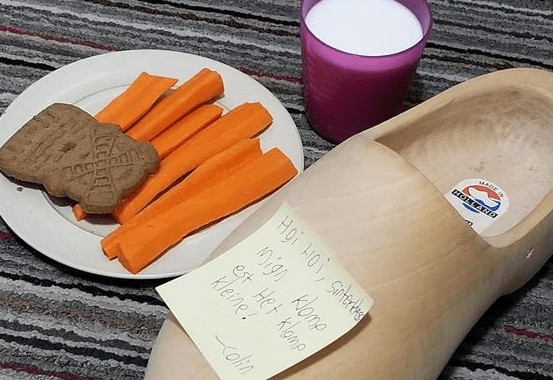
I have no idea where my son learned the Dutch he wrote on the note. There are a couple small mistakes, but it says “Hi, my clog and the little clog” (the small one’s not in the photo).
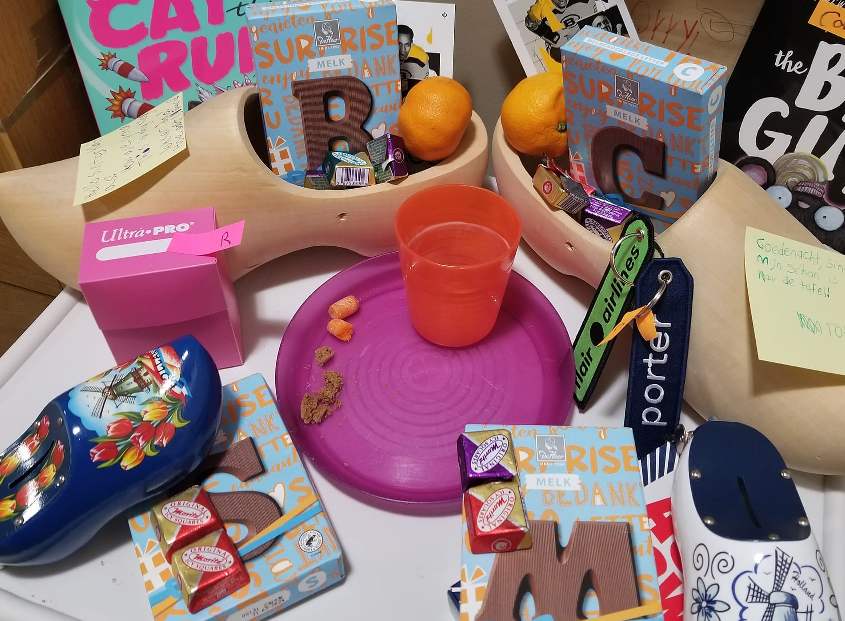
Our kids are more immersed in Sinterklaas. We’ve been marking it every year since our eldest was born. In fact, we thought he might arrive on Sinterklaas! Every year, the kids will put out their shoes along with some klompen (clogs), as well as a snack for Sint and his horse. The last few years they’ve also left notes. Then we’ll watch a few YouTube videos with Sinterklaasliedjes (“Sinterklaas songs”) and then off to bed.
The kids didn’t do too bad last year.
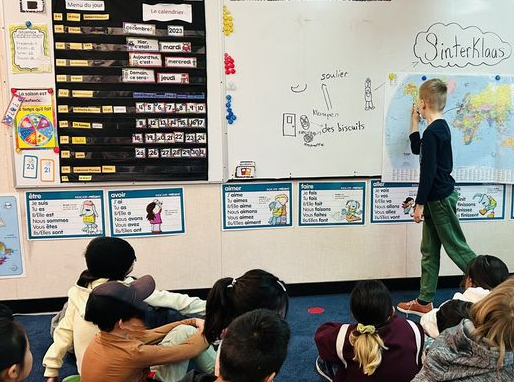
When our eldest was in second or third grade, he made a presentation to his class about Sinterklaas. He asked for help with that, and I gave him a few things he could take to school. Our youngest did the same thing last year – except I had no idea he was doing it until after the fact! He had asked me to email his teacher a video of a Sinterklaas song, but I didn’t know what it was for or that it was part of his presentation. His teacher emailed us to say that he knocked it out of the park!
Sharing Sinterklaas with his class!
Of course, anyone even vaguely familiar with Sinterklaas has probably heard of Zwarte Piet (“Black Piet”). For decades, Zwarte Piet was seen as Sint’s delightful helper. The association many people have with a beloved childhood memory likely makes it difficult to accept the unsavory fact that Piet is anything other than a negative stereotype. I don’t buy any of the arguments defending this outdated and offensive figure, which are based on fallacies, myths, and disregard for history. It’s often a waste of breath to argue and about this time of year I have to mute my social media feeds connected to the Netherlands.
While Piet remains a polarizing topic, in recent years it seems that attitudes are changing and the popularity of Zwarte Piet as traditionally depicted has begun to decrease dramatically. Over the last ten years or so, there has also been a shift to reforming or rebooting the character, with the emergency of Roetveegpiet (“Sooty Piet”) (characters with dirty faces due to the soot of the chimney) and Kleurenpiet (“Coloured Piet”) (characters with faces of all colours of the rainbow).
Meanwhile, Sinterklaas is less than a month away – better start planning for another busy December!
“Sinterklaas Kapoentje” – You can see the lyrics, English translation, and history of the song here.
I’m at least a week behind in the 52 Ancestors Challenge, but as Amy just reminded me less than ten minutes ago, there is no behind, only progress!
Many countries have an honours system to recognize the contributions of its citizens. According to a 2004 memo to the Select Committee on Public Administration of the UK House of Commons, with the exception of Switzerland and Ireland, every western state has instituted some system by which worthy individuals can be recognized. The United States has the Presidential Medal of Freedom. The British have their knighthoods. In Canada, we have the Order of Canada, which even at the highest rank does not denote a knighthood, unlike the on again off again highest rank of the Order of Australia, although it’s been “off again” since 1986. Even our provinces have these honour systems – in British Columbia we have the Order of British Columbia.
Inaugural Order of BC recipient Bryan Adams.
[Interlude while I look for the autograph I have of Bryan Adams. I cherish it not because of the signature, but because of the person who gave it to me. Adams was one of the recipients of the Order of British Columbia the first year it was awarded. I was working in the B.C. Parliament Buildings at the time. The office I shared with three other interns was right next door to the committee room where they bestowed the medals. We had a window looking into that room, but they made us close the blinds. One of the dearest members of the legislature’s dining room staff, who was attending to the coffee and treats for the ceremony, asked Adams for an autograph for each of the four of us, without our knowledge. Later she presented them to us, saying ” you nice boys might be fans so I thought you might like these.“]
However, since this week’s prompt is “Least”, I’m going to look at the lowest ranks of these honours. While I have extended family who hold the lowest rank of the Order of Canada, I’m going to look at a very distant cousin of mine who has received a similar honour in the Netherlands.
While the Netherlands is a constitutional monarchy (like Canada), there isn’t really much of a nobility and things like knighthoods are fairly understated. Titles, prefixes, or post-nominals are not used in the Netherlands in relation to civilian honours, so those who have been bestowed with a Dutch civil honour do not have any indication of their appointment in their names, regardless of the level or degree. Even Members of the Order of Canada (the lowest of three levels) are entitled to use “CM” after their names!
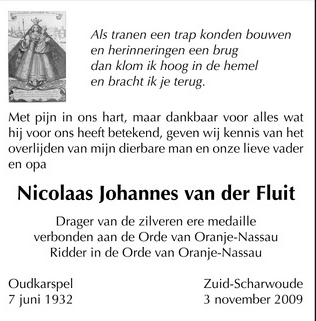
Nicolaas Johannes van der Fluit (1932 – 2009), a very distant cousin of mine (third cousin once removed, to be precise) was named a member of the Orde van Oranje-Nassau (Order of Orange-Nassau) in 2009. According to the familiebericht (family notice) of Nicolaas’s death, he was a “Drager van de zilveren medaille verbonden aan de Orde van Oranje-Nassau Ridder in de Orde van Oranje-Nassau” (Bearer of the silver medal of the Order of Orange-Nassau and (Knight in the Order of Orange-Nassau).
The Order of Orange Nassau is the lowest order of chivalry in the Netherlands, granted to individuals who have made a special contribution to society. Apparently about 4500 people are appointed to the various levels every year. Nicolaas’s appointment was in recognition of his contributions to the field of sports, community welfare, and housing and culture.
When I began to research this honour I was confused by the designation in Nicolaas’s familiebericht. The silver medal (along with gold and bronze) was only an honourary designation. Holders of the medal were affiliated with, but not actual members of, the Order of Orange-Nassau. “Ridder” was separate from the honorary levels and was the lowest rank of the order, just above gold, silver, and bronze.
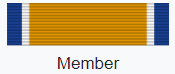
However, in 1996, the order was reformed and the various levels were replaced with six grades. Gold, silver, and bronze were replaced with by the “Member” class (“Lid”, in Dutch), which is currently the sixth and lowest level of the Order. The Member designation is no longer an affiliate level, so those holding the designation are actually members of the order. Ridder remains the fifth level of the order.
Based upon the familiebericht, it appeared to me that Nicolaas might have been originally named to the silver level, but was elevated to ridder at some later time.
My father’s uncle, Jan Meester (1925 – 2012) was also part of the Order of Orange Nassau. What little information I have about his appointment is that he had received a “Medal of Honor, attached to the Order of Orange Nassau in Silver”. This suggests his appointment was prior to 1996; however, as with Nicolaas’s familiebericht, that could be misleading. I also do not know the activities Jan had performed that garnered him the honour.
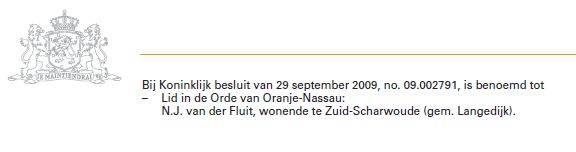
For Nicolaas, I resolved the matter when I found the notice of his appointment in the Staatscourant, the official publication of the Kingdom of the Netherlands since 1814. It is the equivalent of the Canada Gazette. (I have not yet found a copy of the Staatscourant with Jan’s appointment.)
The October 9, 2009 edition (#15208) states:
Bij Koninklijk besluit van 29 september 2009, no. 09.002791, is benoemd tot Lid in de Orde van Oranje-Nassau: N.J. van der Fluit, wonende te Zuid-Scharwoude (gem. Langedijk).
In English: By Royal decree of September 29, 2009, No. 09.002791 is named as a Member of the Order of Orange-Nassau: N.J. van der Fluit, residing in Zuid-Scharwoude (in the municipality of Langedijk).
Thus Nicolaas was appointed to the order after it was reformed in 1996 and at the lowest level of the order, Lid (Member). Nevertheless, I would imagine it was an incredible honour to receive. I wonder if a nice lady obtained his autograph for anyone.






 A Deck of Ancestors