As I’ve written about before, my family are avid board gamers and card players. Something else many of us love are puzzles. Jigsaw, crosswords, logic puzzles, trivia, cryptograms, sudoku, and, of course, word search puzzles. Our youngest child not only loves doing mazes, he has been creating his own for the family to solve ever since he was six years old. Heck, the way I studied for the LSAT was by working my way through a stack of Dell‘s Logic Problems and Word Games. I was essentially just continuing to do something I was doing anyway, and I did very well on the exam. (Dell was also was the origin of the modern-day sudoku, which ran in its magazine under the name “Number Place” in the late 1970s – which was where I first saw the game.)
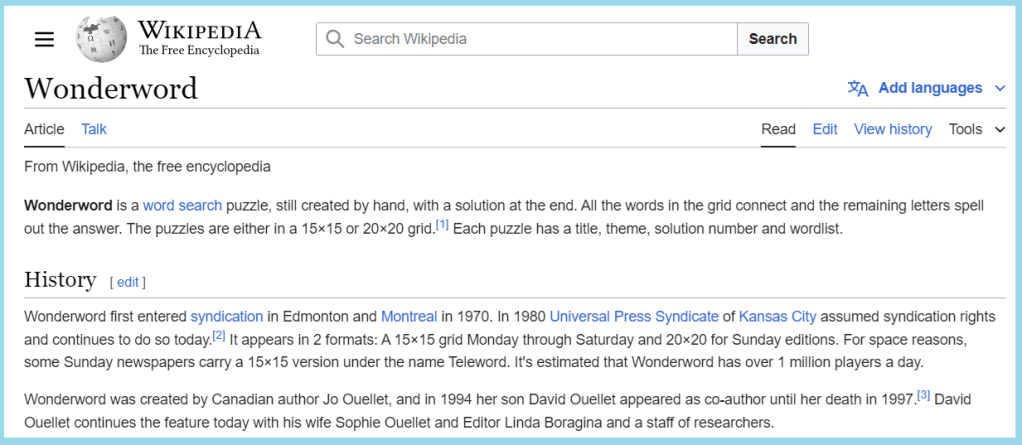
While he was primarily a card player – especially cribbage – my maternal grandfather, Leo Burgess, loved the Wonderword, a word search puzzle.
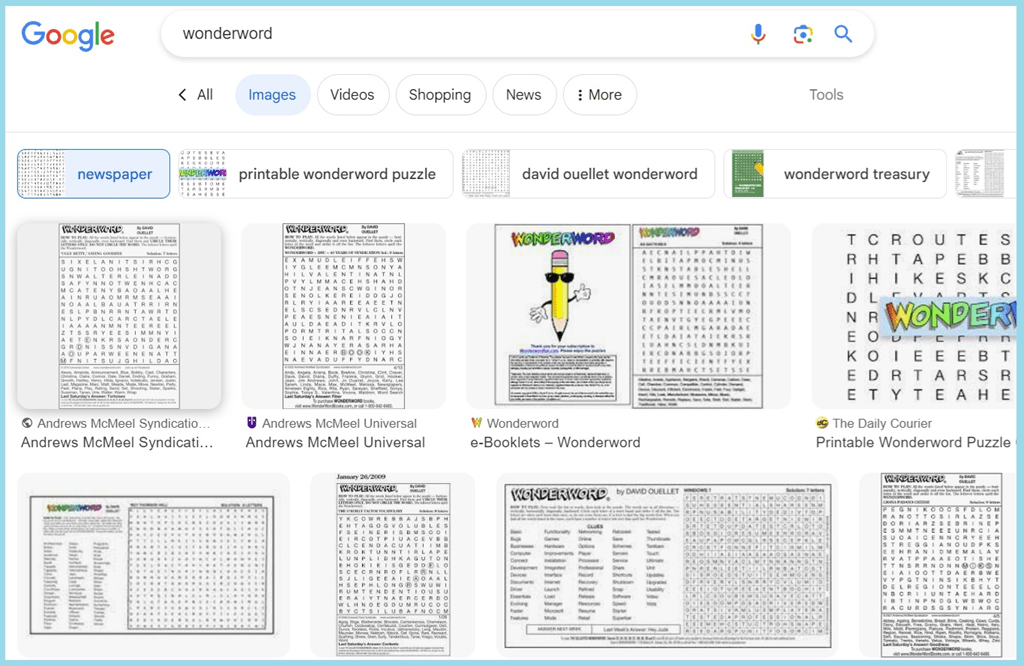
Google Image Search for the Wonderword. I was quite surprised to learn that it’s still a thing!
He did it every day. Unfortunately, his local paper, The Lethbridge Herald, stopped publishing it. However, we were living in Saskatchewan at the time and the Saskatoon Star-Phoenix continued to publish it. So I diligently clipped it from the paper every day. When I had what I considered to be enough, I’d mail him a small collection.
I loved doing it for him. I kept it up for a few years. I only stopped when we moved to British Columbia and our new local paper didn’t publish it.
Maybe my love for puzzles and word games is why I love genealogy. It’s essentially one perpetual puzzle!
I’m one of five siblings. My sisters and I live in British Columbia, both of my brothers live in Alberta. Until a few years ago, both my brothers lived in the same town as my parents. During the first summer of the pandemic, the elder of my two brothers moved to another town, about 90 minutes away from my folks. As a result, it was a couple years until I saw his new home.
In October 2022, my father’s younger brother passed away. That same week, my father ended up in hospital with a broken hip. I flew out to Alberta for the memorial service and to see our dad. On my return trip home, I spent a night at my brother’s new place.
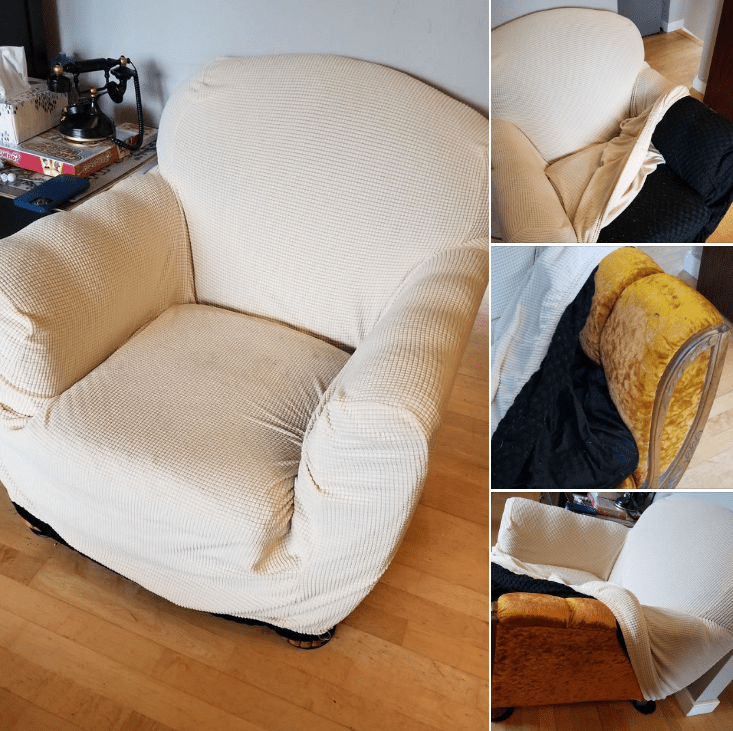
I was completely flabbergasted to discover that in his living room, under two upholstery covers (they have a lot of pets!), was the armchair that belonged to my great grandmother, Emelia Anton. I have no idea how old it actually is.
I know my grandmother acquired it from her mother sometime in the late 70s or early 80s and had it reupholstered. I thought it was disposed of after my grandfather passed away. I never realized that it ended up with my brother someway, somehow. It was really cool to see something that had once belonged to my great grandmother, which I remember well from our visits with her when I was a kid.
Update: Talking to my mother in August 2025, it turns out that this chair belonged to her other grandmother, her father’s mother, Hazel Nelson.
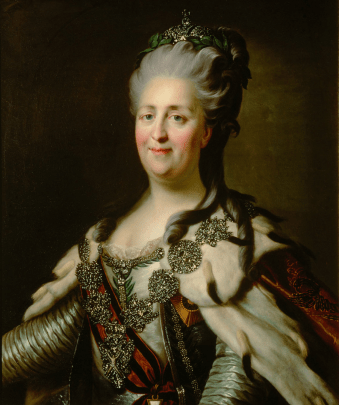
My mother’s maternal line are all Germans from Russia. The Russian Empire expanded significantly during the 18ths century. When Catherine the Great came to power in 1763, she encourage immigration, partly to re-establish farming in regions that had laid fallow during periods of warfare, modernize the country, and to populate regions the Empire had absorbed.
Catherine the Great
Catherine’s manifesto inviting settlers bears some resemblance the homestead schemes introduced in the United States and Canada over a century later.
Among other things, she promised land, free transportation to Russia, and economic incentives (including freedom from taxes for a period of time and interest-free loans for the purchase of equipment). As well, settlers were promised that they could freely practice their religion, retain their language, and be free from military service. The settlers were also promised a degree of self-government.
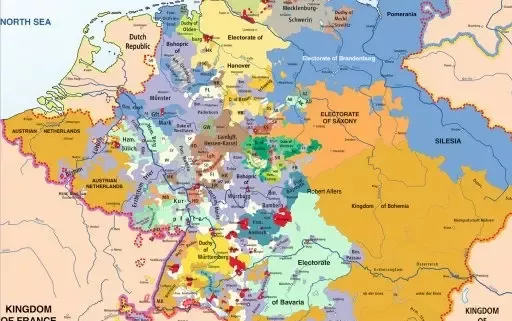
While settlers came from several places in Europe, a majority were Germans. At the time, there was no “Germany”. Rather, the region was primarily composed of a multitude of principalities, dutchies, and other small states. While Catherine’s promises provided a significant pull, economic and political conditions in the German states provided a significant push.
Germany in 1789
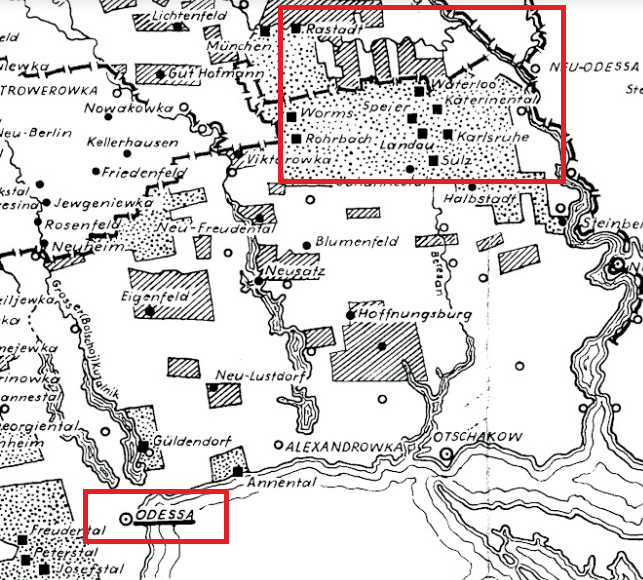
The first wave of settlers formed colonies in the Volga region (“Volga Germans”). The next wave occurred after Catherine’s grandson, Alexander I, issued a similar manifesto with many of the same promises. My ancestors were part of this wave of settlers, who formed colonies in what is now southern Ukraine, particularly in the area north of Odessa (“Black Sea Germans”).
The German colonies in the Beresan district in 1890, as seen in relation to Odessa. All four of my maternal grandmother’s grandparents came from Rastadt and Karlsruhe, located in the upper right-hand corner.
The German colonies were usually composed of members of the same religion. The main colonies were Catholic, Lutheran, and Mennonite. These colonies thrived for decades. However, in 1871, Czar Alexander II repealed the manifestos of Catherine and Alexander I. The German colonists lost many of their privileges. Shortly afterwards, they lost their exemption from military service. The next Czar, Alexander III, took further steps to incorporate the German population into general Russian society, which included discouraging the German language and encroaching on the school system established by the colonists.
Needless to say, this immediately sparked waves of emigration of the German colonists, many of whose families had been in Imperial Russia for decades. Many of these Germans left for the United States and Canada, relocating to the plains stretching from Texas to Saskatchewan. Other colonists left for Argentina and Brazil.
My grandmother’s paternal line originally settled in Texas, starting with my great great grandparents, Michael Lerner and Barbara Schmidt and their six children. They came over in 1893 on the S.S. Lahn, which landed at Ellis Island – less than 18 months after it had opened. Michael and Barbara had six more children after settling in Texas, the first of whom was my great grandfather, Heronimus “Jerome” Lerner. Over time, many of their children relocated to Saskatchewan, including Jerome. Michael and Barbara ultimately made the same move themselves, leaving behind several of their adult children.
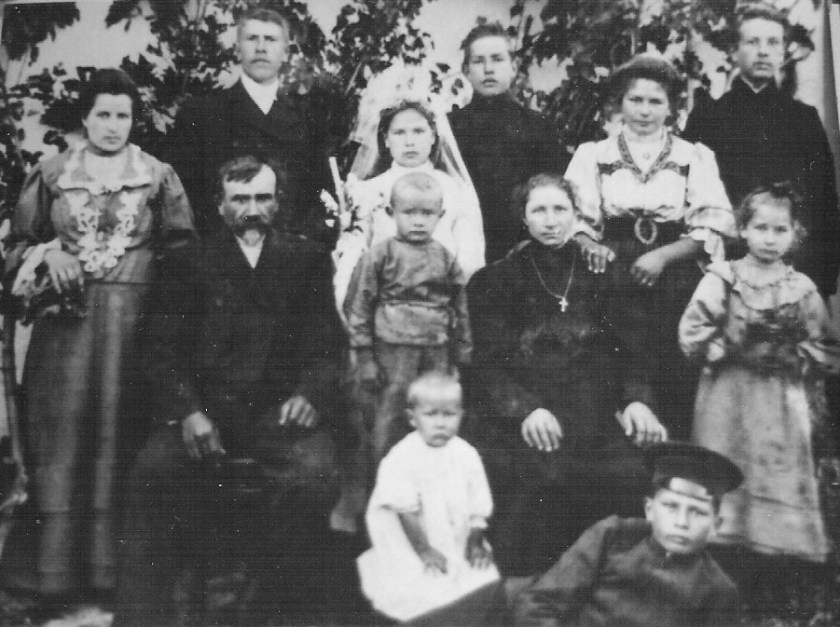
My grandmother’s maternal grandparents, Jacob Anton and Margaretha “Margaret” Heck, came directly to Canada in 1912 with all their children and settled in Saskatchewan. This included my great grandmother, Emelia Anton, who was nine years old at the time. She lived to be 94 and I knew her well.
The Anton family, circa 1910. Likely taken in Selo Suchoi, Veronesch, Russia. My great grandmother, Emelia, is the little girl standing at the edge of the right side of the photo.
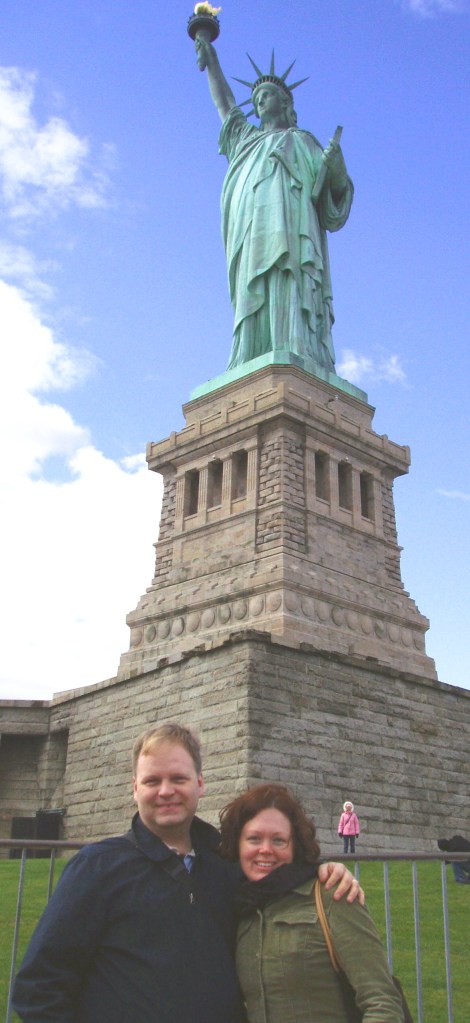
Emelia had not had much schooling before coming to North America, but was very religious. She said that she was frightened and nervous during the journey, as she did not know anything about where she was going and did not fully understand what was going on. However, on reaching New York, she said her fears subsided when she saw “the Madonna”. When she saw that, she knew she would be safe and all would be well. Of course, the “Madonna” was the Statue of Liberty. As she had never heard of it before, she thought it was a statue of the Virgin Mary.
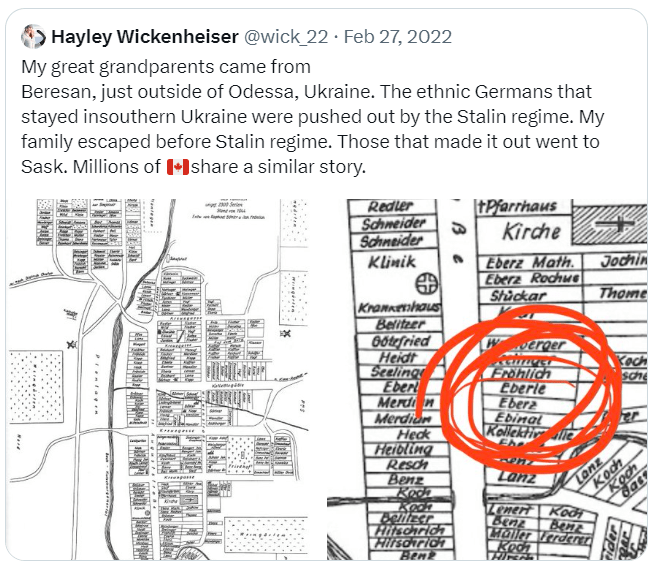
There are many well-known descendants of the Germans from Russia. They include Lawrence Welk, who married my grandmother’s fourth cousin. While I am generally disinterested in celebrity, I was excited to learn that Hayley Wickenheiser is a descendant of Germans from Russia. Her great grandparents lived in Rastadt, where Mike and Barbara had lived before emigrating. However, her family was there decades after mine left, as the did not leave until they fled Stalin’s regime.
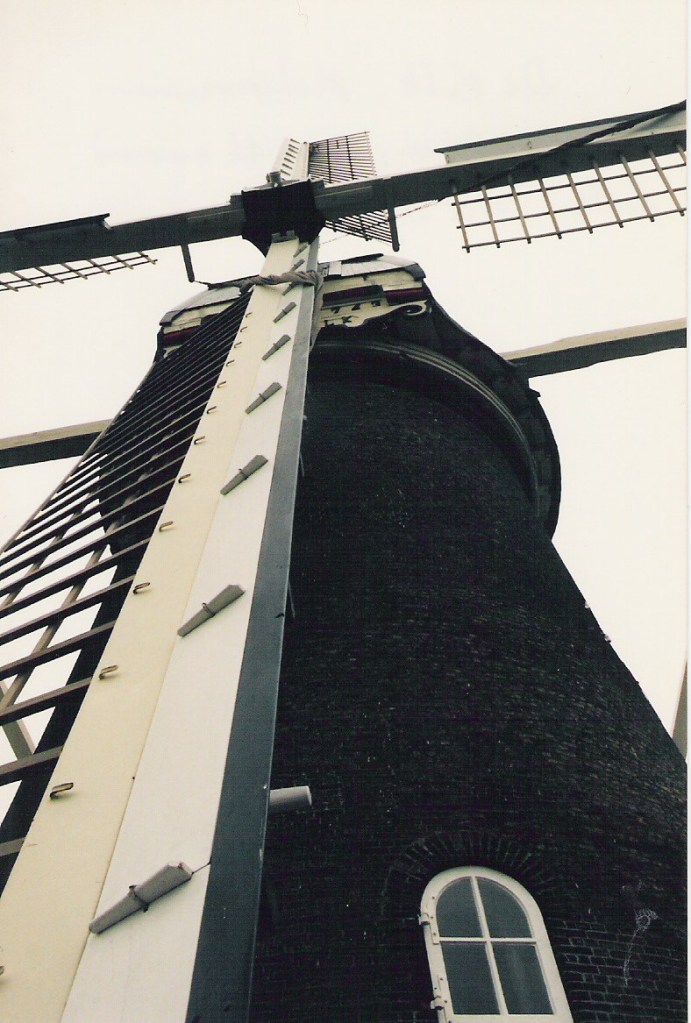
While most of my Dutch ancestors were farmers and labourers, it should come as no surprise that a few worked in windmills. On my father’s maternal side of the family, three of my Gx4 grandfathers were watermolenaaren (singular, watermolenaar – “water mill worker”). These were the windmills used for pumping water.
On my father’s paternal line, the surname “van der Fluit” may have originated with a windmill (“Fluijtermolen” – “Whistler Mill”) or the polder (“Fluitpolder”) on which it stood in Veur, Zuid-Holland (now part of Leidschendam). Alternatively, the windmill and polder might have been named after my ancestor, Johannes Dircks (“Jan”) (van der Fluit or Goeman) who owned or constructed them.
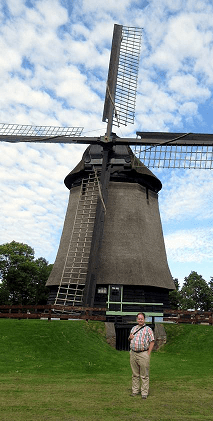
Me standing in front of the windmill in Waarland, Noord Holland, at more than a metre below sea level, about a kilometer from where my father was born and 200 metres from where he was baptized.
My paternal grandmother’s father was Adrianus Komen (1888-1948). Three of his four great grandfathers were all water mill workers. There is a strong possibility all three worked in the same windmill at the same time. I know that two of them, Nicolaas Cornelisz “Klaas” Komen (1786-1864) and Jan Smit (1786-1852) worked at the windmill located in Heerhugowaard, Noord Holland. However, the records I have consulted do not indicate when they worked in the windmill. At most, it is quite likely that Jan was working at the windmill until at least 1852.
I have no idea where and when the third, Johannes “Jan” Woltering (abt 1788-1834) worked in a windmill. I know that it was sometime before 1814, by which time he was working as a carpenter, as documented in the registration of his marriage. Unfortunately, the source from which I obtained the fact he had been a watermolenaar was simply an index and no longer exists. I have not found this item in other sources and records I’ve consulted. The population registers I have seen do not include his occupation. A notarial record I’ve found is dated 1817, which shows Jan working as a carpenter.
Despite this, I have reason to believe that Jan may have worked in the windmill in Heerhugowaard. Jan was born in 1788 in what is now Vreden, North Rhine-Westphalia, Germany. Vreden is about three kilometers from the Dutch border. What he did between his birth and marriage I don’t know, but by 1814 he was living in Akersloot, Noord Holland, which is about 14 kilometers south of Heerhugowaard. After he married he lived and worked in Langedijk, Noord Holland, which is immediately adjacent to Heerhugowaard.
“De Valk” (The Falcon), a windmill in Leiden, Zuid Holland, about 10 kilometers from where Fluijtermolen once stood.
There is one fact in particular that makes me suspect Jan may have worked in the windmill in Heerhugowaard is that Jan Woltering’s son Cornelis married Jan Smit’s daughter Neeltje. Thus, it is possible that the families knew each other because Jan and Jan worked together in the same windmill. Then again, Heerhugowaard was not a large place in 1814 and it is quite possible they knew each other the way everyone in a small town tends to know each other.
Turning to Jan Dircks, the website for the municipality of Leidschendam-Voorburg used to have this information, which I have translated from Dutch:
The square and adjacent street between Prinsensingel, Noordsingel, de Amstelweg, and de Graaf Willem de Rijkelaan is called Fluitpolderplein. This was decided in 1970. But where does the “fluit” in “Fluit Polder” come from anyway? According to a historian of Veur, Hendrik Brouwer Schut, it may have something to do with the whistle of the grinding mills, or possibly the “fluitenkruid” (“cow parsley” or “Queen Anne’s lace” in English). [The Dutch name of the plant refers to the fact a flute or whistle can be made from the stem.] However, there may be a better explanation. In 1648 a large part of the territory of the polder already belonged to a certain Jan Dirckxz, who also went by the name “Fluijt”.
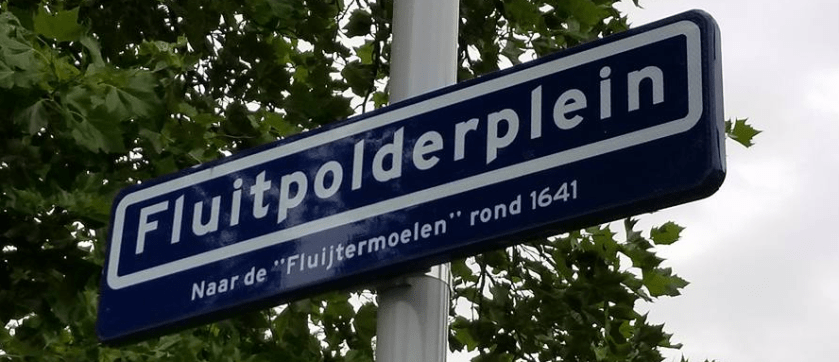
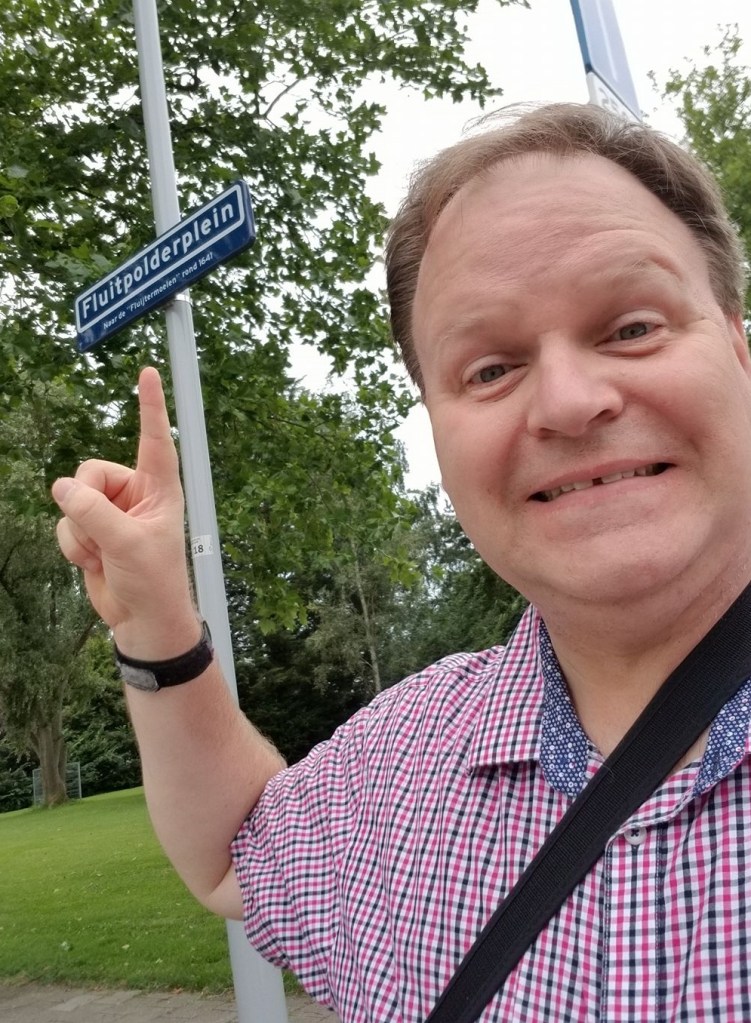
According to the street sign for Fluitpolderplein, the polder was located alongside the “Fluijtermolen” (Fluit Windmill), which was built around 1641.
Am I named after the polder or is the polder named after me?
 A Deck of Ancestors