That feeling when you discover that your Great x12 Uncle was Henry VIII’s royal bum wiper. Genealogy is not for wimps.
While I haven’t researched the connection to the degree required by the Genealogical Proof Standard, Michael Heneage (1540–1600) was my Gx12 Grandfather. Among other things, Michael was a Member of Parliament during the latter part of the reign of Elizabeth I, from 1571 to 1593. Michael represented several different constituencies over the years: Arundel, East Grinstead, Tavistock, and Wigan.
One of Michael’s other roles was Keeper of the Records in the Tower of London. (Sounds like a job for a genealogist!). He was appointed to the position in 1576, jointly with his older brother, Sir Thomas Heneage (1532-1595). Like Michael, Sir Thomas also served as Member of Parliament, from 1553 to 1593. He too held different parliamentary seats over the years: Arundel, Boston, Lincolnshire, and Essex.
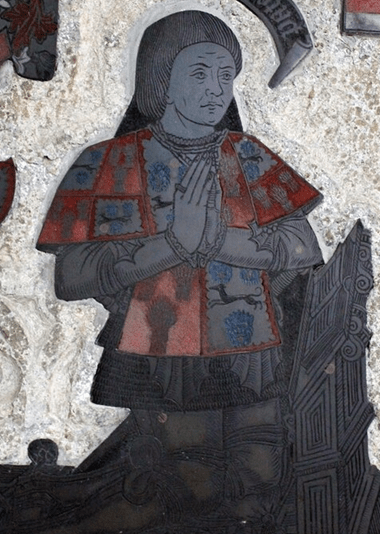
Part of the memorial for Sir Thomas Heneage at St Mary’s Church
Sir Thomas had considerable power and influence over his lifetime. He was educated at Cambridge and had many important connections. Sir Thomas served in the courts of both Henry VIII and Elizabeth I. Among other things, he served as Elizabeth’s Gentleman of the Privy Chamber around 1565 and later as the Treasurer of the Queen’s Privy Chamber. Sir Thomas ultimately became a member of the Privy Council in 1587.
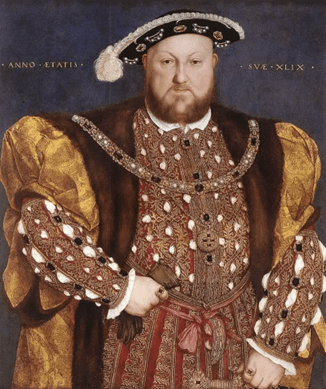
Speaking of privy, Sir Thomas held a number of significant posts during Henry VIII’s reign. This included the office of Groom of the Stool for the King, from 1536 to 1546. Yes, he was the royal bum wiper. That duty of the office, which lasted until the death of Queen Victoria, fell away over the centuries.
The job came with other significant responsibilities and privileges (I’d hope so!), plus the office holder learned a lot of important information. Records of testimonials show that Henry complained to Sir Thomas about his wives, particularly Anne of Cleves. It was extremely important for the Groom of the Stool to be trustworthy and able to exercise utmost discretion. While it would have been detrimental for any of the Grooms to breach that trust, the fact they even had that information gave them tremendous influence.
My wife’s response when I told her about this ancestor? “No wonder you were so good at changing diapers!”
Two weeks ago, I wrote about my roots in the Dutch island of Texel. While the focus was primarily on my paternal grandmother’s ancestors, my paternal grandfather’s side of the family also has a strong connection to Texel. This includes several van der Fluit cousins of varying degrees, many of whom are descendants of my 4x Great Grandfather, Petrus Pieterszoon “Pieter” van der Fluit. I’ve written about at least one of those cousins, Pieter Jansz van der Fluit.
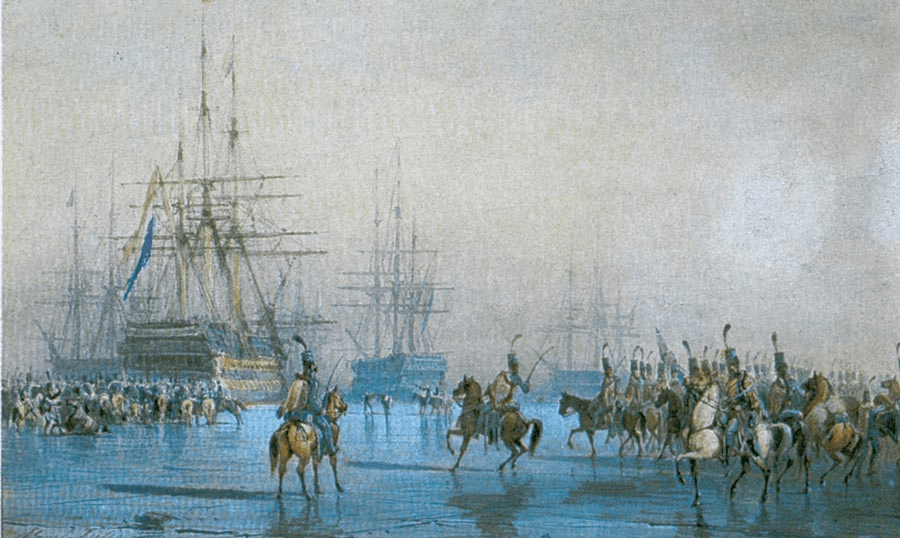
Both sides of my father’s family had a presence on Texel during the French occupation of the Netherlands during the Napoleonic Wars. Many of my ancestors were living on the island during one of the most unusual military confrontations in history, involving a confrontation between cavalry and naval forces.
A depiction of the capture of the Dutch fleet at Texel by French naval painter Antoine Léon Morel-Fatio (1810–1871)
The French invaded the Dutch Republic over the period from 1793 to 1795. There was a great deal of support for the French in the Dutch provinces. The Patriotten (“Patriots”) shared the ideals of the French Revolution. During the French incursion, a French-supported uprising led by the Patriots overthrew the previous regime.
By January 19 , 1795, the Patriots had succeeded and established the Batavian Republic (later the Batavian Commonwealth). While nominally independent, the Batavian Republic was essentially a French vassal state. However, Napoleon was dissatisfied by the rate of change in the new state and was not impressed by its degree of opposition to the English. In 1806 he replaced the Batavian Republic with the Kingdom of Holland, with his brother Louis (Lodewijk in Dutch) installed as its King. When Lodewijk proved to be too sympathetic to his subjects, Napoleon removed him from office and incorporated the Netherlands into France itself.
After the success of the Batavian revolution, the provisional government ordered loyalist Dutch forces to stand down. Despite the support for the French in the Netherlands, the Navy remained loyal to the previous regime. It had formidable forces centred at Den Helder, a major naval port.
The winter of 1794-95 was particularly cold. A storm threatened the Dutch fleet at Den Helder, so it sought shelter on the leeward side of Texel. Nevertheless, the fleet found itself frozen in the ice offshore. Wishing to take advantage of the loyalists’ plight, the French ordered the appropriately-named Admiral Jan Willem de Winter to Den Helder to secure the fleet for the Franco-Dutch forces. De Winter led forces comprised of cavalry and artillery. They arrived on January 22, 1795.
The senior officer of the fleet prepared to scuttle his ships, while de Winter prepared for an attack. However, once news confirmed that the revolutionaries had succeeded and taken over the government, the two sides negotiated a surrender.
There were other reasons why a battle might not have occurred, even if the rebels had not succeeded in overthrowing the government. If the battle had occurred, it would have been a very rare occasion of a land force attacking and (possibly) overtaking a naval force.
Texel was of significant military value during the French occupation. It was a lynchpin of defence against an English naval attack on the Dutch coast. So much so, Napoleon himself visited the island in 1811. One of the key locations he visited were two fortresses at De Schans, a kilometer or so outside of Oudeschild, where many of my ancestors lived. I would love to know what my ancestors might have seen and experienced at that time!
A cousin of mine has a story about one of our van der Fluit ancestors that took place on Texel during the French occupation. He didn’t say who it was specifically, other than a van der Fluit. Whether or not the story is true, or has a kernel of truth, I really cannot say. Nevertheless, whether fact or fantasy, it’s a fascinating legend.
In the course of the wars, Napoleon instituted conscription in many of the French territories, including the Netherlands. Orders were sent to round up all able-bodied men of fighting age and press them into service. One of our Texelaar van der Fluit ancestors sought to evade conscription by hiding in a hay rick while soldiers were rounding up men. The soldiers suspected that people might try to hide in the hay ricks, so they went from rick to rick and pierced them with their bayonets. Legend has it that this particular van der Fluit was praying the rosary while hiding. While doing so, a bayonet passed between his chest and upper arm. He went unscathed and undetected, so he evaded conscription.
“Favourite Photo” is a perennial topic for the 52 Ancestors Challenge. The prompt started out hard enough the first year I participated in the challenge, because I had so many favourites to choose from. If I had realized back then that it was an annual topic, I wouldn’t have posted so many photos back then!
The other problem is that “favourite photo” suggests one photo that you love more than all your others. How to choose??? Simple! Simply read the prompt as “A Favourite Photo”!
Despite that, it’s still hard to choose. What I’ve decided to do is to try to post something I haven’t shared before. While maybe not my favourite, I’ve selected some photos of a memorable family road trip to Alaska in the mid-80s, when I was in grade twelve. I love road trips, and this is one that I’ve only done once (so far!).
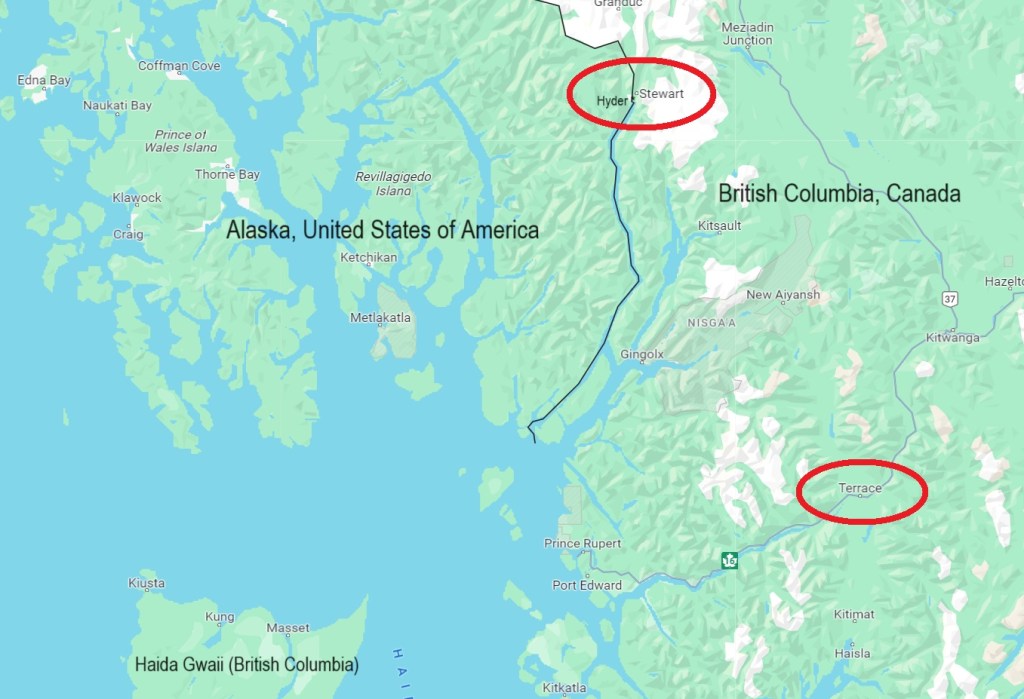
Terrace is near the northwest coast of the province, near the Alaska Panhandle. Just over 300 kilometers away (about a four and a half hour drive) are the border communities of Hyder, Alaska and Stewart, British Columbia.
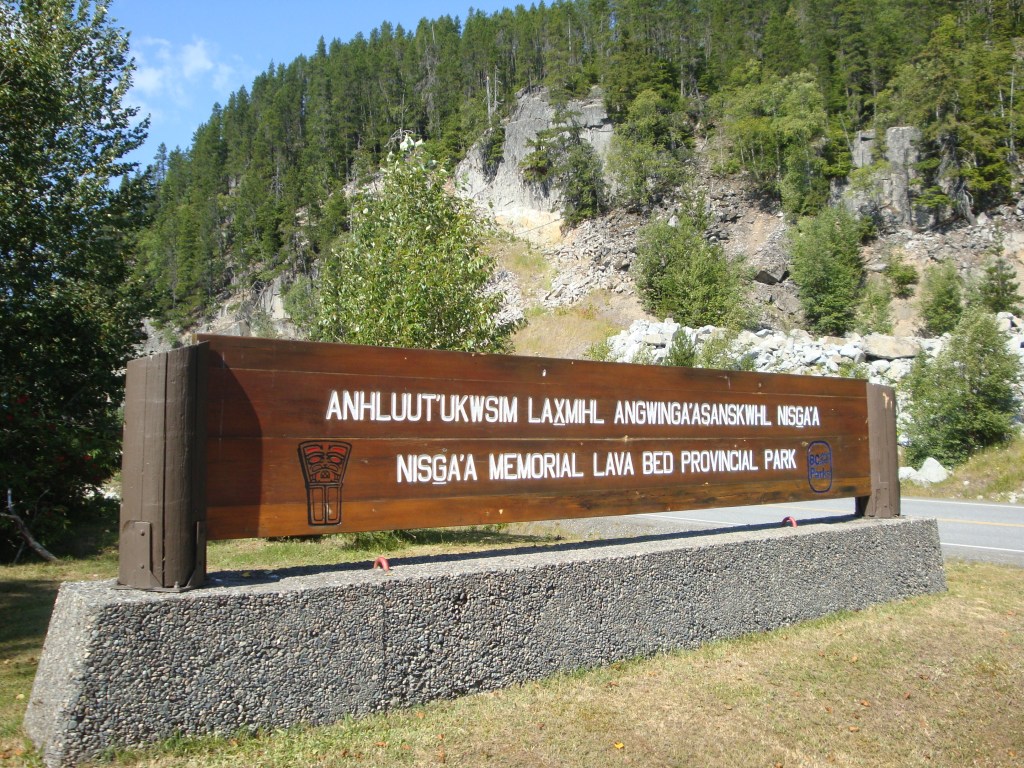
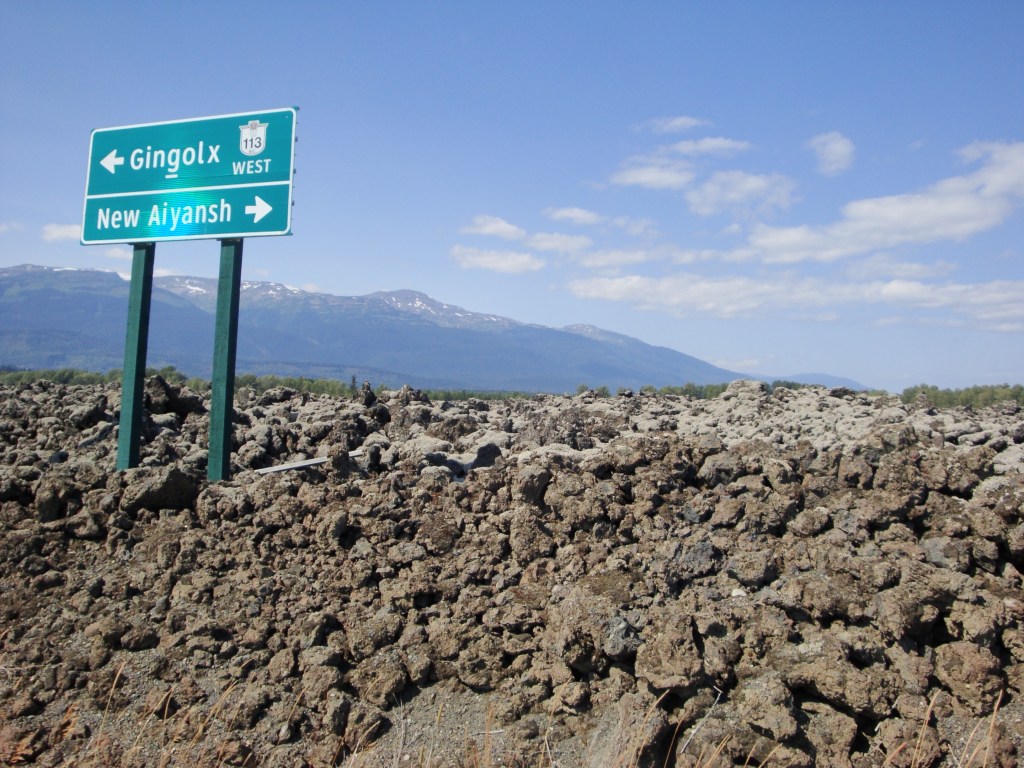
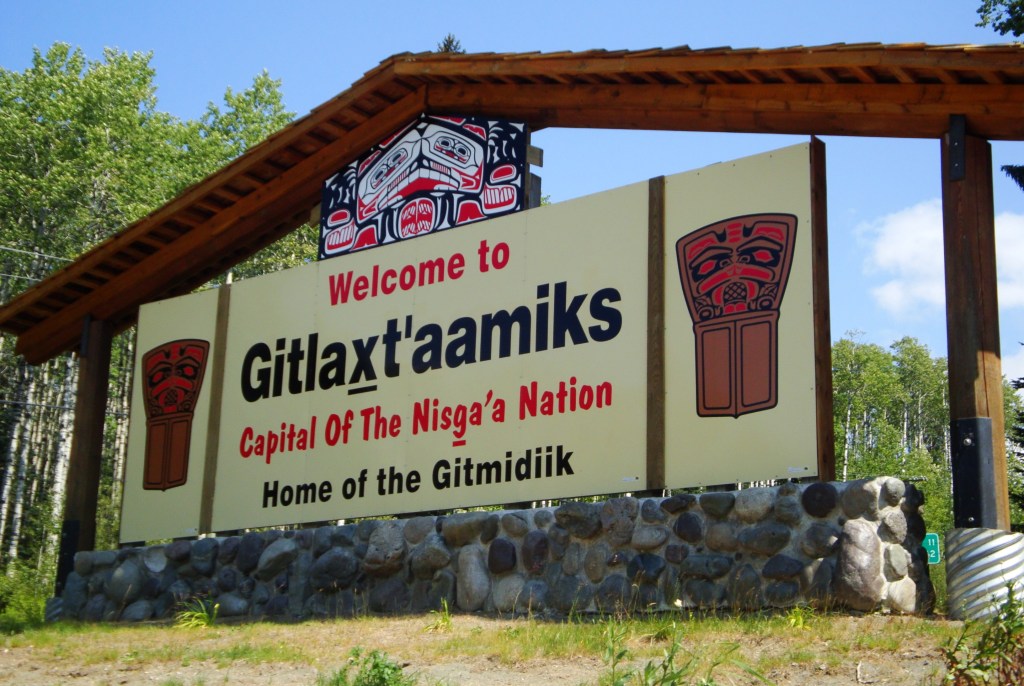
While the destination was novel, it was the journey that was the best. The easiest way to get from Terrace to Stewart/Hyder is along Highway 37. However, we took a less direct and even smaller route, Highway 113, which is now known as the Nisga’a Highway. It travels through lava beds (designated as Nisga’a Memorial Lava Bed Provincial Park in 1992) and the lands of the Nisga’a Nation.
(I’m cheating here. My photos of the lava beds and the Nisga’a territory from the road trip I’m writing about suck. In 2010, I, with my wife and some friends, took a day trip to the Nisga’a, but did not proceed any further north. My photos from that road trip are much better!)
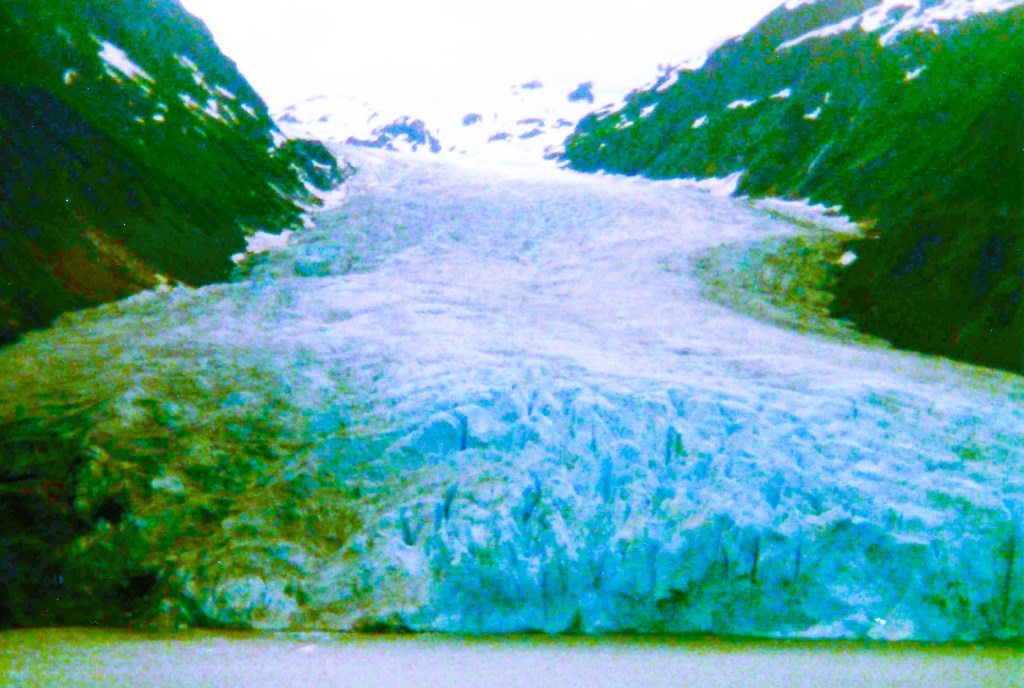
The Nisga’a Highway ultimately connects to Highway 37, which travels north to the Yukon. My folks have actually driven the length of that highway, but we didn’t on this road trip. Rather, we turned west onto Highway 37A at Meziadin Junction. Between Meziadin Junction and Stewart is the Bear Glacier.
The glacier has shrunk an incredible amount in the decades since our road trip. It no longer touches the lake as seen in my photo and is but a sliver of its former self at this location.
At our destination, we stayed in Steward, which was (and still is) the much larger of the two villages. At the time, there was no customs or border station on either side of the border, although there was the remains of one that had clearly been used for target practice. The post office in Hyder was memorable, as it was in an old Airstream (or similar) trailer. I also remember a place selling “Northern Fried Chicken”.
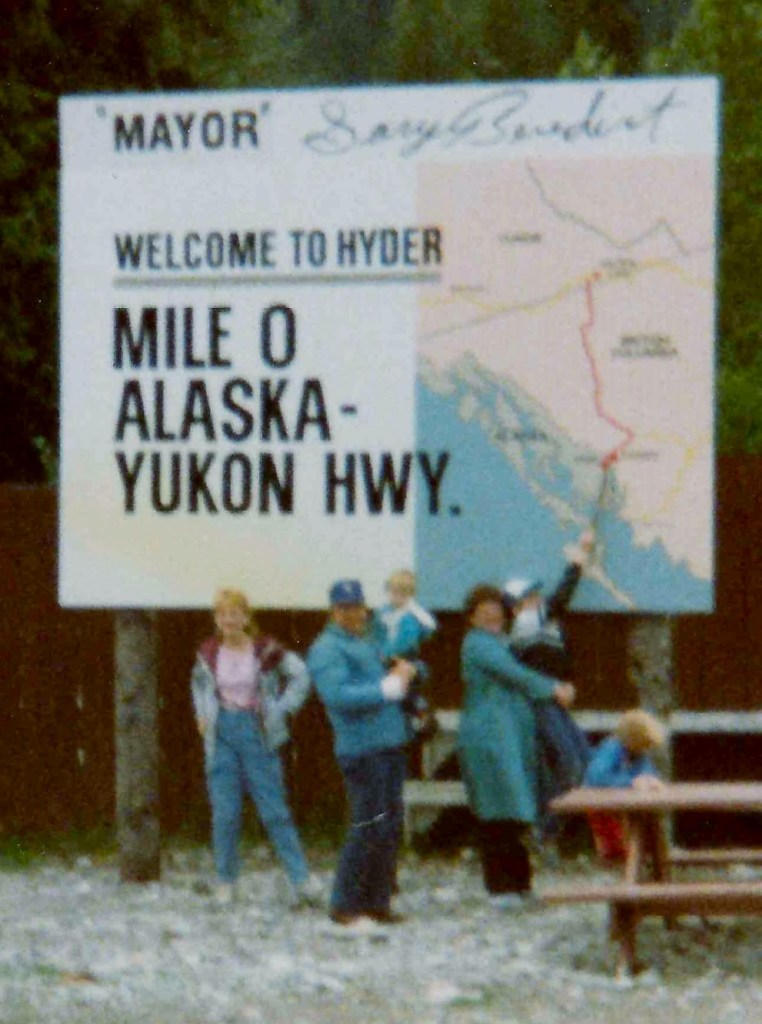
This is a photo of my family at what is purported to be the start of the “Alaska-Yukon Highway.” Of course, I’m not in the photo because I’m the one taking the picture – with a 110 film camera! Otherwise, the whole family is visible here, although my youngest sister (sitting at the table) looks quite odd. It wasn’t the best of cameras, that’s for certain. While you can travel from Hyder/Stewart to Alaska, as shown in the sign, the highway does not officially bear that designation.
One thing we didn’t do in Hyder was get “Hyderized”, which involves taking a shot of Everclear at one of the village pubs. It once appeared in the Guinness Book of World Records as the most alcoholic drink in the world. (Guinness no longer publishes alcohol-related records.) No, Everclear was not something I tried until I was in university.
A great travelogue about Highway 37 (also known as the Stewart – Cassiar Highway, is Nearly 40 on the 37 by my friend Trevor Hughes.
Week Two for the 2024 edition of the 52 Ancestors Challenge, and I’m already struggling. While my experience with the challenge has been rewarding and continues to be so, as I start my third year participating I am finding it harder to find things I haven’t previously written about one way or another. For this week’s prompt, “Origins”, it would have been quite easy to simply recycle any one of a number of past posts. However, I am trying to do something relatively new each week, because I think that’s most in keeping with the purpose and goal of the challenge.
Finally, today, now that Week Three’s prompt has been issued (on another recurring topic!), I thought I had finally come up with something I hadn’t written about before. Turns out that it’s something I’ve touched upon before. Nevertheless, I’m running with it because it’s never been the primary focus of a post.
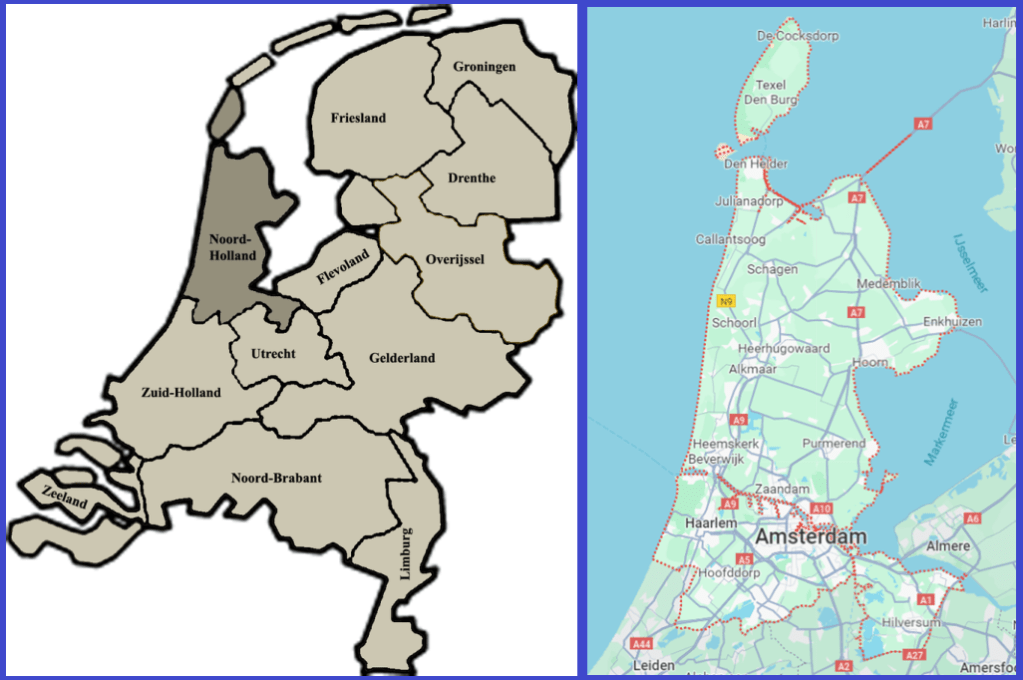
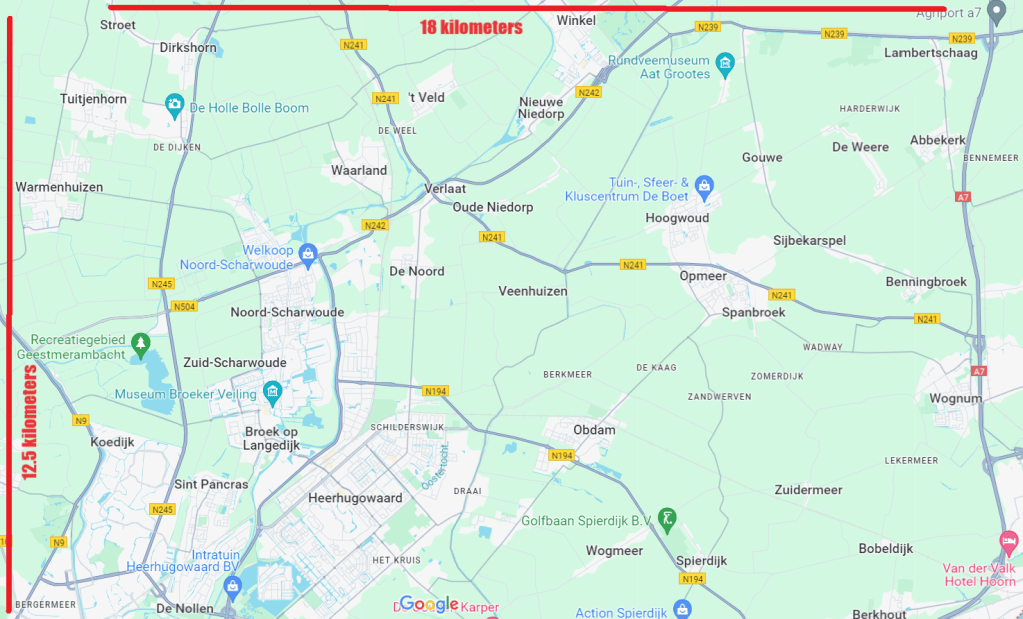
My father was born in the Netherlands, so I have deep Dutch roots. My direct ancestors are primarily from the central part of what is now the province of Noord Holland, going back centuries. My paternal line has been there for 200 years but originated in Zuid Holland, in towns and villages between Den Haag (The Hague) and Leiden. Most of my Noord Holland ancestors were born, lived, and died roughly within a 280 square kilometre area.
The area of Noord Holland where many of my paternal ancestors lived. This is immediately north-east of Alkmaar, one of the larger cities in the area.
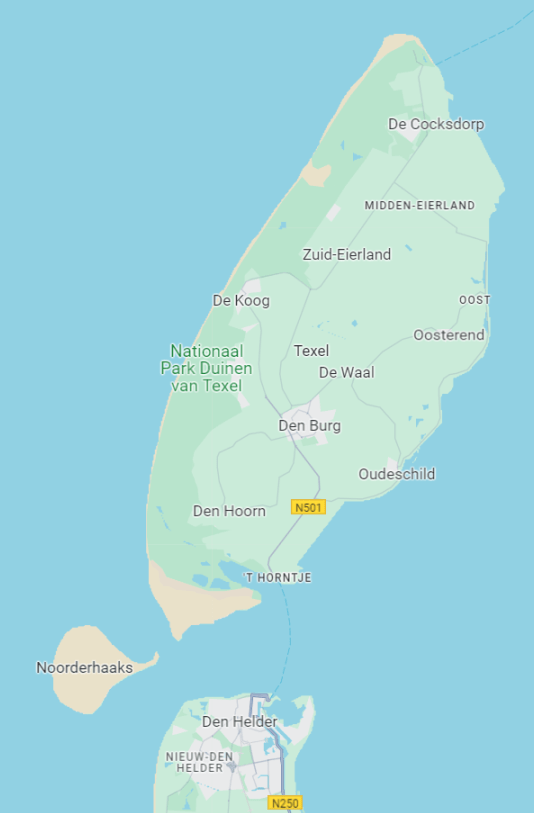
However, several of my Noord Holland ancestors were from Den Helder, a city on the northern tip of the mainland of Noord Holland. It is an important port city. In the 16th and 17th centuries, it was a significant mustering and departure point for Dutch overseas trade and exploration. It is now the home of the Netherland’s main naval base.
Three kilometers north of Den Helder, across the Marsdiep strait, is the island of Texel. Through my father’s maternal grandmother, Elisabeth Bakker (1888-1976), I have significant roots in Texel. I do not know how far back those roots truly go, but I know that one branch of Elisabeth’s maternal line was on Texel by end of the 15th century.
In English, the “x” is pronounced the same as it is in “Texas”. In Dutch, it’s pronounced “Tessel”. Texel is the first and largest of the Wadden Sea islands, which stretch along the entire north coast of the Netherlands. Nine hundred years ago, Texel was part of the mainland. A catastrophic flood in 1170 dramatically changed the geography of north-west Netherlands, including the creation of the island of Texel. There has been settlement on Texel since at least the 12th century. Texel even has its own dialect, Tessels. It was common until the 1950s, after which time it went into significant decline.
The island received city rights in 1415. It has been the site of significant naval engagements over the last 400 years. It was also the site of one of the last battles of World War II in Europe. The island had been relatively unscathed during the war itself. It was only after the war was over that it was devastated. A German battalion made up of Georgian soldiers occupied Texel during the war. Supported by the Dutch Resistance, they rebelled in April 1945. Fighting between the Georgians and Germans lasted well beyond VE Day, ending only with the arrival of Canadian troops on May 20, 1945.
Historically, Texel’s primary economic activity involved agriculture and the sea. It is famous for a breed of sheep, Texels, that originated there. In present times, the island is primarily dependent on tourism. While most of my Dutch ancestors were primarily farmers and labourers, many of my Texel ancestors were sailors.
Both of Elisabeth Bakker’s grandfathers, Jan Cornelis Bakker (1819-1859) and Cornelis Ran (1824-1897), were harbour pilots. I suspect it was that line of work that led them to relocate and settle in Den Helder. Two of Elisabeth’s four great grandfathers, Cornelis Dirksz Bakker (1789-1858) and Reijer Ran (1792-1860), were also sailors. It was Elisabeth’s father, Cornelis Jan Bakker (1855-1914) who broke with that tradition. He was a cobbler and shoemaker.
One of Elisabeth’s great grandfathers who was not a sailor was Jan de Waard (1787-1863). He began his working life as a labourer but for the last twenty years of his life he was a shopkeeper. Jan is interesting because nearly all my paternal line were Roman Catholic, but Jan was baptised in the Reformed Church. However, his wife Cornelia Pieters Kooij was Catholic and their children were baptised as Catholics. It is possible that Jan might have converted.
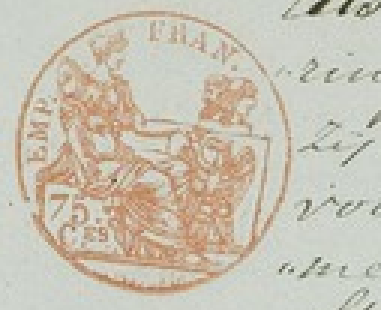
The other interesting thing about Jan and Cornelia is that they were amongst the last to be married during the period of French rule during the Napoleonic wars. They married at Texel on October 10, 1813. The record of their marriage is written in Dutch, but bears the seal of Imperial France. Less than a month after their marriage, a popular uprising resulted in the ouster of the French. On November 30, 1813, the son of the former stadholder of the country returned from exile and was named William I, Sovereign Prince of the United Netherlands and subsequently King.
The other of Elizabeth’s great grandfathers who was not a sailor, Johannes Puinbroek (1786-1865), was not even from Texel. In fact, he is quite the oddity in my family tree. He was born so far south from Texel that the town where he was born, Vrasene, is in Belgium (which at the time was the Austrian Netherlands). Sometime around 1822 and 1824 Johannes relocated to Den Helder, where he met and married his third wife. I have no idea beyond speculation as to what prompted him to move. I thought I had written about him before, given his unusual story, but searching through my posts I found nothing. Well! There is something I haven’t written about before! Stay tuned…
 A Deck of Ancestors