52W Mark III – Week 14: Favourite Recipe

The topic of food is one of the prompts that shows up in the  52 Ancestors Challenge every year. This makes it a difficult topic to write about, since I covered it broadly in the first and second year I participated in the challenge. However, as Amy often reminds participants, the prompts are merely suggestions and we can interpret them as broadly as we want. Which I’ve done, writing about pets when the prompt was flowers, and vice versa!

With this week’s prompt, I’ve not stretched the topic as far as pets to flowers. Rather, I am looking at the favourite treats of my ancestors.

I’ll start with my mother’s maternal line. As I’ve often written about here, that branch of the family are Germans from Russia. One of their favourite treats is halva. It’s a confection that originated in Persia (now Iran) that spread throughout the Middle East and, later, throughout the Ottoman Empire. While halva was originally made with a variety of different ingredients, such as flour and dates, the traditional Turkish version is usually made with sesame seeds and most often sweetened with honey or sugar. You can find halva in many varieties. Halva with pistachios, chocolate, or vanilla is quite common.
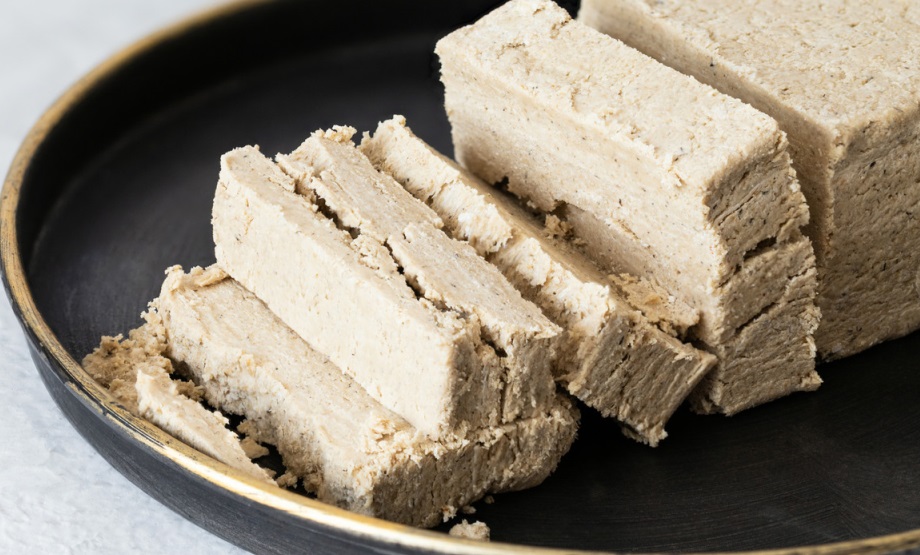
Many German settlements in the Russian Empire were in what is now the Ukraine, which the Russians had taken from the Ottoman Turks in a series of wars in the 17th and 18th centuries. While the German population was originally introduced to the Turkish version of halva, they most likely learned of the sweet treat from the local Jewish population that had been in Ukraine for centuries, including the time of Ottoman rule. However, the Germans soon modified the recipe using sunflowers, which are abundant in Ukraine and that are a symbol of that country. I’ve heard that many German-Russians prefer the sunflower variety, but I’ve never seen it. My grandmother and mother always bought the traditional Turkish version. While not a traditional Christmas food, that is the time of year my mother would most often buy it. My mother often spread it on toast, which is quite delicious.

Turning to my father’s side of the family, I’ll admit that Dutch cuisine is not world-famous for many good reasons. That said, there are many delicious treats that make up for it. One of my favourites, bitterballen, is commonly found as a bar snack. They are somewhat similar to croquettes, but are smaller and rounder. They are made of a mixture of minced beef, roux, onions, and seasonings, breaded, and fried. They’re addictive little snacks. There is a chain of cafes and coffee shops in the Netherlands called The Bulldog. In the 1990s, they had a location in Vancouver. I often went there for lunch with a friend and we always started with bitterballen.

Bitterballen are traditionally served with mustard. Lekker!

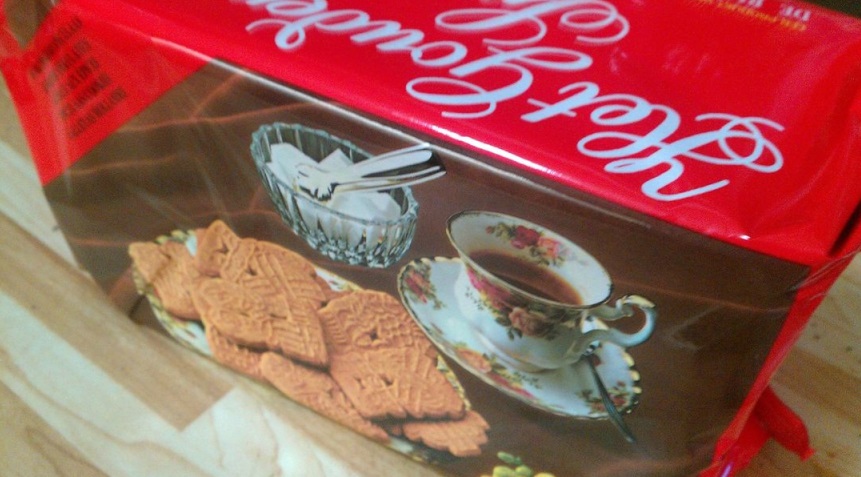
The Dutch also have many sweet treats. Almond-based treats (including marzipan) and baked goods made with warm spices are quite popular. The one I can remember having ever since I was little is speculaas. They always contain ginger, along with spices such as cinnamon, nutmeg, cloves, cardamom, anise, allspice, and white pepper. With those flavours, they were a common Christmastime treat, but now it is common to enjoy them year-round. They are particularly good with coffee. While speculaas might have been obscure outside the Netherlands and its former colonies, they’ve always been relatively easy to find in Canada. I’ve also noticed them popping up on baking and cooking shows in recent years.
Another delicious treat that is also good with coffee are stroopwafels. They’re made up of thin waffle-like wafers with a thin layer of caramel sandwiched in the middle. (“Waffle”, by the way, is an English word of Dutch origin.) They originated in the city of Gouda as a means for bakers to repurpose crumbs and scraps. You can get them freshly made from street vendors in the Netherlands, as well as bakeries and cafes. The availability of stroopwafels in Canada seems to wax and wane, although they’re always available in Dutch specialty stores. They were also featured as the technical challenge during “Caramel Week” on Season Eight of The Great British Bake Off (airing as The Great British Baking Show in the United States and Canada). It’s common to place them on top of a hot cup of coffee, which warms and softens them. So delicious!

Finally, many people know that the Netherlands is famous for its chocolate. During Sinterklaas, a favourite treat is chocoladeletters (“chocolate letters”). Centuries ago they originated as baked goods, but are now almost exclusively made of chocolate. It is traditional to receive a chocolate letter of the initial of your first name. My great grandmother, Elizabeth Bakker, always included chocolate letters in the box of goodies she sent us every Christmas. When we were children, there was always an argument that some letters were bigger than others so they had more chocolate. The truth is, while the surface area of each letter might differ, they are manufactured in different thicknesses so that every letter contains the same amount. The other problem is finding letters that are uncommon initials for names in the Netherlands, although that is less of a problem than it used to be.

Chocolate letters are another item for which, outside the Netherlands, the availability seems to change over time. When I was a kid, they seemed to be available everywhere. Purdy’s made their own for a while, but I haven’t seen them there in a long time. In recent years, the only place I could find them were in Dutch stores. Even then, I could not find Droste letters – the absolute best ones, bar none – anywhere. You could only find the secondary brands. I once asked a vendor if Droste no longer shipped to Canada, and was told they were simply too expensive to carry. Luckily, a couple years ago I found Droste chocoladeletters in a Dutch store in Lethbridge.

Fortunately, chocolate letters seem to be getting easier to find again, as I saw them being sold in many mainstream supermarkets and shops last Christmas. I first noticed them showing up a couple years ago in a local independent grocery store that specializes in Asian foods and ingredients of all places. Plus, in our neighbourhood of Steveston, there is a chocolatier that makes them – in every letter!
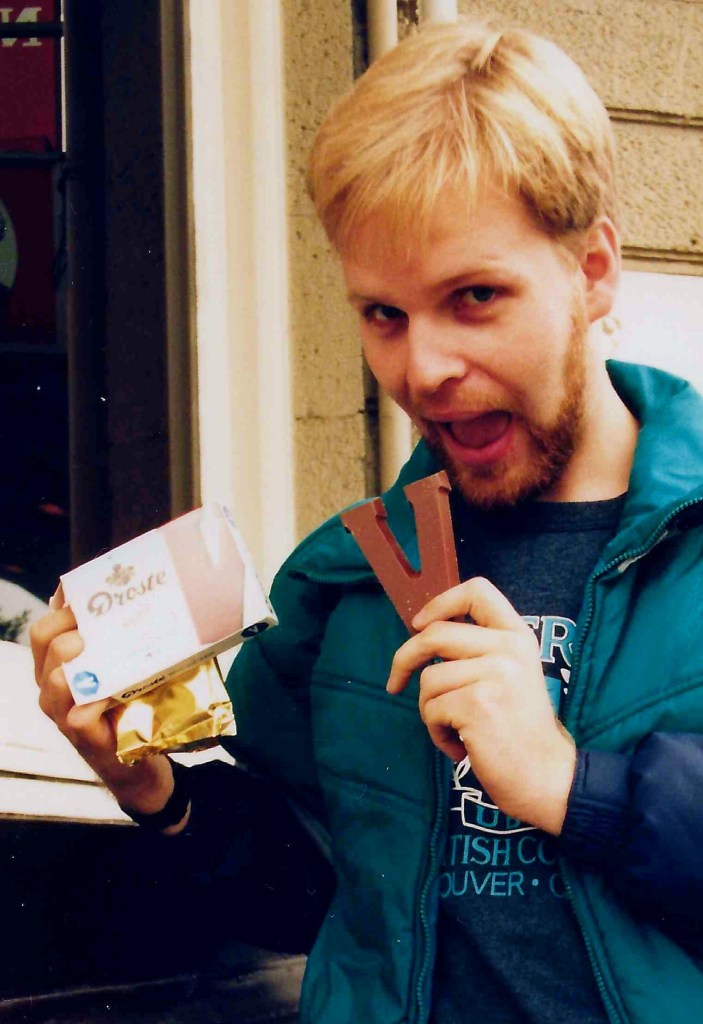
During my first trip to the Netherlands, I discovered a Droste store directly across from the Amsterdam Centraal Station. I enjoyed being able to buy any letter I wanted, well out of season! Sadly, the last time I was in Amsterdam, the store was gone.

52 Weeks Mark III – Week 13: Worship

Wow, we are now one-quarter of the way through this year’s 52 Ancestors Challenge!!

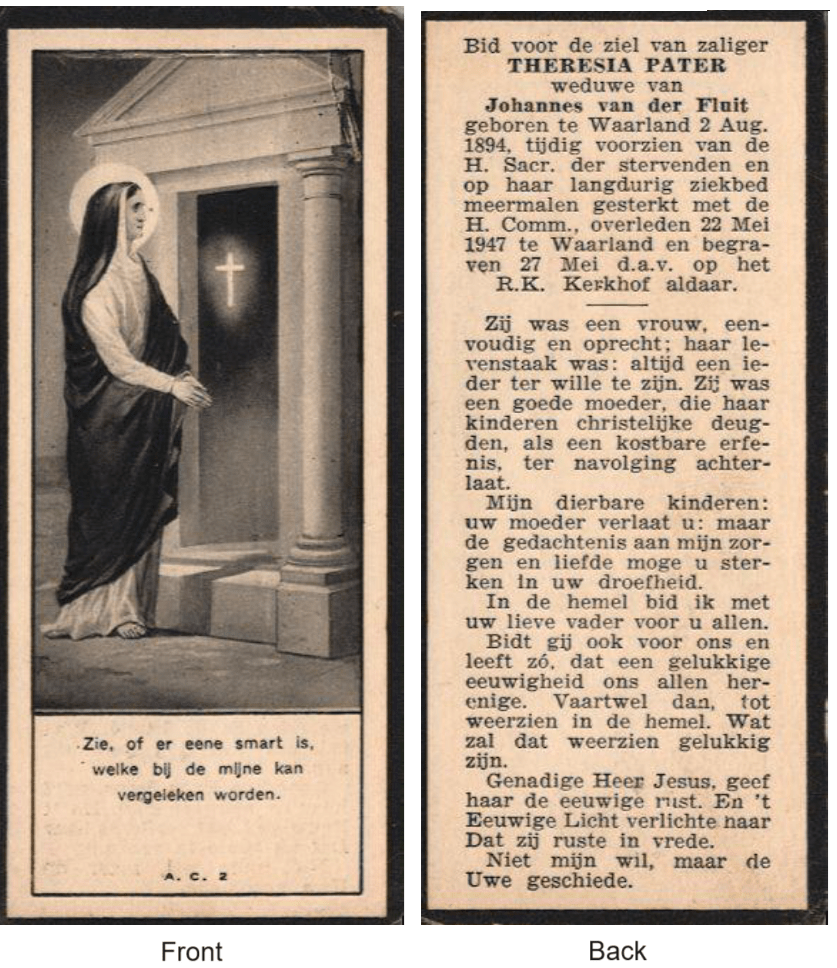
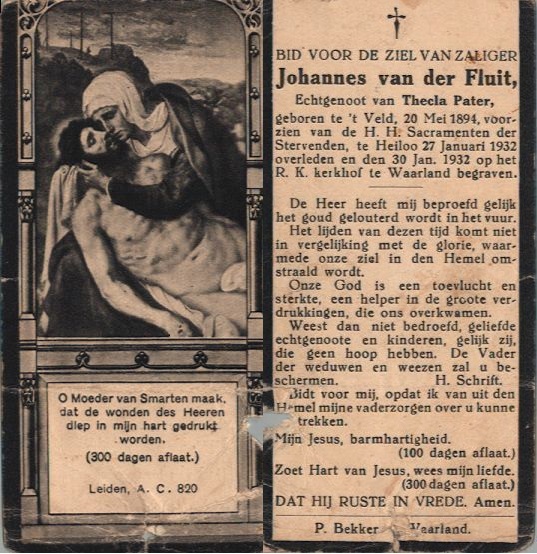
In the Netherlands, there has not been much of a tradition of preparing and publishing obituaries of deceased persons. Deaths were once noted in local newspapers in regular reports of recent entries of births, marriages, and deaths taken from the local civil registry (“burgerlijke stand”). What is more common to see in newspapers are “familieberichten” (“family notices”). These are all secular forms of announcing and commemorating the death of a person.

For Roman Catholics, another common form of remembrance is a “bidprentje” (“prayer card”). In Germany, they are known as a “totenzettel”. These are usually given out at funerals and commemorate a deceased person. They usually consist of a short prayer or biblical verse along with the name of the deceased. However, bidprentjes can be used to mark other religious milestones, such as baptisms, first communions, confirmations, marriages, and ordinations into the priesthood. While they originated as a Roman Catholic tradition, in recent decades the practice of making these cards has occurred within other religious traditions.

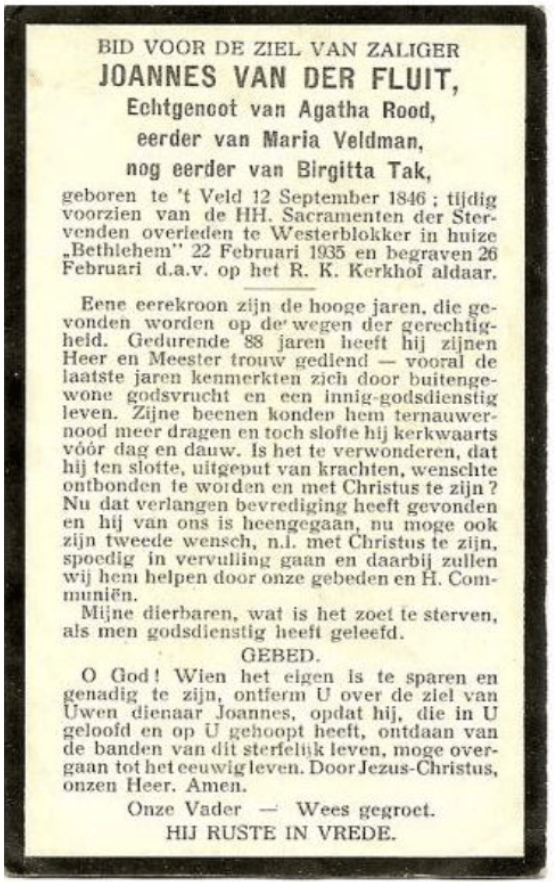
Bidprentjes are a fantastic source of genealogical information. In addition to the name of the deceased they usually include the dates and places of their birth and death and the name of the deceased’s spouse. They also often have details of the date and place of the funeral and interment. Older bidprentjes are quite beautiful as they were adorned with religious art and iconography. In more recent years, they are more likely to include the name of the deceased’s children. In that regard, they now appear quite similar to familieberichten.

Bidprentje for my great grandfather, Johannis Albertus van der Fluit (1894-1932)
Bidprentje for my great grandmother, Teresia (“Teetje”) Pater (1894-1947)
Bidprentje for my great great grandfather, Jan Dirksz van der Fluit (1846 – 1935). It notes that at the time he died he was the widower of Agatha Rood and that he had been previously married to Maria Veldman (my great great grandmother) and before Maria he was married to Brigetta Tak. Jan had outlived all three of his wives.

Neither bidprentjes nor familieberichten are government documents. They are private documents created, distributed, and published by the family. This means a primary source of bidprentjes would be the family of the deceased. There are also genealogical societies that have collections of bidprentjes. The Centrum Voor Familiegeschiedenis (“Centre for Family History” or “Central Bureau for Genealogy”) also has a collection of bidprentjes. While you can search the collection, you must be a member to view and download the document. Familieberichten can be found at Online Familieberichten and Mensenlinq.

52 Weeks Mark III – Week 12: Technology

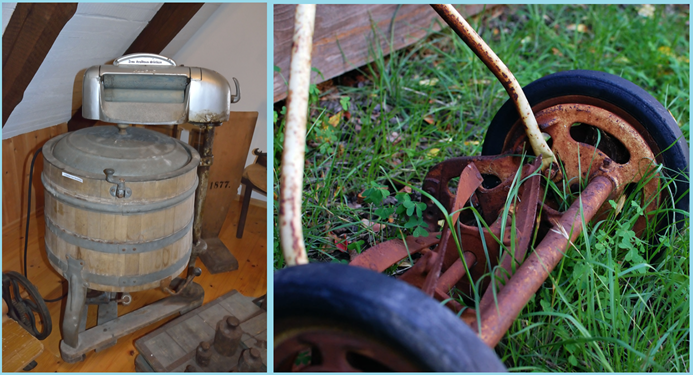
In the early 1970s, my maternal grandparents, Leo Burgess and Helen Lerner, were more than happy to rely on what seemed me to be horribly outdated and obsolete technology. My grandmother still used a wringer-washer and my grandfather used a push mower that to me seemed to be older than Methuselah.

These were both very much like the implements my grandparents used. I remember they each let me have a try at using them. Needless to say, both were hard work. I’ll stick to our modern gizmos, thanks.
[Images shared per Creative Commons licences 3.0 Unported and 2.0 Generic, respectively. Links: washer; lawn mower.]

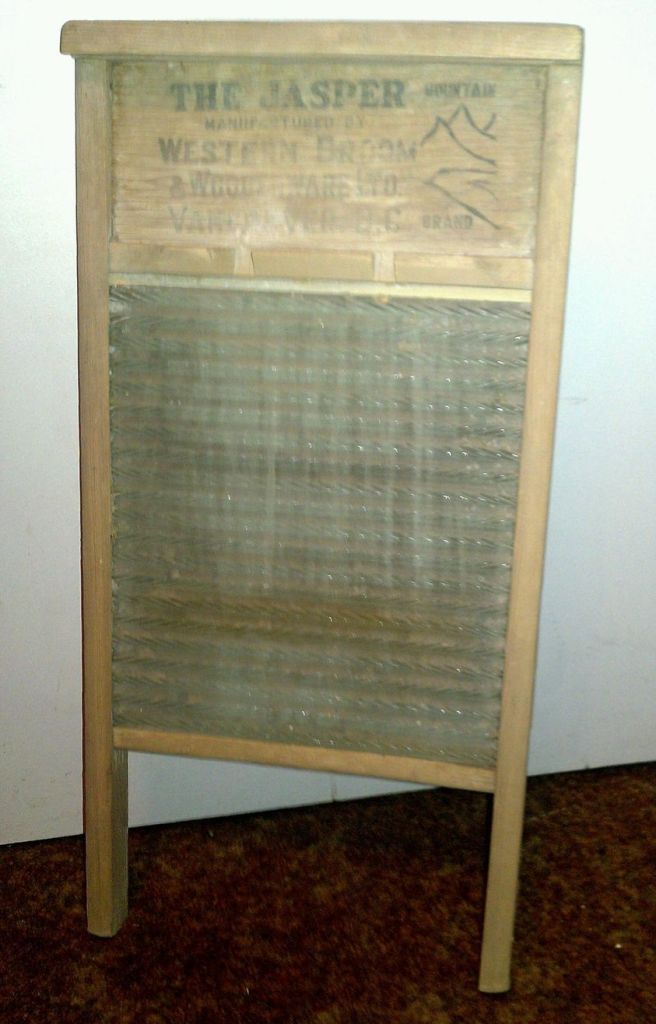
My mother still has the scrub board my grandmother used. She used to keep it in a spare room, which is where I photographed it. A few years ago my folks built a new house, so it now sits in a place of pride.

As can be faintly seen on the washboard, it was manufactured by Fraser Western Broom and Woodenware Ltd. in Vancouver, B.C. I see that the Museum of Vancouver, which is less than a half hour drive from where I live, has one in its collection. Based on the information on the item on its website, this washboard could not have been manufactured any later than 1950. That means my grandmother’s washboard must have been at least 25 or 30 years old when I first saw it.

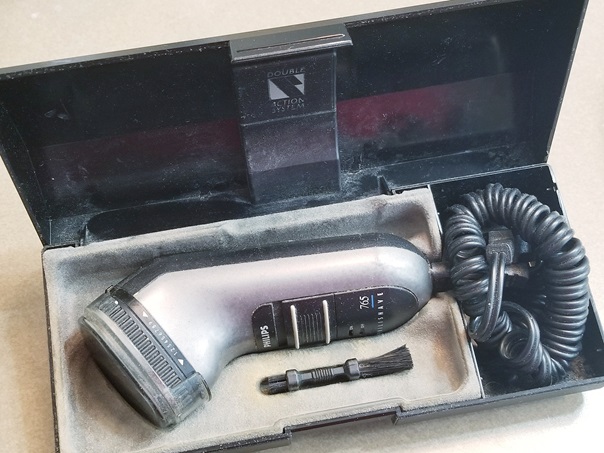
While it may seem my grandparents clung to the past, they did not eschew more modern technology. Ever since before I was in kindergarten, my grandfather always used an electric razor. We always loved it when he would hold it up to our cheeks so that we could have a shave, too. I have the last electric razor my grandfather owned before he passed away in 1995, a Philishave 765. Not only does it still work, but to my surprise I’m still able to buy replacement blades for it. I rarely use it, however, because I still prefer to use a manual razor; plus, several years ago my wife bought me a new one.

This razor must be at least 30 years old, if not older, but it still works!

52 Weeks Mark III – Week 11: Achievement

March is Women’s History Month and March 8 was International Women’s Day. From the International Women’s Day website:

Celebrate women’s achievement. Raise awareness about discrimination. Take action to drive gender parity.

My mother’s aunt, Adeline (“Addie”) Lerner (1930-2023) was a strong advocate for women’s rights during her lifetime, starting in the early 1970s. She was a founding member of one of the first women’s groups in Lethbridge, Alberta, which opened up a women’s centre. Addie also participated in establishing one of the first daycare centres in Lethbridge. She was also a member of the Alberta Status of Women Action Committee – Lethbridge Branch and served on the provincial board as a regional representative in 1989-90.

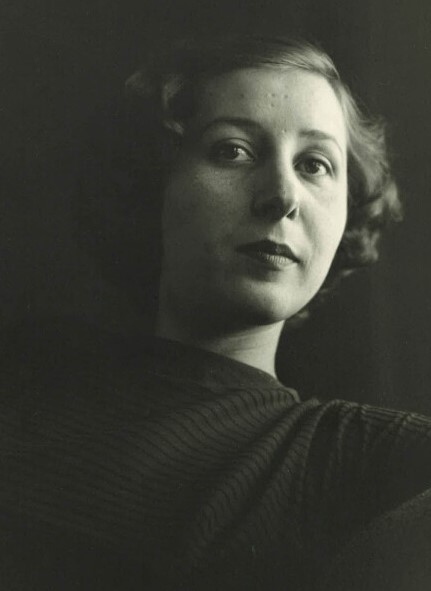
Adeline Lerner 1930-2023

Sometime around 2017, the Alberta Labour History Institute conducted a series of “Interviews Relating to Women and Work in Alberta”. This was part of the ALHI’s “Moving Forward” project. Its goal was:

“…to record and recognize the important work carried out by women throughout Alberta’s history, and to honour the achievements of women in various areas of work and the labour movement. The project involves the gathering and recording of the stories of and about women and work, and making this history available to the public.”

The ALHI interviewed a number of women as part of the Moving Forward project. My Aunt Addie was one of them.

YouTube video of the ALHI interview of my great aunt, Addie Miron (née Lerner). A transcript is available on the ALHI website.

Addie noticed the inequities as a child:

I can remember one time when I was a little girl, my mother did let me run around all over the place, I was free that way. Some relatives came to visit. They came in a buggy and horse, and they had three rowdy boys with them. When they drove up I had a rim of a wagon wheel and I was running around pushing it with a stick. The lady said to my mother, isn’t she a little old to be running around like that with that wheel? Suddenly I felt like I was doing something wrong, but I never would’ve though of that. I guess she was referring to me being a girl and here I am running around like a tomboy. She herself was also indoctrinated to think that way. I don’t think people tried to make you feel bad, it’s just the way they thought.

Adeline Miron

One of Addie’s foundational steps in her participation in the women’s movement was when she took a course called “What is a Woman?” through the University of Lethbridge:

I’m going to find out what is a woman, and I took the course at the university. I don’t think I realized what it was going to be all about, but it was nice to take the course and have these experiences with all these other young women and the odd man in there who was resentful… We’d try and argue some of these things we talked about when we were being put down and the ways we were being treated in society. Some of these people could not see that. But most of the women who took the course took it for the same reason I did. They wanted to know more about why they feel repressed and what they could do about it.

Adeline Miron

Soon afterwards, Addie and some friends decided to start a women’s movement in Lethbridge. In the early days, there were about 35 to 75 women involved.

We decided to start a women’s movement in Lethbridge. We applied for a grant the fall of ’73. We received our grant in ’74 and we opened up a women’s center. I think we used to meet at each other’s houses for a while. There was a building downtown where the birth control center was, that was a new place too, and we rented a couple of rooms in there. It was nice when we got a house all to ourselves. We became quite active, even before we had a place all to ourselves, we gave courses at the library on things to do with women, like women in male oriented jobs, women in female oriented jobs, women in health, and so on.

Adeline Miron

One of the important issues at the time (as now) was childcare.

We lobbied city council. They didn’t seem to fall for it to begin with but eventually we talked them into allowing us to open up a public daycare in Lethbridge. After awhile I worked there for about five years. Some of us that were lobbying were also running the daycare and helping with the children. The children were between two and
six. We also had a kindergarten.

Adeline Miron

Addie worked at the childcare centre from 1980 to 1985. Among other things, she worked with toddlers aged 19 months to three years old, and sometimes cared for children with disabilities.

I think Aunt Addie believed her work and the women she worked with made a positive change. However, there was still a lot of work to be done:

There needs to be a lot of improvement but things have really become better. There’s still room for a lot of improvement, don’t you think so? There’s an attitude that hasn’t gone away completely anywhere – it’s still a male oriented society, more or less.

Adeline Miron

Aunt Addie remained active into her 80s. After her husband Ross passed in 2009, Aunt Addie continued to live on her own in the same house until a few years ago. Sadly, in her last days, it was necessary for her to move into a care home. She passed away last summer, at age 92.

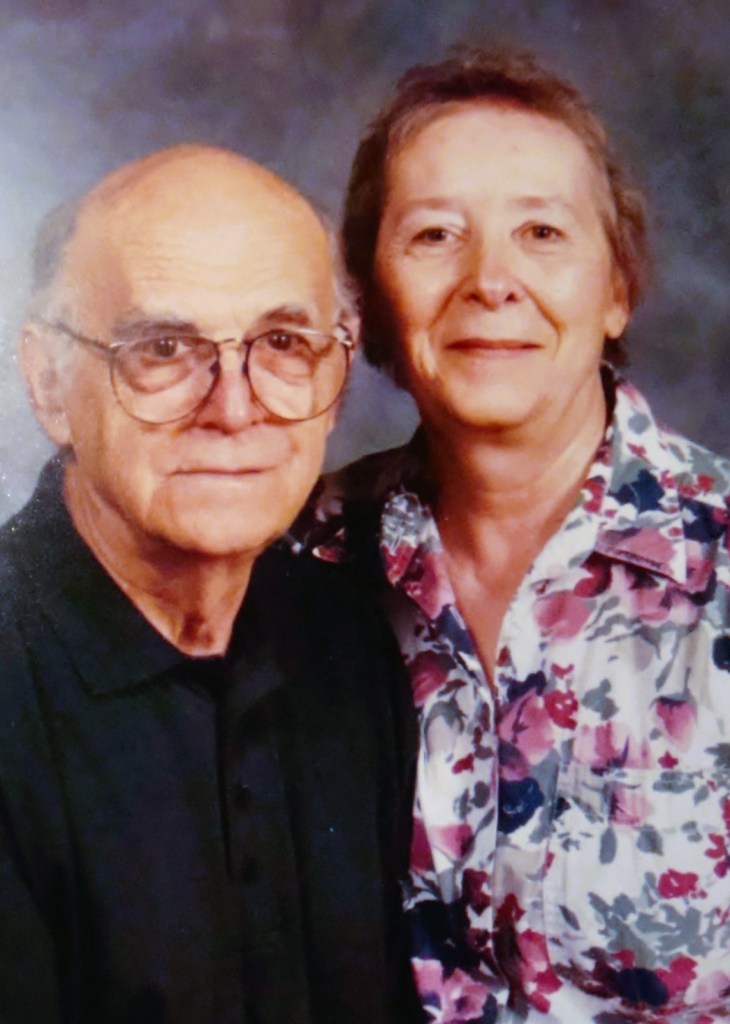
Ross Miron and Addie Lerner

I was fortunate to know Aunt Addie quite well and always made a point of visiting her when I visited Lethbridge. I also had the wisdom to – or dumb luck to think about it -interview her about her life. During one visit about 10 years ago she told me a story about going to her grandmother’s every day after school. It dawned on me that she was talking about someone born in the 1860s. I made a point of asking to visit her again a few days later to interview her. I managed to ask all sorts of questions I should have asked her years ago!

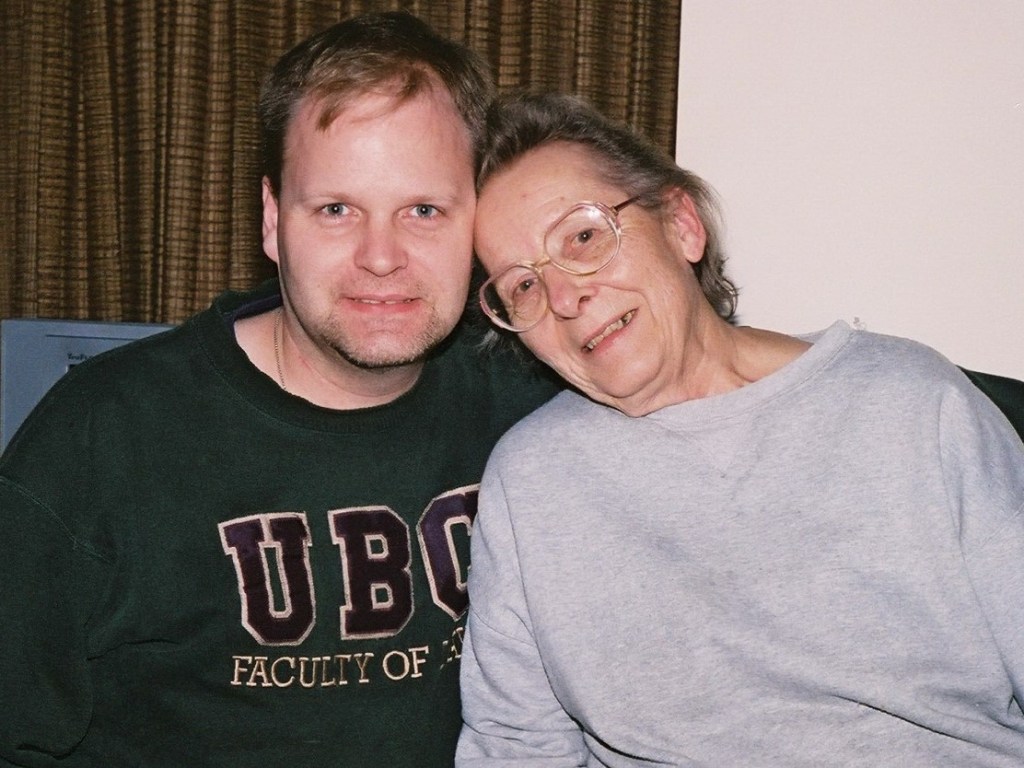
Me with Aunt Adeline

Aunt Addie’s advocacy and work definitely contributed to the achievement of women that we celebrate every International Women’s Day!