This week’s prompt for the 52 Ancestors Challenge is “Love & Marriage”. While this is on the topic, it may be more about genealogy serendipity.
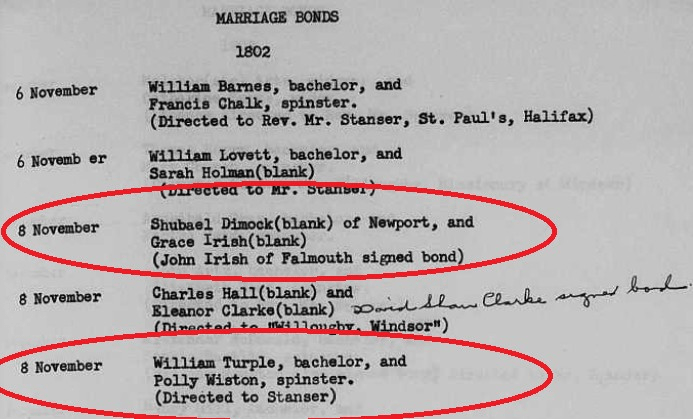
A few years ago I consulted an index of marriage bonds, looking for my 4x great grandfather, William Turple (1778 – ca. 1862), and his first wife, Polly Wiston, of Halifax, Nova Scotia. Much to my surprise, my wife’s 5x great grandparents, Shubael Dimock (1753 – 1834) and Grace Irish (1768 – 1846), are in the same record! Both couples’ bonds were registered the same day, November 8, 1802.
I don’t have an actual marriage record for either couple. William and Polly were likely married in St. Paul’s Anglican Church. I don’t know where Shubael and Grace were married, but as they were Baptist I doubt they married in St. Paul’s.
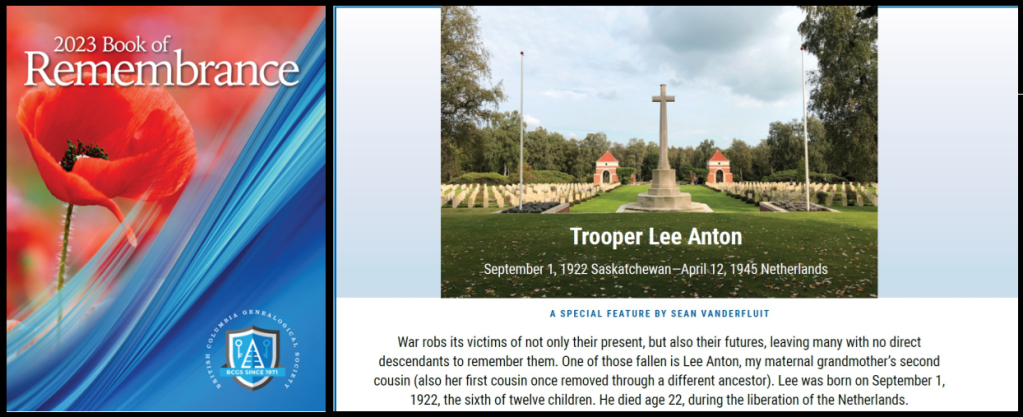
The cover of the book. Feature about Lee on page 98.
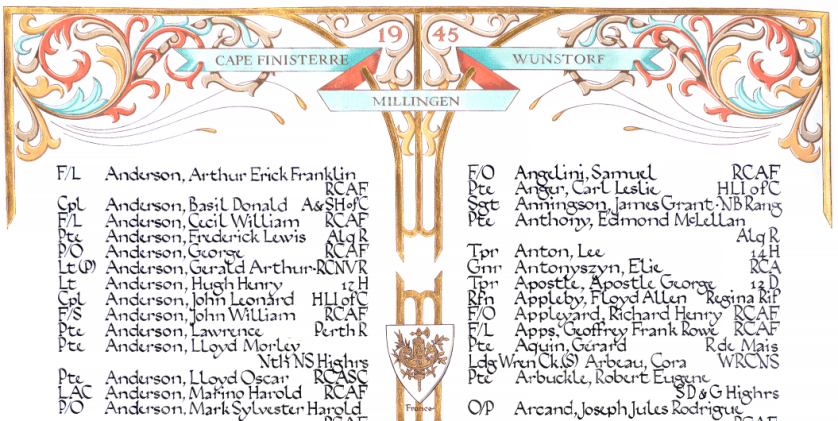
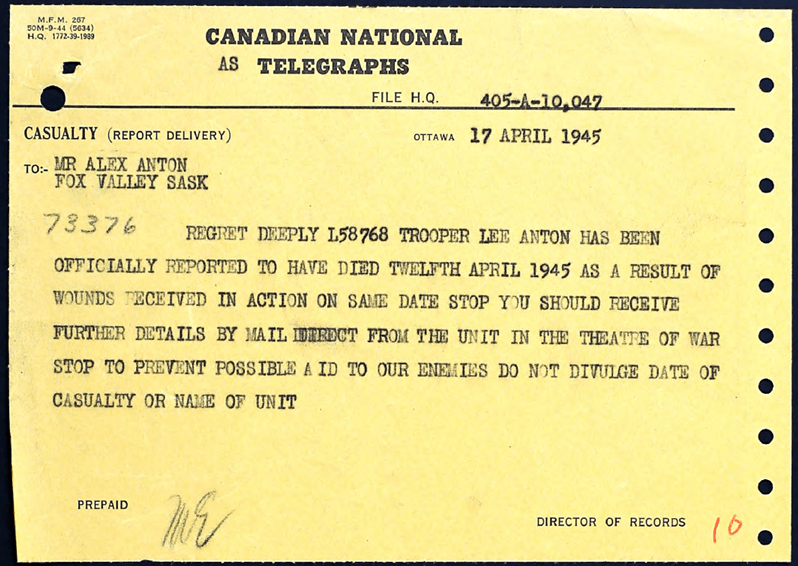
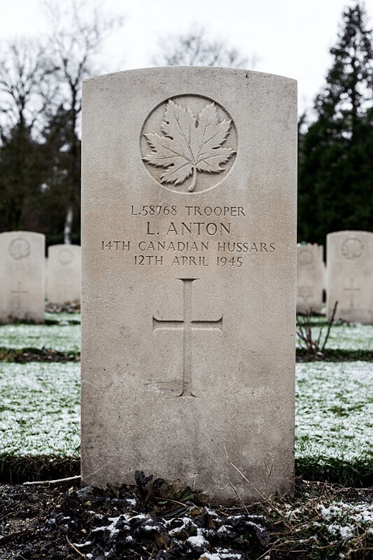
First, to recap, Lee was a Trooper of the 8th Reconnaissance Regiment (14th Canadian Hussars, also known as the 8th Recce) R.C.A.C. Lee was killed in action on April 12, 1945, age 22, less than a month before V-E Day, in the northern part of the Dutch province of Drenthe, the day before the start of the Battle of Groningen. Along with many of Canada’s other fallen soldiers, Lee is memorialized in two very special ways.
It was only a few weeks ago that the significance of the date on which Lee had been killed dawned on me. April 12, 1945 is the day that Canadian troops liberated Camp Westerbork. It was the transit point where the Nazis gathered Dutch Jews before sending them to the death camps. It was the first place they interred Anne Frank after she and her family were betrayed.
Going through the regimental diaries for Lee’s regiment, I discovered that it was the 8th Recce that liberated the camp, which the Germans had abandoned hours beforehand.
Entry from the War Diary of the 8th Reconnaissance Regiment for April 12, 1945 documenting the liberation of Camp Westerbork.
Based upon the chronology set out in the diaries and other war records, advancing on the camp was the first thing Lee’s regiment did that day. It means that the fighting in which Lee was killed occurred after the camp was liberated. While the entire regiment was not involved, there were at least 100 members of the regiment present at the camp, so there is a good chance that Lee was present for the liberation of Westerbork.
A “steppe” is a geographic and ecological region consisting of grassy plains. Some steppes are referred to as savanna and prairie. The largest steppe in the world, the Great Steppe or Eurasian Steppe, stretches from Ukraine to China. The Canadian prairies and the American great plains are other examples of of steppes.
My maternal ancestors originated in the western German states that formed part of the Holy Roman Empire, which came to an end with Napoleon’s conquest of the region. In the nineteenth century, my German ancestors sought a paradise on the steppe, first in Imperial Russia and later in North America. I wrote about these Germans from Russia only a few weeks ago, in Week 7.
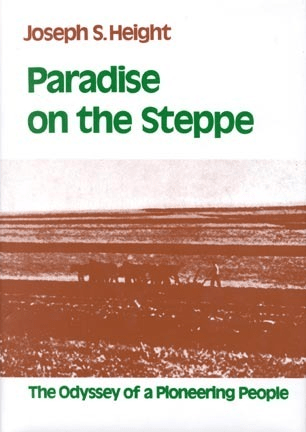
A seminal work documenting the history and culture of these Germans is Paradise on the Steppe by Dr. Joseph S. Height. Dr. Height’s book is well-known amongst family historians who trace their roots to Germans from Russia.
Dr. Height was born in Tramping Lake, Saskatchewan in 1909. In university he specialized in foreign languages. He spent three years in Germany studying philosophy and German. He attended the University of British Columbia and earned degrees in those two disciplines. Dr. Height spent the last fifteen years of his career as a professor at Franklin College in Indiana. Dr. Height passed away in Indianapolis in 1979.
In addition to his academic works, Dr. Height published several books about the history of the Germans from Russia. In addition to Paradise on the Steppe, his works on this topic include Homesteaders on the Steppe, Memories of the Black Sea Germans, and Folksongs of our Forefathers. Dr. Height also translated a portion of The Emigration from Germany to Russia in the Years 1763 to 1862, by Karl Stumpp, another book of great importance to genealogists researching this area of family history.
Based upon twenty years’ research, Paradise on the Steppe sets out the historical, economic, social, and political forces that pushed these Germans from their homelands and pulled them to the Russian and Ukrainian steppe starting in the late 18th century. Dr. Height tells of the hardships the colonists faced from the moment they left their homes through to the hardships they faced in the late 19th and early 20th centuries, with growing oppression by the last Czars, the Bolshevik Revolution, Stalinist suppression, and Nazi invasion.
Dr. Height also details the colonists’ successes, joys, and achievements. He includes chapters about language, folksongs, festivals, holidays, courtship and marriage, food, school life, and church life. Dr. Height also goes into great detail about how the colonists governed themselves. Of course, the book would have been incomplete without its extensive look at the colonists agricultural activities.
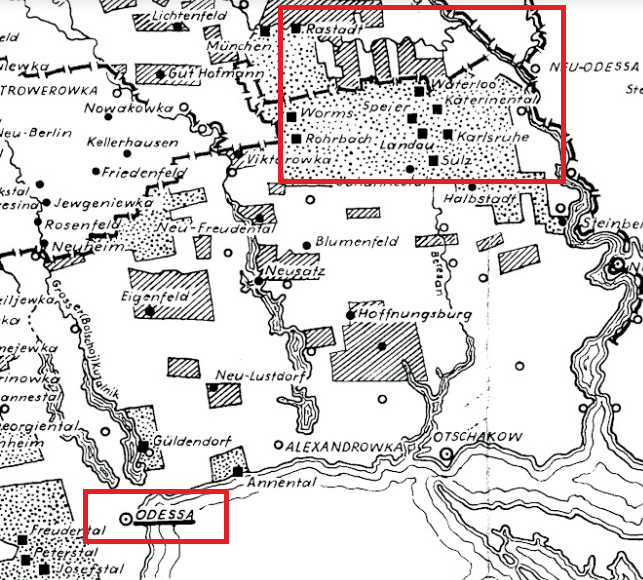
While Paradise on the Steppe provides a look at the collective whole, it also provides important information about the founding colonists of the first colonies and their “daughter” colonies. For example, several of my direct ancestors and related families are included in the lists for the Beresan colonies of Rastadt and Karlsruhe.
The German colonies in the Beresan district in 1890, as seen in relation to Odessa. All four of my maternal grandmother’s grandparents came from Rastadt and Karlsruhe, located in the upper right-hand corner.
By the 1950s, little was left of the German colonies, through decades of emigration or exile to the Soviet Union’s holdings in central Asia and Siberia. Many of the emigrants relocated in places with similar geography and environment – the American great plains, the Canadian prairie, and the pampas of Argentina, to name a few. My grandmother’s paternal line left the Russian Empire in 1893, first settling in Texas and later in Saskatchewan. My grandmother’s mother left Russia with her parents and siblings in 1912.
Paradise on the Steppe is available at many libraries, especially family history libraries. It is also available for loan through the Internet Archive.
I typically consider myself as a descendant of many, many farmers. However, I am always surprised to remember that I am also descended from many individuals for whom education was important. There are also several educators in my extended family, including a high school principal. One of my sisters was a school teacher before becoming a medical doctor. As well, my maternal grandmother, Helen Lerner, originally intended to become a school teacher until a nun steered her in another direction.
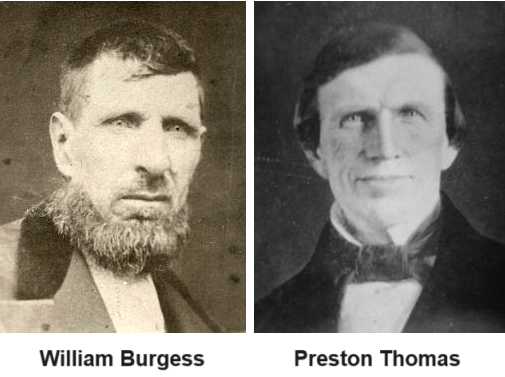
In particular, several of my direct ancestors were school board trustees. The earliest were my Gx3 grandfathers, William Burgess (1822-1904) and Preston Thomas (1814-1877). They served together on the first school board for the Lehi, Utah school district. The school district was created by the city of Lehi by resolution dated February 17, 1854. An election was held three days later, on February 20, 1854. Three school trustees were elected: William, Preston, and Daniel Collett.
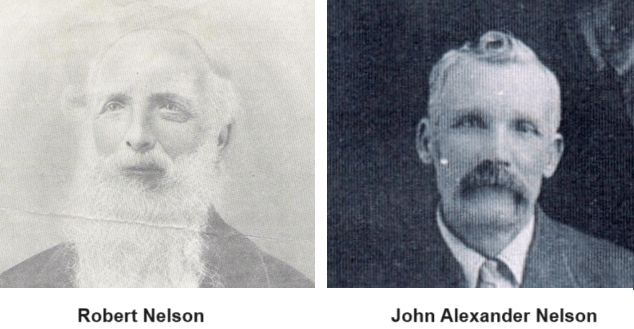
My Grandpa Burgess also had several other school trustees on his maternal line, the Nelson family. According to the 1880 US Census, his great grandfather (another of my Gx3 grandfathers), Robert Nelson (1818-1902) was a school trustee in Smithfield, Utah. Twenty-seven years later Robert’s son, John Alexander Nelson (my Gx2 grandfather) held the same office in Woolford, Alberta. John was one of the founders of the Woolford school board and was one of its first board members.
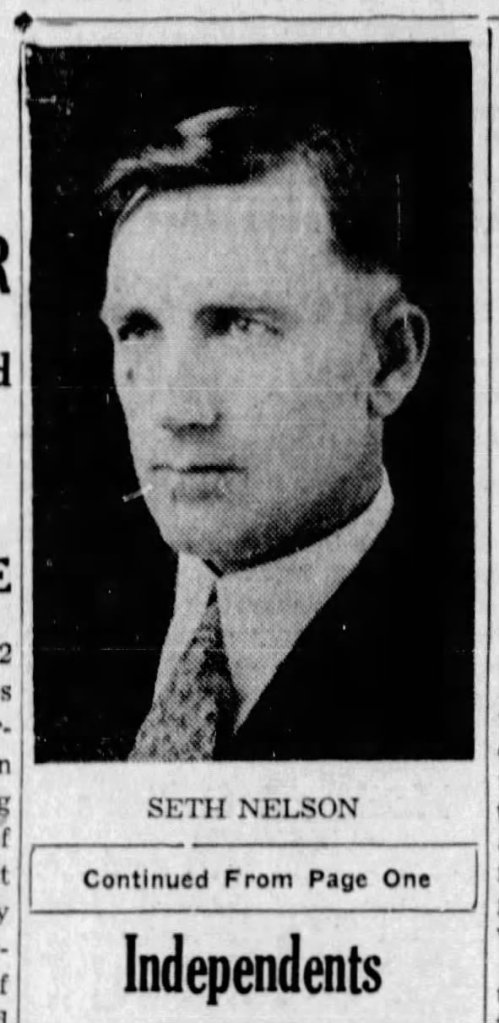
John’s son (my grandfather’s uncle), Seth Henry Nelson Q.C. (1891-1975), also served as a school board trustee in Cardston, Alberta. Seth was a school trustee for 15 years, from 1924 to 1939. Seth served as the Board’s Secretary for the last 10 years of his time in office. Following his last term as a school trustee, Seth made an unsuccessful run for a seat in the Alberta provincial legislature during the 1940 general election. Seth ran as an independent against the incumbent Social Credit candidate, Nathan Tanner. Tanner was a former Speaker of the legislature who was appointed to Cabinet in 1937. Despite running as an independent, it was a close race. Tanner defeated Seth in a two-way race, 2,160 votes to 1,808 (54.4% of the vote).
Education was also a facet of my wife’s side of the family, one of whom also served as a school trustee. Frank Eden (1839-1907), our children’s Gx3 grandfather, was a prominent Halifax, Nova Scotia merchant whose primary business was shoe manufacturing and sales. Frank served two non-consecutive terms as an alderman on the Halifax city council (1892-1893 and 1895-1896). Concurrent with both terms of office on city council, Frank served on the Halifax Board of School Commissioners.
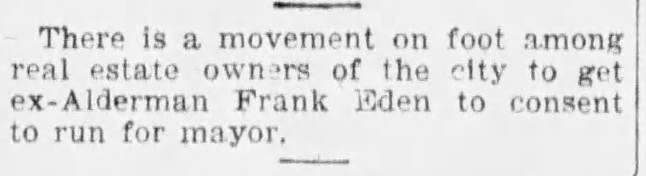
In 1902, there was an attempt to persuade Frank, who was still in the shoe industry, to run for Mayor of Halifax. As stated on page nine of the Halifax Herald, on January 1, 1902: “There is a movement on foot…to get ex-Alderman Frank Eden to consent to run for mayor.” As far as I’m concerned, all puns are intended.



 A Deck of Ancestors