This year marks the 70th anniversary of the North Sea Flood of 1953. A combination of high tides and winter storms on the evening of January 31 and the morning of February 1 resulted in a massive flood that affected England, Scotland, Belgium, and the Netherlands. It was one of the worst floods to hit the Netherlands since 1916.
The southern provinces of Zeeland and Zuid-Holland were particularly hard hit, with the highest death tolls for the country. In the province of Noord-Holland, where my father lived, Red Cross and other sources indicate that there were fewer than a dozen deaths. In addition to the dead and missing, thousands were displaced from their homes and there was massive property damage.
My father was just a boy when the flood struck, but he remembers it well. It is apparent that when he recalls his childhood in the Netherlands, it is one of his clearest memories. The Netherlands still had not yet recovered from World War II and the flood was devastating. While the reasons for emigrating are multifaceted and complex, the devastation of the flood of 1953 was one of the many things that prompted my grandparents to think about leaving the country.
While this video is in Dutch, it is the images that tell the tale. It also primarily shows the devastation in the south of the country. (“Watersnood” is “flood” and “ramp” is “disaster.)
In Week 21 of this year’s 52 Ancestors Challenge, I wrote about one of my brick walls, Anne (“Annie”) Pitre, our children’s great x3 grandmother. The biggest questions were whether her surname at birth was actually “Pitre” or “Peters, and whether she was Acadian. Last week, I found a nugget of information that suggested that Anne was in fact born “Pitre” and that it is more likely that she was Acadian.
Still looking for Anne Pitre!
We just spent two weeks in The Maritimes, where my wife has deep roots. As the trip was primarily to visit family and to acquaint our children with their Maritime heritage, there was precious little time for genealogy research. I was able to get in a few minutes’ time here and there in places like the Nova Scotia Legislature Legislative Library and Pier 21 in Halifax. I had less opportunity to do so in Charlottetown, but a rainy day and change in plans gave me an unexpected hour and a half in the Charlottetown Library.
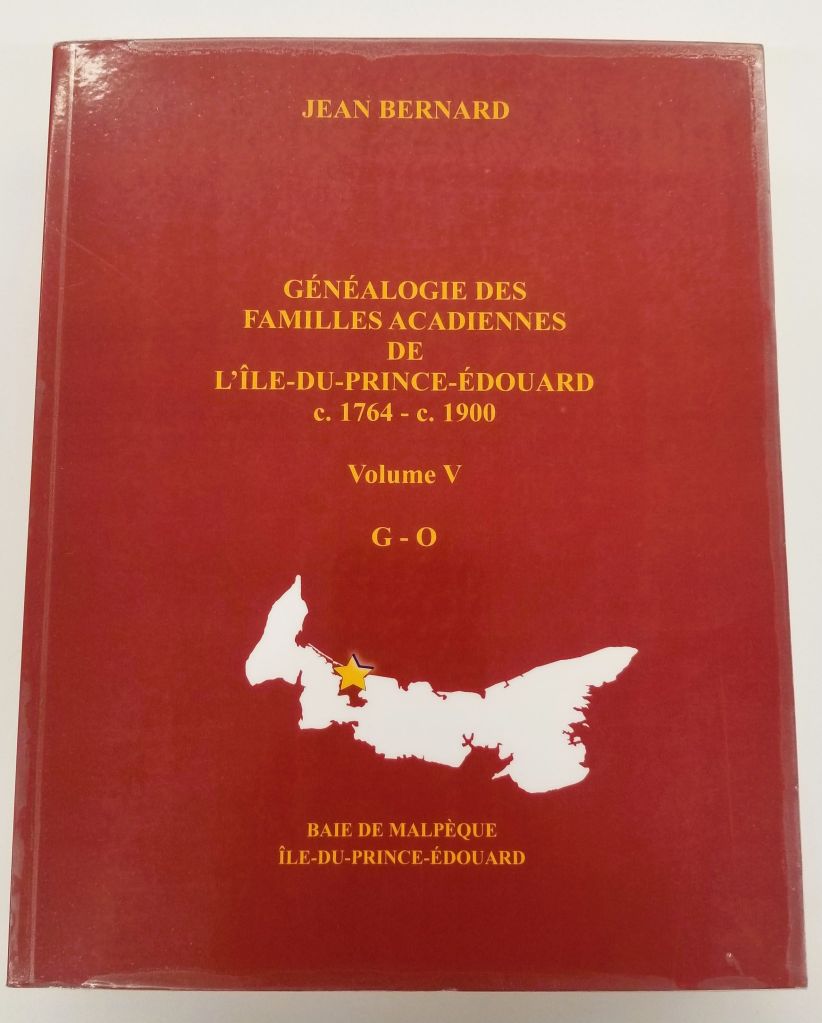
Years ago, before COVID, I had ordered Volume VI of Jean Berard’s Généalogie des Familles Acadiennes de L’Île-Du-Prince-Édouard from the Charlottetown Library through interlibrary loan, which covers surnames starting with the letter “P”. I thought the work was a collection of births, marriages, and deaths, which is why I ordered that volume. However, I was dismayed to discovered it was sorted by marriages, which meant I wouldn’t find Anne under her birth name. Rather, if she was in Berard’s collection, she would be found under “M” with her husband Patrick McKenna. So what I really needed was Volume V.
Before returning the book, I poured through every entry for “Pitre”, but did not find any that included a daughter named Anne that was born anytime near where our Anne was likely to have been born. At least my rusty French got a workout.
I didn’t order Volume V at the time due to several reasons. However, like anything that’s put at the bottom of a to-do list, it tends to stay there.
Fast forward a few years to my time in the Charlottetown Library, which naturally had every volume of Berard’s work on its reference shelf – including Volume VI.
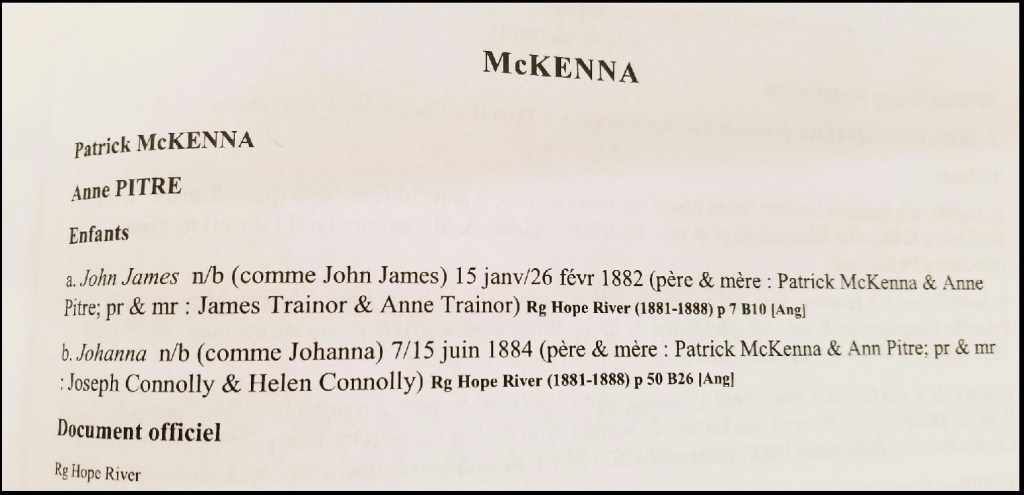
The entry for Patrick McKenna and Anne Pitre, showing the birthdates and baptismal dates of two of their twelve children.
What was exciting about this was that it appeared to confirm that Anne’s surname at birth was Pitre. However, once I translated it into English, I realized that the entry was for the baptisms of two of Patrick and Anne’s children. I had already found these children in the Prince Edward Island Baptismal Index. The only new information here is the inclusion of the children’s godparents. The problem is that I have also previously found some of Patrick and Anne’s other children in the same index, which recorded Anne’s surname at birth as Peters.
One positive thing I can take from this discovery is the fact Anne is even to be found in this collection. Her inclusion in a collection of Acadians strongly supports the conclusion that Anne was Acadian.
I am not a member of the Latter Day Saints (“Mormons”), but my maternal grandfather, Leo Burgess, was. In fact, his direct paternal line were Mormons almost since the beginning. The early members of the church were required to draw on their strength as they faced persecution, exile, and hardship.
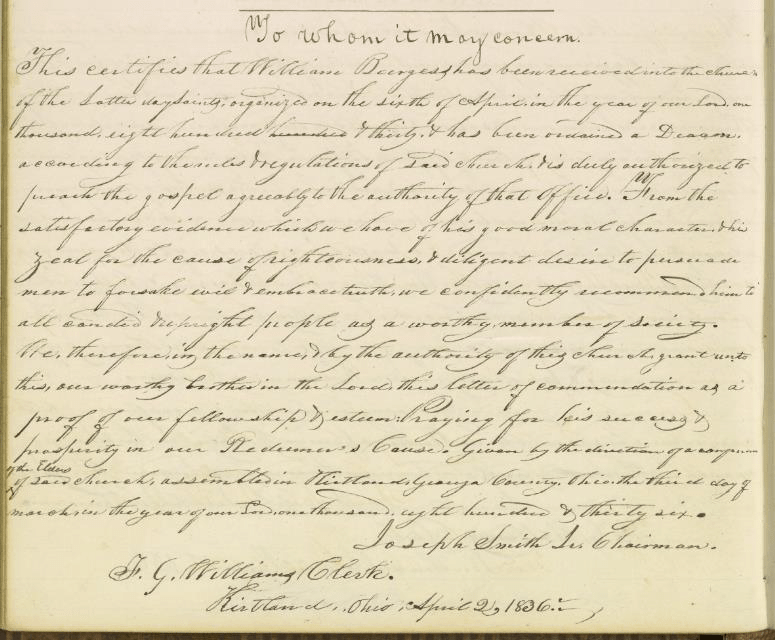
Most sources state that my Gx4 Grandfather, William Burgess (1794-1880) was baptised into the church in 1832, two years after it had been founded by Joseph Smith. However, the Kirtland Elders’ Certificates from the Joseph Smith Papers state that William joined the church and was ordained a deacon on April 6, 1830. All eight of my grandfather’s great grandparents had joined the church in the 1830s and 1840s.
“This certifies that William Burgess has been received into the church of the Latter-Day Saints, organized on the sixth of April, in the year of our Lord, one thousand, eight hundred hundred & thirty, & has been ordained a Deacon…
Joseph Smith Jr. Chairman. F[rederick] G. Williams Clerk. Kirtland, Ohio, April 2, 1836.”
While I am quite skeptical about much of the church’s dogma, I absolutely respect the strength of its early adherents, including many of my direct ancestors who were early members of the church. Many of them experienced and survived unnecessary suffering due to religious persecution. Several others endured an arduous – and for some, deadly – journey from Illinois to Utah over the winter of 1846-1847.
Joseph Smith sought to create a “New Jerusalem”. He and his followers moved to Ohio and soon began building a settlement in Missouri. In 1833, church members were run out of Missouri and a failed banking venture crippled the Ohio settlement. The Mormons attempted a settlement elsewhere in Missouri, but were driven out upon an executive order of the governor, calling for them to be exterminated or expelled from the state. In 1939, the church regrouped in a new community, Nauvoo, Illinois, and began to build their Zion there.
Two years after Joseph Smith’s death in 1844, tensions with non-Mormons increased, such that the Mormons were driven out of their settlement once again. They upped stakes and began the migration to Utah. During the westward migration, over the winter of 1846-1847, about 2,500 church members encamped at Winter Quarters, which was just north of where Omaha, Nebraska came to be. The first settlers arrived in what is now Salt Lake City in July 1847, in what was still Mexican territory.
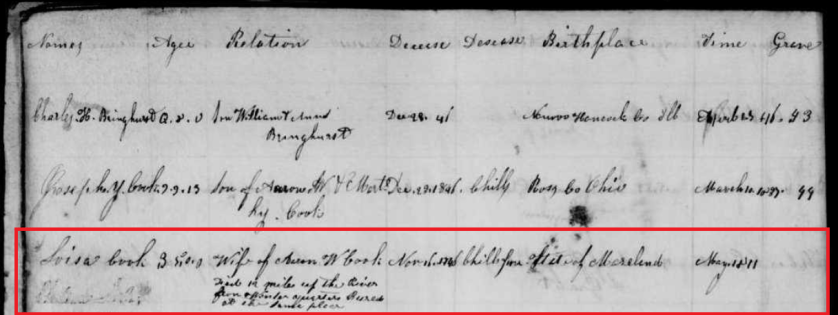
Many of the trekkers did not survive. There are varying accounts of the death toll at Winter Quarters. This is due, in part, to the lack of sufficiently complete and reliable records. It is also due to what was included in each account: some measure death only due to disease, others include deaths of all causes. The periods of time also vary: from a few months over the winter of 1846-1847, to longer periods of time, e.g.,1846 to 1848. Louisa Thomas, my 4x great grandmother, was one of those who perished at Winter Quarters. She died on November 16, 1846. An entry in the Winter Quarters sexton’s records shows that she died 19 miles up the river from Winters Quarters. Louisa’s daughter Charlotte, my Gx3 grandmother, was only nine at the time.
The entry for Louisa Thomas in the Winter Quarters sexton’s records, 1846-1848: “Loisa Cook. 36 years, 0 months, 0 days. Wife of Aaron W. Cook [her third husband]. Died 19 miles up the River from Winter quarters Bur[i]ed at the same place. [Died] Nov 16 1846. [Disease] chills fever. [Born] State of Mareland May 1811.”
To have survived long journeys to settle in new lands, religious persecution, and perilous migration took incredible strength – mental, physical, social, and spiritual. Their conviction and belief carried them through difficult times and experiences. For that I am grateful, because without their strength I would not have been.
I’ve only been to one family reunion, when I was 13. It was a gathering of all the descendants of John Alexander Nelson and Ella Elizabeth Thomas, my great great grandparents.
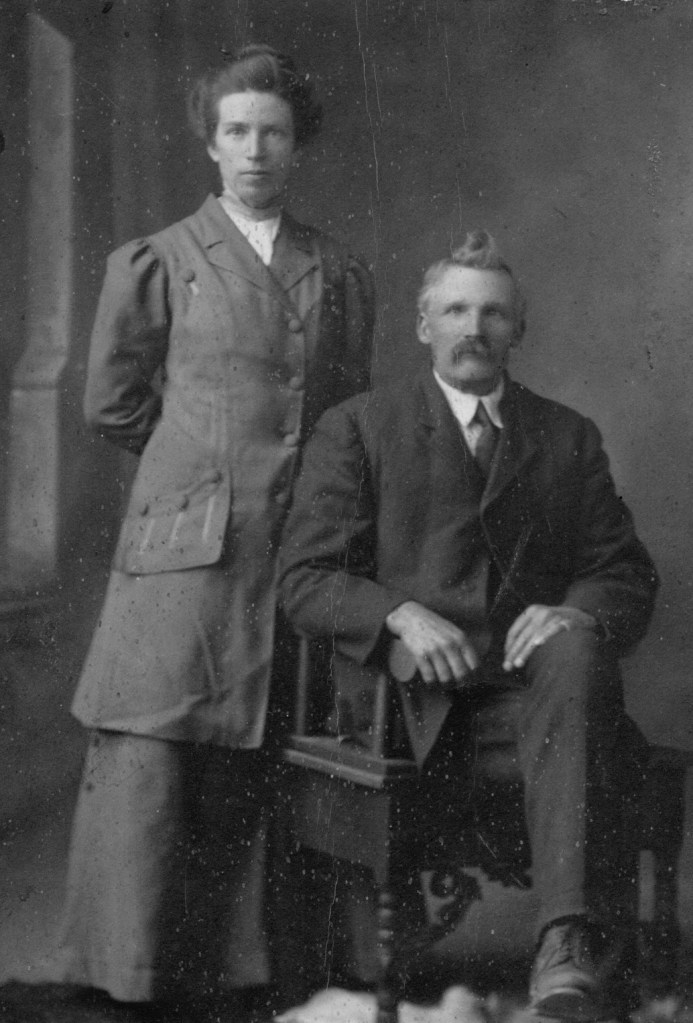
Ella Elizabeth Thomas (1859 – 1941) John Alexander Nelson (1854 – 1942)
They were amongst the earliest settlers of Cardston, which was founded in 1887 by members of the Latter Day Saints (Mormons). John and Ella were both born in Utah a few short years after it became a territory of the United States. John was born in 1854 to Irish immigrant parents. Ella was born in 1859. Her father was originally from North Carolina and her mother was from England. John had worked as a farm labourer in Utah before he married. John and Ella married in Salt Lake City in 1879. Shortly afterwards, John and Ella moved to Smithfield, Utah, where John continued to work in farming.
John and Ella came to Canada in September 1890. John and Ella had five children at the time. The family travelled to Canada by covered wagon. Their eldest daughter, Maria, said that she often drove the wagon team while her father managed the cattle. The family first settled in a sod dugout at “Lee’s Creek”, west of Cardston. They arrived with 13 horses, 7 cows, 7 “other horned cattle”, and a pig.
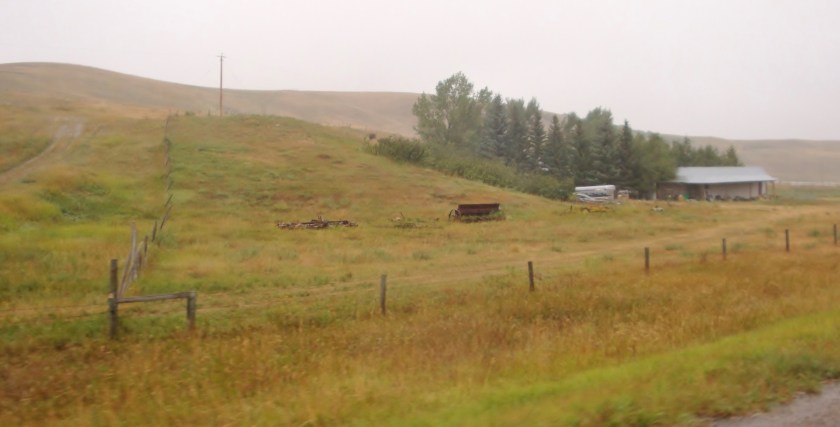
This was where John and Ella first settled in Canada, just west of Cardston, where the prairies meet the foothills of the Rockies.
The book, Alberta Past and Present, states that upon moving to Canada, John homesteaded on 160 acres of raw land. The homestead was located on Lee Creek, which ran through the property and into the centre of Cardston. The farmhouse was about four kilometers southwest of the town centre and is located on what is now Alberta highway 501.
In addition to farming, John also worked in carpentry. As well, John and a partner, John Turner, constructed and operated the first lime kiln in this part of the country. In 1906, John and Ella moved to nearby Woolford, Alberta, where John continued farming. John and Ella briefly returned to Utah in the early 1920s, where John operated an orchard or fruit farm, but they returned to Woolford in 1924. John continued farming the rest of his working life.
Ella did not simply bide her time in the background as a farm wife and mother. According to a Lethbridge Herald article published after her death, in 1892 Charles Ora Card, Cardston’s founder and stake president, called to on Ella to study nursing and obstetrics. After six months’ training, Ella returned to Cardston and started her service. The Herald article says that Ella “answered every call from 1892 to the time when the district was supplied with medical men, and after that time when there was more work than one doctor could do”. Ella continued as a midwife until 1932, when she was 73.
John and Ella had twelve children, two of whom died in infancy. This included my great grandmother, Hazel Nelson, and her twin sister, Irene, who died at one month old. Ella died in October 1941. John died almost a year later, in September 1942.
The reunion was quite an interesting experience for me. The reunion was held in Bigfork, Montana, with attendees from the United States and Canada. At the time, I knew I had American ancestors, but did not realize how large an extended family I had that lived there. A memorable highlight for me was some of my mother’s American cousins hiring me to babysit for them one night – and paying me in American dollars.
Another interesting part of the experience was that our immediate family, and my maternal grandmother, were pretty much the only attendees who were not members of the The Church of Jesus Christ of Latter-day Saints (Mormon) church. While my maternal grandfather Leo Burgess was Mormon, he was no longer an active participant in the church during my childhood, so at the time I knew little about their church, customs, and traditions. In my late teens my grandfather began participating more in the church, which is when I learned much more about them.
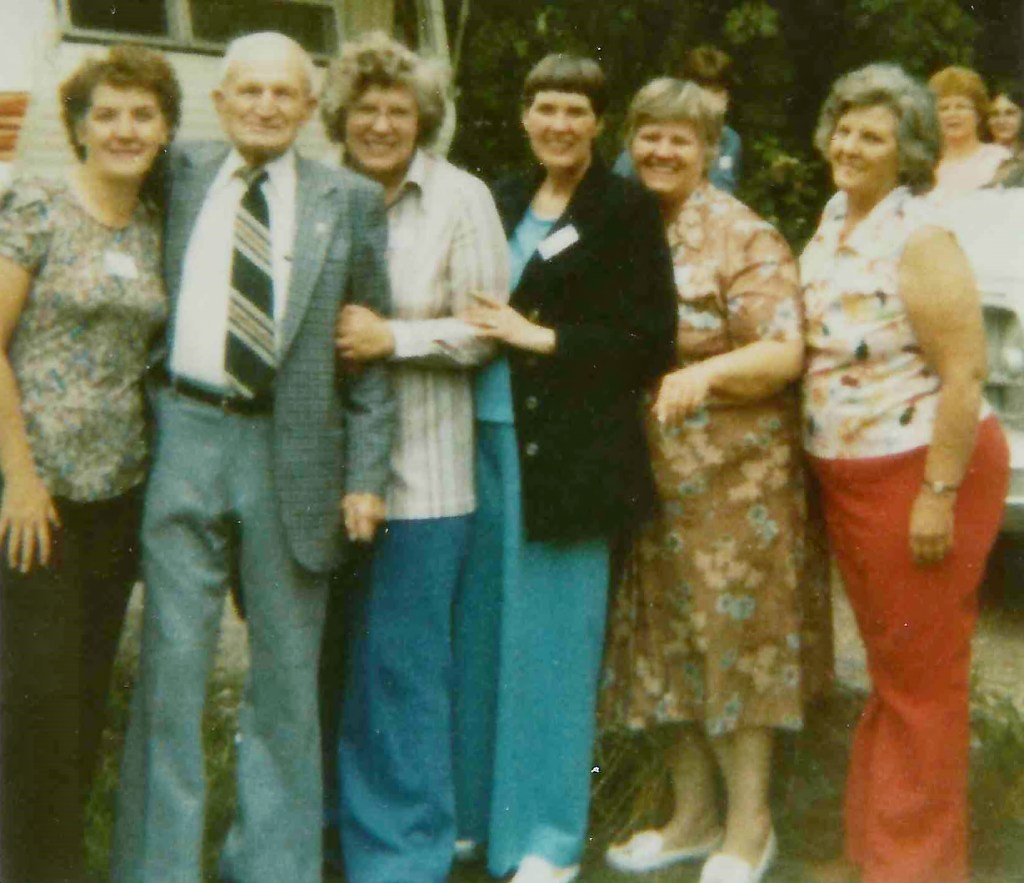
The only photo I have scanned of the Nelson family reunion. This is Cleveland Nelson (1893-1982) with four of my maternal grandfather’s aunts (Cleve’s nieces). From left to right: Fon, Cleve, Julia, Ella, Molly, and Irene. In the background on the right you can see my mother.
The star of the reunion was my great great uncle Cleveland Nelson. Cleve was John and Ella’s eighth-born and last surviving child. He was 87 years old at the time. Everyone wanted to talk to and get a photo with him!

 A Deck of Ancestors