No, not the kid who starred in the eponymous Canadian children’s show that aired in the mid-naughts. (Did we ever decide what to call the first decade of the 21st century?) I mean my Great x4 Grandfather, Daniel Cook.
Daniel was born on December 14, 1769 in Preston, Connecticut, to Isaiah Cook and Mary Palmer. Daniel was the third of eleven children – nine boys and two girls – all of whom were born in Preston.
Daniel has deep New England roots going back four generations on his father’s side, in both Connecticut and Massachusetts. His maternal grandparents were also born in Connecticut, but don’t know much, if anything, about his maternal great grandparents.
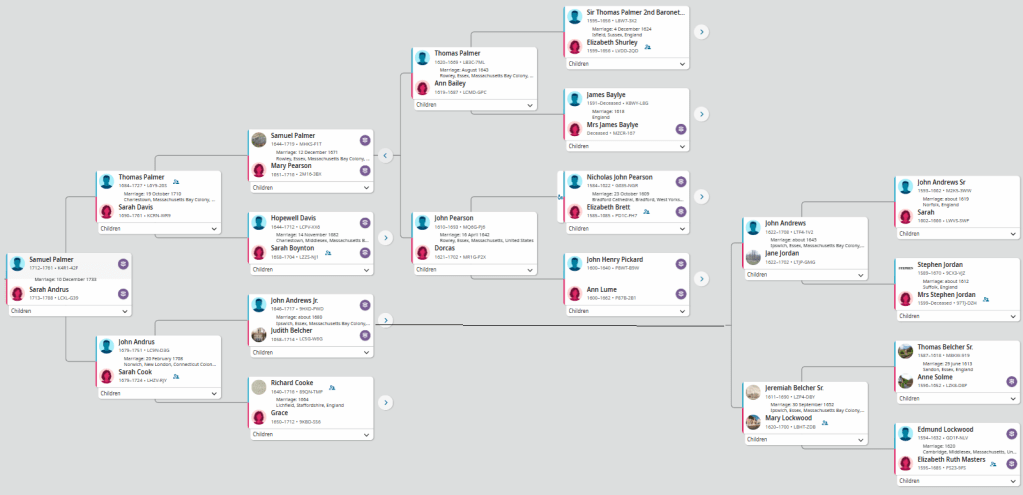
However, a quick look at FamilySearch shows that shows a tree on Daniel’s maternal side going back at least five generations on most lines. Until I look at the sources supporting the connection to the individuals identified in that tree, I won’t be adding them to my database. I know if I did that now, it would be another six weeks before I even return to drafting this post, so instead I simply created a “Person To-Do Task” for Daniel in my RootsMagic database. At most, I will mention that the tree on FamilySearch indicates that on his mother’s side, Daniel’s ancestry also goes back at least three or four generations in Connecticut and Massachusetts.
This tree on FamilySearch shows some of the ancestry of Daniel’s maternal grandparents, Samuel Palmer and Sarah Andrus, none of which I’ve verified or checked sources.
Somehow Daniel came to be acquainted with Miriam Fellows. While she too was born in Connecticut, she lived about 100 kilometers away in almost the opposite corner of what is now the state. Nevertheless, meet they did, as they married in Preston on April 1, 1796.
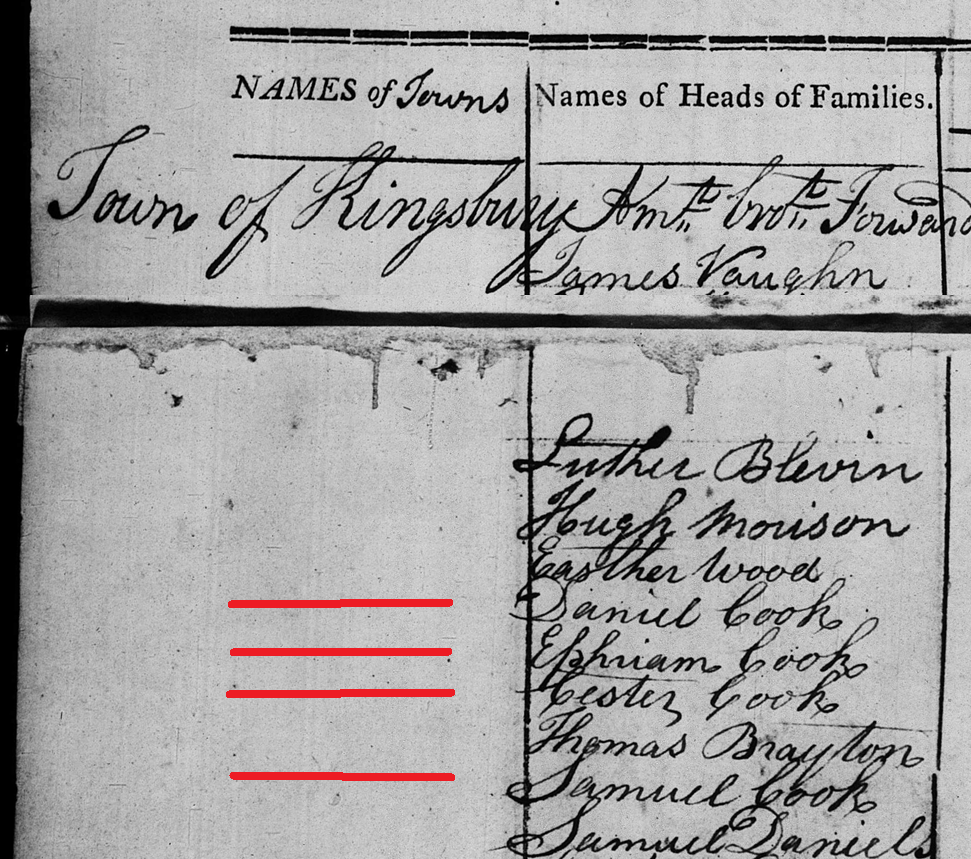
After they married, Daniel and Miriam did not reside in Preston for long. By 1798, they were living in Kingsbury, New York, almost 250 kilometers from Preston. I do not know the motivation for the move, but based upon the 1800 census, Daniel was not alone. Three of his brothers – Ephraim, Chester, and Samuel – are listed as neighbours living in Kingsbury.
Extract from the 1800 US Census, showing brothers Daniel, Ephriam, C(h)ester, and Samuel Cook.
All six of Daniel and Miriam’s children were born in Kingsbury. It appears that only two survived childhood and the teen years, including my Gx3 Grandfather, Henry Lyman Cook.
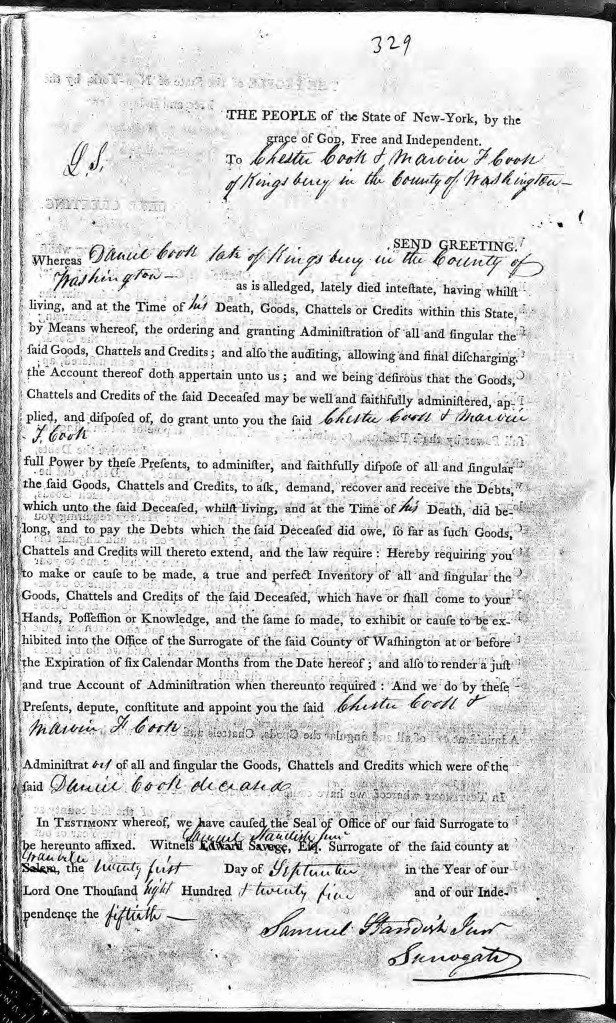
Daniel lived the rest of his life in Kingsbury. He died there on July 12, 1825. Daniel died intestate and the court appointed his son Marvin and brother Chester as the administrators of his estate.
Letter of Administration of Estate issued by the court after Daniel died without a will.
I can’t believe I’ve been working on this week’s post for over six weeks. Ostensibly, I’ve been preparing to write about my Great x4 Grandmother, Miriam Fellows. What started out as updating my research on her turned into a deep dive into her ancestors, in some cases going as far back as her Great x3 Grandparents.
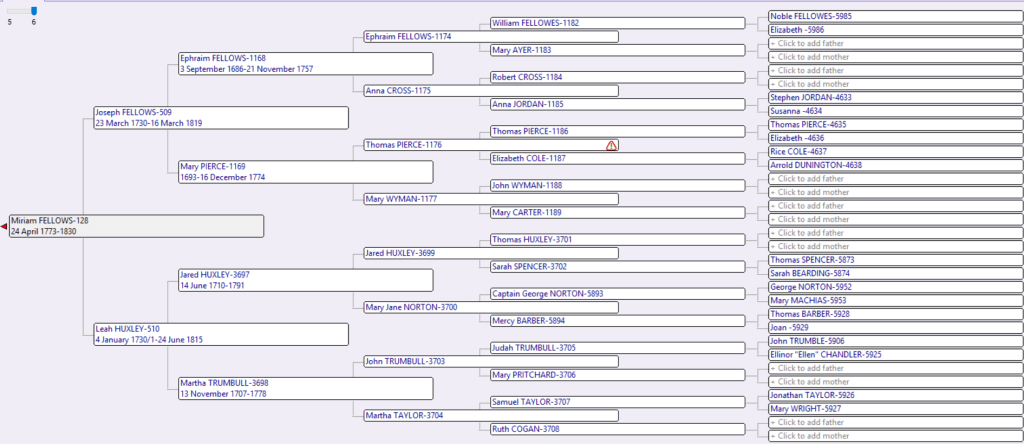
What probably triggered the trip down the rabbit hole was my interest in Miriam’s mother, Leah Huxley.
I’ve always been intrigued by Leah Huxley, not because I knew all that much about her. It’s just that her name is remarkably close to Sandra Bullock’s character in the most excellent movie, Demolition Man, who was named Lenina Huxley. (Who in was named in reference to Lenina Crowne, from Aldous Huxley’s Brave New World. I much prefer Demolition Man to Brave New World)
I’ve spent most of the last six weeks examining the Huxley, Fellows, and Trumbull lines. Sorry, Pierce line. Maybe some other time.
So imagine my dismay when I discovered Leah’s name might not have been Leah at all. She may have been named Martha at birth. Sure, it’s an extremely far cry from a Non-Paternity Event, but I was disappointed to learn that this fun fact might not be a fact at all. That’s not fun.
Turns out she is both Martha and Leah. It seems fairly clear that she was likely registered as Martha at birth, according to the vital records of Suffield, Connecticut. However, her name was recorded as Leah when she married her husband, Joseph Fellows. As well, the birth records of most of her children named her as Leah.
It may be that the forename in the birth record was a transcription error, recording Leah using her mother’s name by mistake. Alternatively, she might have been named Martha at birth, but used the name Leah to differentiate herself from her mother, who was also named Martha. So crisis averted, she’ll always be Leah Huxley to me.
Through Leah and Joseph, Miriam had deep roots in New England, particularly Connecticut. Miriam was born on April 24, 1773, the tenth of eleven children. She, and likely all of her siblings, was born in Canaan, Connecticut. All of Martha’s paternal Great Grandparents were born in New England; the same can be said for all of her maternal Great x2 Grandparents. As far as I have discerned so far, all of her ancestors hailed from England, and most of her forebears came to the New World in the 1640s.
Despite everything I learned in the last six weeks, very little of it was about Miriam.
While Miriam was from Canaan, in the northwest corner of Connecticut, her husband, Daniel Cook, was from Preston, 100 kilometers away in southeast Connecticut. I have no idea how they came to meet, but they married in Preston, Connecticut on April 1, 1796. Within two years, Miriam and Daniel had moved to Kingsbury, New York, where they had six children together. Miriam passed away sometime in 1830*, likely in Kingsbury, five years after her husband died.
That’s it – essentially one paragraph. It’s a bit unsatisfying after all the time I spent trying to learn about her, but at least I’ve learned a lot about her people and where they came from.
* I caught a typo in my post for October 6, 2025 about Henry Lyman Cook, which had Miriam as having lived from 1773 to 1796. However, the latter date is when she married, not when she died.
Looking for words that rhyme with purple? Look no further than William Turple!
William, my Great x4 Grandfather, is on the only branch of direct ancestors on my tree that goes into the Maritimes, a region of Canada that now consists of the provinces of Nova Scotia, New Brunswick, and Prince Edward Island.
William was born in Halifax, Nova Scotia, on May 9, 1778. He was the eldest of six children born to John Philip Turple and Mary Little. William’s paternal grandparents, Johannas Godfed Törpel and his wife Sophia, were amongst the German immigrants who settled in Lunenburg, Nova Scotia in the mid-18th century. I know nothing about Mary’s lineage.
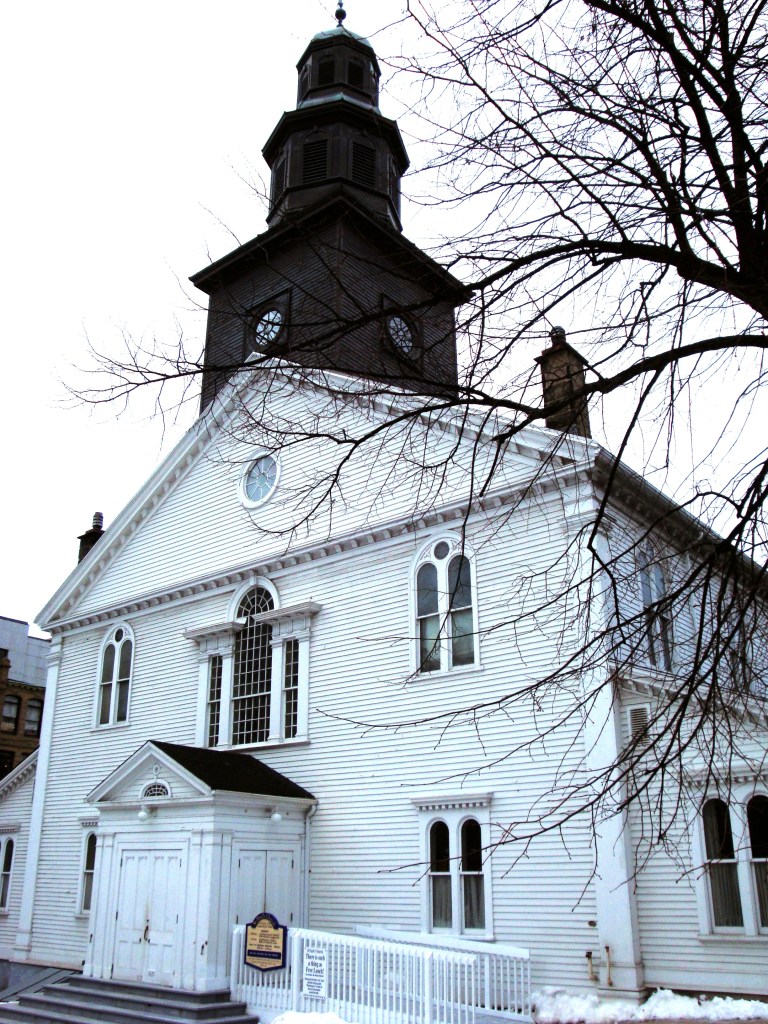
William’s parents married on Christmas Day 1776 at St. Paul’s Church in Halifax. I touched upon the history of St. Paul’s last week, which is the oldest building in Halifax. William was born almost 18 months after his parent’s marriage and he was baptized in St. Paul’s on May 27, 1778. While the church is now 276 years old, it was not even 30 years old when his William’s parents were married and when William was born.
St. Paul’s Church, Halifax, in January 2009.
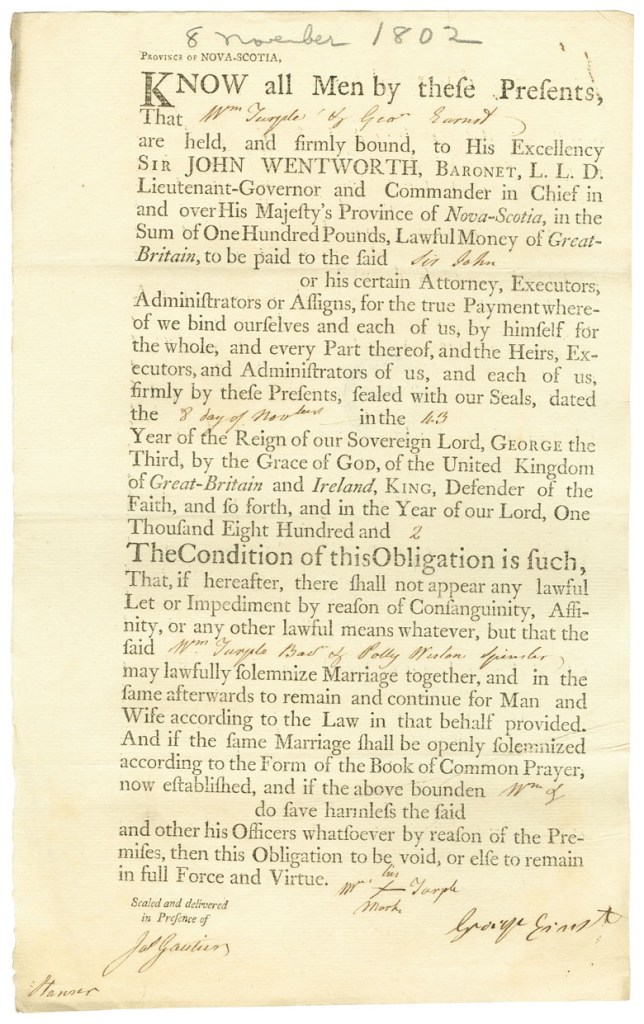
William himself also got married in St. Paul’s – twice. His first marriage was to Polly Wiston, about whom I know nothing other than that she was married to William. I’ve searched for name variants of “Polly”, to no avail. William and Polly married on or about November 8, 1802.
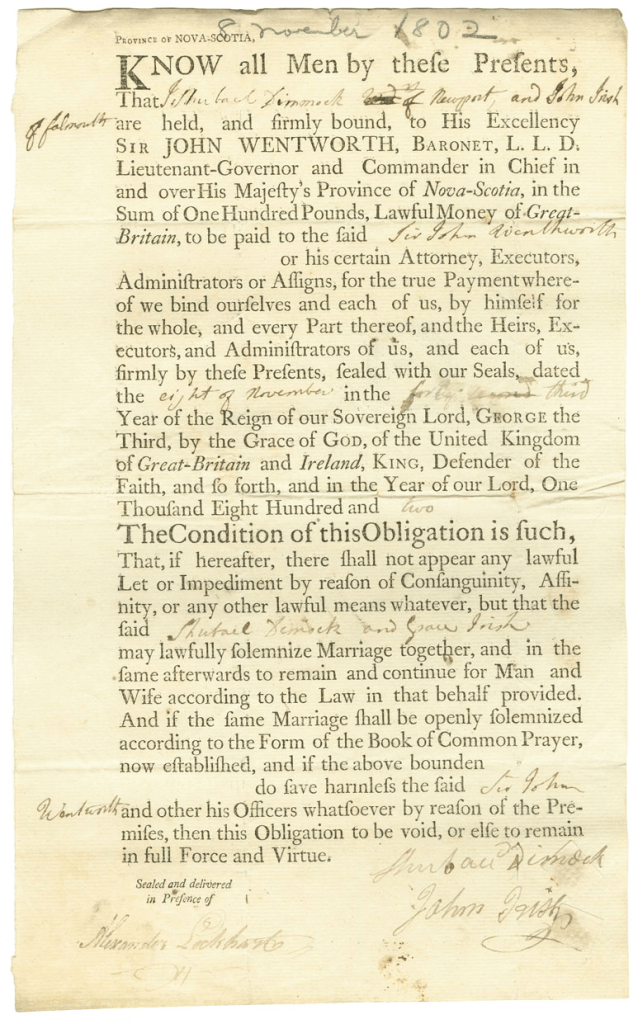
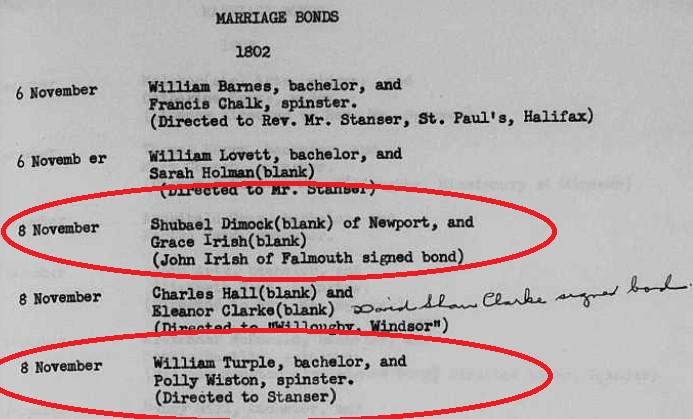
By sheer coincidence, my wife’s Great x5 Grandparents, Shubael Dimock (1753 – 1834) and Grace Irish (1768 – 1846) were issued a marriage bond the same day as William and Polly.
Marriage bond for William Turple, bachelor, and Polly Wiston, spinster.Marriage bond for Shubael Dimock and Grace Irish
William and Polly had one child, a son named John Jacob born around 1804. Polly died sometime between the birth of her son and William’s second marriage in 1814.
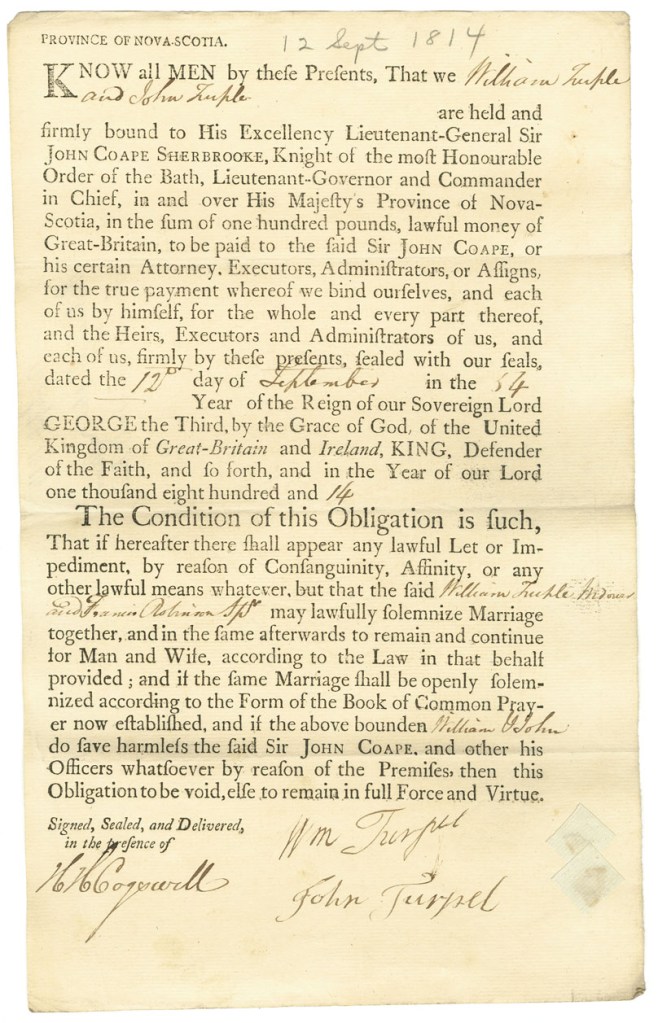
William married Frances “Fanny” Robinson at St. Paul’s Church on September 13, 1814. I find it interesting that William’s first marriage was a year before the Napoleonic Wars began and his second one occurred the year before the Napoleonic Wars ended. Okay, maybe only interesting to me. I was a history major after all.
Together William and Fanny had eight children, although as I explained last week it was more likely that they only had seven. The question mark is a son named William who, if he existed, was a possibly a twin with another son named Stephen. The case against this William is that William and Fanny already had a son named William, who was still alive when the purported second William was born. It’s not unheard of for parents to give the same name to two children, especially if an elder one passed away in infancy or before the later child was born, but I doubt it was so in this case.
As well, there’s no mention of the second younger William in his father’s will. All of William’s other children – including Stephen – were named in his will. The only exception was his daughter Susan (my Great x3 Grandmother), who had moved to Utah with the Mormon migration years before William wrote his will. It’s possible the mystery William could have pre-deceased his father, but I have no indication that is so.
As far as I can determine, William was a carpenter his entire life. Some secondary accounts also suggest William spent his entire life in Halifax. However, the Nova Scotia 1838 census shows that he was living in Granville, Annapolis, Nova Scotia working as a ship carpenter at the time. Otherwise, it does appear that William spent most of his life in Halifax.
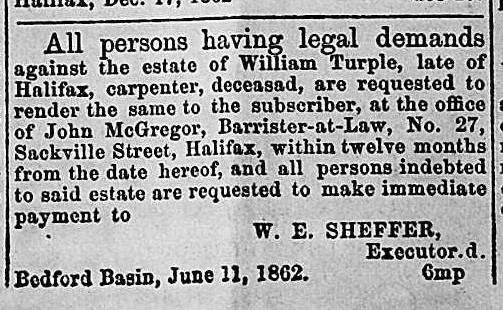
William wrote his will on April 17, 1861. He died sometime before May 20, 1862, as that is when his will was granted probate. It appears that William died while once again a widower, because there is no mention of Fanny in his will.
A notice to creditors of the estate of William Turple in the Royal Gazette, February 4, 1863. Vol. LXII No. 5 page 41.
Having managed to catch up on this year’s 52 Ancestors Challenge, I’m once again weeks behind. At least it was for a good reason, as I’ve spent much of the last three weeks learning about my Great x4 Grandmother, Frances “Fanny” Robinson. While I did not find much more in the way of sources, I have managed to form a somewhat better understanding about what little I know about her.
A large part of that time was spent trying to learn more about when and where she was born and died. Nothing major!
Fanny was born sometime around 1783. Many of the secondary sources I have say she was born in Fewston, Yorkshire, England. Few of those sources provide much supporting information, if any, and what they relied upon is tenuous. A newspaper record regarding her marriage indicated that her father was “J. Robinson” of Cornwallis, Nova Scotia. Some of the researchers relied on a baptism registration for a Frances Robinson for August 19, 1783, naming Jonathan Robinson as her father. Other records show Jonathan Robinson was married to a woman named Susannah Snell.
The baptism registration of a Frances Robinson – hopefully the Frances Robinson
I have found some poll and census records of a John Robinson and a Jonathan Robinson from Cornwallis from around the relevant time, but they don’t show a connection to Fanny. They also don’t show a clear connection to Fewston. Moreover, the Jonathan Robinson shown in the baptism record appears to have spent his whole life in Fewston, without ever having emigrated.
Even if Fanny was born in England, I cannot find any indication as to when she left that country. The one thing I do know is that Fanny and her husband are on the only branch of my family tree that goes into the Maritimes.
Marriage bond for William Turple and Frances Robinson.
The first reliable records I can find for Fanny are the records of her marriage to William Turple, which took place on September 12, 1814 in Halifax, Nova Scotia in St. Paul’s Church.
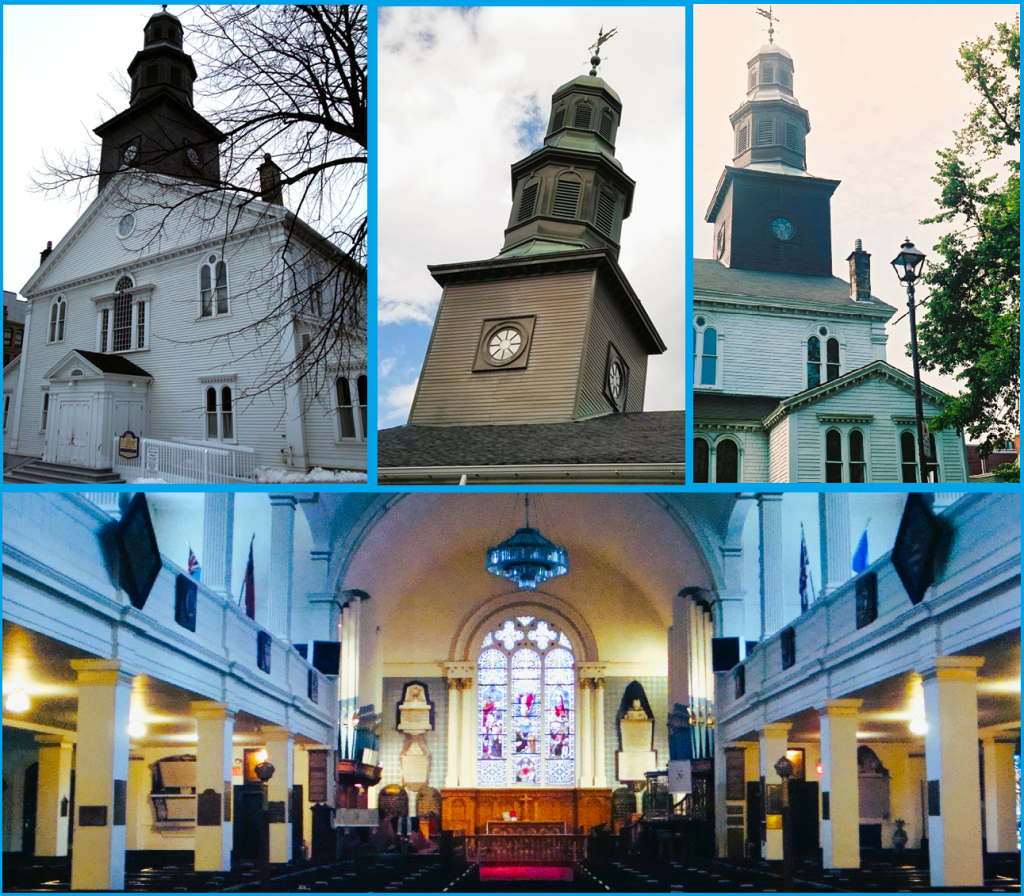
Photos of St. Paul’s that I’ve taken on various trips to Halifax.
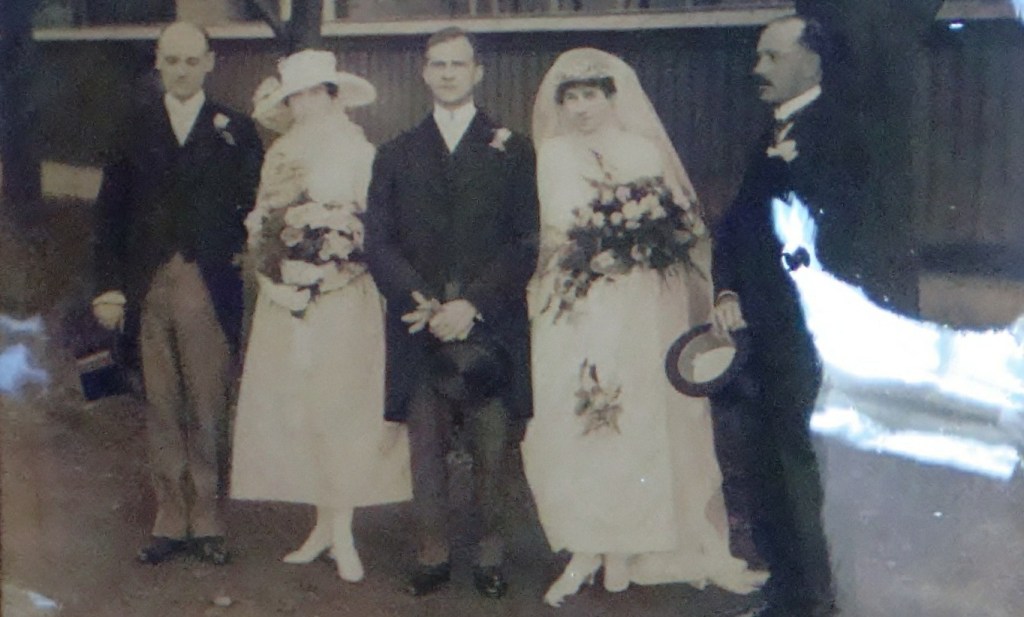
Completed on September 2, 1750, St. Paul’s Church is a Halifax landmark. It’s the oldest building in the city and the oldest surviving Protestant church in Canada. My wife has much deeper and more recent Haligonian roots and many of her family have connections to St. Paul’s. Her grandmother, aunts, and uncles were all baptized at St. Paul’s. Her great grandparents, Edmund MacDonald and Beatrice Dimock, were also married at St. Paul’s.
Edmund MacDonald and Beatrice Dimock, who married at St. Paul’s Church in Halifax on September 25, 1918. Beatrice is wearing the veil worn by her grandmother, Ellen Venning, who married George Dimock in 1866. My wife wore that same veil when we got married.
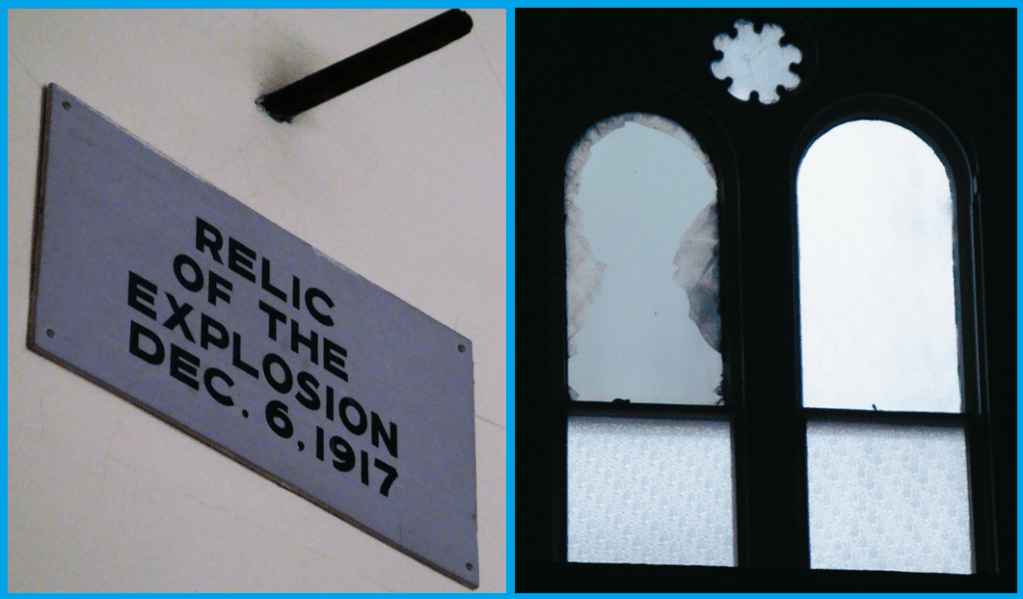
St. Paul’s also bears some interesting scars from the Halifax Explosion of December 6, 1917. It was the largest man-made explosion at the time, resulting from the collision of two ships in Halifax harbour during World War I. One is a piece of wood blown from another building into the interior of St. Paul’s, where it wedged into the wall and has remained there ever since. The other is the Explosion Window. A shattered window on the side of the building bears an eerie human-shaped silhouette. The legend is that it’s the outline of a Deacon who was standing beside the window at the time of the explosion. Of course, that makes no sense, since the force of the explosion came from the outside and the Deacon was standing on the inside.
The “relic” of the explosion and the explosion window.
But I digress. Very much.
Returning to Fanny, she and William had at least seven children, although some of my secondary sources list eight. The wrinkle likely involves a William. Fanny and William’s third child and first son was named William, who lived to be 80. Fanny’s fifth pregnancy may have been twins – boys named Stephen and William. It is this William that isn’t included in some lists I’ve seen. The second William is also not mentioned in his father’s will, although it is as likely that he predeceased his father as much as he never existed. Then there’s the next born, who was named Edmund William. Fanny must have really liked the name William.
In 1838, Mormon missionaries appeared in Halifax. By 1843, the Latter Day Saints had established a church there. Fanny and some of her children all joined. Fanny was baptized on November 16, 1844. This was only five months after church founder Joseph Smith died, which had resulted in a succession crisis with several claimants to the leadership of the church.
Fanny and her children found themselves aligned with James Strang, who himself had only joined the Mormon church four months before Smith’s death. However, like many Halifax Mormons, it appears this largely occurred by default rather than any actual theological position or political choice. Strang had risen quickly through the church’s ranks and claimed that a week before his death Smith had given him a letter naming him as his successor. The “Strangites” were one of the smallest factions and Strang’s claim failed quickly.
Brigham Young, who was the successful claimant to Smith’s mantle, sent a delegation to Halifax in 1851 to establish his control of the church in the city. Upon arrival, the delegation excommunicated Strang’s followers, including Fanny and her children. Over time, many of those followers were re-admitted into the church and re-baptized. It seems that Fanny and her children recanted and rejoined the church, but eventually they all left the church other than Fanny’s daughter Susan, my 3x Great Grandmother.
Susan had been married to a man named Charles Brady, who she left sometime after giving birth to a daughter, Amelia. Susan moved in with her parents, who helped raise Amelia. Late in life after moving to Utah with her mother, Amelia wrote about Fanny:
“My dear gramar that raised me (her) name was Fanny Turpel. My grandfather’s name was William Turpel…I love to sit and think of her.”
Just as mysterious as Fanny’s birth was her death. I have not been able to find any record or mention of her death. At most, I assume she died before her husband, because there is no mention of her in William’s will, which was written in 1861 and proved in 1862.


 A Deck of Ancestors