

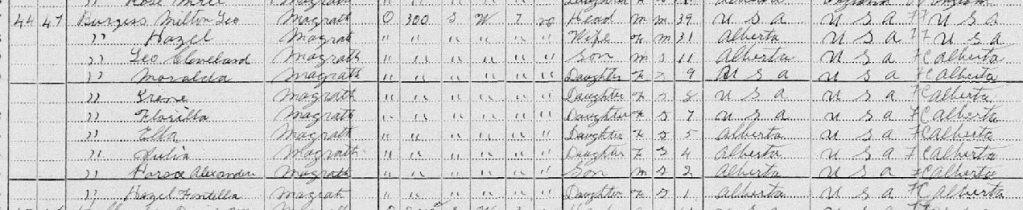
I am not a member of the Latter Day Saints (“Mormons”), but my maternal grandfather, Leo Burgess, was. In fact, his direct paternal line were Mormons almost since the beginning. The early members of the church were required to draw on their strength as they faced persecution, exile, and hardship.
Most sources state that my Gx4 Grandfather, William Burgess (1794-1880) was baptised into the church in 1832, two years after it had been founded by Joseph Smith. However, the Kirtland Elders’ Certificates from the Joseph Smith Papers state that William joined the church and was ordained a deacon on April 6, 1830. All eight of my grandfather’s great grandparents had joined the church in the 1830s and 1840s.
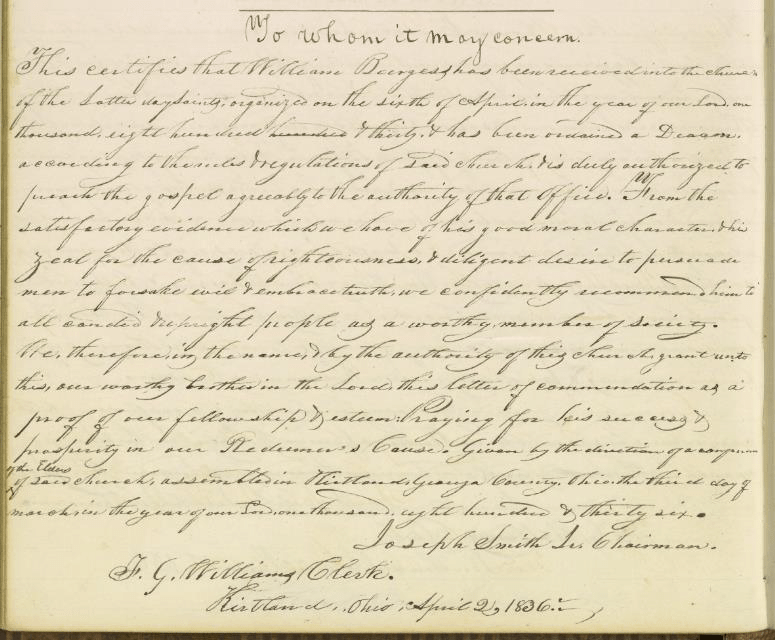
Joseph Smith Jr. Chairman.
F[rederick] G. Williams Clerk.
Kirtland, Ohio, April 2, 1836.”
Kirtland Elders’ Certificates, p. 84, The Joseph Smith Papers
While I am quite skeptical about much of the church’s dogma, I absolutely respect the strength of its early adherents, including many of my direct ancestors who were early members of the church. Many of them experienced and survived unnecessary suffering due to religious persecution. Several others endured an arduous – and for some, deadly – journey from Illinois to Utah over the winter of 1846-1847.
Joseph Smith sought to create a “New Jerusalem”. He and his followers moved to Ohio and soon began building a settlement in Missouri. In 1833, church members were run out of Missouri and a failed banking venture crippled the Ohio settlement. The Mormons attempted a settlement elsewhere in Missouri, but were driven out upon an executive order of the governor, calling for them to be exterminated or expelled from the state. In 1939, the church regrouped in a new community, Nauvoo, Illinois, and began to build their Zion there.
Two years after Joseph Smith’s death in 1844, tensions with non-Mormons increased, such that the Mormons were driven out of their settlement once again. They upped stakes and began the migration to Utah. During the westward migration, over the winter of 1846-1847, about 2,500 church members encamped at Winter Quarters, which was just north of where Omaha, Nebraska came to be. The first settlers arrived in what is now Salt Lake City in July 1847, in what was still Mexican territory.
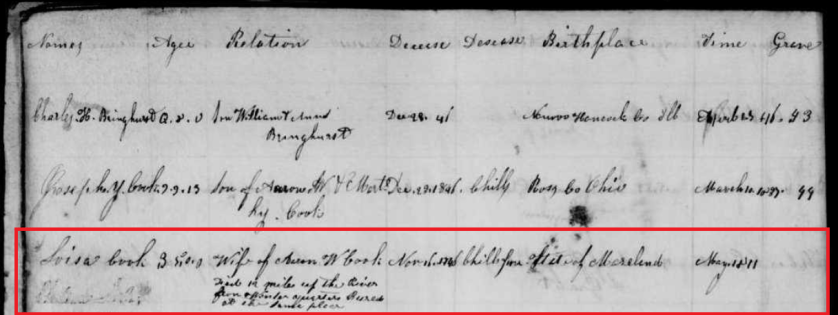
Many of the trekkers did not survive. There are varying accounts of the death toll at Winter Quarters. This is due, in part, to the lack of sufficiently complete and reliable records. It is also due to what was included in each account: some measure death only due to disease, others include deaths of all causes. The periods of time also vary: from a few months over the winter of 1846-1847, to longer periods of time, e.g.,1846 to 1848. Louisa Thomas, my 4x great grandmother, was one of those who perished at Winter Quarters. She died on November 16, 1846. An entry in the Winter Quarters sexton’s records shows that she died 19 miles up the river from Winters Quarters. Louisa’s daughter Charlotte, my Gx3 grandmother, was only nine at the time.
To have survived long journeys to settle in new lands, religious persecution, and perilous migration took incredible strength – mental, physical, social, and spiritual. Their conviction and belief carried them through difficult times and experiences. For that I am grateful, because without their strength I would not have been.
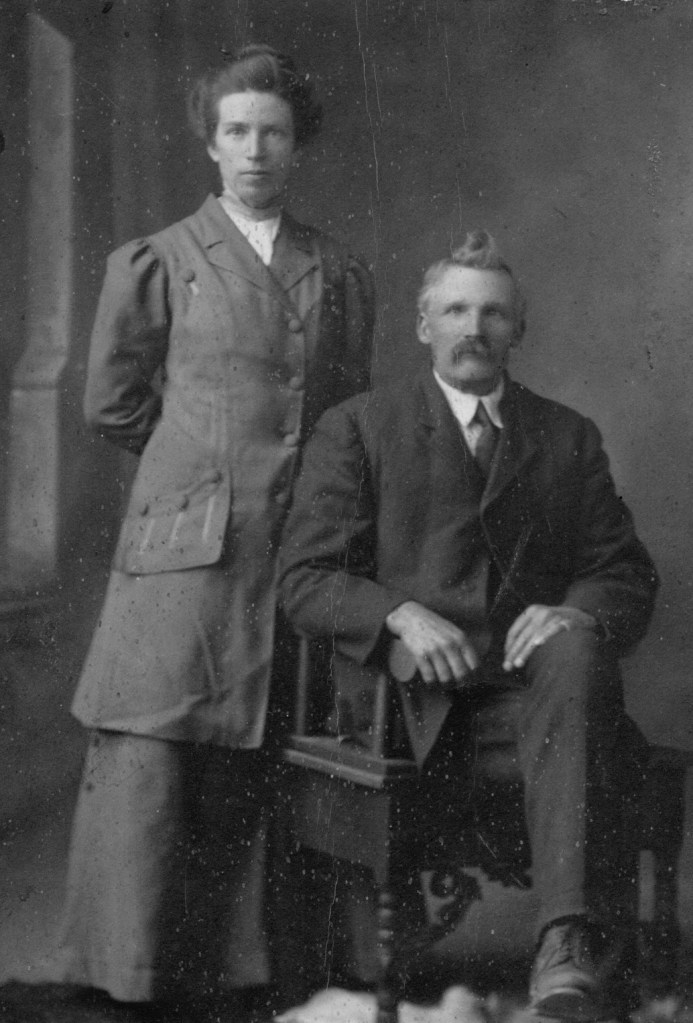
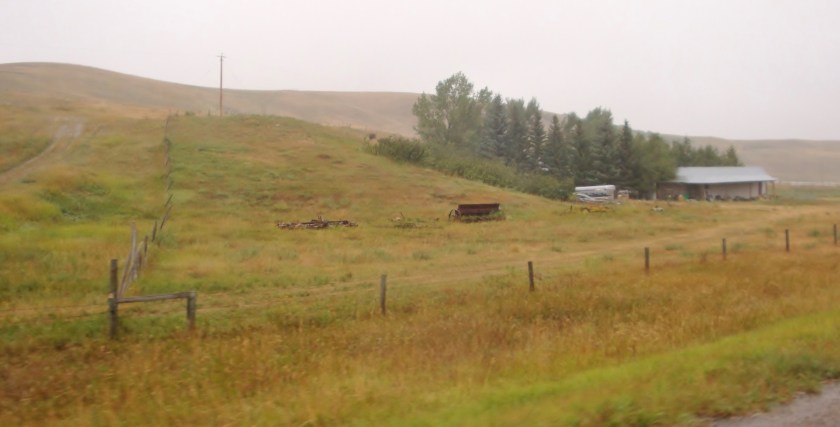

 A Deck of Ancestors