52W Mark II – Week 1: I’d Like to Meet

Happy New Year! It’s time for another trip around the sun and another year of Amy Johnson Crow’s “52 Ancestors in 52 Weeks“! We’re starting off the year on the theme of “I’d Like to Meet”.

I’m grateful that the challenge is not which ancestor we would “most like to meet”, but simply an ancestor we’d “like to meet”. For anyone who has been doing genealogy for a while, it would be hard to narrow it down to just one. Rather than choose a single ancestor, I’ve selected a category of ancestor: my great grandparents.

While I would love the opportunity to meet ancestors further back in my tree, they seem so much more remote and abstract than my great grandparents, who seem more tangible and real. I know people who knew them, and I even had many visits with one of them. My great grandparents would be able to shed a lot of light on things I don’t know about them and their immediate families. It would open a gateway to improving and expanding my research.

1. Johannis Albertus van der Fluit (my father’s paternal grandfather)
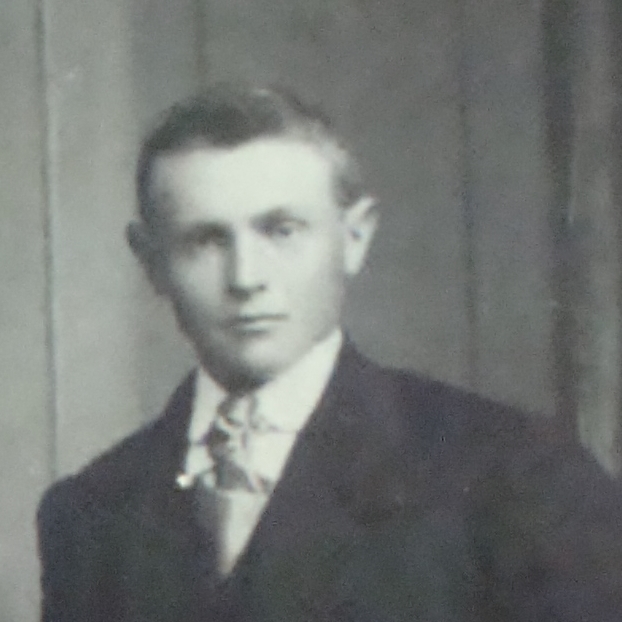
Johannis was born in ‘t Veld, North Holland, in 1894. He was an agricultural worker most of his short life. While I don’t have a lot of the details, he sustained a head injury that resulted in a mental disorder. He spent the following years suffering from delusions and passed away in a sanitorium in 1932. My grandfather was eight years old.

2. Theresia “Teetje” Pater (my father’s paternal grandmother)
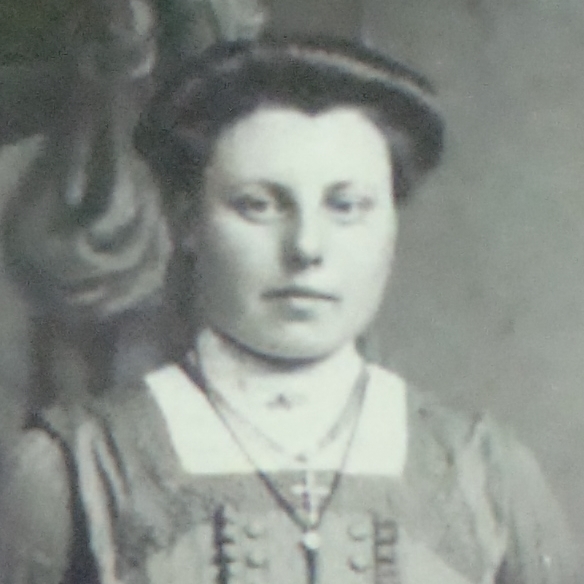
Teetje was born in Waarland, North Holland in 1894. That is the same village where my father was born. Teetje was 37 when she was widowed and was left to raise eight children on her own, the youngest of whom was one year old at the time. I don’t know how she supported herself or the family. She passed away in 1947, a few months before my father was born, so he never knew her.

3. Adrianus “Arie” Komen (my father’s maternal grandfather)
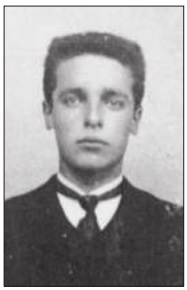
Arie was born in Zuid-Scharwoude, Noord Holland in 1888. Arie spent his whole life as an agricultural labourer. Arie was only 59 years old when he passed away in January 1948, when my father was only a few months old. I don’t recall my grandmother ever speaking about her father, so most of what I know about Arie is from the documentary evidence I have found over the years.

4. Elizabeth Bakker (my father’s maternal grandmother)
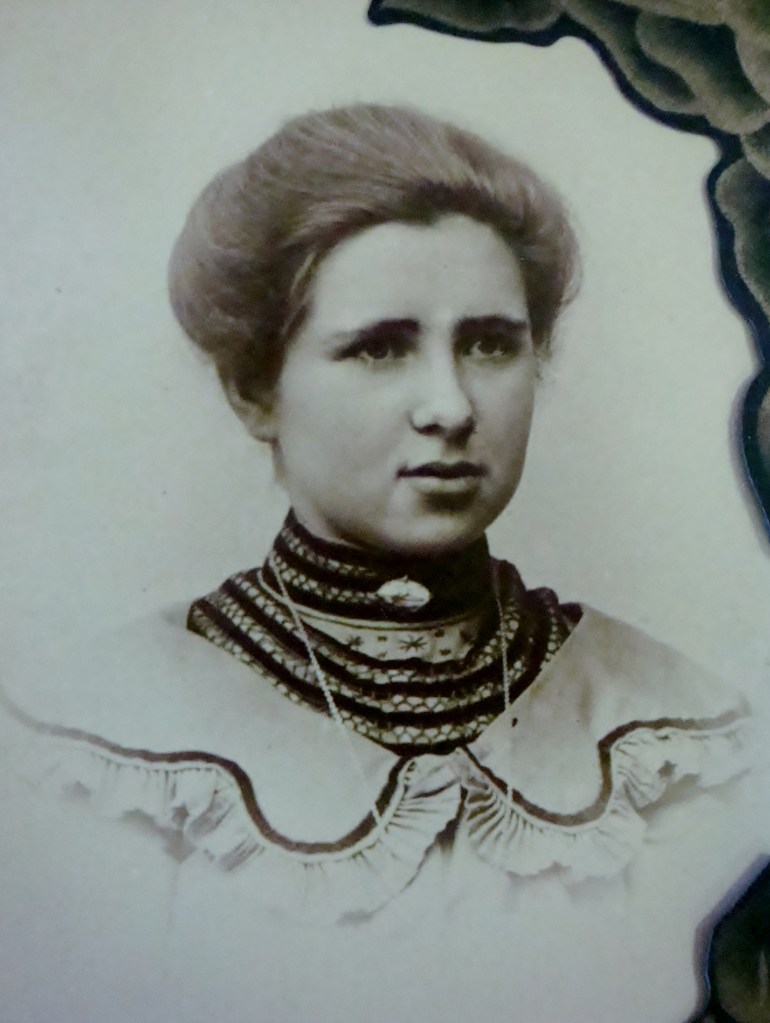
Elizabeth was born in Den Helder, North Holland, in 1888. I have little information about her prior to her 30s. Prior to marrying Arie Komen in 1921, when she was 32, she had worked as a domestic servant in Den Helder and Amsterdam. While Elizabeth died in 1976, when I was in grade four, I never met her, but I was quite familiar with “Oma Komen”. She wrote often to my parents and every December she would send us a package of goodies for Sinterklaas and Christmas. My father remembers her well. During a trip to the Netherlands in 2017, my father showed me where she had lived.

5. Milton Leo Burgess (my mother’s paternal grandfather)
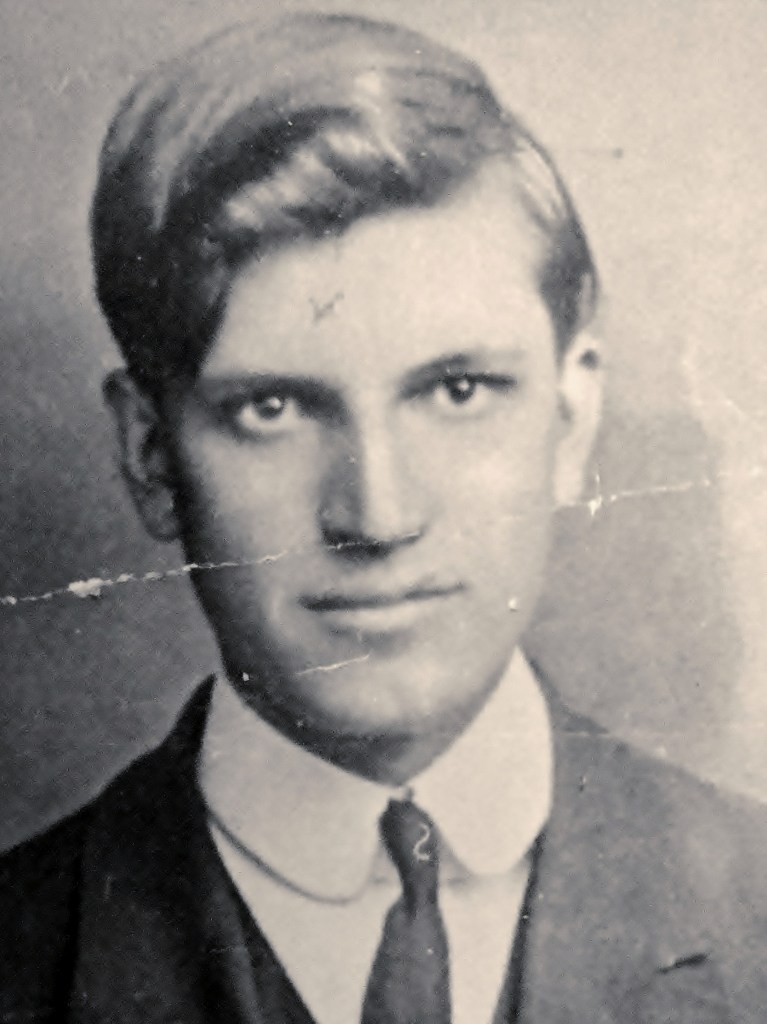
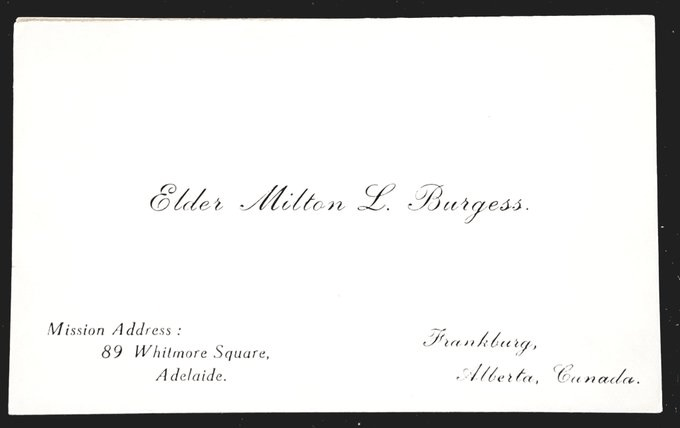
Milton was born in Vernal, Utah, in 1891. He came to Canada with his parents when he was 14. Milton was Mormon, so when he was 20 he spent two years in Adelaide, Australia on a mission. Even today with air travel, Australia is pretty far away, so it must have felt even more so when Milton went there. A few years ago, someone reached out to me on FamilySearch and said that he had some of Milton’s calling cards from his time on the mission. I was quite surprised and very grateful when he sent me one of the cards through the mail!
In his 20s and 30s Milton was a farmer. Later in life he had several other occupations. Sometime before 1941 he as a plumber. He worked in a woolen mill, where he lost a finger of his left hand due to a work injury. Milton also worked for a short time as a grave digger around 1950.

Milton died in 1964, a few years before I was born. My mother has told me many stories about Milton over the years. I also have a small cache of letters he wrote to my grandfather in the 1940s. Most of them were gentle admonishments, such as disapproving of my grandfather working in establishments that served alcohol, coffee, and tea, or telling him that it was time to stop seeing the Catholic girl he had been dating and to find a nice Mormon girl to settle down with. Fortunately for me, my grandfather did not follow that advice, as that Catholic girl became his wife and my grandmother!

6. Hazel Nelson (my mother’s paternal grandmother)
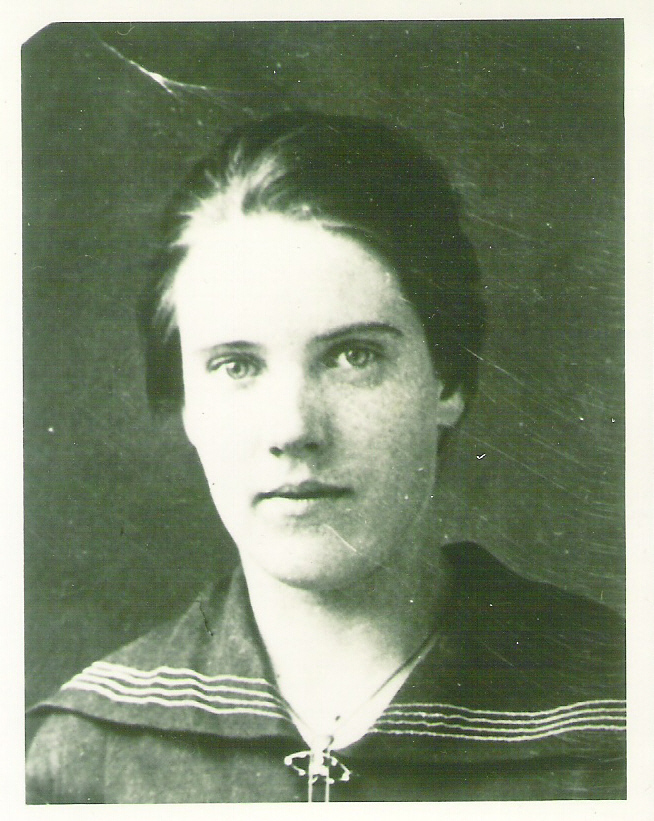
I’ve written a lot about Hazel in this blog (in particular, in this post about “Sisters”). She and her sister Irene were twins, born in 1899, and were the first twins to be born in Cardston, Alberta. Sadly, Irene died a little over a month after she was born. Hazel passed away in 1967, three days before I was born. While she might not have met me, she knew I was coming. My mother literally went from her grandmother’s funeral to the hospital to give birth to me. As far as I’ve been able to determine, I was Hazel’s first great grandchild. I’ve often asked my mother about what Hazel might have thought about her approaching status as a great grandmother. My mother has lots of stories about Hazel. It sounds like she was the quintessential grandmother.

7. Heronimus Michael “Jerome” Lerner (my mother’s maternal grandfather)
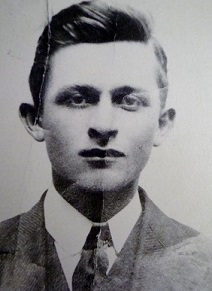
Jerome Lerner was born in Henrietta, Texas in 1895. His parents were Germans from Russia and Jerome was the first of their children to be born after they emigrated. Jerome immigrated to Canada when he was 22, where he took up farming outside Fox Valley, Saskatchewan. Many of his siblings, as well as his parents, followed Jerome to Saskatchewan over the following few years.

Jerome developed a mental health condition in later life, which contributed to the breakdown of his marriage. Nevertheless, Jerome managed to continue farming until he died in 1954. My mother never met her grandfather. Fortunately, I had the foresight to interview my great aunt about her father.

8. Emelia Anton (my mother’s maternal grandmother)
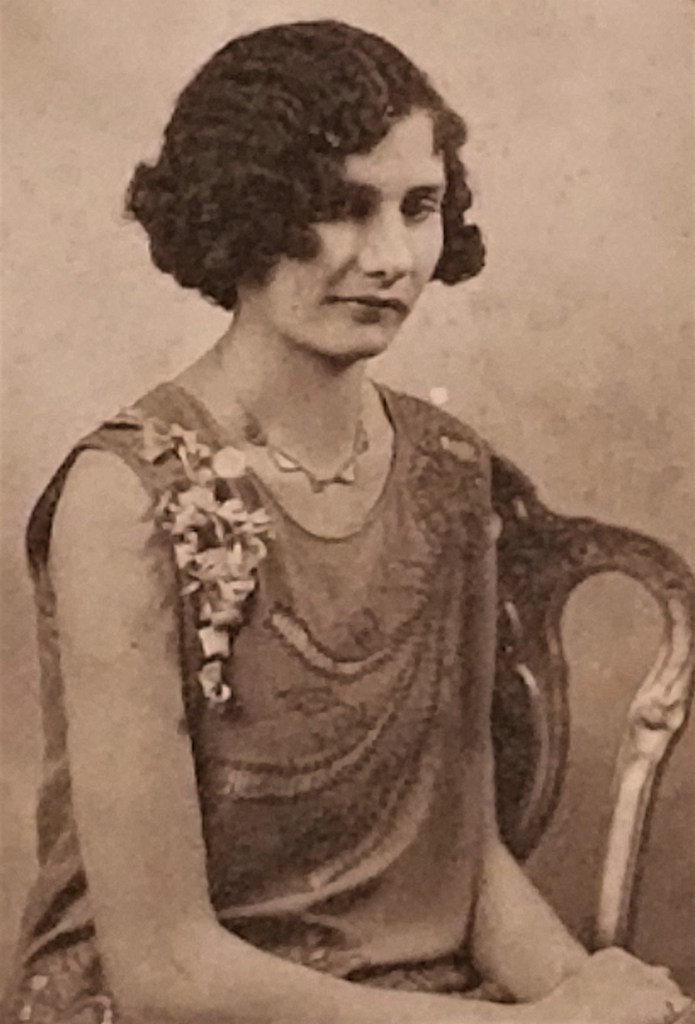
Emelia was born on January 1, 1903; however, I don’t know if that was by the Julian or Gregorian calendar. Emelia’s parents were Germans from Russia, who lived in one of the many German colonies in Imperial Russia, in what is now part of Ukraine. Sometime in 1900, Emelia’s parents and older siblings moved to Selo Suchoi, Veronesch, Russia, where Emelia was born. The family emigrated to Canada in 1912 and settled in Rastadt, Saskatchewan, just outside Fox Valley.

Emelia lived to be 94, outliving my grandmother by 13 years, so I knew her quite well. When I was a kid we visited her every time we were in Lethbridge, Alberta, which was at least once or twice a year. To this day, I am perplexed as to why I did not ask her more about her family and her life story, given my interest in genealogy since childhood.

I will never forget my amazement when I learned that she was German. During a visit when I was in grade eight, my mother said, “Grandma, guess what? Sean is taking German in school!” My first thought was to wonder why great grandma would care. To my great surprise, her reaction was to start speaking to me in German. Until that time (for many good reasons), I thought she was English!
52 Weeks – Week 42: Lost

The theme for this week’s 52 Ancestors Challenge is “Lost”. Given that it’s Week 42, I suppose what has been lost is the answer to the Ultimate Question of Life, The Universe, and Everything. Since I don’t have access to Deep Thought, I will have to consider a much simpler matter.

I began researching my family tree when I was about nine years old.

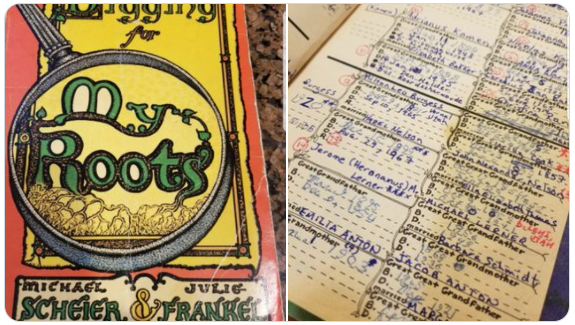
My first genealogy book, which I got through Scholastic Book orders when I was in Grade 4 or 5. Fortunately, it’s not lost and I still have it to this day.

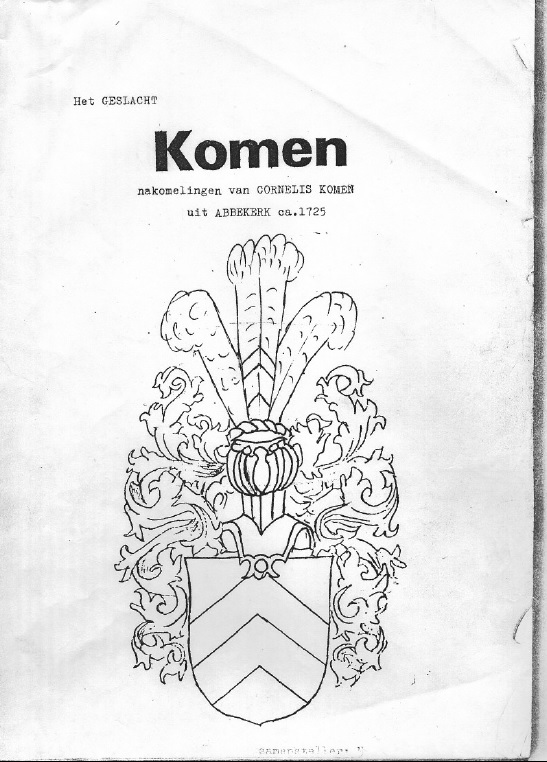
One of the earliest genealogical resources I had was a book my grandmother, Christina Komen, had about her family history, Het Geslacht Komen: Nakomelingen van Cornelis Komen uit Abbekerk ca. 1725 (“The Komen Line/Lineage: Descendants of Cornelis Komen from Abbekerk circa 1725”).

Cornelis Komen is my great 6x grandfather. It attempts to show all of his known descendants up to the time it was published. In addition to 36 pages consisting of a descendants’ narrative, additional pages include illustrations, interesting statistics, maps, numerous photos, and many “bidprentjes” (“prayer cards”, which could also be called funeral cards) and “familieberichten” (“family notices”). The quality of the image reproductions in the book were fairly poor, but they were discernable nonetheless. As well, the book includes a name index.

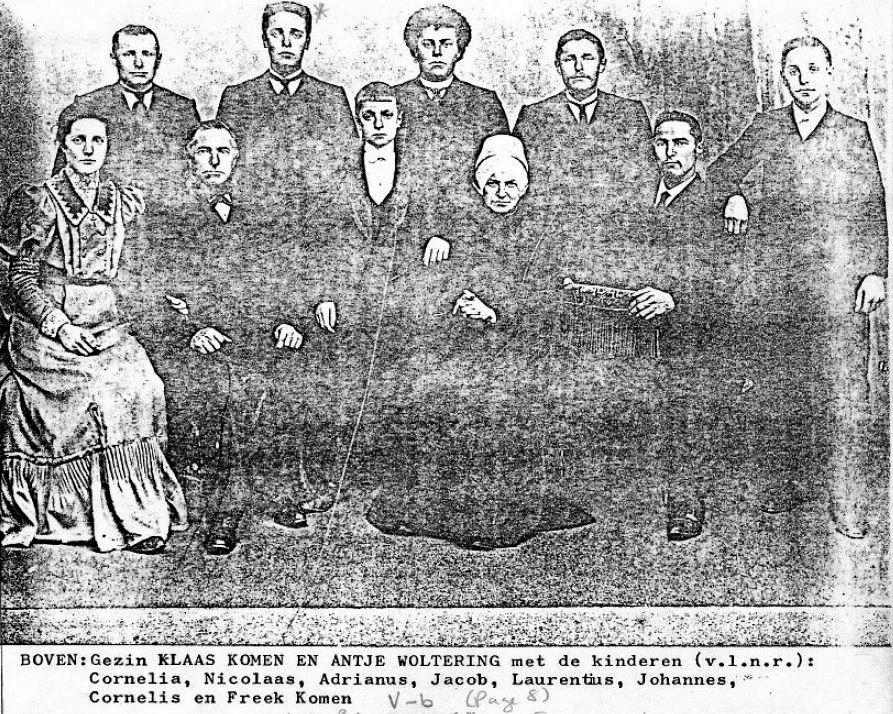
From page 8: “Above: Family KLAAS KOMEN and ANTJE WOLTERING with the children (from left to right: Cornelia, Nicolaas, Adrianus, Jacob, Laurentus, Johannes, Corenlis, and Freek [a diminutive of Frederik].”
Klaas and Antje are my great x2 grandparents (my grandmother’s grandparents).

My grandmother showed the book to me soon after she received it. Needless to say, it was fascinating to me. At the time, it was the furthest back I had ever seen documented for any branch of my family. I think back then, the furthest back ancestors I knew of were probably some of my second great x2 grandparents, and here was a book going four generations back from that. The book was one of the earliest texts I have in Dutch, which started me on a decades-long journey of trying to learn the language. It was also the one of the earliest detailed exposures I had to the geography of the area where my father was born.

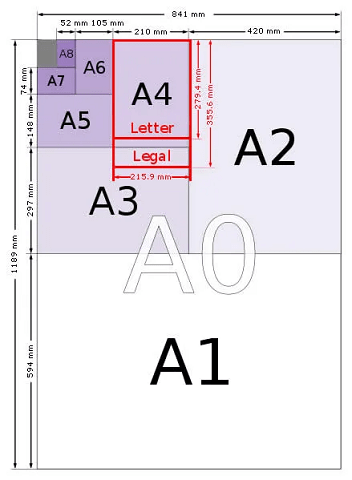
European paper sizes are so much more logical.

Years later, sometime in my late teens or early twenties, my grandmother loaned the book to me. Luckily, one of the first things I did was photocopy it. It wasn’t easy, because it was printed on A3 or A4 sized paper, which are different from the letter and legal sizes commonly used in North America. Today’s computerized photocopiers can easily adapt the size of the copy to fit the original, but such a thing did not exist at the time. Despite the quality of photocopiers at the time, I think the copy turned out fairly well. Many years later, I scanned the photocopies. I know I made the scans when Geocities was still a thing, so I am surprised by the quality of the scans.

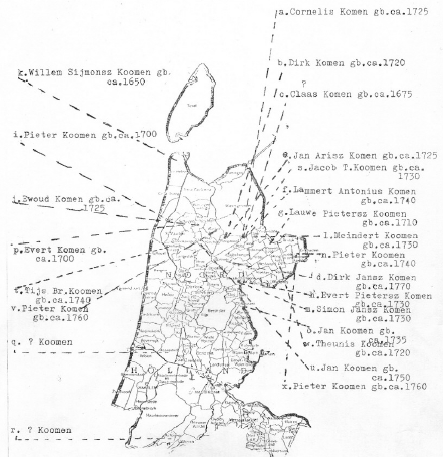
By the time I copied the book, I had moved to Vancouver. Going through it, I was amazed to see that there were other Komen descendants in Canada, all located in British Columbia. Some were in the Okanagan, in south-central B.C., some were on Vancouver Island, and some were in the suburbs of Vancouver, within 25 kilometers of where I was living at the time.

Page iv, showing the locations of various members of the Komen family in Noord Holland (North Holland).

It was fortunate that I copied the book. Years later, my grandmother misplaced it. She spent years looking for it. There might be copies of the book in a Dutch archive, and I am sure that there is – or was – a copy in the holdings of the CBG Centrum voor familiegeschiedenis (“Center for Family History”, formerly the “Centraal Bureau voor Genealogie”, hence “CBG”). However, as far as I knew at the time, the only extant copy of the book was the photocopy I had made.

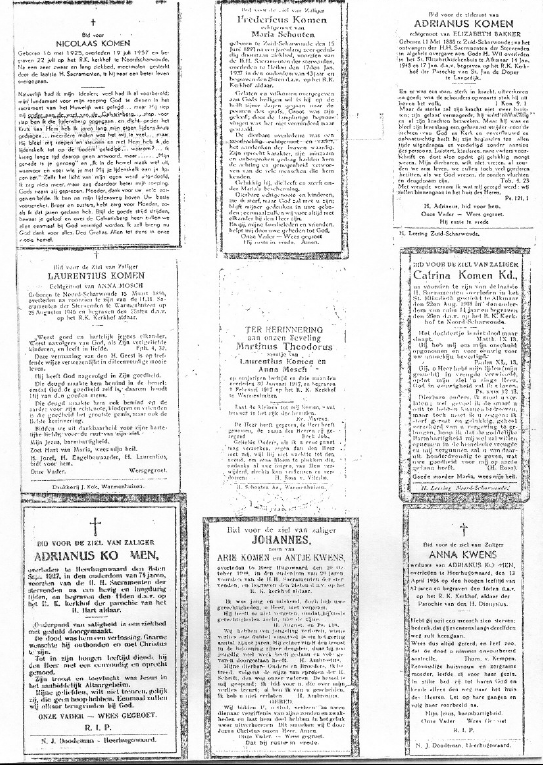
Page 11, showing the bidprentjes for my great grandfather and his siblings.

After my grandparents passed away, many of the family photos and other items of interest to genealogists ended up in the possession of my father’s youngest sister. She is not really a family historian or genealogist, but she has shown or loaned many of those items with me over the years. While writing this, it crossed my mind that I should ask her if she found the book and has it in her collection. It would be nice to know whether it is still around.

52 Weeks – Week 41: Handed Down

For this week’s theme for the  52 Ancestors Challenge, “Handed Down”, I know exactly what I wanted to share.

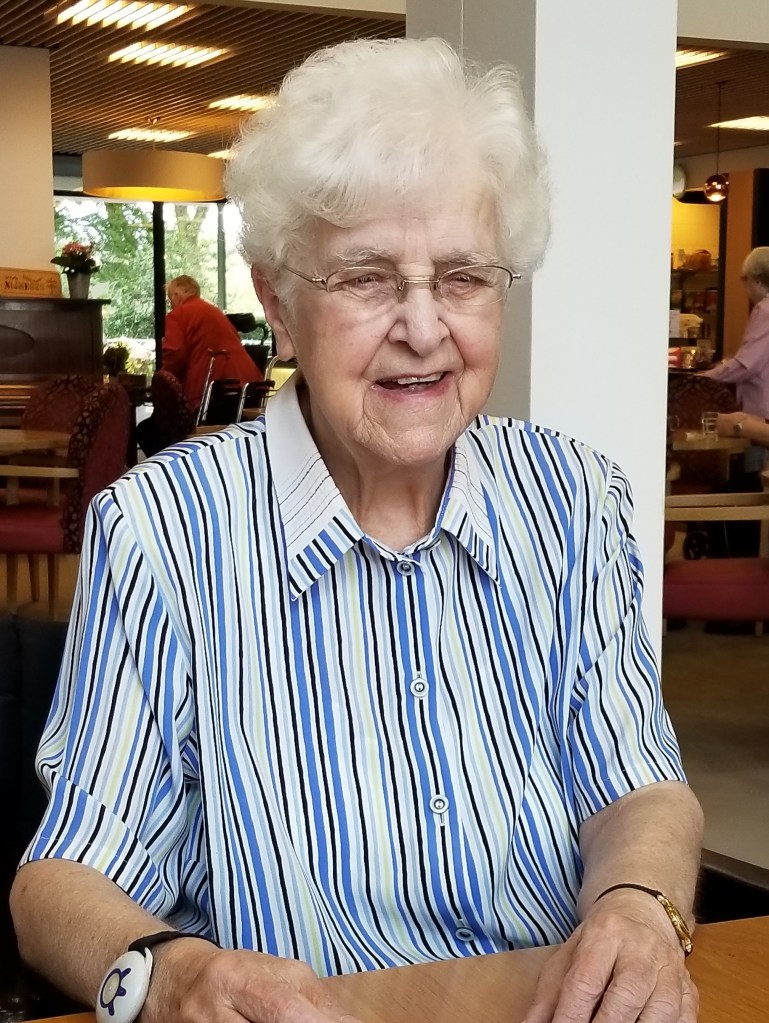
Tante Riet (1932-2021) in 2017.

As I wrote about in Week 10, my Tante Riet served as a missionary in Metro Lampung, Indonesia for many of years. When I was around 15 years old, she visited us during a trip she took to Canada. She gave me a hand-painted silk bookmark from Indonesia. I though I knew where I had been carefully storing it, but to my surprise it wasn’t where I thought it would be. Wat jammer, as you might say in Dutch.

However, I did find many wonderful mementos – wedding invitations, cards, letters, photos, and other souvenirs of special events. I even found a lovely thank you note a close friend of mine gave me thirty years ago. She wrote the first half in Dutch. While I could understand it at the time, with three decades of struggling to learn the language, I’m happy to say that I fully understand it now. Good thing I set it aside for so long!

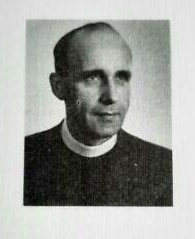
Cornelis Jan “Kees” Komen (1928-1987)

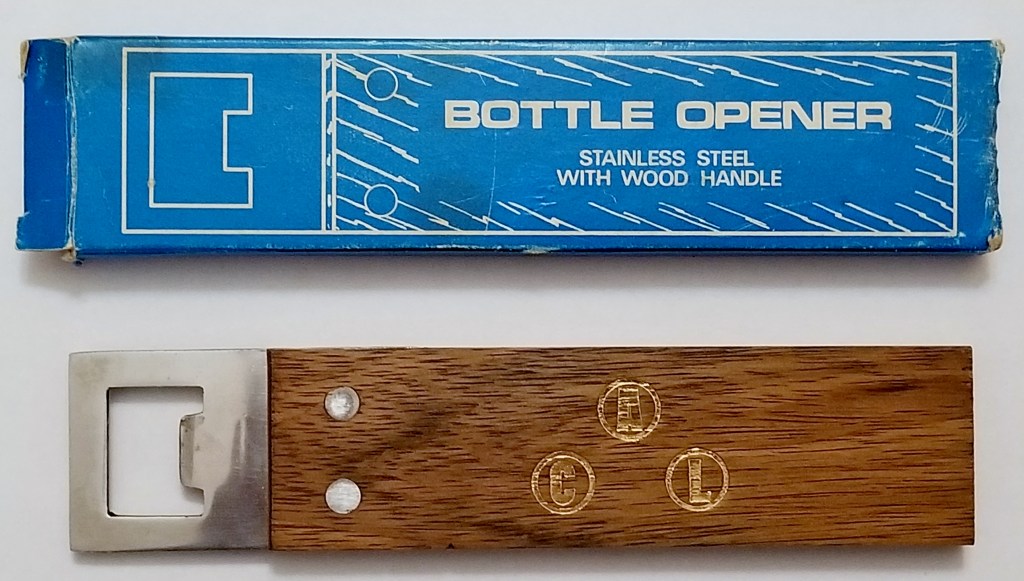
However, none of those items were things that fit this week’s theme. So instead I will share an item I inherited from one of Tante Riet’s older brother, Oom Kees. I also wrote about him in Week 10 and, like his sister, he led a religious life. I never met Oom Kees, who passed away in 1987. Somehow this item made its way from him to my mother, who passed it on to me – a very nice bottle opener. I have no idea if this was of any special significance to him or if there was a story behind it. I also have no idea how or why my great uncle came into possession of this item, which is a promotional item advertising a potato wholesaler. Was his parish a big purchaser of wholesale potatoes?

The note my mother enclosed when she sent it to me -which I still have – does not explain much. It simply says that it belonged to Oom Kees, my dad’s uncle, who had passed away in January that year. However, I received it gratefully, as I had little in the way of physical mementos from my family in the Netherlands.

I haven’t taken this out of the box in decades. I only took it out to photograph it for this post.
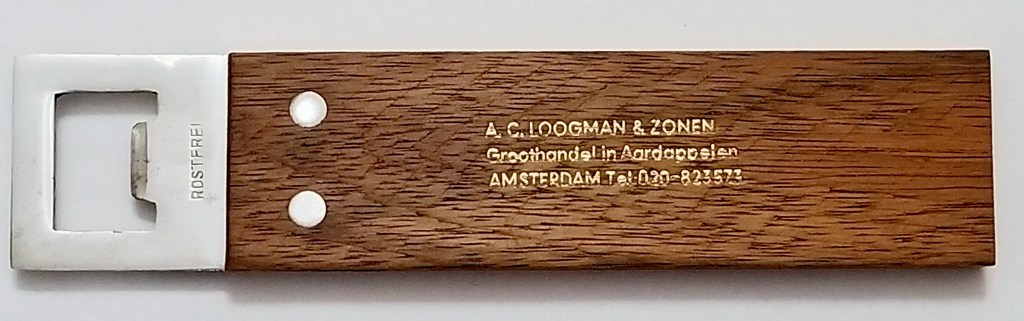
The back side.

The back side of the opener advertises “A.C. Loogman & Zonen – Groothandel in Aardappelen”. In English, “A.C. Loogman & Sons – Potato Wholesalers”. It seems odd that they’d have a bottle opener as a promotional item. You would think a more appropriate item might be a potato peeler.

I googled the company and it turns out they were in business up to November 2020, at which time it went bankrupt. Using the Wayback Machine of the Internet Archive, I found the from the last capture of their website (www.acloogman.nl), which included a short company history, which I’ve translated into English:

When you think of quality potatoes, you cannot ignore AC Loogman. Since 1953, we have ensured that customers from all over the world can enjoy the best potato varieties, collected directly from the grower and packed by us according to their wishes. Thanks to our extensive fleet and ultramodern fully automatic packaging machines, we can deliver large quantities within the country and abroad. But smaller regional customers can still count on our personal and committed service.

While a rather nondescript item, it certainly is one of the oddest heirlooms in my possession!

Addendum

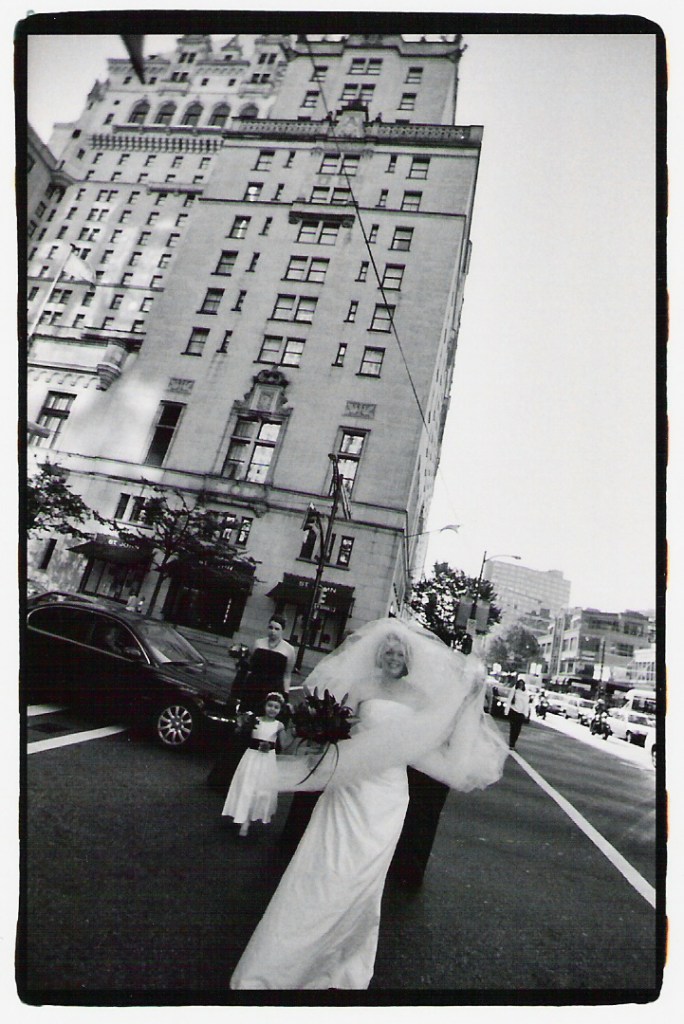
I generally focus on my side of the family in this blog, so it did not occur to me to think of my wife’s veil for our wedding. It was the same veil her great grandmother wore when she got married in 1918. A costume designer my wife knows did some repair work on it and added a bit of volume to it to spruce it up and make it look as good as new.

Addendum to the Addendum (Feb. 17, 2025): I just learned from a September 1918 newspaper that my wife’s great great great grandmother wore the same veil at her wedding in 1866. So my wife was wearing a pre-Confederation item! Talk about something old to go with the something new, borrowed, and blue!

52 Weeks – Week 33: Service

I’ve written about military service and religious service, so the twist I’ve taken for this week’s 52 Ancestors Challenge, “Service”, is to look at domestic service. Most of my ancestry consists of labourers and agricultural workers, so none were so posh as to have had servants. However, I do have ancestors who were the servants.

Sometime in my early teen years, I heard it told that during the war my paternal grandmother worked as a domestic servant. I’m unable to verify the story, as there is no longer anyone who would have first-hand knowledge of that fact. What civil records that might provide more information are not yet publicly available due to privacy laws and the lack of passage of sufficient time.

Elizabeth Bakker

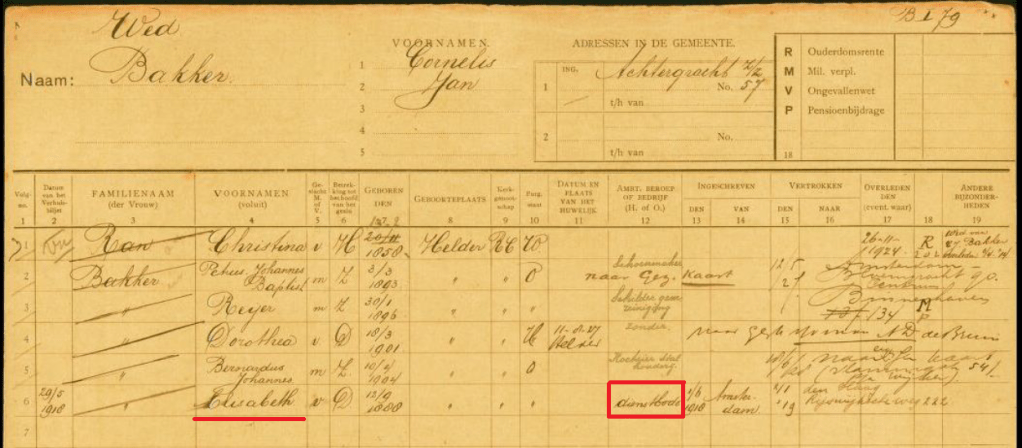
My grandmother’s mother, Elizabeth Bakker, was also a domestic servant (“dienstbode” in Dutch) before she married. It appears she spent time working in Amsterdam as a domestic servant before returning to her hometown of Den Helder, where she performed similar work until 1920 or 1921. However, by the time she married in April 1921, she as “zonder beroep” (“without job”). Elizabeth’s older sister Johanna and her younger sister Cornelia also worked as a domestic servants.

The Bevolkingsregister (“Population Register”) family card for Cornelis Jan Bakker and family. His daughter Elizabeth (my great grandmother) is shown as a dienstbode (“domestic servant”).

My third great grandmother, Maartje Mettes, was a domestic servant when she married her first husband, Klaas Buur. Klaas was also a domestic servant at the time of the marriage. My suspicion is that they may have worked in the same household, which I will need to research. However, by the time Maartje married her second husband, my third great grandfather Cornelis Komen, she was “van beroep zonder” (“without a job”).

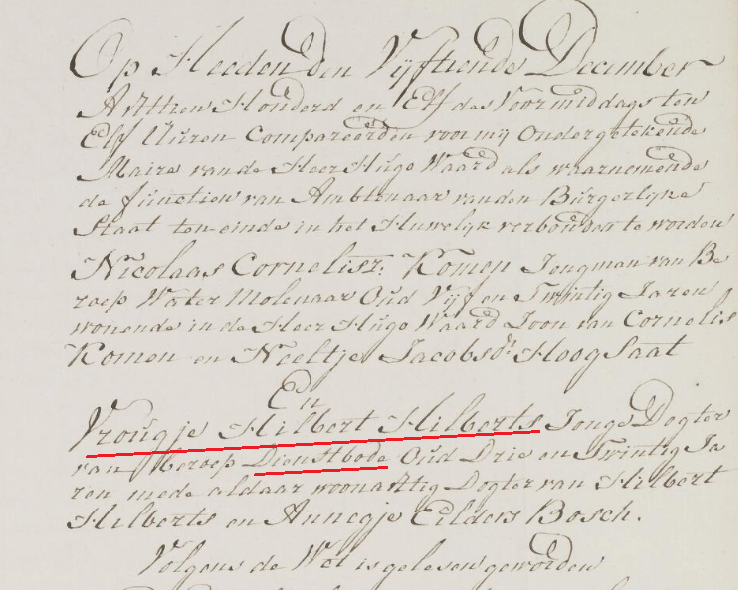
My great x4 grandmother, Vrouwtje Hilbert Hilberts, also spent time as a domestic servant and was doing that work when she got married.

Marriage registration for my great x4 grandparents, Nicolaas Cornelisz (“Klaas”) Komen and Vrouwtje Hilbert Hilberts. Vrouwtje was noted as van beroep dienstbode (“working as a domestic servant”) at the time of marriage in 1811.

Although in the majority, women were not the only domestic servants in my tree. While I have not done much research on my great x4 grandfather, Thomas Hadlond, he was a domestic servant in England before leaving for America and settling in Nebraska. I also have a 3x great uncle, Petrus (“Pieter”) van der Fluit who worked as a dienstknecht (“manservant”). Finally, in another form of domestic service, William Stockwell, my 8x great grandfather, likely came over to America as an indentured servant, gaining his liberty before he married.