
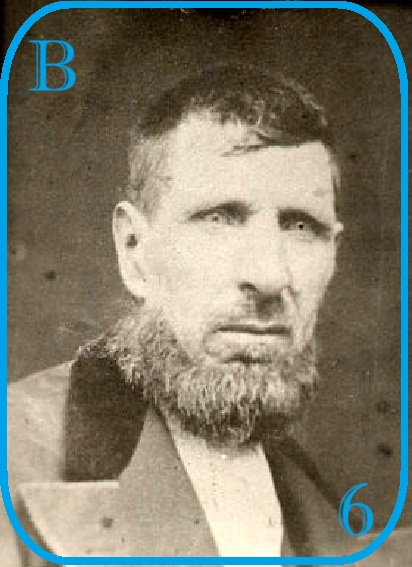
52W Mark IV – Week 32: Card B6 William Burgess

William Burgess, Jr. (1822-1904)

The Church of Jesus Christ of Latter Day Saints – the Mormons – was founded by Joseph Smith in April 1830 in Fayette, New York. In July 1832, Harrison Burgess of Putnam, New York, heard a Mormon missionary by the name of Simeon Carter. Harrison converted to the new religion and was baptized in October 1832. By the end of that year, Harrison’s parents and siblings (of whom there were at least nine at the time) also joined the Mormon church.

This included my Gx3 Grandfather, William Burgess Jr., who was about nine years old at the time. He was born on March 1, 1822, in Putnam. He was the sixth of twelve children born to William Burgess Sr. (1794-1880) and Violate Stockwell (1794-1880).

The Mormons relocated to Kirkland, Ohio in 1831. By September 1833, William was living there with his family. However, according to secondary sources, William Jr. lived in Joseph Smith’s house for a considerable period of time.

In the meantime, Smith was trying to establish Missouri as the church’s headquarters. However, between the Governor of Missouri driving the Mormons out of the state and a financial scandal involving the Kirtland Safety Society, a joint stock company intended to become a bank, the Mormons relocated to Nauvoo, Illinois in 1839. The Burgess family joined the fledgling church there by 1841, if not earlier.

While in Nauvoo, William joined the Third Company, Fifth Regiment of the Nauvoo Legion, a state-authorized militia that existed from 1841 to 1845. During his time with the Nauvoo Legion, William attained the rank of Colonel. As well, William was ordained as a “Seventy”, a level of priesthood within the Mormon church. He also participated in constructing the Latter Day Saints’ temple in Nauvoo.

William married his first wife, Maria Pulsipher, in September 1840 in Lima, Illinois. More accurately, William entered into a legal marriage with Maria. His next two wives were polygamous unions. Early church leaders secretly began the practice while the church was in Nauvoo. The church did not openly start the practice until 1852, after Joseph Smith had died and it had established itself in Salt Lake City. William and Maria remained married until her death in 1892. They had nine children together.
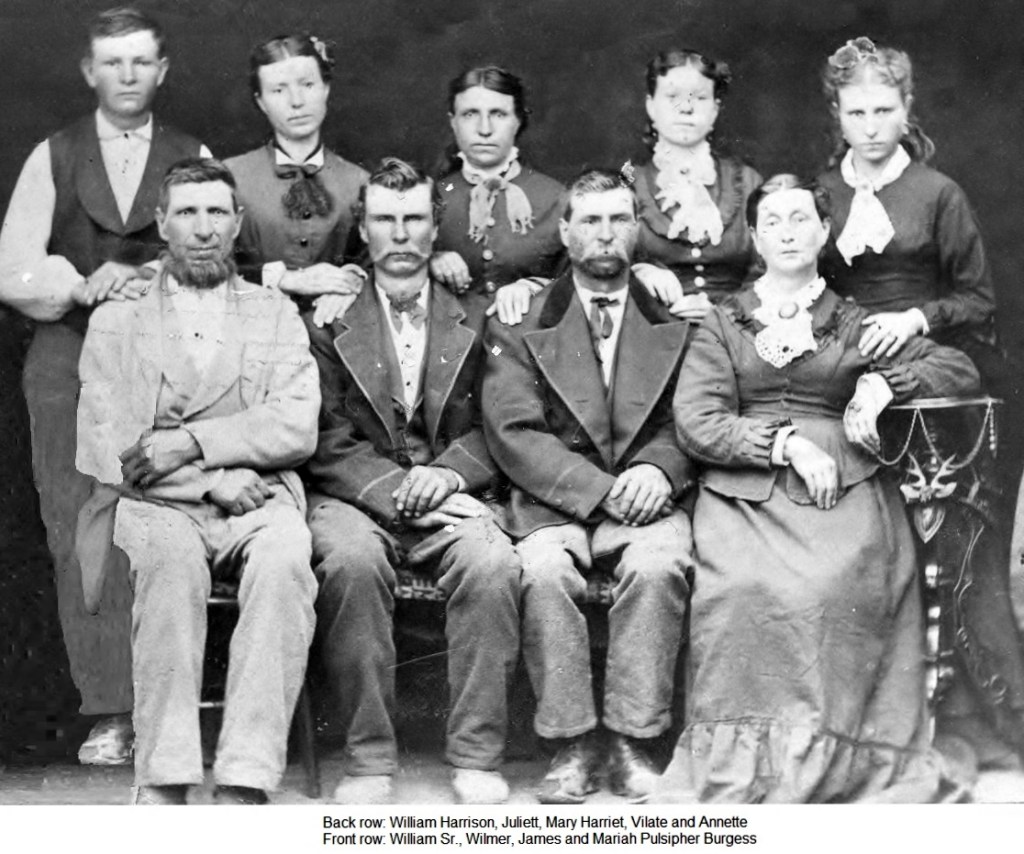
William with his first family.

The Mormons were driven out of Nauvoo in 1846, which marked the beginning of the Mormon Migration to Utah. During the westward migration, over the winter of 1846-1847, about 2,500 church members encamped at Winter Quarters, which was just north of where Omaha, Nebraska came to be. The first settlers arrived in what is now Salt Lake City in July 1847, in what was still Mexican territory.

William and Maria were part of this great migration. They were in Winter Quarters from at least September 16, 1846 to May 1848. They set out as members of Brigham Young’s company, which consisted of about 1,220 people. William arrived in Utah by September 1848 and settled in Huntington, about 175 kilometers southeast of Salt Lake City.

William was not in Huntington for long. By the next year, 1849, he was in Salt Lake City where he joined the militia. Upon enlisting he was made a captain; by 1853 he was a colonel. William also took up farming near Salt Lake City.
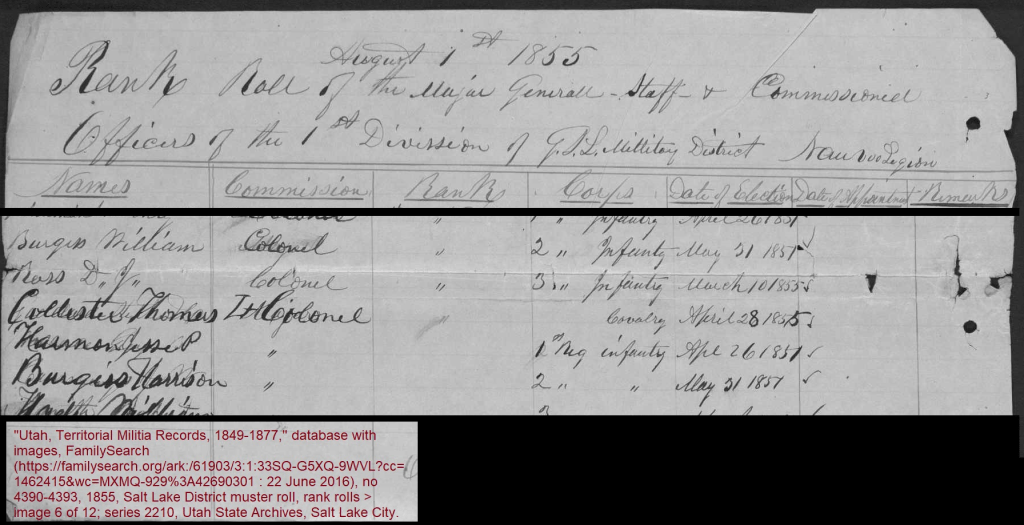
Militia record showing both William and his older brother Harrison.

While in Salt Lake City, William entered into a polygamist marriage with my Gx3 grandmother, Charlotte Liggett, on June 3, 1852. William was more than twice Charlotte’s age at the time – he was 30 and she was 14. Sadly, that kind of age gap, and the incredibly young age of the girls, was not uncommon with the early Mormon polygamists.

Shortly after marrying Charlotte, William entered into a mission. It appears that he may have or was to have carried out his mission in Great Britain; however, it is more likely that he performed his mission within the United States. At or around the time William completed his mission, he was ordained as President of the Ninth Quorum of Seventies.

By the start of 1854, William and family were living in Lehi, Utah, which is about 40 kilometers due south of Salt Lake City. The city of Lehi established a school board on February 17, 1854 and held an election for trustees three days later. Three men were elected: William, Preston Thomas, and Daniel Collett. Sixty five years later, William’s grandson, Milton Burgess, married Preston’s granddaughter, Hazel Nelson. Milton and Hazel are my great grandparents.
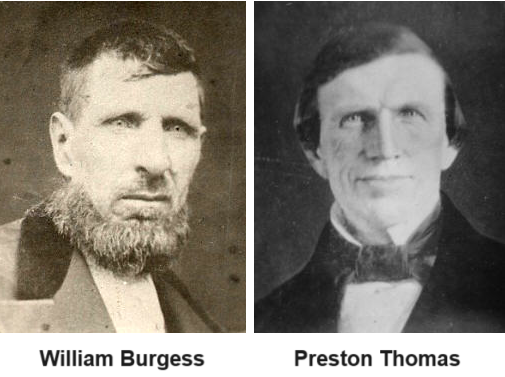
Lehi school board trustees, 1854.

A month after William was elected to the Lehi school board, he was elected an alderman of Lehi. In addition to his electoral positions, William was one of the founders of the Lehi Dramatic Club, which was established in 1855. Its first productions were plays called “Priestcraft in Danger” and “Luke the Labourer”. The club performed in Lehi’s log schoolhouse, using tallow candles for footlights and painted wagon covers for scenery and curtains. I doubt William actually performed on stage. Rather, I believe he was one of the people overseeing the operations of the club. For example, William obtained the licence required by the town for operation of the club. Nevertheless, it is entirely possible that he may have been treading the boards!
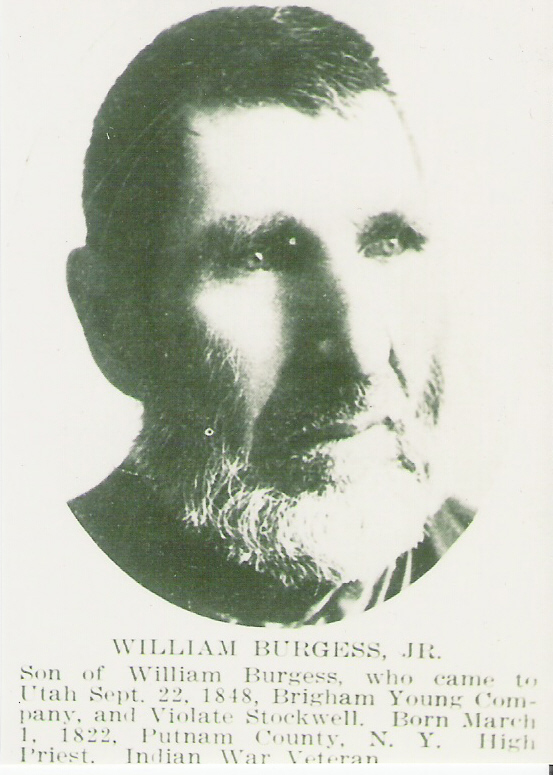
William did not complete his term as alderman in Lehi. He resigned in March 1855, because he and his family moved to Salmon, Idaho, not far from where Sacagawea was born. While in Salmon, William embarked on a three-year mission for the church. The mission was based out of Fort Lemhi, a Mormon mission located about 40 kilometers south of Salmon. Initially, the mission consisted of twenty-seven sent to Lemhi by Brigham Young. At its peak, the mission grew to about 200 people. The Mormons were forced to abandon the mission due to conflict with the Bannock and Shoshone.

Sometime around or after moving to Salmon, likely in 1857, Charlotte left William. The marriage lasted long enough for them to have had one son, which was lucky for me, because he was Horace Burgess, my Gx2 Grandfather. By some accounts, the marriage ended because Charlotte did not get along with Maria; by others, it was because she was disenchanted with polygamy. Some sources indicate that the couple divorced. However, being a polygamous marriage, there may have been no formal civil registration of the marriage and, therefore, no formal divorce. While at the time of their marriage William and Charlotte had been “sealed” (a Mormon ritual meant to bind familial relationships for eternity), Charlotte had the sealing annulled in 1890.

After the Lemhi mission came to an end, William and family moved to Parley’s Canyon, which is now on the outskirts of Salt Lake City, where he had been granted 10 acres of land. William built a sawmill where he milled shingles for use at the nearby fort and for houses. William’s father and his brothers Harrison, Horace, and Melanchton also worked at the mill.

On February 21, 1858, William married Catherine Chamberlain, who was 18 years old at the time. Catherine had been previously married, at age 16, to a fellow by the name of William Randolph Teeples. Catherine and William had at least one child together. I have not researched the circumstances as to when Catherine and William separated, if they did at all. All the while, William was still married to Maria, who was 35 years old by this time. In fact, each of Maria’s last two children were born within a few months of each of Catherine’s first two children with William. Catherine ultimately had four children with William. This means that William fathered 14 children in total.
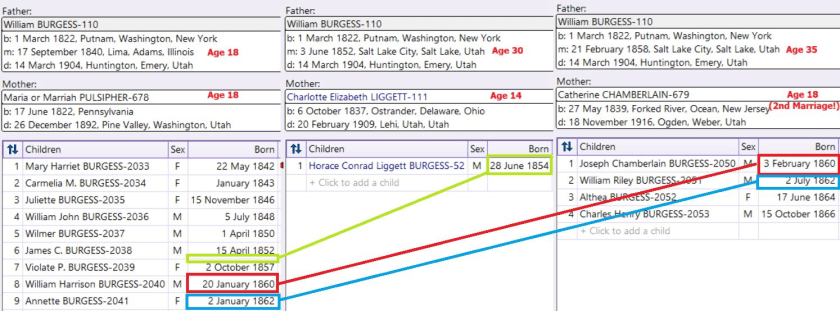
A rough sketch showing the ages of William and his three wives at the time of each marriage. As well, I’ve highlighted the relative times at which William fathered some of his 14 children, including the timing of Maria’s last two children and Catherine’s first two.

In 1862, William established a sawmill in Pine Valley, Utah, which furnished most of the lumber for southern Utah (then referred to as “Dixie”). It was one of the first sawmills in the region. The mill was a seasonal operation, so until 1880 William divided his time between Pine Valley in the summer and St. George, Utah, in the winter. The Pine Valley sawmill provided the lumber that was used to build the pipe organ for the local church. As well, apparently some of the lumber William milled was used for the construction of the Salt Lake Tabernacle.

In 1880, William relocated to Thurber, Utah, where he spent five years. Finally, around 1885, William settled back in Huntington, where he had begun life in Utah, and spent the rest of his life there. William had many business endeavours in Huntington. He was a bee keeper, which is fitting because Utah is known as the Beehive State. William also bought into the Co-op Mercantile Company as one of the principal stockholders and served as its president for seven years. He also worked as a carpenter, farmed, and raised cattle.
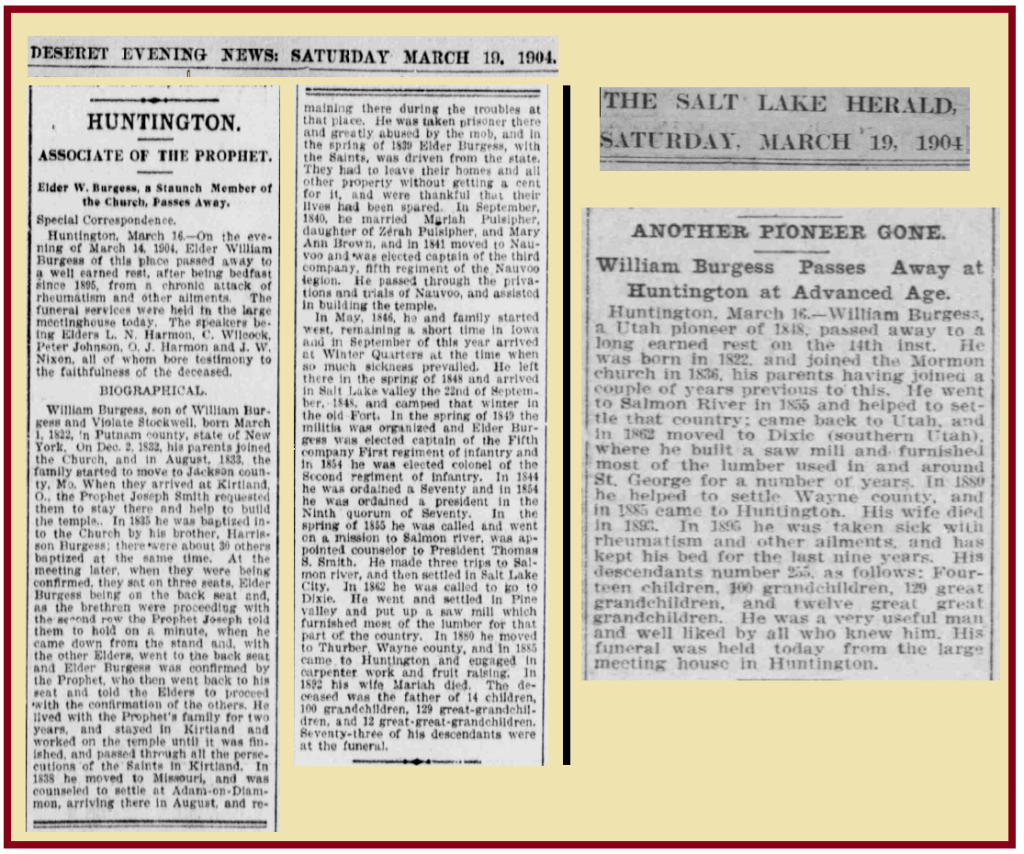
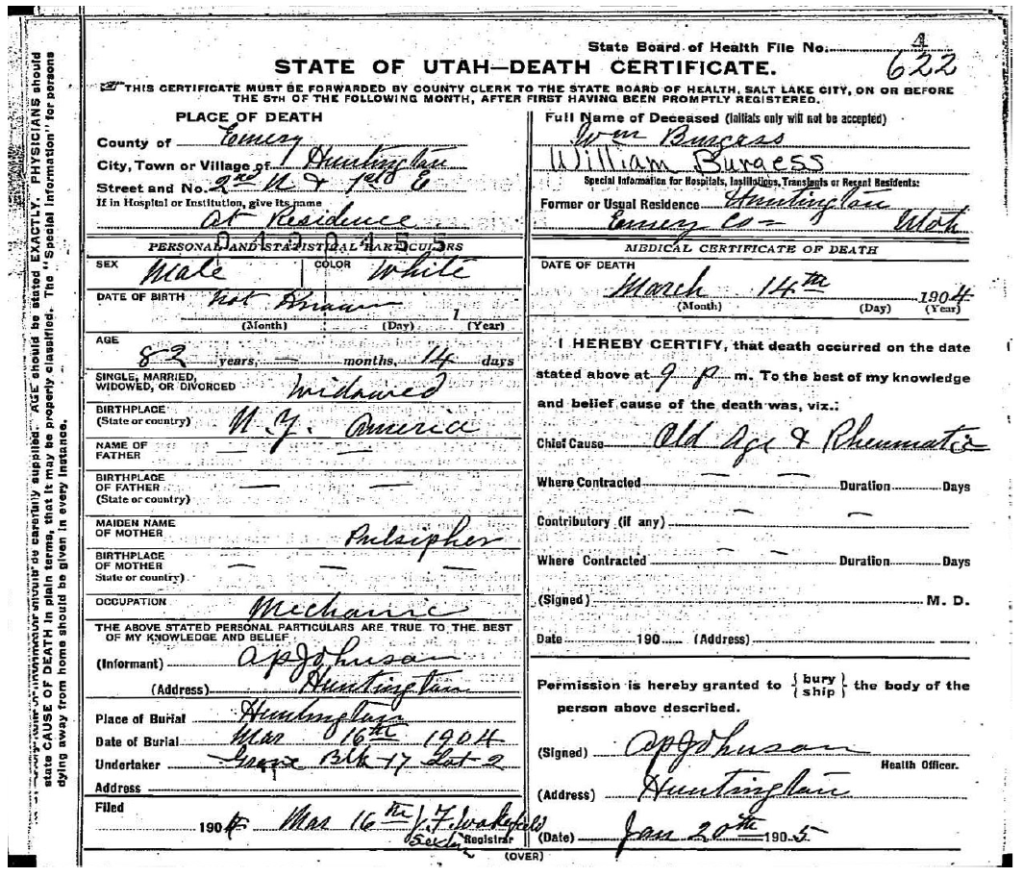
William died on March 14, 1904 after having been bedridden for nine years due to rheumatism and other ailments. He is buried at the Huntington City Cemetery.
52W Mark II – Week 33: Strength

I am not a member of the Latter Day Saints (“Mormons”), but my maternal grandfather, Leo Burgess, was. In fact, his direct paternal line were Mormons almost since the beginning. The early members of the church were required to draw on their strength as they faced persecution, exile, and hardship.

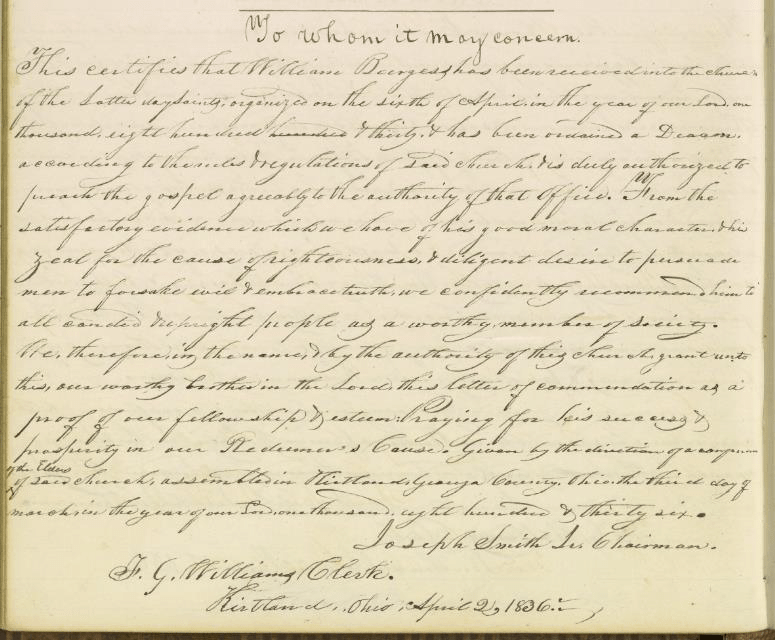
Most sources state that my Gx4 Grandfather, William Burgess (1794-1880) was baptised into the church in 1832, two years after it had been founded by Joseph Smith. However, the Kirtland Elders’ Certificates from the Joseph Smith Papers state that William joined the church and was ordained a deacon on April 6, 1830. All eight of my grandfather’s great grandparents had joined the church in the 1830s and 1840s.

“This certifies that William Burgess has been received into the church of the Latter-Day Saints, organized on the sixth of April, in the year of our Lord, one thousand, eight hundred hundred & thirty, & has been ordained a Deacon…

Joseph Smith Jr. Chairman.
F[rederick] G. Williams Clerk.
Kirtland, Ohio, April 2, 1836.”

Kirtland Elders’ Certificates, p. 84, The Joseph Smith Papers

While I am quite skeptical about much of the church’s dogma, I absolutely respect the strength of its early adherents, including many of my direct ancestors who were early members of the church. Many of them experienced and survived unnecessary suffering due to religious persecution. Several others endured an arduous – and for some,  deadly – journey from Illinois to Utah over the winter of 1846-1847.

Joseph Smith sought to create a “New Jerusalem”. He and his followers moved to Ohio and soon began building a settlement in Missouri. In 1833, church members were run out of Missouri and a failed banking venture crippled the Ohio settlement. The Mormons attempted a settlement elsewhere in Missouri, but were driven out upon an executive order of the governor, calling for them to be exterminated or expelled from the state. In 1939, the church regrouped in a new community, Nauvoo, Illinois, and began to build their Zion there.

Two years after Joseph Smith’s death in 1844, tensions with non-Mormons increased, such that the Mormons were driven out of their settlement once again. They upped stakes and began the migration to Utah. During the westward migration, over the winter of 1846-1847, about 2,500 church members encamped at Winter Quarters, which was just north of where Omaha, Nebraska came to be. The first settlers arrived in what is now Salt Lake City in July 1847, in what was still Mexican territory.

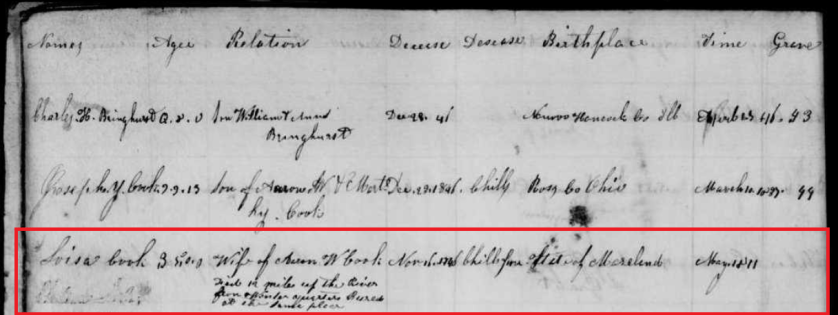
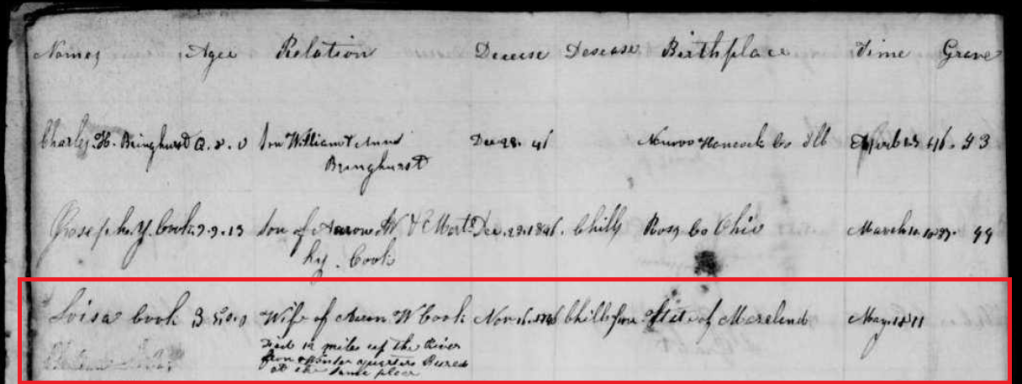
Many of the trekkers did not survive. There are varying accounts of the death toll at Winter Quarters. This is due, in part, to the lack of sufficiently complete and reliable records. It is also due to what was included in each account: some measure death only due to disease, others include deaths of all causes. The periods of time also vary: from a few months over the winter of 1846-1847, to longer periods of time, e.g.,1846 to 1848. Louisa Thomas, my 4x great grandmother, was one of those who perished at Winter Quarters. She died on November 16, 1846. An entry in the Winter Quarters sexton’s records shows that she died 19 miles up the river from Winters Quarters. Louisa’s daughter Charlotte, my Gx3 grandmother, was only nine at the time.

The entry for Louisa Thomas in the Winter Quarters sexton’s records, 1846-1848: “Loisa Cook. 36 years, 0 months, 0 days. Wife of Aaron W. Cook [her third husband]. Died 19 miles up the River from Winter quarters Bur[i]ed at the same place. [Died] Nov 16 1846. [Disease] chills fever. [Born] State of Mareland May 1811.”

To have survived long journeys to settle in new lands, religious persecution, and perilous migration took incredible strength – mental, physical, social, and spiritual. Their conviction and belief carried them through difficult times and experiences. For that I am grateful, because without their strength I would not have been.

52 Weeks – Week 34: Timeline

In the timeline of the 52 Ancestors Challenge, we’re on Week 34, which is the theme of the week, “Timeline”!

Plotting out the timeline of an ancestor or family group can be a great analytical tool. However, I find what is just as important are timelines of history. Knowing the history of a place can provide context and clues as to our ancestors’ actions.

Timelines of history are totally bodacious and most triumphant.

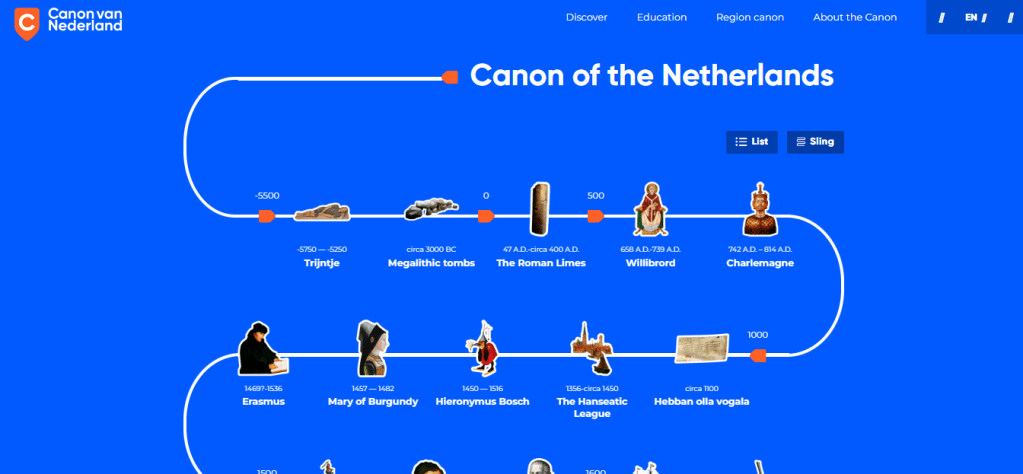
One of my favourite timelines of history is the Canon of the Netherlands. In addition to my love of genealogy, I have always loved history (it was my major in undergrad) and the Canon appeals to my inner history geek. It is a timeline of fifty historical events that together show the historical and cultural development of the Netherlands as a nation. Not only that, there are separate canons for every province and the regions within each province. It is a beautiful piece of work and I enjoy reading it independent of any family history research I might be doing.

The Canon was developed at the behest of the Dutch ministry of education and provides a summary of what is taught in Dutch primary schools. The website is available in English for the timeline itself and for each of the historical and cultural events listed on the timeline, although other information (such as the “About” pages, FAQs, and regional Canons) is only available in Dutch. That’s where the translate functions of browsers like Chrome can come in handy, although I like to try to read them in the original Dutch as part of my decades-long struggle to learn the language.

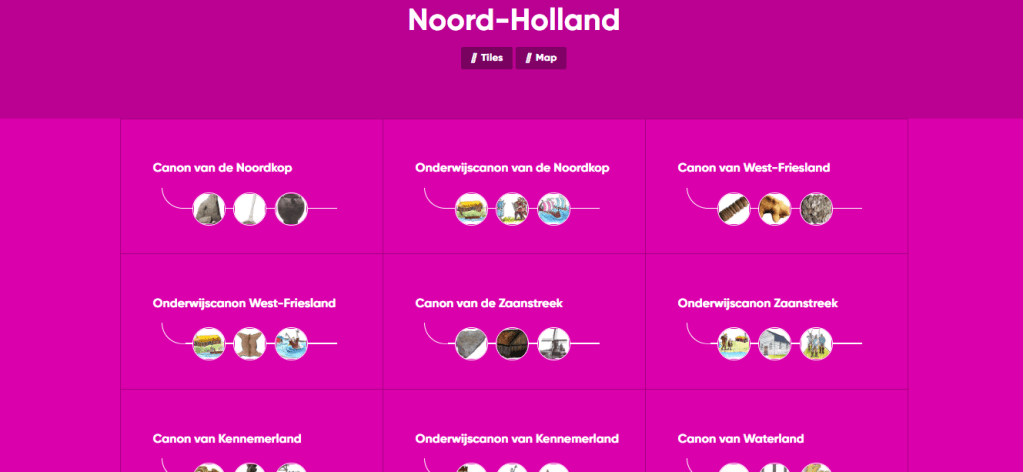
The Canon for Noord Holland (North Holland), the province where my father was born.

Knowing when the Netherlands was under French dominion helps in understanding the timeline of some of my ancestors. Napoleon originally structured the Netherlands as a separate “Kingdom of Holland”, with his brother Louis as the King. Over time, Louis ran the kingdom more with Dutch interests in mind, so in 1810 Napoleon abolished the kingdom and incorporated the Netherlands as part of France itself. Records from the time of French rule might be in Dutch, French, or a combination of both. Records I’ve found from after the Netherlands was incorporated into the Empire are more likely to be in French.

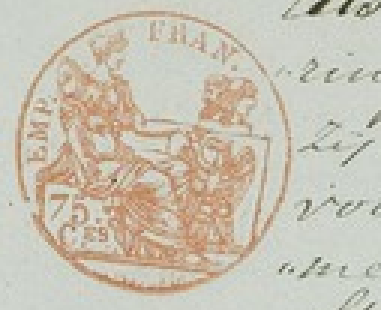
My Great x 4 grandparents, Jan de Waard and Cornelia Pieters Kooij, married on October 10, 1813. The record of their marriage is written in Dutch, but bears the seal of Imperial France. Less than a month after their marriage, a popular uprising resulted in the ouster of the French. On November 30, 1813, the son of the former stadholder of the country returned from exile and was named William I, Sovereign Prince of the United Netherlands. Jan and Gurr marriage was one of the last in Texel to be registered under the French regime.

Knowing the timelines of history have also been helpful in understanding my maternal grandfather’s family history. He was Mormon (Latter Day Saints) and several of his direct ancestors were amongst the earliest converts to the new religion, joining in the 1830s in New York State. Knowing the history of Mormon migration helps me understand my maternal ancestors’ movements and why they did certain things at certain times.

The group’s founder, Joseph Smith, sought to create a “New Jerusalem”. He and his followers moved to Ohio and soon began building a settlement in Missouri. In 1833, church members were run out of Missouri and a failed banking venture crippled the Ohio settlement. The Mormons attempted a settlement elsewhere in Missouri, but were driven out upon an executive order of the governor, calling for them to be exterminated or expelled from the state. In 1939, the church regrouped in a new community, Nauvoo, Illinois, and began to build their Zion there. Two years after Joseph Smith’s death in 1844, tensions with non-Mormons increased, such that the Mormons were driven out once again. They upped stakes and began the migration to Utah. During the westward migration, over the winter of 1846-1847, about 2,500 church members encamped at Winter Quarters, which was just north of where Omaha, Nebraska came to be. The first settlers arrived in what is now Salt Lake City in July 1847, in what was still Mexican territory.

Knowing this timeline, I can test the accuracy or reliability of information I have found about my Mormon ancestors. For example, some of the information I’ve found about my great x4 grandfather, Conrad Liggett, suggests that he died in Nauvoo before 1839. However, as Mormon settlement in Nauvoo did not begin until 1839, I doubt the veracity of that information.

If you were buried in Ohio in 1838, odds are you did not die in a town that was settled by the Mormons in 1839.

As well, if I have a Mormon ancestor who passed away in late 1846 or early 1947, chances are good that it occurred during the migration to Utah. For example, Conrad’s widow, Louisa Thomas, my 4x great grandmother, died on November 16, 1846. Sure enough, an entry in the Winter Quarters sexton’s records shows that Louisa died 19 miles up the river from Winters Quarters.

The entry for Louisa Thomas in the Winter Quarters sexton’s records, 1846-1848: “Loisa Cook. 36 years, 0 months, 0 days. Wife of Aaron W. Cook [her third husband]. Died 19 miles up the River from Winter quarters Bur[i]ed at the same place. [Died] Nov 16 1846. [Disease] chills fever. [Born] State of Mareland May 1811.”

Timelines of history can take you on some most excellent adventures!

52 Weeks – Week 28: Characters

This week’s 52 Ancestors Challenge theme is “Characters”. While that actually provides a wide scope, the inclination might be to write about an ancestor who had a big personality or was quite the extrovert. I’ve decided to write about an ancestor who most likely needed quite a bit of character to have endured what life sent her way.

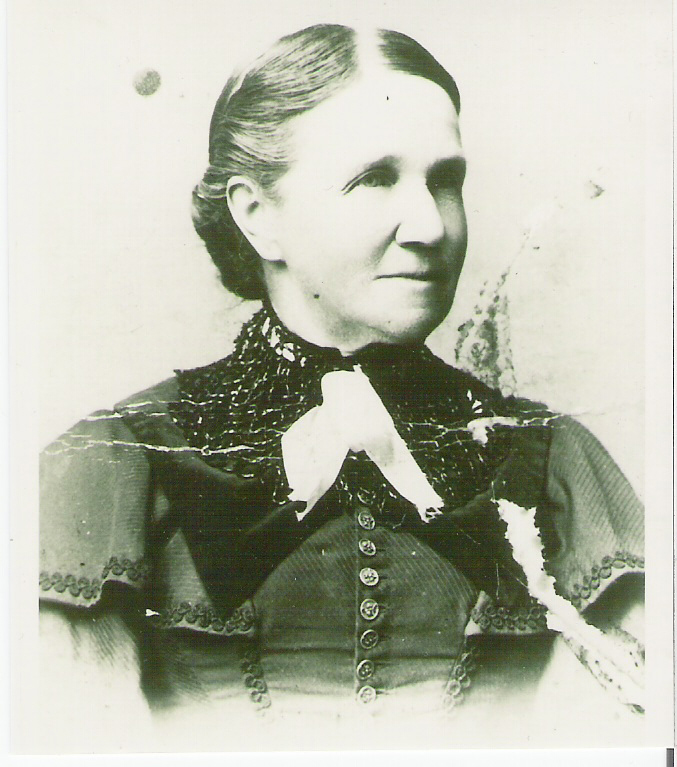
One of my Gx3 grandmothers was Charlotte Elizabeth Liggett. Charlotte was born on October 2 or 6, 1837, to Conrad Liggett and Louisa Thomas. According to some sources, Charlotte was born born in Dover Township, Union County, Ohio, although most other accounts say it was Ostrander, Delaware, Ohio. While in different counties, these communities are about five kilometers apart.

Charlotte Elizabeth Liggett

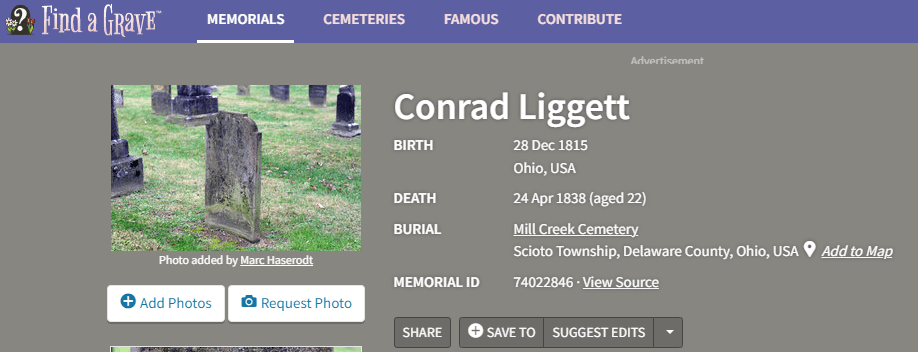
Conrad and Louisa married on February 28, 1837. Unfortunately, Conrad died shortly after Charlotte was born. I have been unable to find definitive sources as to when and where he actually died, although it is likely that it occurred in April 1838. Several sources suggest he died at Nauvoo, Illinois sometime before 1839. However, the Latter Day Saints (Mormons), of which he was likely a member, did not really begin to settle in Nauvoo until after they were expelled from Missouri in late 1838. It may be that Conrad himself never left Ohio. According to Find a Grave, Conrad is buried in Ohio, although there is always the possibility that his remains were transported to Ohio after his death.

Louisa remarried in 1841, to Aaron Cook. This marriage may have occurred in Nauvoo. With the Mormons being driven out of Nauvoo starting in 1846, Louisa, Aaron, and Charlotte set out in the westward migration to what is now Utah. The migration, undertaken in haste and without time for proper preparations, was arduous. On the way to Winter Quarters in Nebraska, in November 1846, Louisa died. Charlotte had just turned nine.

After time spent at Winter Quarters, Aaron continued to Utah with Charlotte. According to one family history I’ve read, upon reaching Utah Aaron, he “married Charlotte off” to a Mormon elder. That was likely a reference to Charlotte’s first husband, my Gx3 grandfather, William Burgess. The marriage occurred on June 3, 1852, when William was 30 and Charlotte was only 14. Even worse, this was a polygamous marriage, as William was still married to his first wife of 12 years, Maria Pulsipher.

The marriage did not last long. Fortunately for me, it lasted long enough to produce one child, my Gx2 grandfather, Horace Burgess. Apparently Charlotte did not get along with Maria. Charlotte left William sometime in 1857, when she was 19. Many secondary sources suggest that William and Charlotte divorced. However, being a polygamous marriage, there may have been no formal civil registration of the marriage and, therefore, no formal divorce. While at the time of their marriage William and Charlotte had been “sealed” (a Mormon ritual meant to bind familial relationships for eternity), Charlotte had the sealing annulled in 1890.

Shortly after leaving her first husband, Charlotte entered into her second marriage, with William Whitehead Taylor, on September 7, 1857. This was also a polygamous marriage, and at age 28, William was almost 10 years older than Charlotte.

While Charlotte’s early life may have been difficult, it may have been much less onerous after she joined with William. It appears that they remained together for 50 years, until William passed away in 1907. Charlotte and William were never sealed during their lifetimes, as a bishop had told Charlotte that she could not be sealed again. Apparently they were sealed after Charlotte’s death, as it was her “dying wish”.

The Salt Lake Tribune, April 25, 1908, Page 11

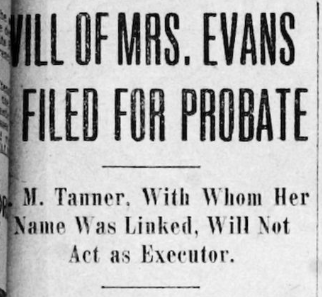
Charlotte and William had four children. It appears their second child, Louisa, may have died in infancy or childhood. Their eldest, Sarah, died at age 49, when Charlotte was 70. There was a small amount of notoriety in the press when Sarah died. She was married twice. The first marriage was to Prime Evans. The second marriage was with a J. M. Tanner. However, this was not a legal marriage. According to newspaper reports at the time of Sarah’s death, this was a secret polygamous marriage, solemnized within the church after polygamy was outlawed. Tanner had been named executor of Sarah’s will and guardian of children Sarah had adopted (young relatives of hers). However, he ultimately declined to act in either role, likely because of the scandalous nature of his relationship with Sarah.

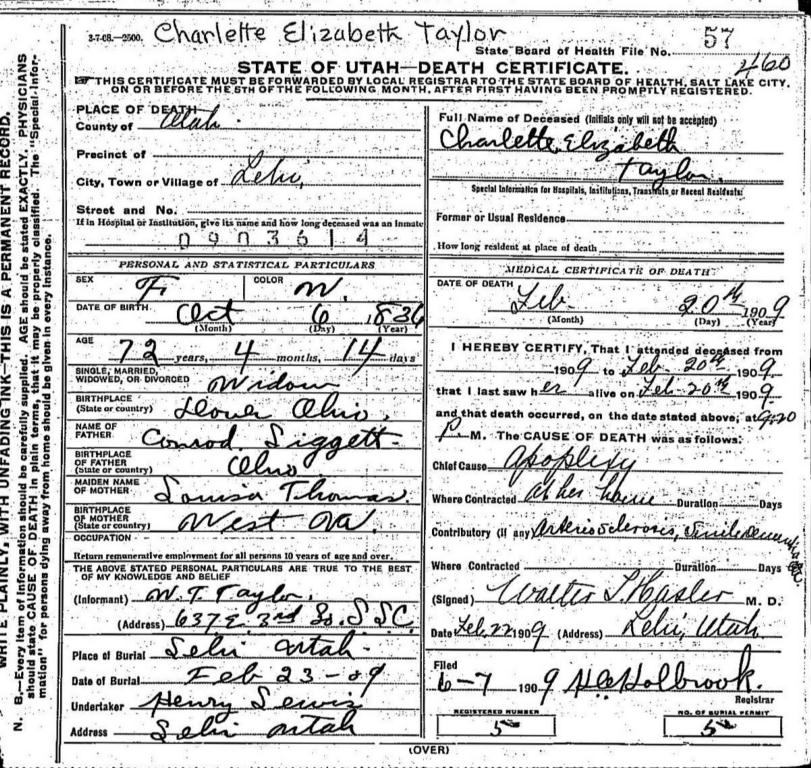
Charlotte died at home in Lehi, Utah on February 20, 1909 due to apoplexy, a term formerly describing a cerebral hemorrhage or stroke. Charlotte is interred at Lehi City Cemetery, with her second husband.

Charlotte’s Death Certificate