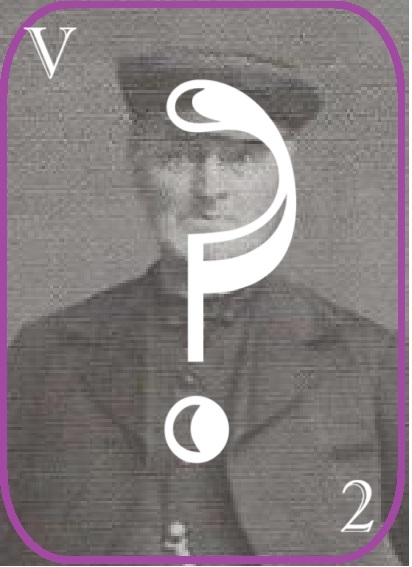
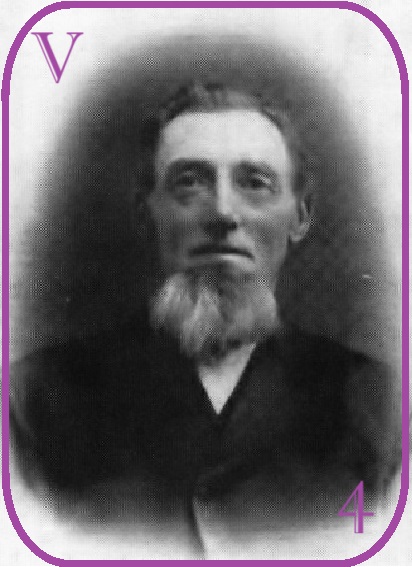
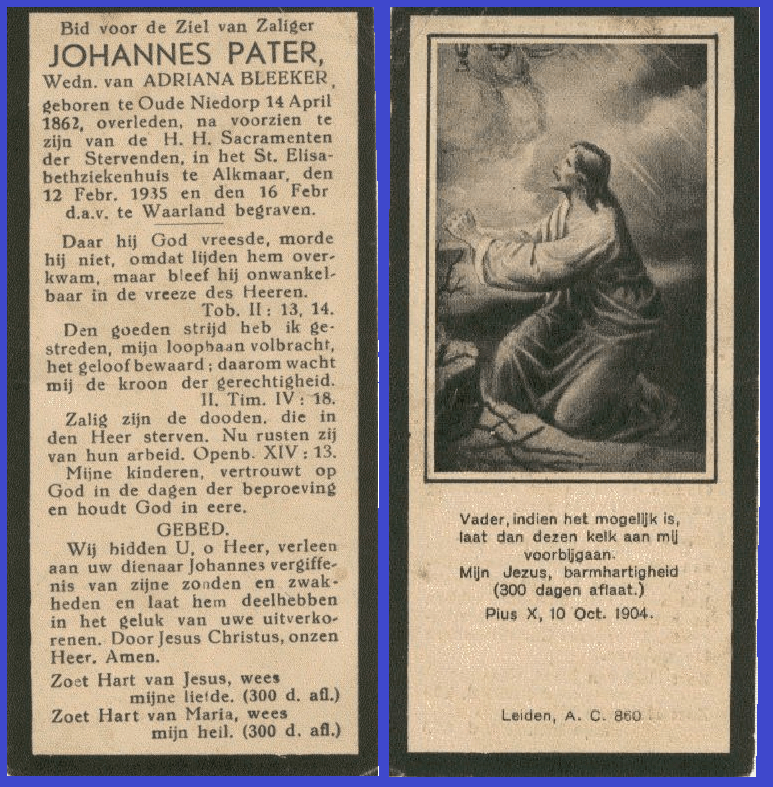
52W Mark IV – Week 4: Card V4 Johannes Jansz (Jan) Pater

Johannes Jansz (“Jan”) Pater (1862-1935)

I’ve always found it amazing when talking to my grandparents’ generation about their grandparents. I remember when my great aunt Addie casually mentioned in passing about how she’d usually go to her grandmother’s house every day after school. It immediately popped into my head that she was talking about someone who was born in the mid-19th century. It felt like a bridge through time.

Likewise for my Gx2 grandfather, Johannes Jansz (“Jan”) Pater. I found an article in a Dutch magazine, Toendertoid: Stichting Waarland van Toen (“Then and There: Foundation of Waarland“) containing an interview of my great uncle Jan van der Fluit (“Ome Jan” 1918-2011), where he shared childhood recollections of his grandfather Jan Pater. I met Ome Jan on my first trip to Waarland. He was still living in the house where he was born and spent his childhood. Reading Ome Jan’s story made me feel like there was no barrier in time and space between me and my Gx2 grandfather.
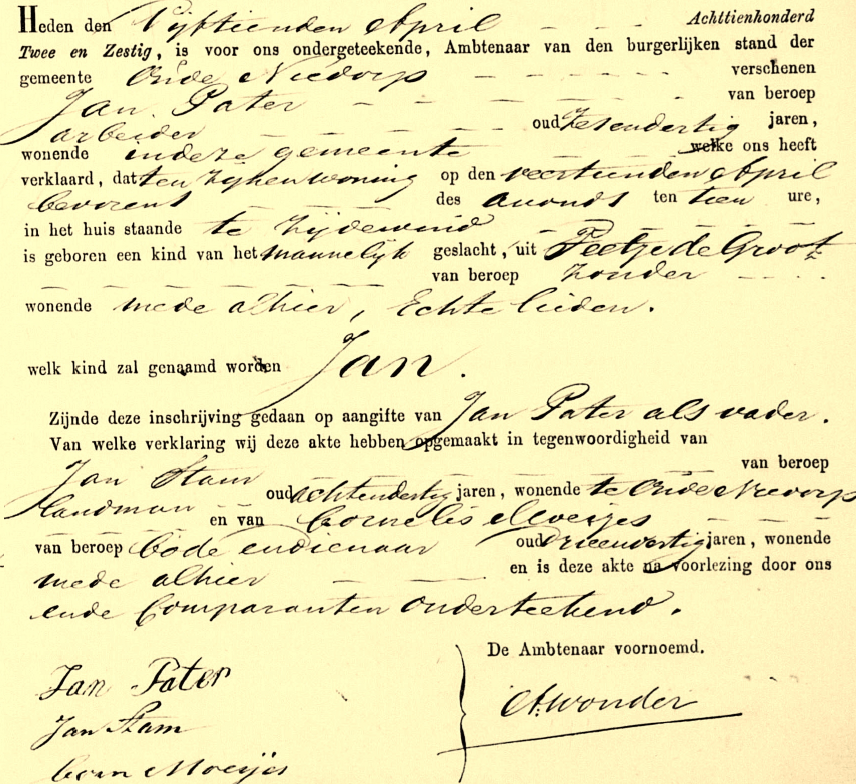
Jan’s birth registration

Jan Pater was born on April 14, 1862 in Oude Niedorp, Noord Holland. By 1882, Jan was working in Oude Niedorp as a farm labourer, as noted in a militia register. Military service was compulsory. Jan’s military service was as a conscript under the national service (the militia), somewhat equivalent to reserve or national guard duty. Adrianus was assigned to the “torpedo corps”. The militia register shows that Adrianus was 172 cm (5′ 7 1/2″) tall with a flat face, low forehead, gray eyes, a “just” nose, and blond hair.

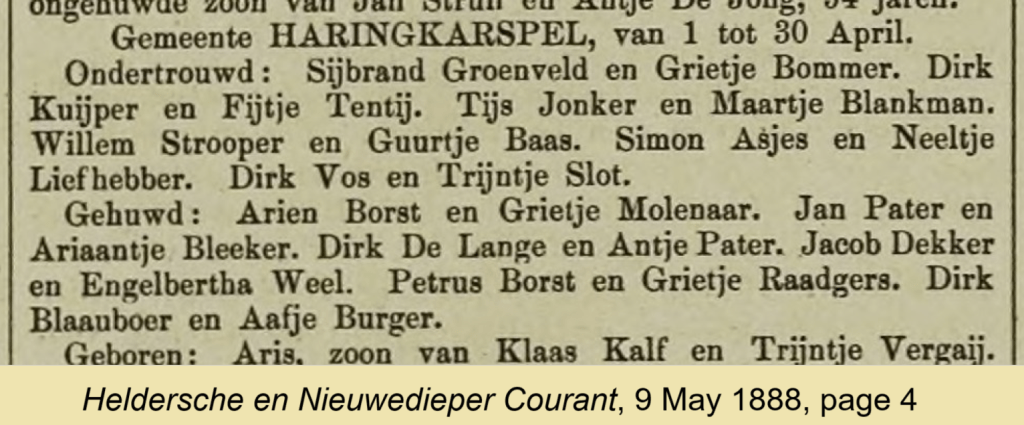
Jan remained in Oude Niedorp at least until 1888, working as a farm labourer. On April 19, 1888, he married Ariaantje Jacobs (“Adriana” or “Jaantje”) Bleeker in gemeente Harenkarspel, Noord Holland. At the start of their marriage, they briefly lived with Adriana’s parents, but by the time their first child was born they had moved out on their own. Together Jan and Adriana had four children, three boys and one girl (my great grandmother, Teetje Pater). The eldest only lived a few weeks; the others lived to adulthood.
After he and Adriana were married, Jan continued to work as a labourer. Sometime around 1917 he began farming in Slootgaard, a village within Harenkarspel. It is now part of gemeente Schagen.

According to Ome Jan’s account, Jan Pater had over three acres of land where he carried out mixed farming. Jan’s youngest son – and Ome Jan’s uncle – was also named Jan, who helped on his father’s farm. The elder Jan had four cows and a horse, while the younger Jan had 100 brown and white chickens.

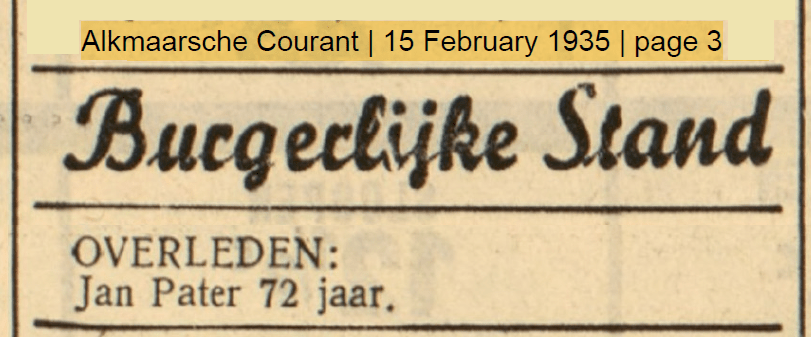
My records indicate Jan continued farming in Slootgaard at least until 1930, when he was in his late 60s. However, the registration of his death in 1935 indicates that he was still farming at that time. Jan’s death was due to an unfortunate accident with a horse at a railway crossing.
Addendum March 2, 2025: Always pay attention to the FAN club: “Friends, Associates, and Neighbours”! When an ancestor has a lot of siblings, it can be tedious to do all the research on them, too. Often I’ll do a quick-and-dirty entry into my database and then leave it languish for years.

Tonight I was flushing out my research on Jan’s siblings. For the four oldest, it was mostly entering information from death records, as the first two died very shortly after birth and the next two died shortly before their 17th birthdays. It wasn’t until the fifth child, Antje, two years older than Jan, that any child of Jan Pater and Teetje de Groot survived to adulthood.

Going through Antje’s marriage registration, I saw that one of the witnesses was her younger brother Jan. Then I expanded the image on the screen and noticed the signatures on the proceeding page were the same. What? Zooming in, I realized it was Jan and Adriana’s marriage registration! A double wedding. Siblings Antje and Jan got married the same day!


Signatures of the parties and witnesses of the double wedding of siblings Jan Pater (left) and Antje Pater (right)

52W Mark IV – Week 3: Card V3 Maartje Veldman

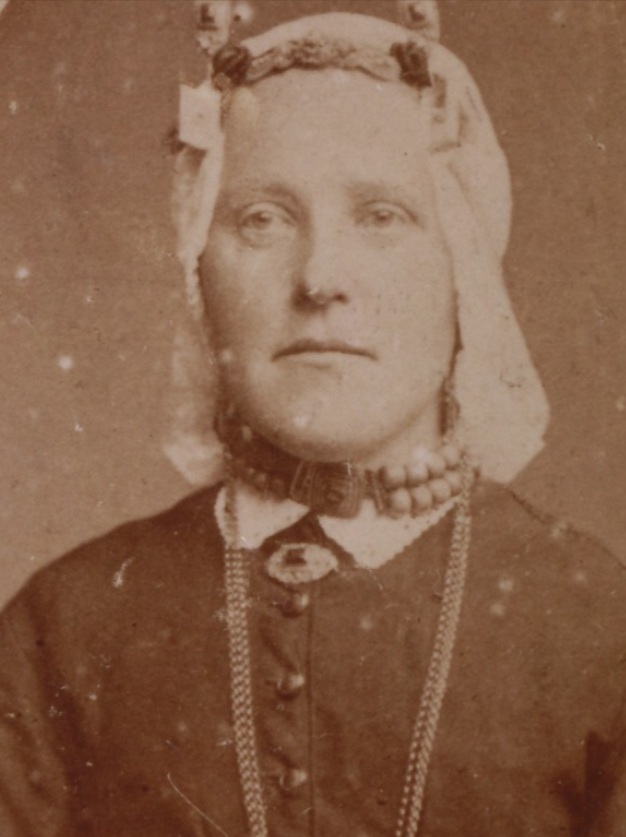
I have photos of thirteen of my sixteen great great grandparents. Maartje Veldman (1862-1904) is one of three for whom I don’t.

Maartje Veldman was the mother of Johannis Albertus van der Fluit and my father’s great grandmother. She was also the second wife of Jan Dirksz van der Fluit. Maartje was born on December 22, 1862 in Nieuwe Niedorp, Noord Holland, the third child of Jan Veldman and Trintje Stoop.

Like many unmarried Dutch women of her social status, and several of my other female ancestors, Maartje worked as a dienstbode (domestic servant) before she was married. Fortunately for genealogists, many gemeenten (plural of gemeente, a form of municipality usually comprised of several communities) kept a Dienstboderegister as part of their Burgerlijke Standregisters (Civil Registration Registers). This was due, in part, because many domestic servants lived with the families they served.

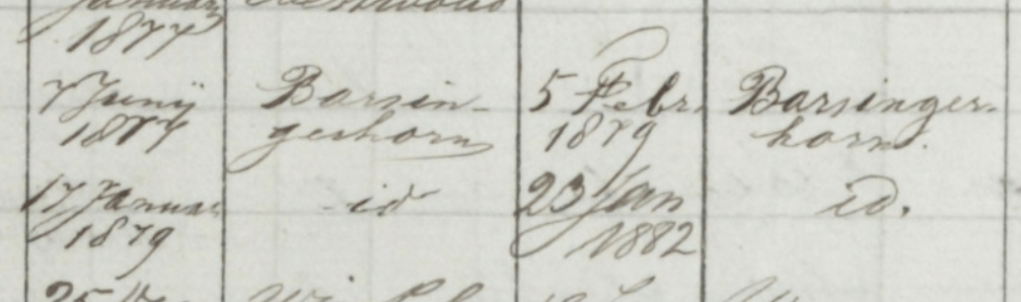
What caught my eye about Maartje’s registration is that she started work as a domestic servant much younger than my other ancestors. She was 14 years old when she began her first job on June 7, 1877. Her family was resident in Barsingerhorn, but her work was for a family that lived about 7.5 kilometers south, in Oude Niedorp. Maartje remained with that family until February 5, 1879, a couple months after she turned 16.

Another thing that caught my eye was that two weeks before Maartje left Oude Niedorp, her older sister Elizabeth (1861-1935), moved to Oude Niedorp to work as a domestic servant. Elizabeth is directly below Maartje in the Dienstboderegister. Elizabeth was 17 years old at the time. Elizabeth remained there until January 23, 1882, when she returned home to Barsingerhorn. Elizabeth married her first husband, Arie Zut, three months later, on April 21, 1882.

Maartje and Elizabeth in the Oude Niedorp Dienstboderegister (Servant Register) 1860-1889.

I haven’t found any indication that Elizabeth had worked as a domestic servant prior to this posting. What seemed odd is that the younger sister left home for work before the elder sister.

Coming and going. The top line is Maartje, the one below is Elizabeth.

There was no rest for Maartje when she left Oude Niedorp and returned home to Barsingerhorn. She immediately began work for a new family that was also resident in Barsingerhorn, which meant that Maartje was able to live at home with her parents during this job.

The Dienstboderegister does not indicate how long Maartje worked as a domestic servant in Barsingerhorn. All I know is that she was no longer working when she married Jan.

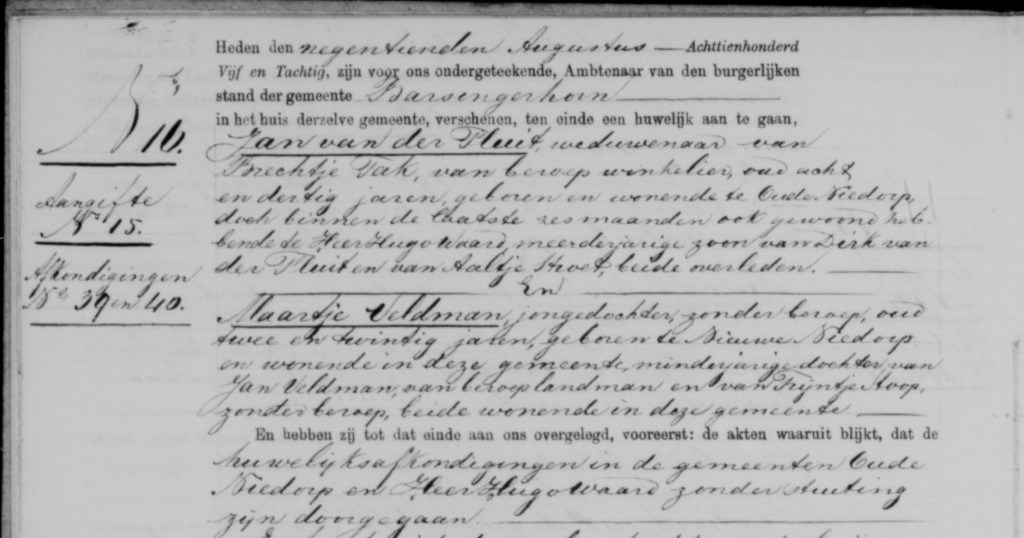
Top of the entry for the registration of Jan and Maartje’s marriage.

Jan and Maartje had seven children together, but the first two died shortly after birth. The rest survived to adulthood and married. The youngest child, a daughter named Brigettha Maria, was born on July 4, 1904. Maartje died one month later, on August 5, 1904, in Oude Niedorp. She was 41 years old. While I do not have a cause of death, I cannot help but wonder if it had been related to childbirth.

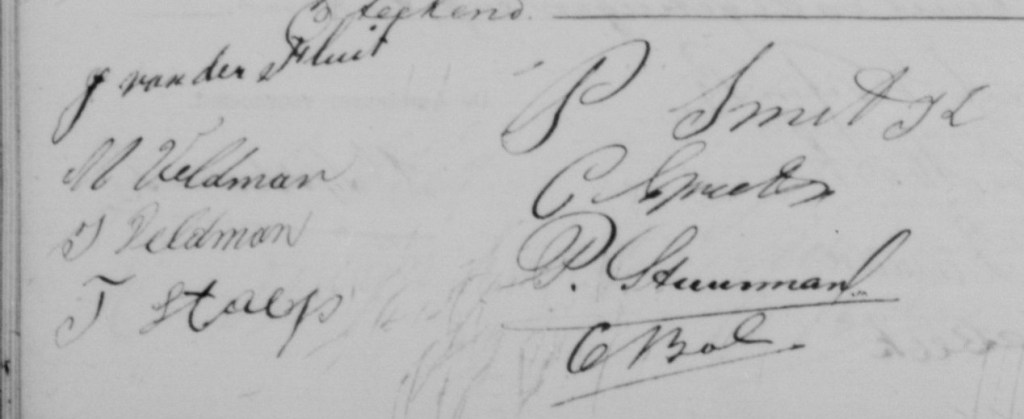
The signatures of Jan, Maartje, and the witnesses on the marriage registration.

UPDATE!

February 15, 2025: Eureka, I’ve found a photo of Maartje!

It’s Maartje Veldman!

52W Mark IV – Week 2: Card V2 Jan Dirksz van der Fluit

Jan Dirksz van der Fluit (1848-1935)

Jan Dirksz van der Fluit was born in Oude Niedorp, Noord Holland, Netherlands on September 14, 1846 to Dirk Pietersz van der Fluit and Aaltje Klaasse Stroet.

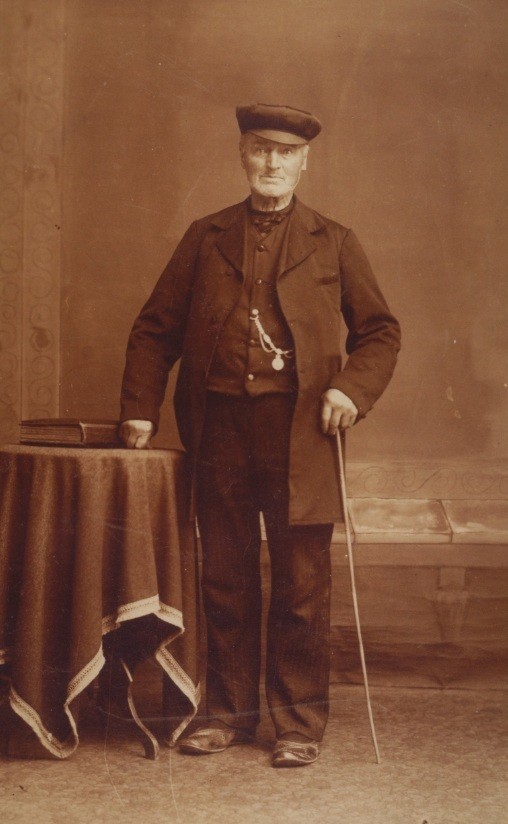
While I have a significant amount of information and source material for Jan, the one great mystery is whether the man seen in the image above is, in fact, Jan Dirksz van der Fluit. In an email, the person who provided it to me questioned whether he had correctly identified Jan as the person in the photo. He indicated that it is possible that the man is actually Jan’s brother-in-law, Klaas Dekker (1832 – 1912). Klaas was married to Jan’s sister Geertje (1841-1928). My correspondent did not indicate where he acquired the image. So this card is either Jan van der Fluit or Klaas Dekker.

The other mystery about Jan is how he spent his life between the day he was born and his first marriage to his first wife, Bregtje (also “Brechtje” or “Brigetta”) Tak, who he married on April 9, 1880. That’s a 33 year gap in time for which I have no information. At most, at the time of his marriage to Bregtje, Jan had been a farmer and a labourer, most likely in Oude Niedorp or Niuewe Niedorp.

[Update February 20, 2025: Today I found a Bevolkingsregister for Oude Niedorp for 1860-1885, with an entry for Jan’s mother, Aaltje Stroet and all her children. This was after Jan’s father had died. It indicates that up to age 15, Jan was most likely living with his mother in ‘t Veld. From age 15 to 18, Jan lived in Heerhugowaard. I will have to look for a Bevolkingsregister for Heerhugowaard to see if I can learn more. In February 1865, Jan moved back home with his mother and siblings in ‘t Veld.]

Bregtje was born in Oude Niedorp in May 20, 1855. She was 24 when she married Jan, who was 33 at the time. Jan and Bregtje had three children: Dirk, Geertruida, and Petrus. It was not a long marriage, as Bregtje died on December 8, 1884, nine days after Petrus was born. Given the close connection in time, it may be that it had been a difficult childbirth that ultimately resulted in Bregtje’s demise.

Jan married for a second time nine months later, to Maartje Veldman (1862-1904), in Barsingerhorn, Noord Holland on August 19, 1885. Maartje was 22 when she married Jan, who was then 38. I am descended from Maartje, who is Card V3 – so more on her next week. Jan’s marriage to Maartje lasted almost 20 years, ending when Maartje passed away.

Heldersche en Nieuwedieper Courant, September 9, 1885, page 4.
“Engaged and Married: Jan van der Fluit, widower of Brechtje Tak, 38 years old, and Maartje Veldman, never married, 22 years old.

Jan and Maartje had seven children together, although the first two did not survive infancy. Their fourth child was my great grandfather, Johannis Albertus van der Fluit. Jan outlived Johannis by three years. Maartje passed away on August 5, 1904, exactly one month after the birth of her youngest child, Brigettha.

Jan married for a third time, to Aagje Rood in Oude Niedorp on January 24, 1907. Aagje was born on December 20, 1863, in Heerhugowaard, Noord Holland, making her 43 when she married Jan. Aagje was a widow at the time she married Jan, having been previously married to Arie Pater. I have not done much research into Arie, but would not be surprised if he is somehow related to me given that my father’s maternal line is Pater. However, to date I have yet to find any connection between Arie and my Paters. Unlike Jan’s previous wives, Aagje outlived Jan – by two and a half months. She died on May 4, 1935.

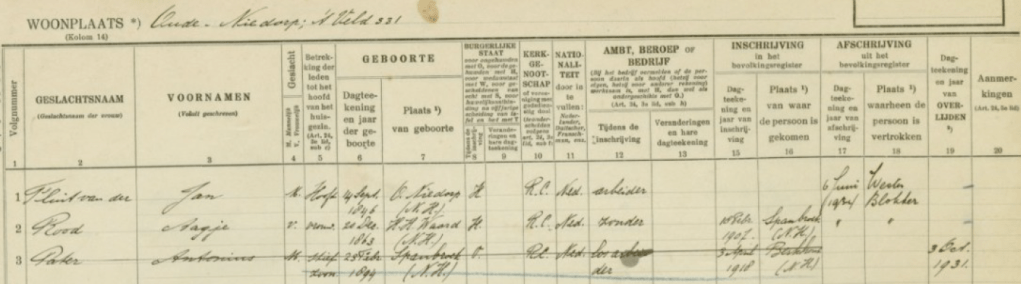
Bevolkingsregister for Oude Niedorp for 1931 to 1938

At the time of his second marriage, Jan was a merchant and shopkeeper. I know he was involved in that line of work until at least 1894, but I do not know the extent or details of that occupation. By 1904, he had returned to work as a labourer, which he apparently did until a year before he died. Since he died in 1935, that would mean he was still working when he was 87. The Bevolkingsregister (population register) for Oude Niedorp for 1910 to 1930 shows that he was a labourer during that entire time. The Oude Niedorp Bevolkingsregister for 1931 to 1938 indicated that he was still a labourer, at least until June 1934 when he moved to Westerblokker, which is about 16 kilometers from Oude Niedorp.

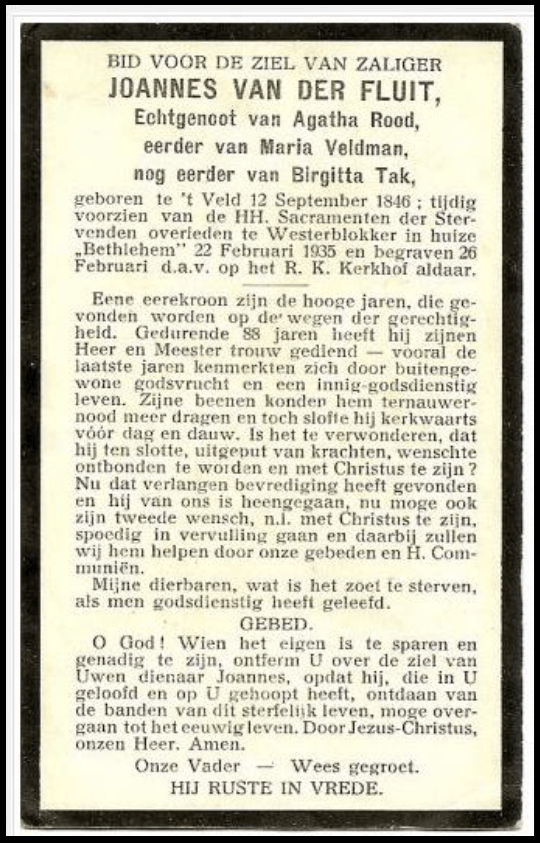
Jan’s bidprentje

However, I doubt that was so. It seems unlikely that he would still be working as a labourer in his mid-80s. The bidprentje (prayer card or in memoriam card) given out when he died. It indicated that in his last years “his legs could barely carry him”, yet he was still able to “shuffle” or “trudge” to church every day before dawn. His death registration also clearly indicated he was no longer working at the time he died.

Jan’s work was not limited to being a labourer during this period. In 1907, he was also working as a milkman; in July 1917 he was once again doing some form of work as a merchant.

On June 6, 1934, Jan and Aagje moved to Westerblokker. I still have to find the Bevolkingsregister for Westerblokker from that time. It’s on my to-do list; however, it is not yet available to the public because it includes a time period that is restricted under privacy laws. Jan died seven months later, on February 22, 1935. His bidprentje says that he passed away in “Bethlehem” house. Bethlehem was a monastery, which must have had some sort of palliative or care home. Jan was buried in Westerblokker.

UPDATE!

February 15, 2025: Late last week I was able to verify that yes, indeed, this is a photo of Jan Dirksz van der Fluit! Not only that, but it resulted in finding a photo of his wife Maartje Veldman!

Jan Dirksz van der Fluit!!

52W Mark IV – Week 1 (Part Two): Card V1 Johannes van der Fluit and Teetje Pater

Theresia “Teetje” Pater (1894 – 1947)
Johannis Albertus van der Fluit (1894 – 1932)

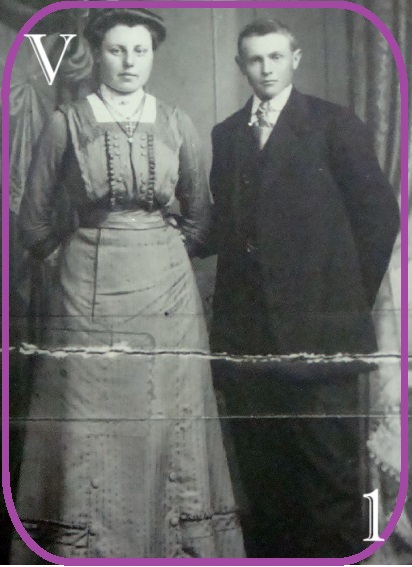
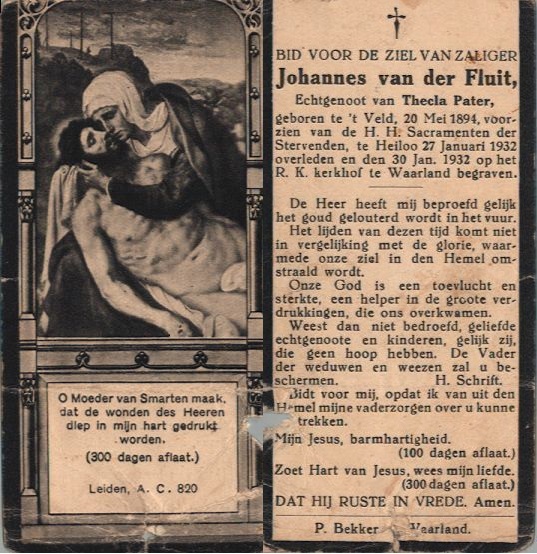
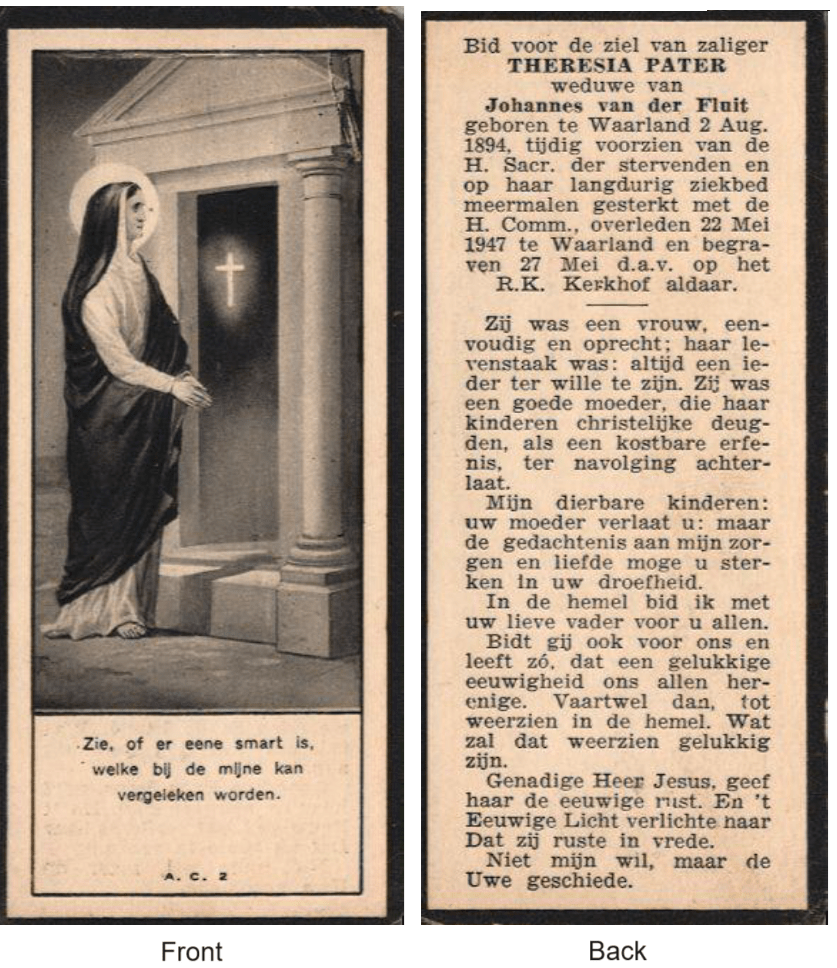
Johannis Albertus van der Fluit (1894-1932) and Theresia “Teetje” Pater (1894-1947) were my father’s paternal grandparents. Teetje was two months older than Johannis. She was born on February 15 and he was born on April 14. My father never met either of them as they both died before he was born.

Johannis was born in ‘t Veld, North Holland. He was an agricultural worker most of his short life. Teetje was born in Waarland, North Holland, the same village where my father was born. Johannis and Teetje were third cousins. They were both direct descendants of Cornelis Klaasz de Groot and Geertje Jans de Wit, their great great grandparents and my Gx5 grandparents. Teetje is descended from their eldest son, Jan, while Johannis is descended from their youngest daughter, Elisabeth. This makes me my own sixth cousin!

The Netherlands used to have mandatory military service, although in practice most conscripts never really served; rather, it was more like a reserve militia or national guard. Johannis was conscripted in January 1914, when he was 19 years old. Johannis was assigned to the 21st Infantry Regiment based out of Den Helder. On my understanding of the militia register, Johannis remained enlisted until he died in 1932, at age 37. The militia register also shows that Johannis was 171 cm (5’6″), which today seems rather short for a Dutch man. He would certainly have been dwarfed by my father, my brothers, and me!

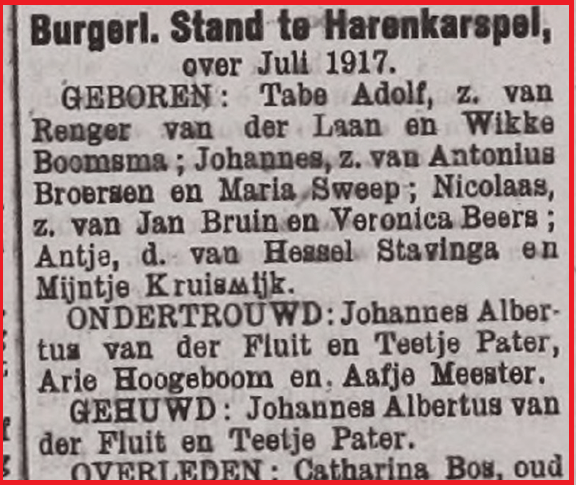
Johannis and Teetje’s engagement and marriage. Heldersche Courant August 8, 1917 page 4

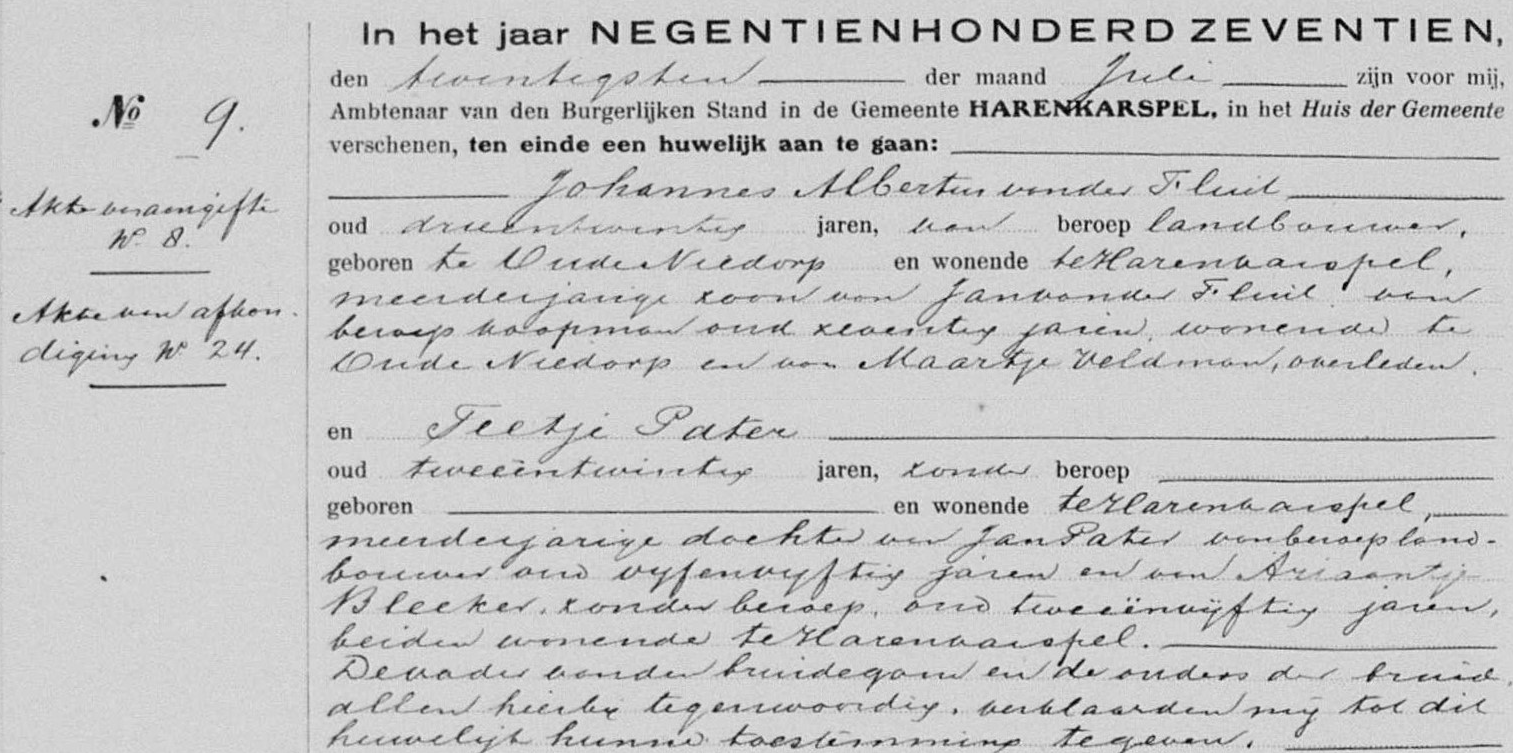
Johannis and Teetje married in Harenkarspel, North Holland, on July 20, 1917. The witnesses were Jacob Smit, “brievengaarder” (an official charged with receiving or issuing mail at a location where there was no post office; their home served as an auxiliary post office), age 31, and Simon Brommer, [occupation illegible], age 61, both resident in Harenkarspel.

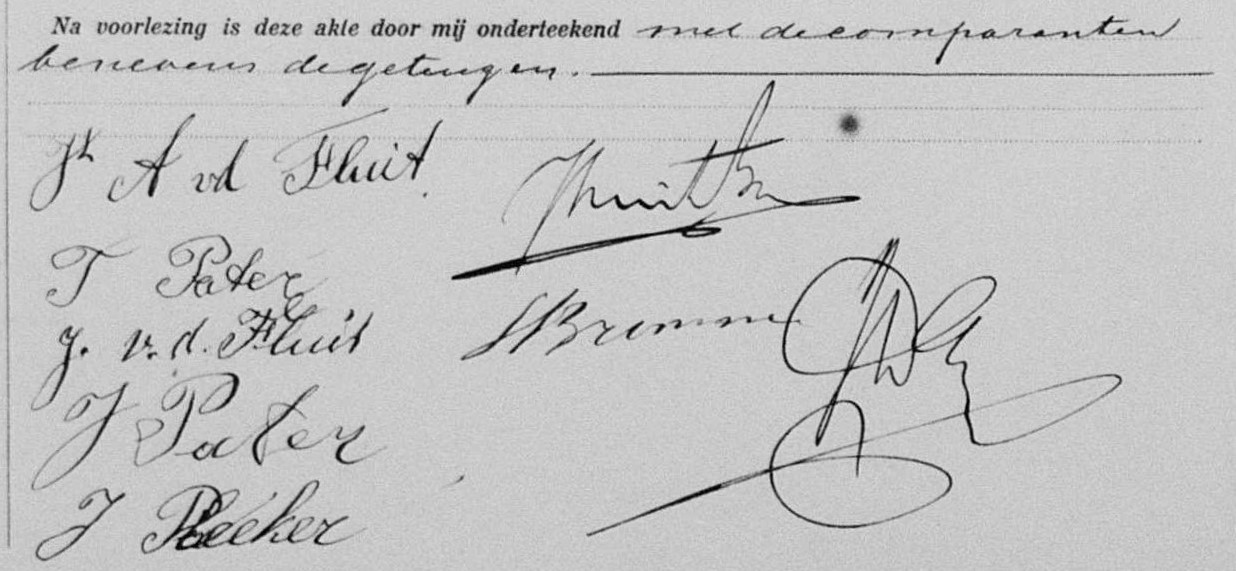
Marriage registration for Johannis and Teetje. The signatures on the left are Johannis, Teetje, Jan van der Fluit (Johannis’s father), and Jan Pater (Teetje’s mother). I’m uncertain about the one on the bottom, “T. Bleeker”, because Teetje’s mother was named Adriana. Adriana was still alive at the time and Teetje did not have any immediate family whose initial was “T”.

The Oude Niedorp Bevolkingsregister (“population register”) for 1910-1930 shows that in 1917 Johannis was working there as a hired worker. Johannis and Teetje relocated to Harenkarspel on November 13, 1919. According to the Harenkarspel Bevolkingsregister for 1920-1939, Johannis was a labourer in the employ of others when he moved into the gemeentje (municipality), but later became a self-employed farmer.

Apparently, Johannis sustained some sort of head injury after an accidental blow to the head. My belief is that this occurred sometime in or after 1930, when Johannis and Teetje’s youngest child, Anny, was born. My records also show that Johannis was still working as of 1930. In fact, the Bevolkingsregister for Harenkarspel shows that Johannis had lived there until January 19, 1932, when he relocated to Heiloo, where he died eight days later, on January 27, 1932. This timeline suggests that Johannis’s head injury may have occurred shortly before he was placed in the sanitorium.

Since Johannis died so young, I do not know many people who knew him. He died when my grandfather, Adrianus “Arie” van der Fluit (1923-2002) was eight years old. I only heard passing mentions of Johannis a long time ago, most likely second-hand because I don’t recall my grandfather ever talking to me about his father.

After his injury, Johannis began to exhibit strange behavior and suffered from delusions, which were very unsettling to him. Most likely he had developed a mental disorder. One account I heard was that during a delusional episode it took my grandfather’s two older brothers and some neighbours to restrain Johannis.

At some point in time, Johannis was placed in a sanitorium, where he continued to suffer from delerium. It is most likely the sanitorium was in Heiloo, the town where Johannis died. I know that Heiloo had a sanitorium at the time.

Sometime shortly before his death, Johannis experienced a period of rational thought. Teetje was summoned to see him, which occurred close to the time Johannis died. Teetje was 37 when she was widowed and was left to raise eight children on her own, the youngest of whom was one year old at the time.

Sometime after Johannis died, Teetje’s younger brother Johannes “Jan” Pater (1900 – 1948) moved in with Teetje and her children. Jan, who had a hunched back, had never married. Presumably he moved in with Teetje to help her after Johannis died.

Teetje died on May 27, 1947, after a long illness. She was buried at St. Wulfram’s Roman Catholic Church in Waarland, which I believe is the same place where Johannis was buried. Anny, their youngest child, was 17 when Teetje passed away.

Bidprentjes (prayer cards) for Johannis and Teetje.