52 Weeks – Week Nine

Women

A new month brings a new theme for the 52 Ancestors Challenge, “Women”. The first week of the month shares that theme. It took a fraction of a second for me to think of who I wanted to write about this week.

I often see questions posed in genealogy forums about the preservation of records. Every time I see one, it reminds me of my Aunt Diana. The world knew her as Helen Burgess, a scientist and a leading expert on paper preservation, but with family she went by her middle name because she shared her first name with my grandmother. While Aunt Diana passed away more over 20 years ago – not yet even 50 years old – I can still find her work is cited in modern papers.

Helen Diana Burgess, B.Sc., M.Sc., M.A.C.
(1951 – 1999)
Me with my Aunt Diana. My grandparents’ house is in the background. I have no idea why we were in the neighbour’s yard.

I idolized my Aunt Diana when I was a kid. At the time, she was an undergraduate student at the University of Lethbridge. She was the only person I knew in university at the time. However, to me, her academic pursuits and later career were only part of her identity. I modeled a lot of my behaviour after her, from sharing her interests to developing a love of some of her favourite foods.

Aunt Diana excelled at nurturing children’s intellect without any us even realizing it. Many of my favourite gifts as a kid came from her, including many books. I still have a lot of them. While Aunt Diana read all kinds of books, her favourite genre was mystery novels. She had walls of bookshelves filled with them, and a few of the books she gave me were in that vein. These included the Alfred Hitchcock and the Three Investigators series, about three boy detectives, which were everything boring old Hardy Boys books were not. I’ve passed those on to my sons. She also gave me a copy of L.R. Wright’s award-winning novel, The Suspect. That book kind of blew my mind, because it was a murder mystery set in Sechelt, Canada not far from where I lived, and not Sometown USA.

Aunt Diana also instilled in me her love of art. She loved to draw and paint. When I turned ten, she gave me a set of oil paints, complete with canvases, brushes, turpentine, and linseed oil. I often received postcards from her from around the world, as her work took her to some of the greatest museums of the world. I still have every one of those postcards. I was lucky enough to visit a few museums with her. It was something to have her as my own personal tour guide and art expert.

Diana graduating from the University of Lethbridge, 1973

Aunt Diana obtained a Bachelor of Science (Honours) in chemistry in 1973. Diana followed this with a Masters of Science in bio-organic chemistry from U.B.C. in 1977 and a Master of Conservation from Queen’s in 1979. Her thesis at Queen’s was about the “degradation of cellulose during conservation bleaching treatments”. To mark its 40th anniversary, the Queen’s Art Conservation Program conducted an interview series regarding leaders in conservation with a link to the school. One of the sets of interviews was about my aunt, conducted with her friends and colleagues.

Some of my Aunt Diana’s books, including her two masters theses, which now sit on my mother’s bookshelf. After getting an “A” in Grade 12 chemistry, I could almost understand the title of her U.B.C. thesis.
Science!

In 1978, Aunt Diana started her career with the Canadian Conservation Institute in Ottawa. By the time she took early retirement in 1998 due to her health, Aunt Diana was a Senior Conservation Scientist. She specialized in the conservation of paper artifacts, but she also worked with other materials. Diana was an expert in conservation bleaching, the use of enzymes, deacidification, and cellulose degradation analysis.

It was a big deal to me and my family when Aunt Diana was one of the scientists featured on an episode of The Nature of Things. The episode, “Turning to Dust“, was about the deteriorating paper in old books and their preservation.

On a more practical level, Aunt Diana would often give my mother tips about what household products – particularly bleach-based products – were worth it and which were rubbish. She also taught me decades ago about the perils of adhesive photo albums and the wonders of acid-free and archival paper products.

Of course, because Aunt Diana was a scientist who was at the top of her field, it always seemed normal to me that women could be scientists. Every time I see a query about preservation of genealogical records, it makes me wish I could ask her and reminds me how much I miss her.

With Aunt Diana back when I only had two siblings. She was my brother’s godmother. Her we are after the baptism.

52 Weeks – Week Six (Part One)

Maps – Part One

Week six of the 52 Ancestors Challenge has us navigating maps. Like the Favourite Photo challenge, I had a hard time choosing. So this week I’ll be doing two entries.

Where I stand once stood the farmhouse where my maternal grandmother was born.
Beautiful downtown Rastadt, Saskatchewan. If the middle of nowhere has a middle of nowhere, this is it.
(Actually, this is suburban Rastadt, but no one really is counting.) Where I am standing once stood the farmhouse where my maternal grandmother, Helen Lerner, was born.
(Section 7, Township 17, Range 24, West 3)

My maternal grandmother, Helen Lerner, was born at the family farmhouse near Rastadt, Saskatchewan, which is about 16 kilometers (10 miles) east of Fox Valley. It’s where her her parents and grandparents – Germans from Russia – settled upon moving to Canada. There’s nothing left of Rastadt now other than the old schoolhouse and the cemetery.

Rastadt, Saskatchewan Cemetery, April 1, 1997. Located at 50°30’00.9″N 109°15’32.3″W
You can find the cemetery listing here.

In early 1997, I had a few months off after having left a job for a new endeavor. I visited my folks, who live in southern Alberta, during that time off. I had not been to Fox Valley since I was a kid, so while visiting my folks I thought it might be a fun family history road trip to do with my mother.

Fox Valley is about midway between Medicine Hat, Alberta and Swift Current, Saskatchewan.

One of the first things I did upon arriving at Fox Valley was visit the village hall. It was a wise decision. Not only were the staff extremely helpful, they had maps of all the farms in the district, labelled with the current owners and occupants of each section of land. It was an amazing thing to see, because many of the surnames on the map were in my family tree database.

Map of the farms and residents surrounding Fox Valley, Saskatchewan as of 1997. Fox Valley is just below and to the right of the large number “5”. While not easy to see, the Fox Valley Cemetery is marked with a small red box labelled “D”. The larger boxes to the east are where my great grand parents and great great grandparents farmed, along with the Rastadt Cemetery.
The same area, as seen on Google Maps. Fox Valley is in the oval on the left. My ancestors’ farms are on the right, along with the Rastadt Cemetery.

A history of Fox Valley was published in 2004, Fox Valley and Liebenthal, Saskatchewan: Remember When… In addition to the family history of the village’s residents, this extremely useful book includes a section in which it records all the residents of these parcels of land throughout most of the 20th Century. In conjunction with this map, the book, and census records, I’ve been able to plot out where my ancestors lived and farmed.

Detail from the map above.

The locations I’ve marked are based upon the 1921 census, except for Jacob Anton, who died a month before that census was taken. For him I used the 1916 census. My grandmother’s parents were Jerome and Emelia Lerner, whose farm is the southernmost one marked on the map.

A: Michael Lerner and Barbara Schmidt (my grandmother’s paternal grandparents)

B: Heronimus “Michael” Lerner and Emelia Anton (m grandmother’s parents, and where my grandmother was born.

C: The Rastadt Cemetery. (D, not seen in the detail, is the Fox Valley Cemetery.)

E: Jacob Anton and Margaretha (“Margaret”) Heck, my grandmother’s maternal grandparents.

Serendipity

My mother and I used this map to visit the schoolhouse, cemetery, and plot of land where my grandmother’s house had once been. After taking the photo of me, we drove a bit down the road where I used a driveway of a farmhouse to turn around. The farmer who lived there saw me and came out, thinking anyone he didn’t know who was out there must be lost.

After explaining that I actually meant to be in his part of the world, we got to talking. It turned out he was a cousin of my grandmother’s. He and his wife invited us in for coffee and they showed us all sorts of interesting family photos and mementos. Talk about serendipity! He even told me the farmhouse my grandmother was born in still existed – a farmer had bought the building and moved it to his land.

Even more fortuitous, he told me that a family history was being put together of the Boechler family, the Boechler Family History. Barbara Schmidt’s mother was a Boechler. The farmer gave me the contact information for the author. My timing was another stroke of luck. I made the call not long afterward and learned that the book was being finalized and would be going to press in a matter of days. It also turned out that Emelia’s branch of the family – from which I am descended – was a huge mystery. I was able to supply most of the information about Emelia and her descendants in time for publication.

Another form of map. This was taken inside St. Mary’s Church in Fox Valley, showing the location of each person interred at the Rastadt Cemetery.

In Part Two, I’ll be looking at another piece of prairie farmland, this time in Alberta on my mother’s paternal side.

More Than a Full Deck

Here’s the deal…

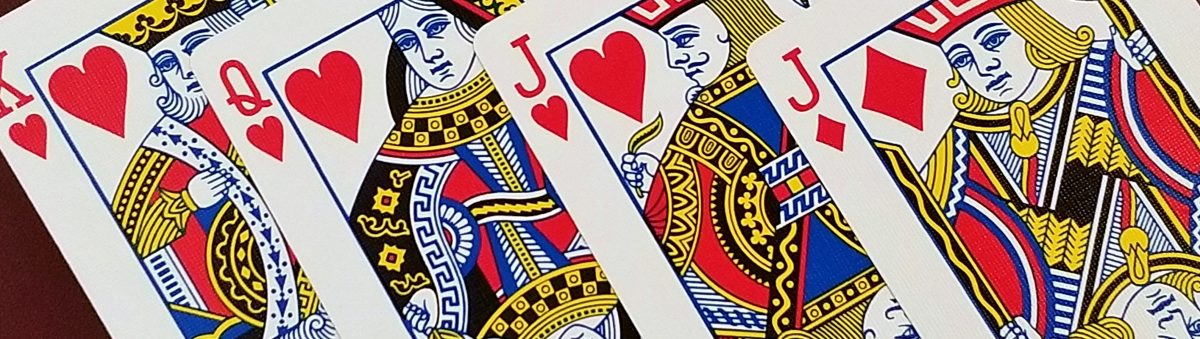
Three years in a row, I signed up for Amy Johnson Crow’s “52 Ancestors in 52 Weeks“. The first two times, that was as far as I got. Hopefully, third time’s the charm. Hence this blog, only a quarter century behind the times. As someone who enjoys games as much as genealogy, I naturally associated the number of weeks of the challenge with the number of cards in a deck.

I’d love to figure out how to centre this image – and justify this caption. [Edit: I figured it out!]

Despite the association with a deck of cards, I’ve identified more than 52 ancestors. In fact, I’ve managed to identify 55 out of my 64 great great great grandparents. So it seems I am playing with more than a full deck.

My interest in genealogy began when I was about eight years old. It was prompted along the way by questions I had as a child that, to me, had odd answers. When I was in elementary school, I asked my mom why my school principal always asked if I was Belgian. She said, “because you have a Dutch last name”. At the time, I thought Belgium was an entirely French-speaking country, so that answer made no sense. In grade eight, I switched from taking French to German. One day while visiting my great grandmother, my mother said, “Grandma, Sean is taking German in school.” I was bewildered why a woman who I thought was of English origin would care. I was even more surprised when she started speaking to me in fluent German.

Literally my first genealogy book, which I bought when I was 8 or 9.

My father’s side of the family is Dutch, going back generations, mostly from the part of the Netherlands that is now the provinces of North Holland and South Holland. However, several weeks ago I discovered connections to the Achterhoek, the easternmost part of the province of Gelderland that pokes into Germany. I have also recently been investigating a branch of the family that originates in Zeeland and what is now Oost-Vlaanderen (East Flanders). Sometime in the early 19th century, one of those Zeelanders ended up in the northernmost part of North Holland. His daughter, my third great grandmother, married into a family that has deep roots on the island of Texel.

My mother’s side is much more of a mix. Her mother’s side of the family are what is known as Germans from Russia. One branch came to Canada by way of Texas, the other branch came directly to Canada. My mother’s paternal side has roots in the United States, several branches of which go back to colonial times, including the Mayflower and Salem. My maternal grandfather’s direct paternal line goes back to a Hessian mercenary who initially fought for the British in the American Revolution, but later switched sides. That branch of the family were also some of the original members of the Latter Day Saints (the Mormons). They joined the church in its infancy, moving from New York to Ohio to Illinois. They were also part of the migration along the Mormon Trail to Salt Lake City.

I’ve also done a lot of work on my wife’s side of the family. At present, my intention with this blog is to focus on my side of the family. However, I will probably delve into my wife’s side from time to time because there are some fairly interesting stories there. Our eldest child, who shares my love of genealogy, is fascinated with a branch of his mother’s family that has deep roots on the island of Jersey. To be honest, I find it fascinating as well.