52W Mark II – Week 50: “You Wouldn’t Believe It”

Old newspapers are a great resource for genealogists. However, I do more than read just the item I’m looking for. I enjoy seeing what else was in the news on the same day as an ancestor’s birth, marriage, death, or other newsworthy action. Not only because it provides context for the familial event, but also because there are some really fun or interesting items to be found. There are all sorts of things you wouldn’t believe.

This is page two of the Newmarket Era (Newmarket, Ontario) for October 1, 1875.
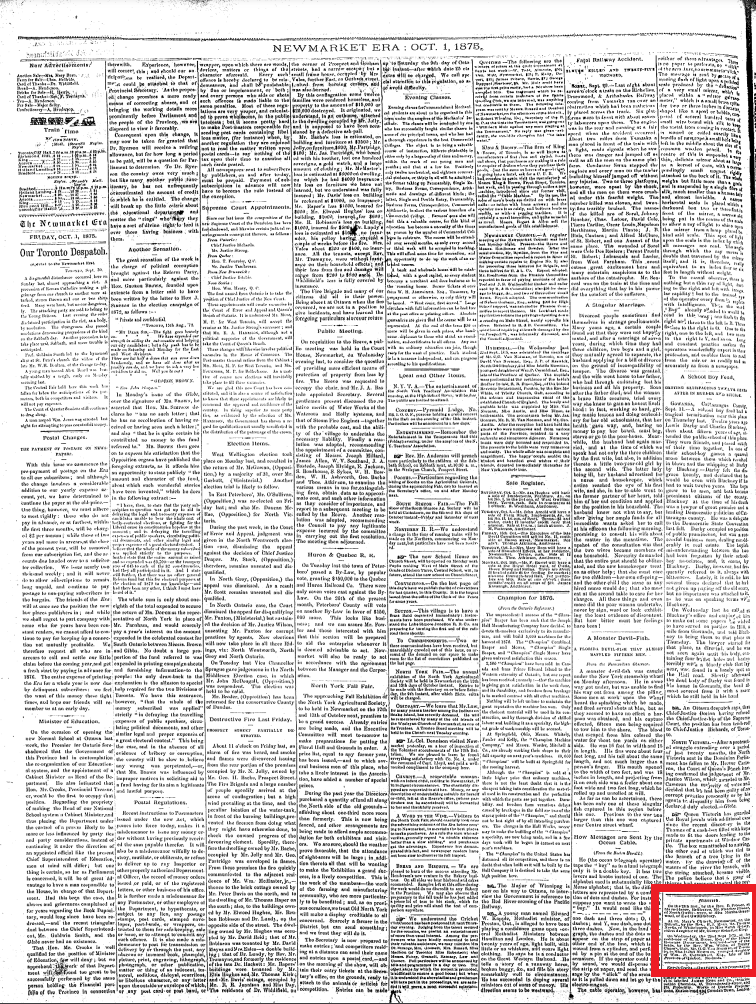
The item I was interested in is found in the bottom right-hand corner, marked in red. It announces the marriage of our sons’ great great great grandparents, Charles Crittenden Van Norman and Isabella Newman Carmichael.

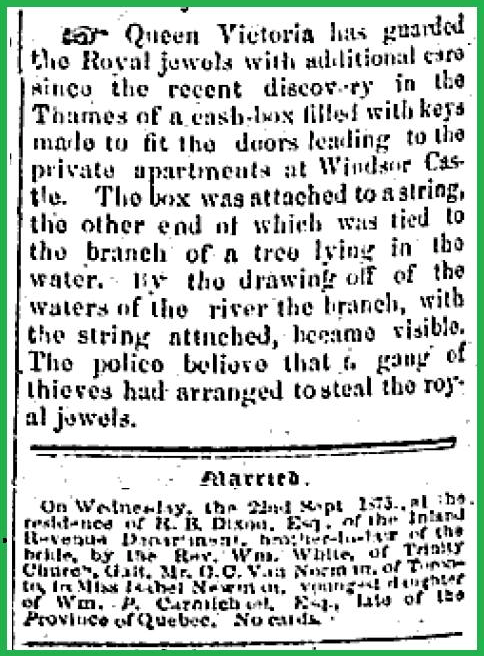
However, there are lots of fun, interesting, and odd bits on the rest of the page. The first thing I noticed is immediately above the marriage notice: a great bit about what appears to have been a foiled plot to rob Windsor Castle, when Queen Victoria was on the throne.
Buried elsewhere on the middle of the page was an item about the first appointees to the newly created Supreme Court of Canada. Note that there were no appointees from west of Ontario, although the only western provinces at the time were Manitoba and British Columbia.
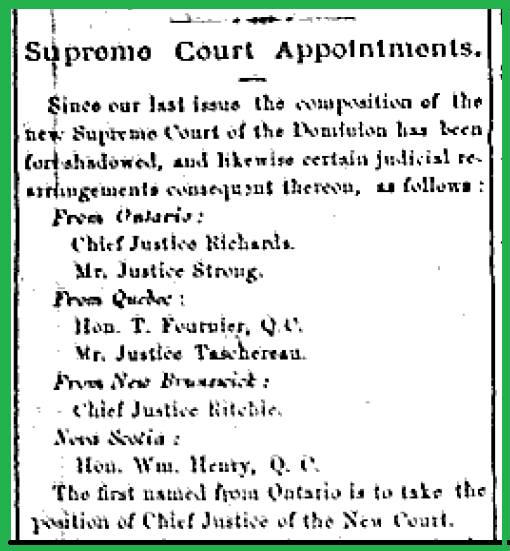
That’s right, you wouldn’t believe it, the Supreme Court of Canada did not come into existence until seven years after Confederation. It wasn’t even front page news. The placement of the item in the middle of the page, in the third column, below a piece on new regulations for local postmasters, indicates the relevant unimportance of the court at that time. It wasn’t even the highest court for the country. That role was held by the Judicial Committee of the Privy Council in the UK until 1949 – 82 years after Confederation. Elsewhere on the page is an item noting that the first choice for Chief Justice of the new court turned down then offer – he preferred to remain in his position as the head of one of the provincial appeal courts.
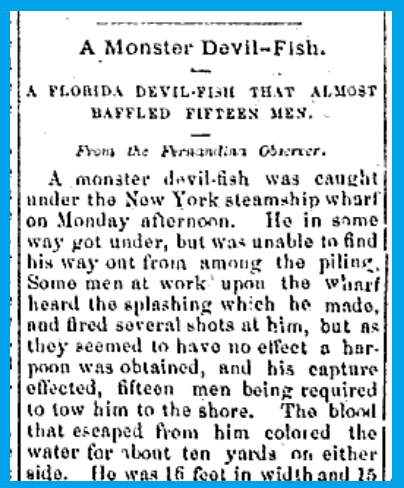
A few columns over is an item that you wouldn’t believe – “A Monster Devil Fish”. An incredible story about “A Florida Devil-Fish That Almost Baffled Fifteen Men”! The item ends by noting that “only only of these singular fish” had been captured before, “previous to the war.” Obviously, readers at the time would have known what war the story was referring to. Today, given that the item came from an American wire service, it’s most likely the reference was to the American Civil War.
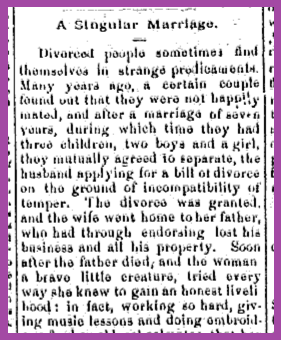
Above the Devil-Fish item is another story that not only you wouldn’t believe, you probably would not want to believe.  “A Singular Marriage” tells the story of a divorced single mother of three (a “brave little creature”). She ended up in such a state of poverty that she was left with the prospect of begging, starving or going to the poor-house, unless she took a job as the housekeeper and nanny for her ex-husband, his new wife, and their two-year old daughter. “All these things and even more did the poor woman undertake, never by sign, word or look exhibiting the least evidence of discontent. But bitter her feelings must have been!”

You wouldn’t believe it.
52W Mark II – Week 48: Troublemaker

Two “Troublemakers” come to mind for this week’s 52 Ancestors challenge. They are both ancestors of our children.

David Van Norman (Our Kids’ Gx4 Grandfather)

Up until the 1830s, the colonies of Upper Canada and Lower Canada (roughly modern-day Ontario and Quebec) were ruled by oligarchic elites. In Upper Canada, they were disparagingly called the Family Compact; in Quebec, they were called the Château Clique (even though they were largely anglophones, one of whom was John Molson, founder of the brewery company). Their rule was largely self-serving and the government was run through patronage. Discontent was further fueled by economic depression.

A Reform movement developed in both colonies. The Reformers initially tried to change the system politically, from within, including electing Reformers to the colonial legislatures. When this failed, rebellions broke out in both colonies in 1837: in Lower Canada in November and Upper Canada in December.

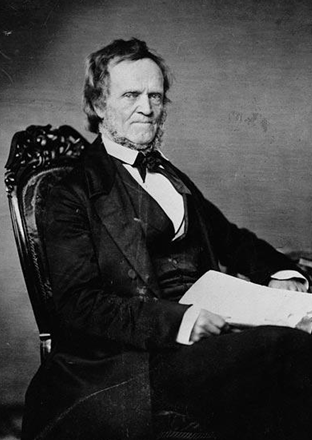
Reformer and Rebel William Lyon Mackenzie

William Lyon Mackenzie was the leader of the rebels in Upper Canada. He was a journalist, member of the colonial legislature, and the first Mayor of Toronto. He was also the grandfather of the longest serving Canadian Prime Minister, William Lyon Mackenzie King. After losing re-election to the legislature in 1836, he concluded that political change could only occur through conflict. His small militia was quickly defeated. Mackenzie and some followers fled to the United States. In mid-December, the rebels established the Republic of Canada on Navy Island in the Niagara River. The British attacked and the rebels retreated to the US, where Mackenzie was arrested and jailed for violating the its Neutrality Act, which prohibited attacks against any country at peace with the United States. President Van Buren pardoned Mackenzie, who returned to Canada after reforms had been instituted and the colonies of Upper and Lower Canada had been merged to form the Province of Canada.

David Van Norman was born to Loyalist parents in Kingston, Upper Canada, in 1815. The Loyalists were those who supported the British crown during the American Revolution. After the war, many migrated to Canada. David began his working life as a school teacher. Later in life he turned to farming. David was sympathetic to the Reformers. David was imprisoned during the 1837 rebellion; however, I have been unable to determine whether he actually participated in the fighting. Whatever the circumstances, the government clearly considered him to be a troublemaker.

Apparently David knew Mackenzie and the two remained good friends until the latter died in 1861. David passed away in Keswick, Ontario.

Richard Newman (Our Kids’ Gx10 Grandfather)

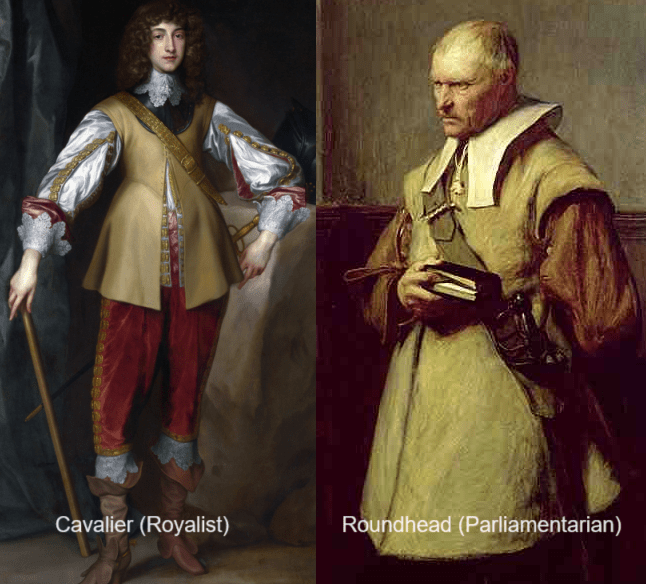
Richard Newman (c. 1620 – 1695) was a barrister who supported King Charles I during the English Civil War between the Royalists and the Parliamentarians led by Oliver Cromwell (also referred to as the Cavaliers and Roundheads). Richard’s aid to the King included financial support by way of loans. Richard was appointed High Steward of Westminster during the Civil War.

Richard also fought alongside the King’s heir, Prince Charles (later Charles II) at the Battle of Worcester in 1651. Richard served with the rank of colonel. After the Royalist loss there, Richard assisted the Prince by helping him to escape to France and by sending him money during his exile. Richard was imprisoned by Cromwell for his troublemaking. Richard was later released, presumably when Charles II returned to the throne in 1660.

52W Mark II – Week 47: This Ancestor Stayed Home

Stayed home??? This is not the  52 Ancestors theme for me! My ancestors never stayed anywhere for very long! Even before moving to North America, my ancestors moved around a lot.

I follow in that tradition, having lived all over western Canada. By the time I moved away from home for university, I had lived in Lethbridge AB (two places), Regina SK, Medicine Hat AB, Creighton SK (on the Manitoba border), Duncan BC, Chemainus BC, Terrace BC, North Battleford SK (two houses), Terrace BC (again – and two houses!). The longest we ever lived in one house was the second place we lived in North Battleford. I was always the new kid in the class.

Even after I moved away from home I didn’t stop moving. While I lived in two different residences during undergrad, I spent the summers in Terrace, Coquitlam, and Vancouver, respectively. After graduation, I lived in North Vancouver for a short time until I relocated to Victoria BC for a six-month legislative internship (where I stayed at two different addresses). I then relocated to Vancouver for a few months until embarking on a seven-week trip to Europe. On my return, I stayed at my folks, who by then had moved to Williams Lake BC (with several moves still yet to come for them). I moved back to North Vancouver, followed by longer residencies in Vancouver, Burnaby, and Richmond BC.

By my count, to date I have lived at 25 different addresses since I was born. The longest was 13 years, a record I set in the 90s. I would be very happy to beat that record. Our children, on the other hand, have only moved once in their lives, and have attended the same elementary school for every grade. I can’t even imagine what that’s like!

I feel like I lived a Johnny Cash song.

52W Mark II – Week 46: This Ancestor Went to Market…

[Disclaimer: This post largely relates to the law in Canada. The applicable law and requirements for obtaining an ISBN and depositing a work with an archive will vary by country. This post is also only a general commentary on the law, it does not constitute legal advice.]

For many genealogists and family historians, creating a family history book is the dream. Most of these works are self-published, either in print or in digital form. Some genealogists only give away a small number of copies amongst family and friends. Others might create a family history book and make it available for purchase to a limited set of family and friends, often through online self-publishers (e.g. Blurb, Lulu, Shutterfly, etc.. Others will take their books to market and make them available for purchase to the general public and world at large.

My teaser trailer. 😉
[By the way, for the life of me I cannot figure out why images won’t centre for me anymore. I thought I had figured out the fix in my last post, but it seems that was a one-time thing. Sorry!]

What a lot of genealogists might not realize is that in certain – but not all – circumstances it is mandatory to obtain an International Standard Book Number (“ISBN”) and to deposit a copy of the publication with Library and Archives Canada.

An ISBN is a unique globally-recognized 13-digit numerical identifier assigned to a publication. An ISBN is used to identify each edition and format of any given work for use in distribution and marketing. I say “publication” because the requirement applies not only to print books, but also to graphic novels, picture books, digital and ebooks, audiobooks, DVDs, pamphlets, and brochures, among other things. A separate ISBN is assigned for every unique iteration of a work. This means that the same work published as a hardcopy print book, an audiobook, and an ebook will have three different ISBNs.

ISBNs are overseen by the International ISBN Agency. Assignment of ISBNs from country to country are through an affiliated agency. In the case of Canada, Library and Archives Canada is the designated ISBN agency.

The legal requirement for assignment of an ISBN to a publication originates in section 10 of the Library and Archives of Canada Act, S.C. 2004, c. 11. Further detail is set out in the Legal Deposit of Publications Regulations, SOR/2006-337. The statute mandates “legal deposit” of published works by qualifying publishers with Library and Archives Canada. As part of this process, Library and Archives Canada requires the publisher to obtain an ISBN for the publication.

Under the legislative and regulatory scheme, a publisher subject to these rules is one who make a publication available in Canada, publish from an official place of business in Canada, have 75% of their employees based in Canada, and are authorized to reproduce publications or productions and control the content. For self-published materials, these rules apply to those who reside in Canada.

For print publications, publishers must deposit one copy if they produce 4 to 99 copies of the publication. If the publisher issues 100 or more copies, they must submit two copies. Further information is available at “About Legal Deposit” on the Library and Archives Canada website, which also sets out the manner in which a publisher deposits a publication.

Library and Archives Canada website also provides information about ISBNs, including the online form used to apply for an ISBN account. The good news is that obtaining an ISBN is simple and free (a great price!). After submitting an online application, it takes about two weeks for Library and Archives Canada to send you a username and password. Once you have an account, it only takes a moment or two to register a work, which will be automatically assigned an ISBN on the spot.

It is important to note that the mandatory nature of these rules only applies to publications that are sold, marketed, or made available for public distribution. The latter would include making a work available to a public library, museum, or archive. If you’re creating a self-published work that you’re giving away without charge to family and friends, with no intention of selling or making available to the general public, you are generally not required to obtain an ISBN or provide copies to Library and Archives Canada.

However, even if you are not legally required to obtain an ISBN and deposit copies with Library and Archives Canada, you are encouraged to do so. In fact, as a family historian, it should be desirable for you to do so. First and foremost, you make your publication available to other researchers, who might very well benefit from your work. You also preserve your work for posterity. I would even go one step further, by offering to deposit a copy of the work with a provincial or local archive in the area associated with the family history documented in your book. If you’ve made other genealogical information available to the world at large, such as by posting your tree on Ancestry, the reasons for you to have done so likely apply to depositing a copy of your work with an archive.

It’s always nice to curl up with a good book.