52W Mark IV – Week 2: Card V2 Jan Dirksz van der Fluit

Jan Dirksz van der Fluit (1848-1935)

Jan Dirksz van der Fluit was born in Oude Niedorp, Noord Holland, Netherlands on September 14, 1846 to Dirk Pietersz van der Fluit and Aaltje Klaasse Stroet.

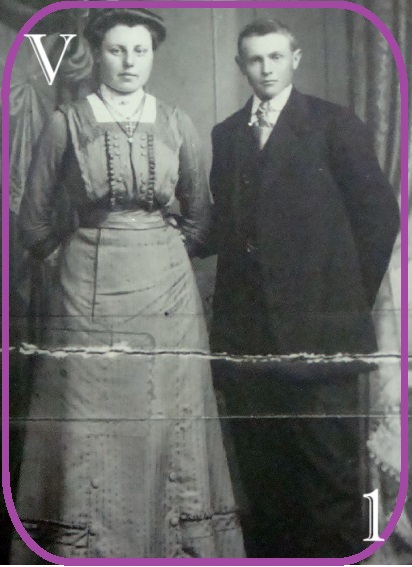
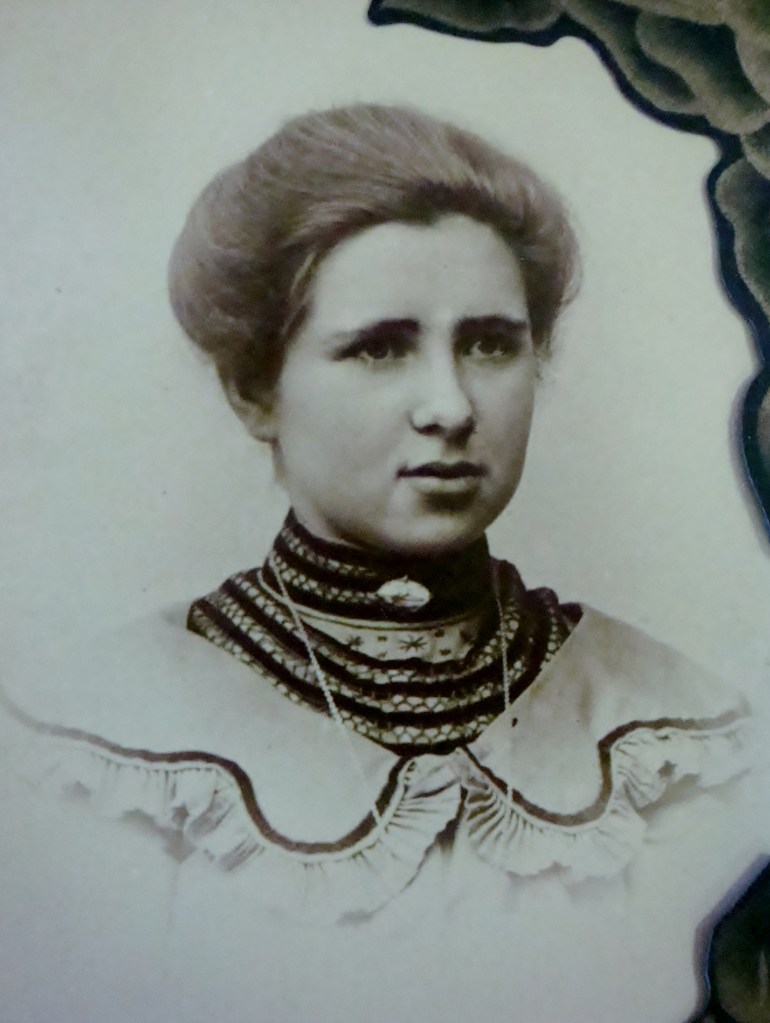
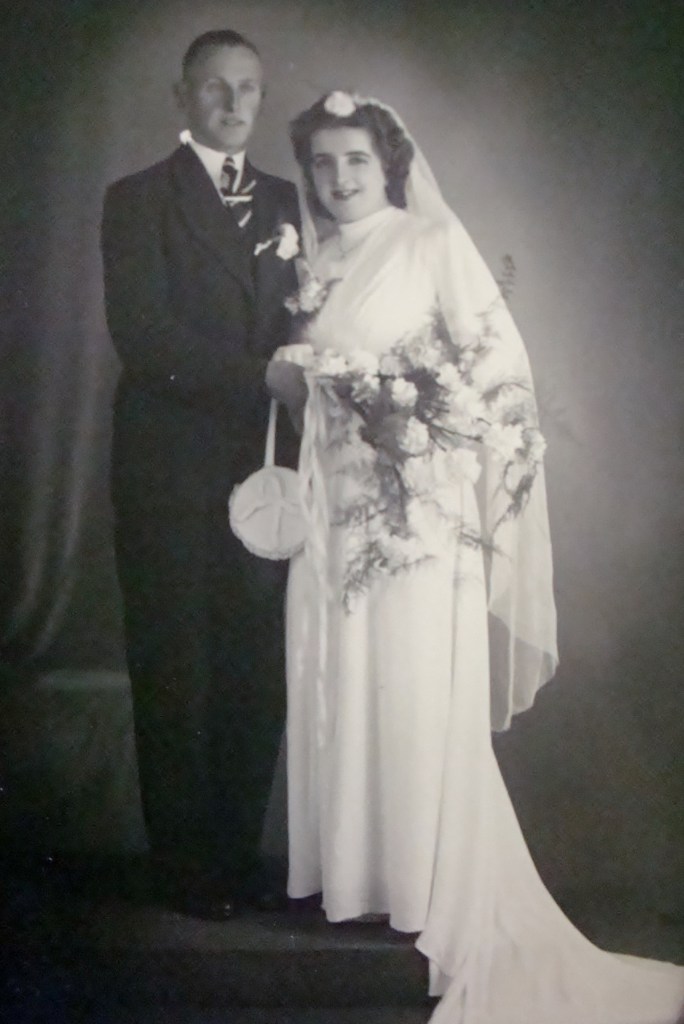
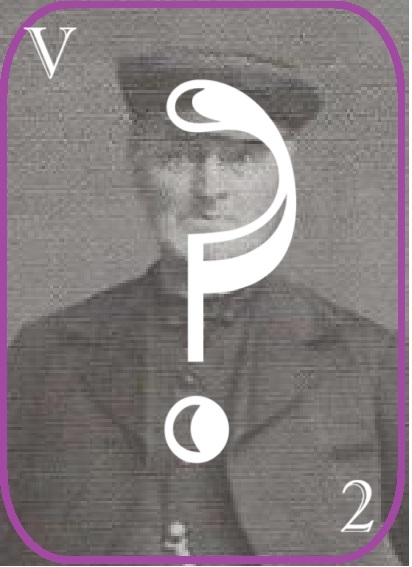
While I have a significant amount of information and source material for Jan, the one great mystery is whether the man seen in the image above is, in fact, Jan Dirksz van der Fluit. In an email, the person who provided it to me questioned whether he had correctly identified Jan as the person in the photo. He indicated that it is possible that the man is actually Jan’s brother-in-law, Klaas Dekker (1832 – 1912). Klaas was married to Jan’s sister Geertje (1841-1928). My correspondent did not indicate where he acquired the image. So this card is either Jan van der Fluit or Klaas Dekker.

The other mystery about Jan is how he spent his life between the day he was born and his first marriage to his first wife, Bregtje (also “Brechtje” or “Brigetta”) Tak, who he married on April 9, 1880. That’s a 33 year gap in time for which I have no information. At most, at the time of his marriage to Bregtje, Jan had been a farmer and a labourer, most likely in Oude Niedorp or Niuewe Niedorp.

[Update February 20, 2025: Today I found a Bevolkingsregister for Oude Niedorp for 1860-1885, with an entry for Jan’s mother, Aaltje Stroet and all her children. This was after Jan’s father had died. It indicates that up to age 15, Jan was most likely living with his mother in ‘t Veld. From age 15 to 18, Jan lived in Heerhugowaard. I will have to look for a Bevolkingsregister for Heerhugowaard to see if I can learn more. In February 1865, Jan moved back home with his mother and siblings in ‘t Veld.]

Bregtje was born in Oude Niedorp in May 20, 1855. She was 24 when she married Jan, who was 33 at the time. Jan and Bregtje had three children: Dirk, Geertruida, and Petrus. It was not a long marriage, as Bregtje died on December 8, 1884, nine days after Petrus was born. Given the close connection in time, it may be that it had been a difficult childbirth that ultimately resulted in Bregtje’s demise.

Jan married for a second time nine months later, to Maartje Veldman (1862-1904), in Barsingerhorn, Noord Holland on August 19, 1885. Maartje was 22 when she married Jan, who was then 38. I am descended from Maartje, who is Card V3 – so more on her next week. Jan’s marriage to Maartje lasted almost 20 years, ending when Maartje passed away.

Heldersche en Nieuwedieper Courant, September 9, 1885, page 4.
“Engaged and Married: Jan van der Fluit, widower of Brechtje Tak, 38 years old, and Maartje Veldman, never married, 22 years old.

Jan and Maartje had seven children together, although the first two did not survive infancy. Their fourth child was my great grandfather, Johannis Albertus van der Fluit. Jan outlived Johannis by three years. Maartje passed away on August 5, 1904, exactly one month after the birth of her youngest child, Brigettha.

Jan married for a third time, to Aagje Rood in Oude Niedorp on January 24, 1907. Aagje was born on December 20, 1863, in Heerhugowaard, Noord Holland, making her 43 when she married Jan. Aagje was a widow at the time she married Jan, having been previously married to Arie Pater. I have not done much research into Arie, but would not be surprised if he is somehow related to me given that my father’s maternal line is Pater. However, to date I have yet to find any connection between Arie and my Paters. Unlike Jan’s previous wives, Aagje outlived Jan – by two and a half months. She died on May 4, 1935.
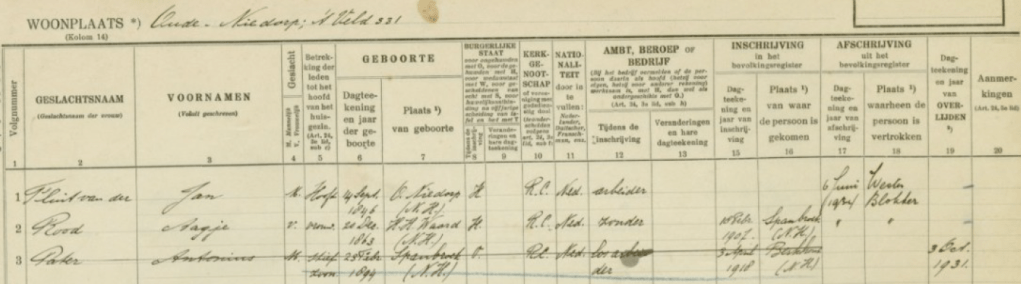
Bevolkingsregister for Oude Niedorp for 1931 to 1938

At the time of his second marriage, Jan was a merchant and shopkeeper. I know he was involved in that line of work until at least 1894, but I do not know the extent or details of that occupation. By 1904, he had returned to work as a labourer, which he apparently did until a year before he died. Since he died in 1935, that would mean he was still working when he was 87. The Bevolkingsregister (population register) for Oude Niedorp for 1910 to 1930 shows that he was a labourer during that entire time. The Oude Niedorp Bevolkingsregister for 1931 to 1938 indicated that he was still a labourer, at least until June 1934 when he moved to Westerblokker, which is about 16 kilometers from Oude Niedorp.
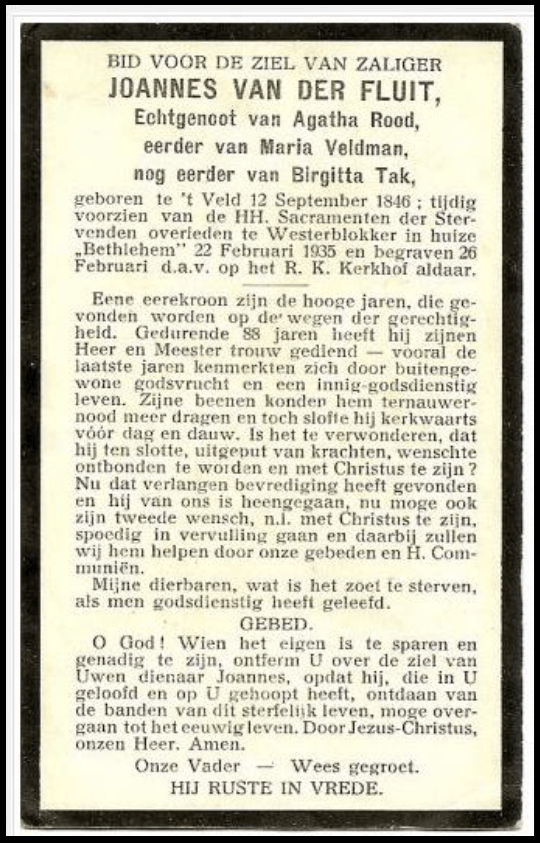
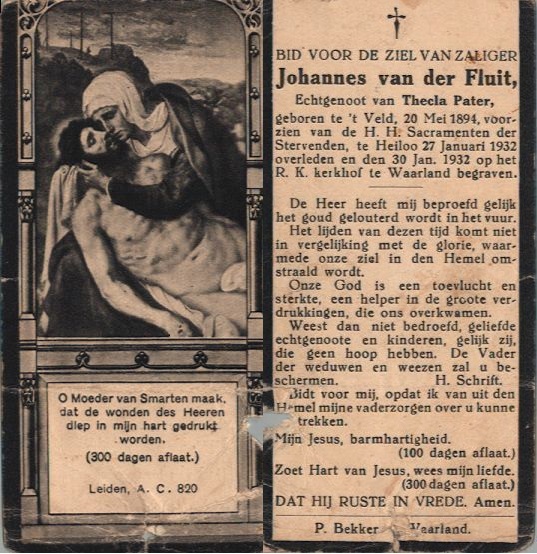
Jan’s bidprentje

However, I doubt that was so. It seems unlikely that he would still be working as a labourer in his mid-80s. The bidprentje (prayer card or in memoriam card) given out when he died. It indicated that in his last years “his legs could barely carry him”, yet he was still able to “shuffle” or “trudge” to church every day before dawn. His death registration also clearly indicated he was no longer working at the time he died.

Jan’s work was not limited to being a labourer during this period. In 1907, he was also working as a milkman; in July 1917 he was once again doing some form of work as a merchant.

On June 6, 1934, Jan and Aagje moved to Westerblokker. I still have to find the Bevolkingsregister for Westerblokker from that time. It’s on my to-do list; however, it is not yet available to the public because it includes a time period that is restricted under privacy laws. Jan died seven months later, on February 22, 1935. His bidprentje says that he passed away in “Bethlehem” house. Bethlehem was a monastery, which must have had some sort of palliative or care home. Jan was buried in Westerblokker.

UPDATE!

February 15, 2025: Late last week I was able to verify that yes, indeed, this is a photo of Jan Dirksz van der Fluit! Not only that, but it resulted in finding a photo of his wife Maartje Veldman!
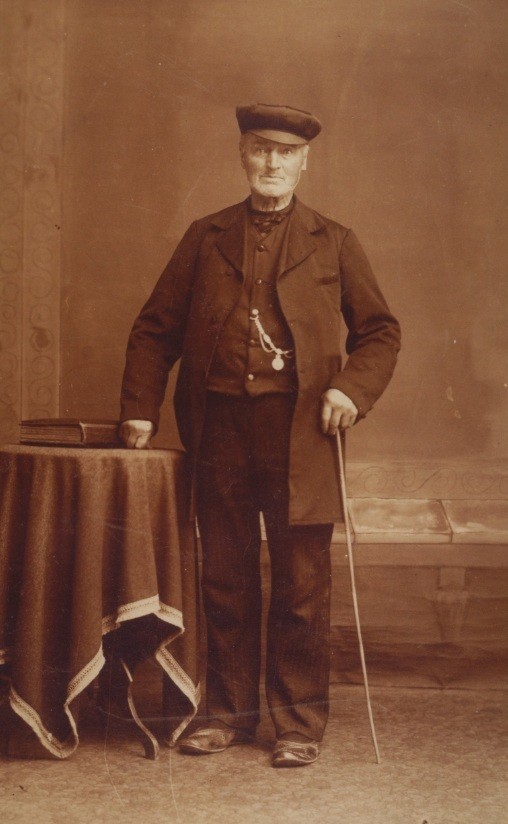
Jan Dirksz van der Fluit!!

52W Mark IV – Week 1 (Part Two): Card V1 Johannes van der Fluit and Teetje Pater

Theresia “Teetje” Pater (1894 – 1947)
Johannis Albertus van der Fluit (1894 – 1932)

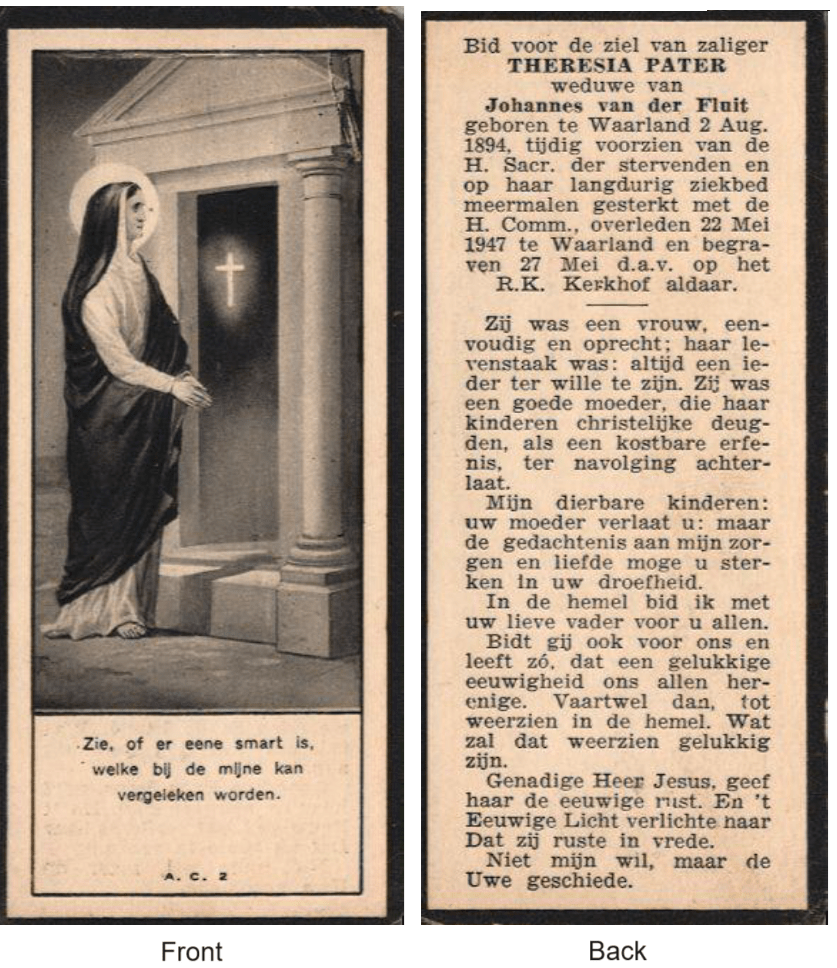
Johannis Albertus van der Fluit (1894-1932) and Theresia “Teetje” Pater (1894-1947) were my father’s paternal grandparents. Teetje was two months older than Johannis. She was born on February 15 and he was born on April 14. My father never met either of them as they both died before he was born.

Johannis was born in ‘t Veld, North Holland. He was an agricultural worker most of his short life. Teetje was born in Waarland, North Holland, the same village where my father was born. Johannis and Teetje were third cousins. They were both direct descendants of Cornelis Klaasz de Groot and Geertje Jans de Wit, their great great grandparents and my Gx5 grandparents. Teetje is descended from their eldest son, Jan, while Johannis is descended from their youngest daughter, Elisabeth. This makes me my own sixth cousin!

The Netherlands used to have mandatory military service, although in practice most conscripts never really served; rather, it was more like a reserve militia or national guard. Johannis was conscripted in January 1914, when he was 19 years old. Johannis was assigned to the 21st Infantry Regiment based out of Den Helder. On my understanding of the militia register, Johannis remained enlisted until he died in 1932, at age 37. The militia register also shows that Johannis was 171 cm (5’6″), which today seems rather short for a Dutch man. He would certainly have been dwarfed by my father, my brothers, and me!

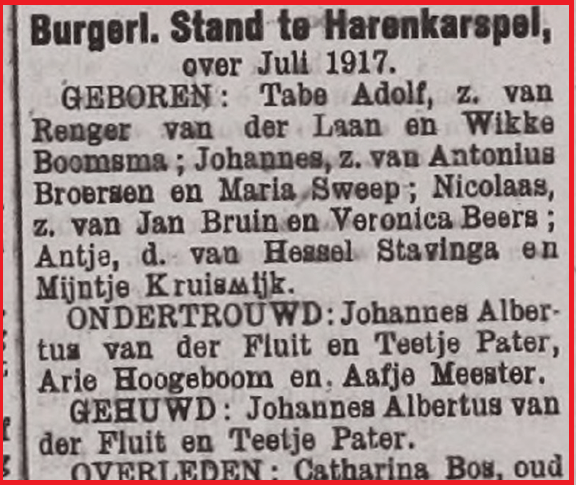
Johannis and Teetje’s engagement and marriage. Heldersche Courant August 8, 1917 page 4

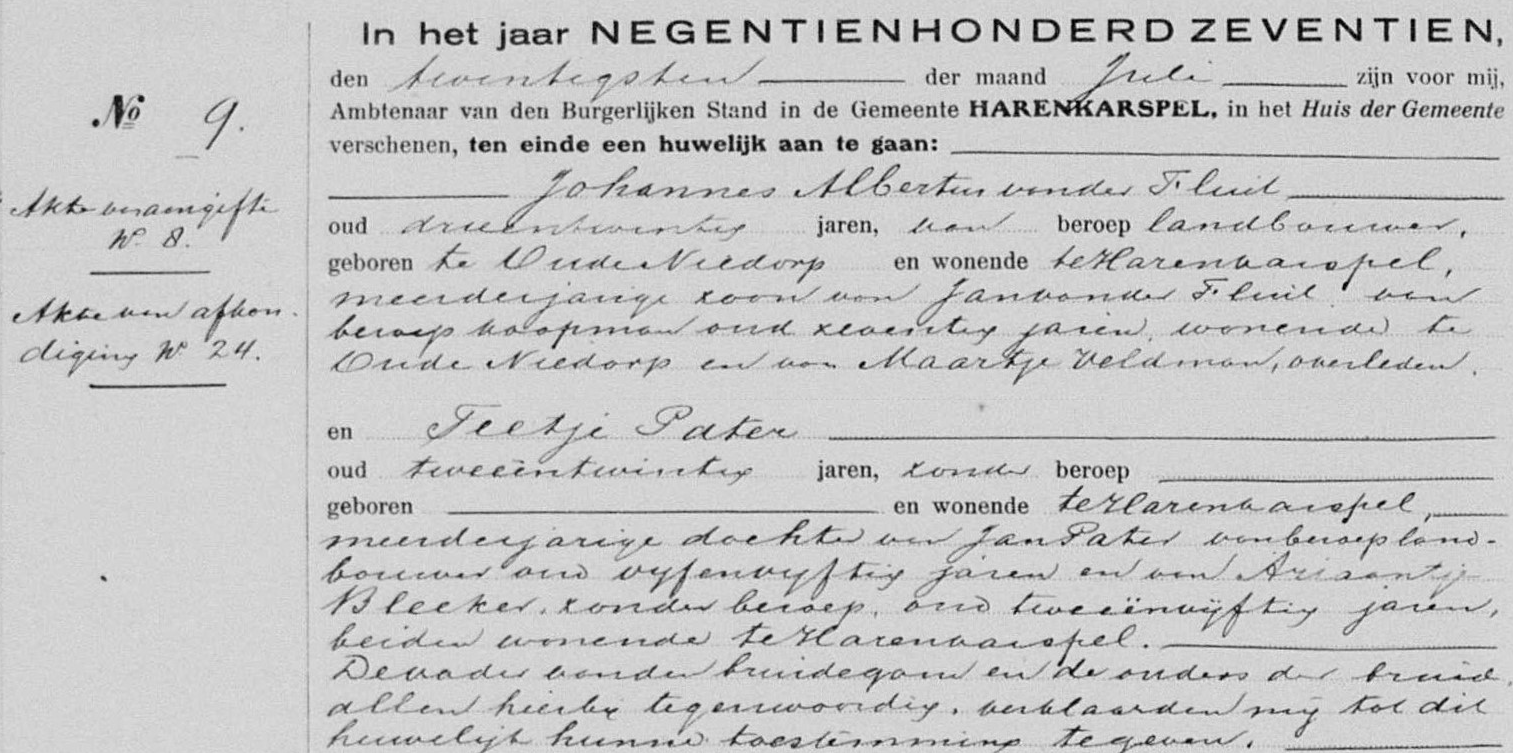
Johannis and Teetje married in Harenkarspel, North Holland, on July 20, 1917. The witnesses were Jacob Smit, “brievengaarder” (an official charged with receiving or issuing mail at a location where there was no post office; their home served as an auxiliary post office), age 31, and Simon Brommer, [occupation illegible], age 61, both resident in Harenkarspel.

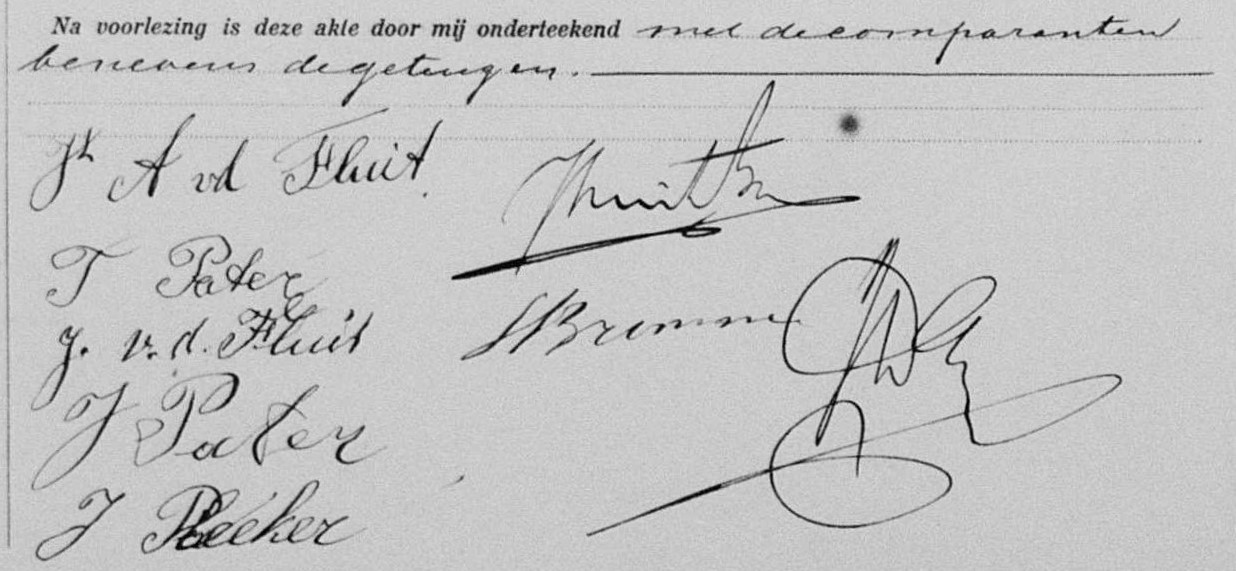
Marriage registration for Johannis and Teetje. The signatures on the left are Johannis, Teetje, Jan van der Fluit (Johannis’s father), and Jan Pater (Teetje’s mother). I’m uncertain about the one on the bottom, “T. Bleeker”, because Teetje’s mother was named Adriana. Adriana was still alive at the time and Teetje did not have any immediate family whose initial was “T”.

The Oude Niedorp Bevolkingsregister (“population register”) for 1910-1930 shows that in 1917 Johannis was working there as a hired worker. Johannis and Teetje relocated to Harenkarspel on November 13, 1919. According to the Harenkarspel Bevolkingsregister for 1920-1939, Johannis was a labourer in the employ of others when he moved into the gemeentje (municipality), but later became a self-employed farmer.

Apparently, Johannis sustained some sort of head injury after an accidental blow to the head. My belief is that this occurred sometime in or after 1930, when Johannis and Teetje’s youngest child, Anny, was born. My records also show that Johannis was still working as of 1930. In fact, the Bevolkingsregister for Harenkarspel shows that Johannis had lived there until January 19, 1932, when he relocated to Heiloo, where he died eight days later, on January 27, 1932. This timeline suggests that Johannis’s head injury may have occurred shortly before he was placed in the sanitorium.

Since Johannis died so young, I do not know many people who knew him. He died when my grandfather, Adrianus “Arie” van der Fluit (1923-2002) was eight years old. I only heard passing mentions of Johannis a long time ago, most likely second-hand because I don’t recall my grandfather ever talking to me about his father.

After his injury, Johannis began to exhibit strange behavior and suffered from delusions, which were very unsettling to him. Most likely he had developed a mental disorder. One account I heard was that during a delusional episode it took my grandfather’s two older brothers and some neighbours to restrain Johannis.

At some point in time, Johannis was placed in a sanitorium, where he continued to suffer from delerium. It is most likely the sanitorium was in Heiloo, the town where Johannis died. I know that Heiloo had a sanitorium at the time.

Sometime shortly before his death, Johannis experienced a period of rational thought. Teetje was summoned to see him, which occurred close to the time Johannis died. Teetje was 37 when she was widowed and was left to raise eight children on her own, the youngest of whom was one year old at the time.

Sometime after Johannis died, Teetje’s younger brother Johannes “Jan” Pater (1900 – 1948) moved in with Teetje and her children. Jan, who had a hunched back, had never married. Presumably he moved in with Teetje to help her after Johannis died.

Teetje died on May 27, 1947, after a long illness. She was buried at St. Wulfram’s Roman Catholic Church in Waarland, which I believe is the same place where Johannis was buried. Anny, their youngest child, was 17 when Teetje passed away.

Bidprentjes (prayer cards) for Johannis and Teetje.

52W Mark III – Week 46: Cultural Tradition

My wife and I dread December. Not only is the whole month a whirlwind of activity leading up to Christmas, both our children have December birthdays. My brother-in-law is Jewish, and we’re always welcomed into the Hannukah festivities. The worst year was when a birthday, Christmas, and first night of Hannukah all occurred on the same day – something that is happening again this year. Plus, of course, we celebrate Sinterklaas.

Sinterklaas is a traditional holiday generally celebrated in the Netherlands and its former colonies, Belgium, and parts of Germany and France. It takes its name from its central figure who, like Santa Claus, has his origins in St. Nicholas, an early Christian bishop who lived in what is now Turkey. In fact, Santa Claus owes much of his origin to Sinterklaas.

Sinterklaas has much in common with Christmas. However, unlike Christmas, Sinterklaas is celebrated on December 6, the feast day of St. Nicolas in the Christian calendar. Both Sinterklaas (also called “Sint”) and Santa deliver gifts the night before their respective holidays, Sinterklaas often arrives in the Netherlands in mid-November and travels around the country visiting children, participating in parades, and handing out treats and gifts.

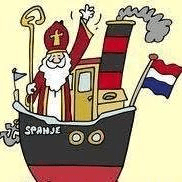
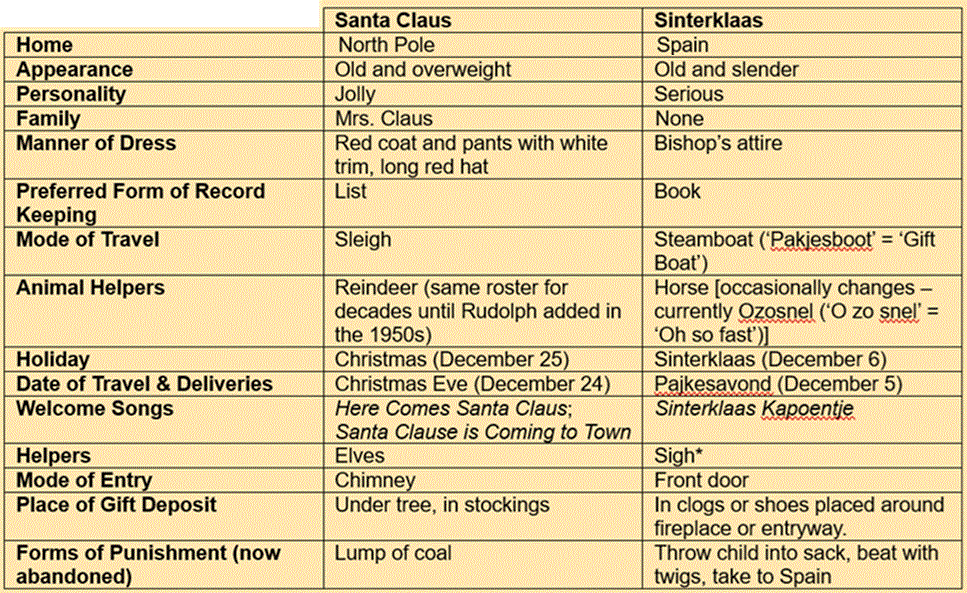
While Sint and Santa have much in common, they have many differences. Sint lives in Spain (probably rooted in the fact that the Netherlands was part of the Spanish empire until the 16th century), travels by steamboat, and rides a horse. As well, Sint’s appearance is rooted in his church origins, so he is dressed like a bishop.

A Few Differences Between Santa and Sint
Elizabeth Bakker

Since only my father is Dutch, we did not observe many of the Dutch cultural traditions, and definitely not in the way they do in the Netherlands. My great grandmother, Elizabeth Bakker (1888 – 1976), always sent us a package of goodies for Sinterklaas. However, at the time I didn’t know it was for Sinterklaas. I never even heard of Sinterklaas until well after my great grandmother died. I thought the package was for Christmas and that she sent it early in the month so it would get to us in time.

I loved those packages – they always contained many of the traditional Sinterklaas treats: pepernoten, kruidnoten, taai taai, and speculaas (all forms of spiced cookies, somewhat like gingerbread, although the former two are quite small); marzipan; borstplaat; and, of course, chocoladeletters  (“chocolate letters”)!!

The letters originated centuries ago as baked goods, but are now almost exclusively made of chocolate. It is traditional to receive a chocolate letter of the initial of your first name. When we were kids, there was always an argument that some letters were bigger than others so they had more chocolate. The truth is that, while the surface area of each letter might differ, they are manufactured in different thicknesses so that every letter contains the same amount. The other problem is finding letters that are uncommon initials for names in the Netherlands, although that is less of a problem than it used to be.

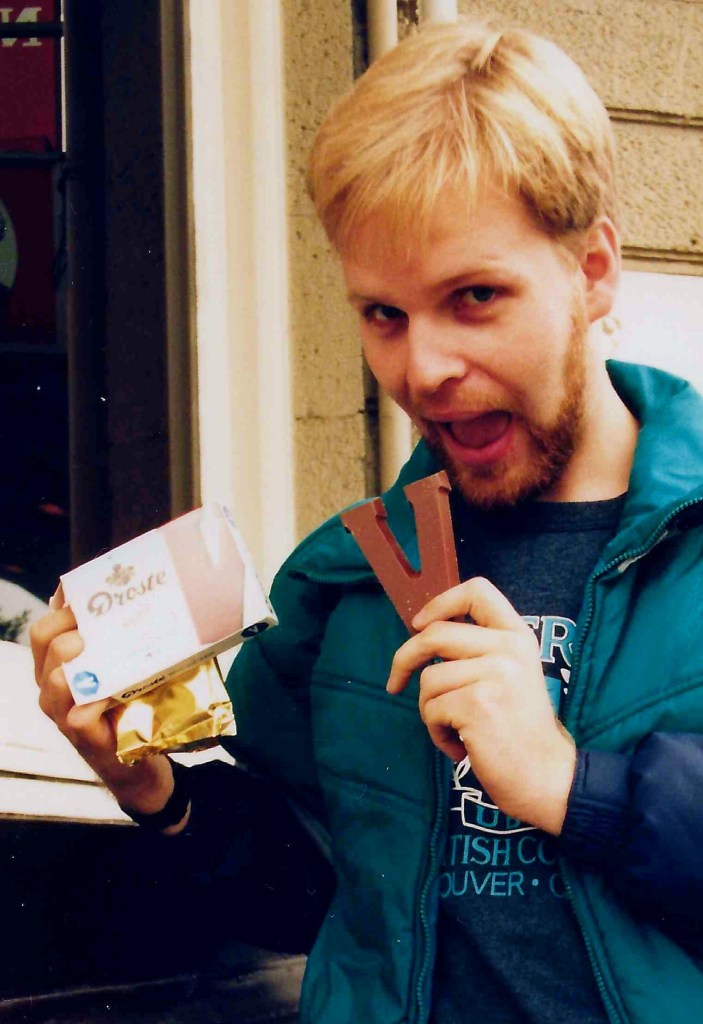
I found a Droste store in Amsterdam!

Chocolate letters are another item for which, outside the Netherlands, the availability seems to change over time. When I was a kid, they seemed to be available everywhere. Purdy’s made their own for a while, but I haven’t seen them there in a long time. In recent years, the only place I could find them were in Dutch stores. Even then, I could not find Droste letters – the absolute best ones, bar none – anywhere. You could only find the secondary brands. I once asked a vendor if Droste no longer shipped to Canada, and was told they were simply too expensive to carry. Luckily, a couple years ago I found Droste chocoladeletters in a Dutch store in Lethbridge.

Fortunately, chocolate letters seem to be getting easier to find again, as I saw them being sold in many mainstream supermarkets and shops last Christmas. I first noticed them showing up a couple years ago in a local independent grocery store that specializes in Asian foods and ingredients of all places. Plus, in our neighbourhood of Steveston, there is a chocolatier that makes them – in every letter!

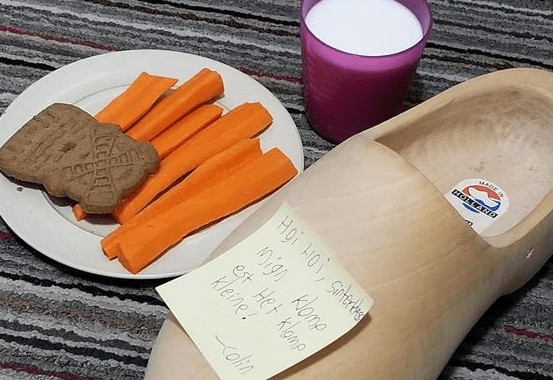
I have no idea where my son learned the Dutch he wrote on the note. There are a couple small mistakes, but it says “Hi, my clog and the little clog” (the small one’s not in the photo).

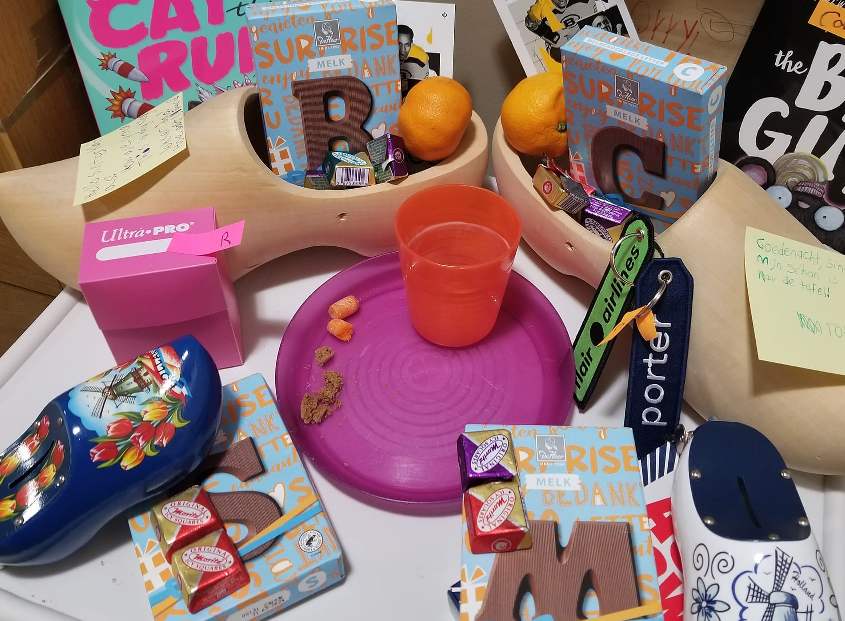
Our kids are more immersed in Sinterklaas. We’ve been marking it every year since our eldest was born. In fact, we thought he might arrive on Sinterklaas! Every year, the kids will put out their shoes along with some klompen (clogs), as well as a snack for Sint and his horse. The last few years they’ve also left notes. Then we’ll watch a few YouTube videos with Sinterklaasliedjes (“Sinterklaas songs”) and then off to bed.

The kids didn’t do too bad last year.

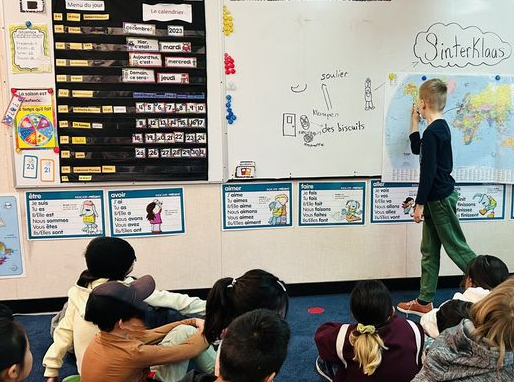
When our eldest was in second or third grade, he made a presentation to his class about Sinterklaas. He asked for help with that, and I gave him a few things he could take to school. Our youngest did the same thing last year – except I had no idea he was doing it until after the fact! He had asked me to email his teacher a video of a Sinterklaas song, but I didn’t know what it was for or that it was part of his presentation. His teacher emailed us to say that he knocked it out of the park!

Sharing Sinterklaas with his class!

Of course, anyone even vaguely familiar with Sinterklaas has probably heard of Zwarte Piet (“Black Piet”). For decades, Zwarte Piet was seen as Sint’s delightful helper. The association many people have with a beloved childhood memory likely makes it difficult to accept the unsavory fact that Piet is anything other than a negative stereotype. I don’t buy any of the arguments defending this outdated and offensive figure, which are based on fallacies, myths, and disregard for history. It’s often a waste of breath to argue and about this time of year I have to mute my social media feeds connected to the Netherlands.

While a bit on the academic side, Black Pete: Analyzing a Racialized Dutch Tradition Through the History of Western Creations of Stereotypes of Black Peoples provides a thoughtful analysis of the problem.

While Piet remains a polarizing topic, in recent years it seems that attitudes are changing and the popularity of Zwarte Piet as traditionally depicted has begun to decrease dramatically. Over the last ten years or so, there has also been a shift to reforming or rebooting the character, with the emergency of Roetveegpiet (“Sooty Piet”) (characters with dirty faces due to the soot of the chimney) and Kleurenpiet (“Coloured Piet”) (characters with faces of all colours of the rainbow).

Meanwhile, Sinterklaas is less than a month away – better start planning for another busy December!

“Sinterklaas Kapoentje” – You can see the lyrics, English translation, and history of the song here.

52W Mark III – Week 36: We Don’t Talk About It

With the prompt of “We Don’t Talk About It” for this week’s  52 Ancestors Challenge, the expectation was likely that participants would write about the bad secrets. However, not all secrets are bad!

Adrianus Joseph “Arie” van der Fluit (1923 – 2002) and Christina (“Tiny”) Komen (1923 – 2000) on their wedding day.

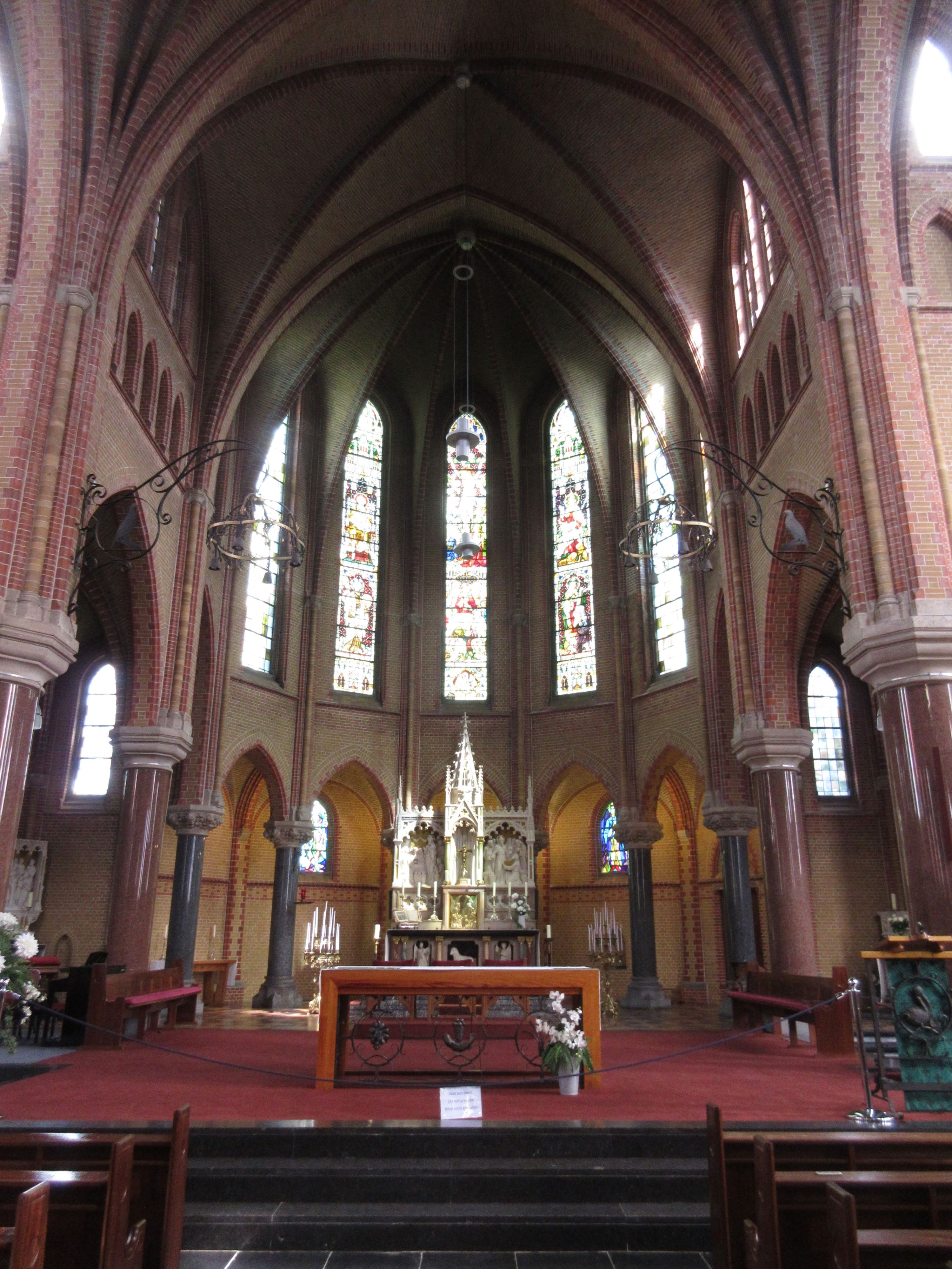
My father and his siblings organized a surprise party to celebrate my paternal grandparents’ 40th wedding anniversary. Adrianus (“Arie”) van der Fluit and Christina (“Tiny”, rhymes with “genie”) Komen were married on November 7, 1948, in Langedijk, Noord Holland, Netherlands at St. Jan de Doper Katholieke Kerk (St. John the Baptist Roman Catholic Church).

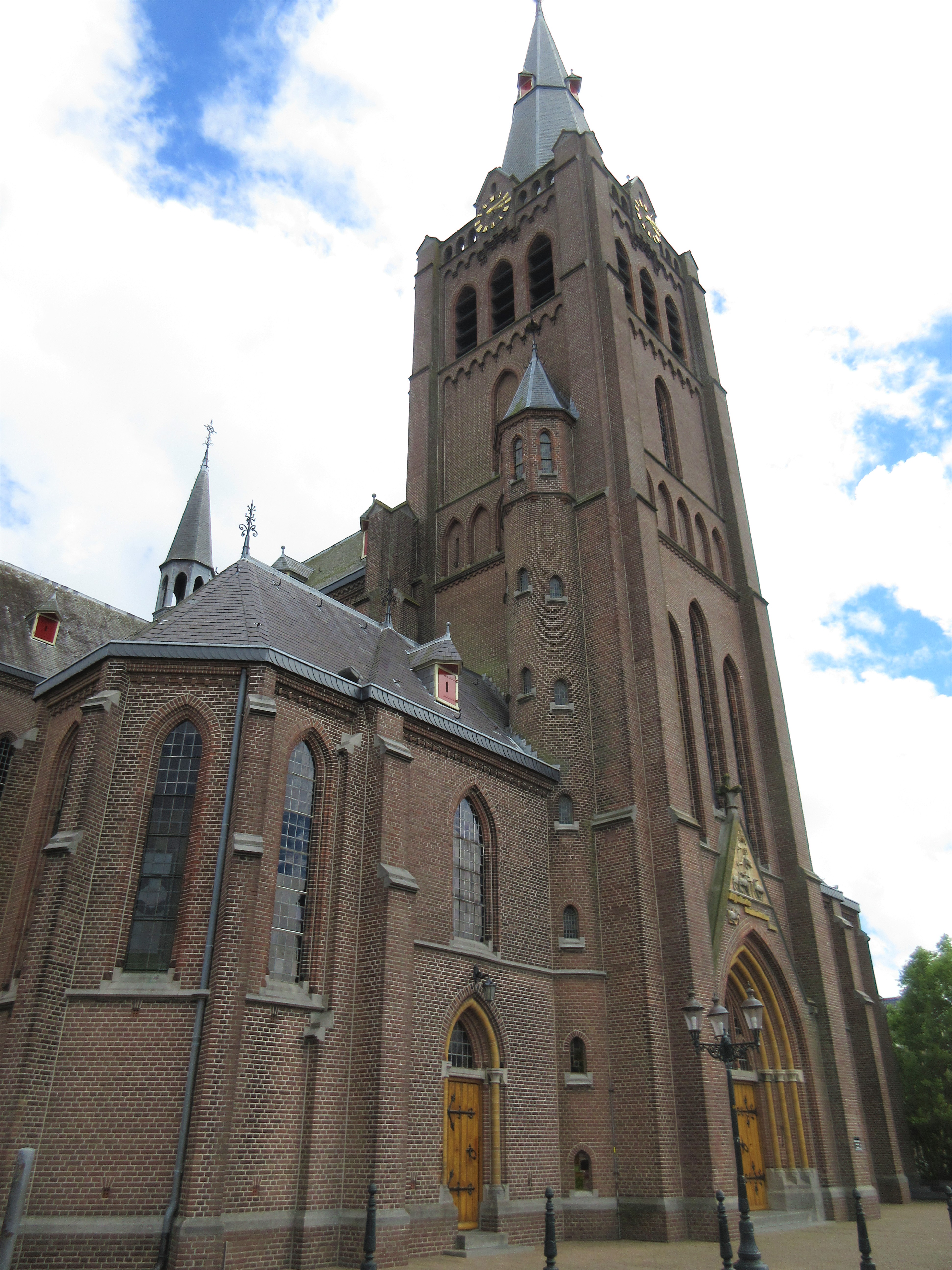
Kerk van Sint-Joannes de Doper, Noord-Scharwoude, Noord Holland, Netherlands, where my grandparents were married.

All my father’s siblings lived in Lethbridge, like my grandparents, so all the family living there were in attendance. My parents and siblings were living in northern British Columbia at the time, so my folks left my brothers and sisters with some family friends. In addition to all their children and most of their grandchildren, several family members also came over from the Netherlands to join in the festivities.

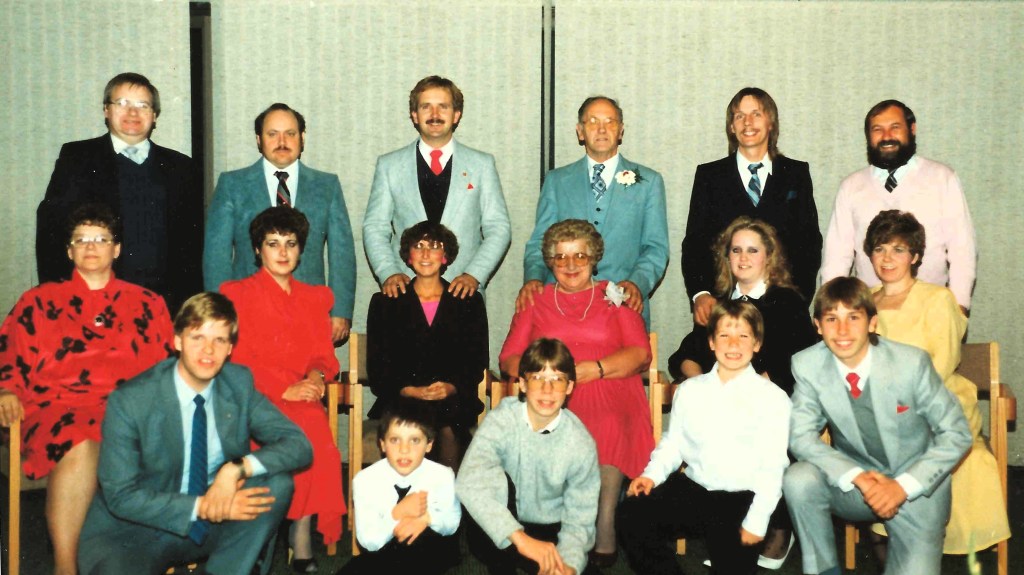
My grandparents, all their children and spouses, and about half their grandchildren (my four younger siblings did not attend). Several more grandchildren were born years after this celebration.

I had already left home and was living in Vancouver, so I flew to Alberta. I had lived in Vancouver long enough to have gotten used to the very mild winters there, forgetting that it was real winter elsewhere. So I boarded my flight wearing only a light jacket, only to be greeted by -11°C weather.

Two of my father’s cousins who made the trip from the Netherlands to celebrate my grandparents’ 40th wedding anniversary. That’s my noggin in the lower right.

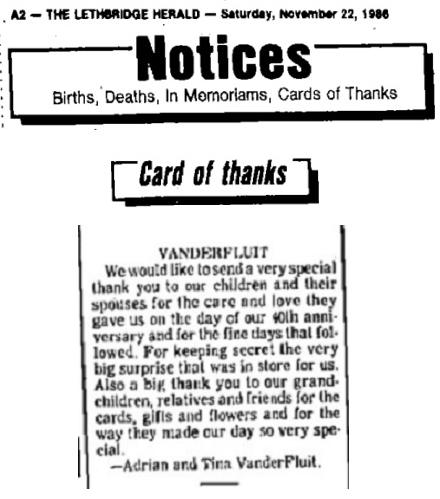
My grandparents took out a “thank you” notice in the Lethbridge Herald on November 22, 1986:

“We would like to send a very special thank you to your children and their spouses for the care and love they gave us on the day of our 40th anniversary and for the fine days that followed. For keeping secret the very big surprise that was in store for us. Also a big thank you to our grandchildren, relatives and friends for the cards, gifts and flowers and for the way they made our day so very special.”

Speaking of surprises, I was surprised to discover that I had written about this before, for last year’s 52 Ancestors Challenge! Upon making that discovery, I thought I might scrub this and choose a new topic. However, I changed my mind because (a) I’m feeling lazy (b) I have too many other things to do and (c) I had chosen several different photos than before. But let’s not talk about it, okay?