52W Mark III – Week 20: Taking Care of Business

When I was a kid, we moved around a lot. People often asked my if my dad was in the military. No, he was a Woolworths manager.

My father entered the Woolworth manager training program right out of high school. Back in the day, the program involved a lot of moving around. Later, promotions almost always meant a transfer. He was with the company for 28 years, leaving the company about six months after Wal-Mart bought it out in Canada. That’s a story for another time.
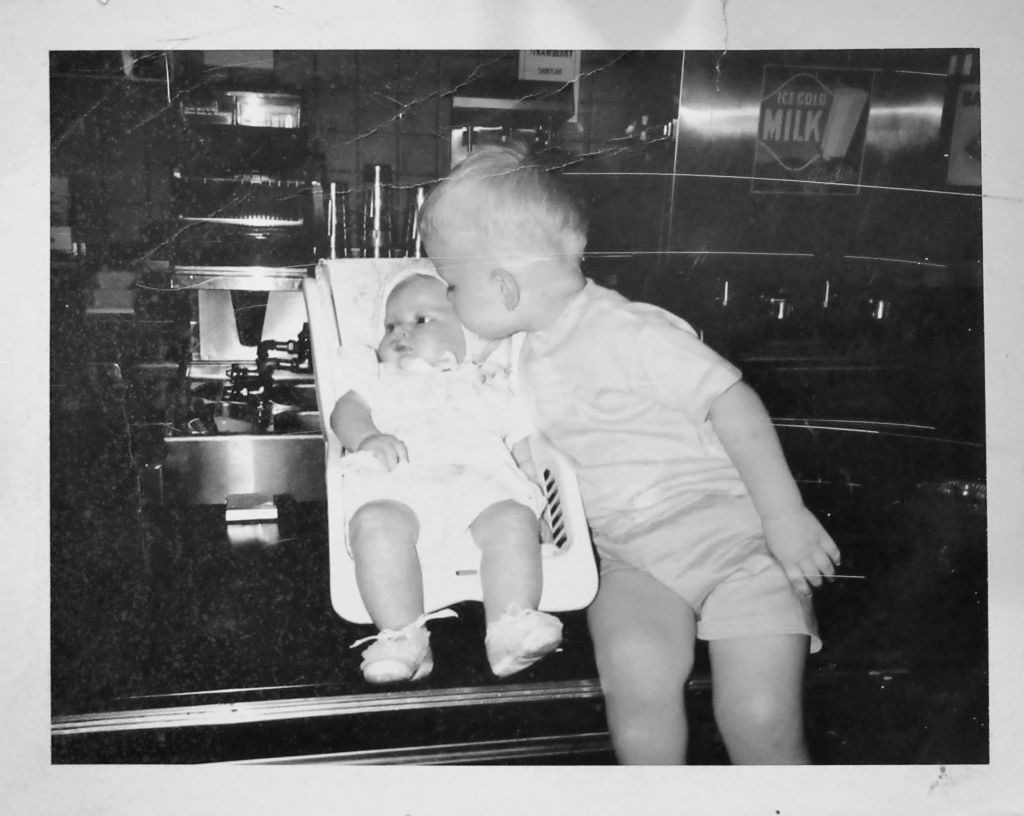
My sister and me at the Woolworths in Regina

My dad began his career with Woolworth’s in Lethbridge, Alberta as a management trainee. He once told me that his very first assignment on his first day was to unload a shipment of bras, and the female staff stood there giving him a hard time. Next, my dad trained in the Regina, Saskatchewan and Medicine Hat, Alberta stores, where he was an assistant manager.

Dad’s first store as manager was in Flin Flon, Manitoba. After Flin Flon, dad was transferred to Terrace, B.C., and shortly afterward to Duncan, B.C., where he opened a new store there as the Associate Manager.
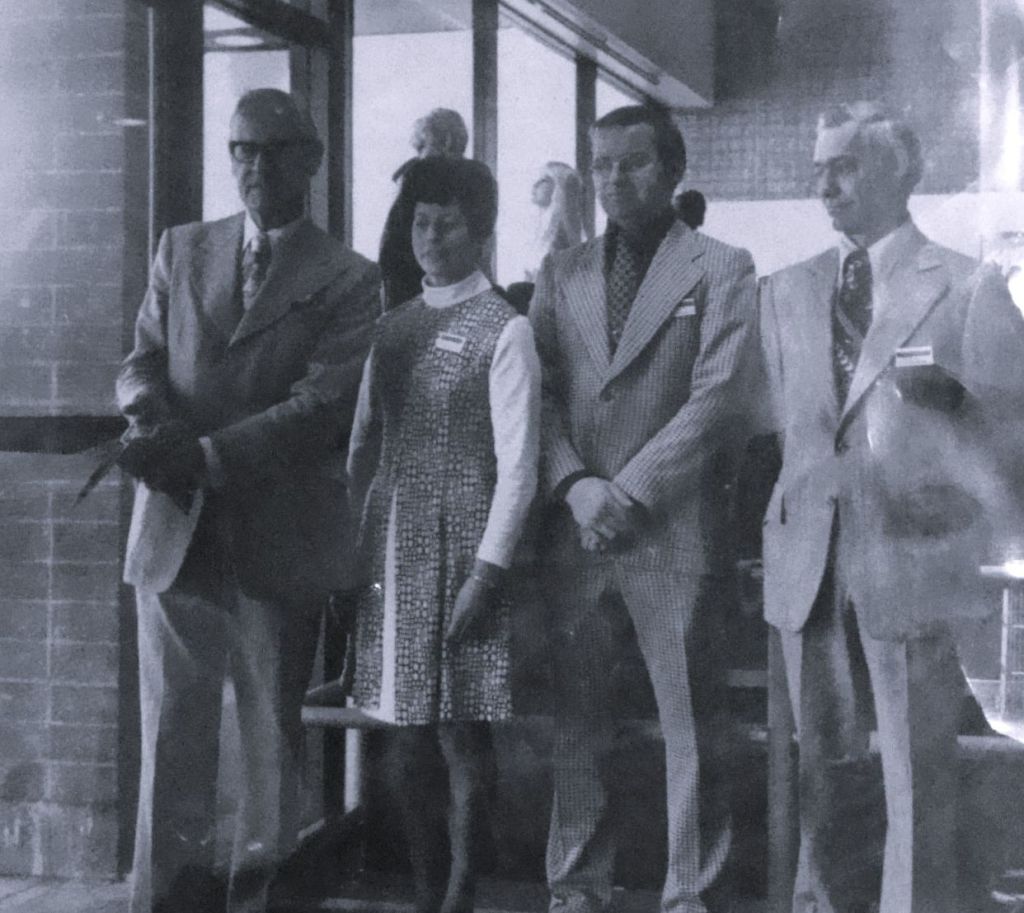
Grand Opening of the Woolworths in Duncan. My dad is second from the right.

At one point, the Canadian head office in Toronto transferred dad to Kirkland Lake, Ontario. However, when the international head office learned about the transfer, they cancelled it. They thought it was too much to move a man with young kids halfway across Canada.
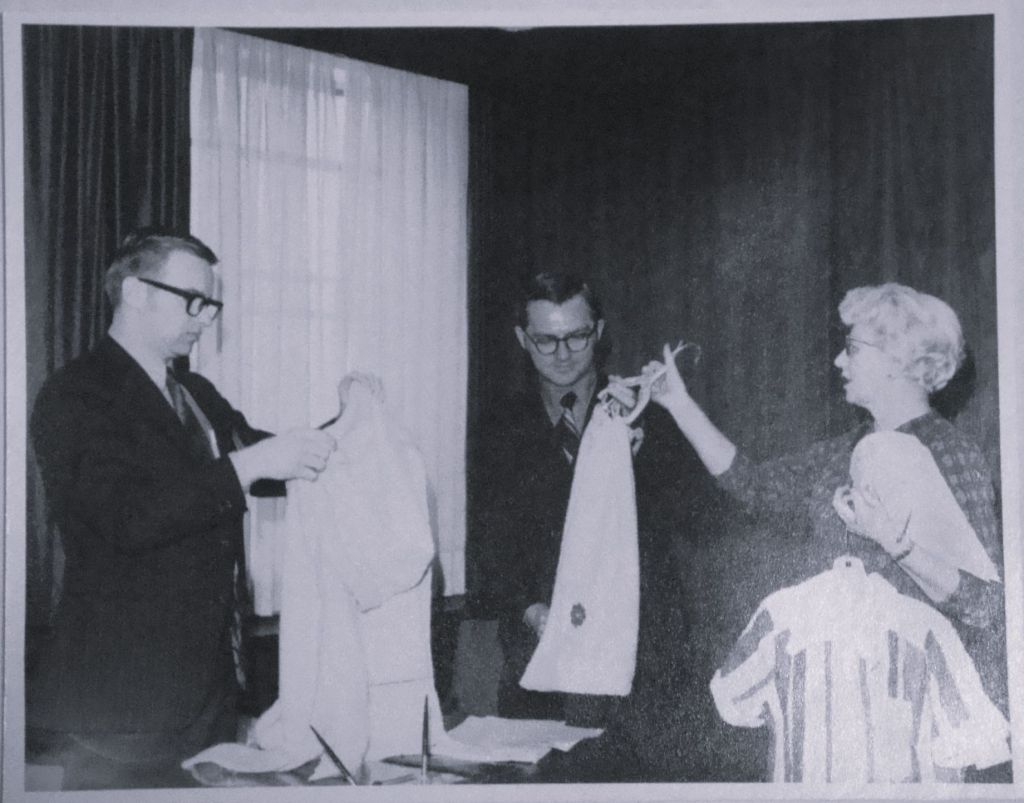
My dad (left) at the Canadian head office in Toronto.

Dad transferred to North Battleford in 1974 and was General Manager when Woolworths opened a large new store there as the anchor tenant of the Frontier Mall in 1975.
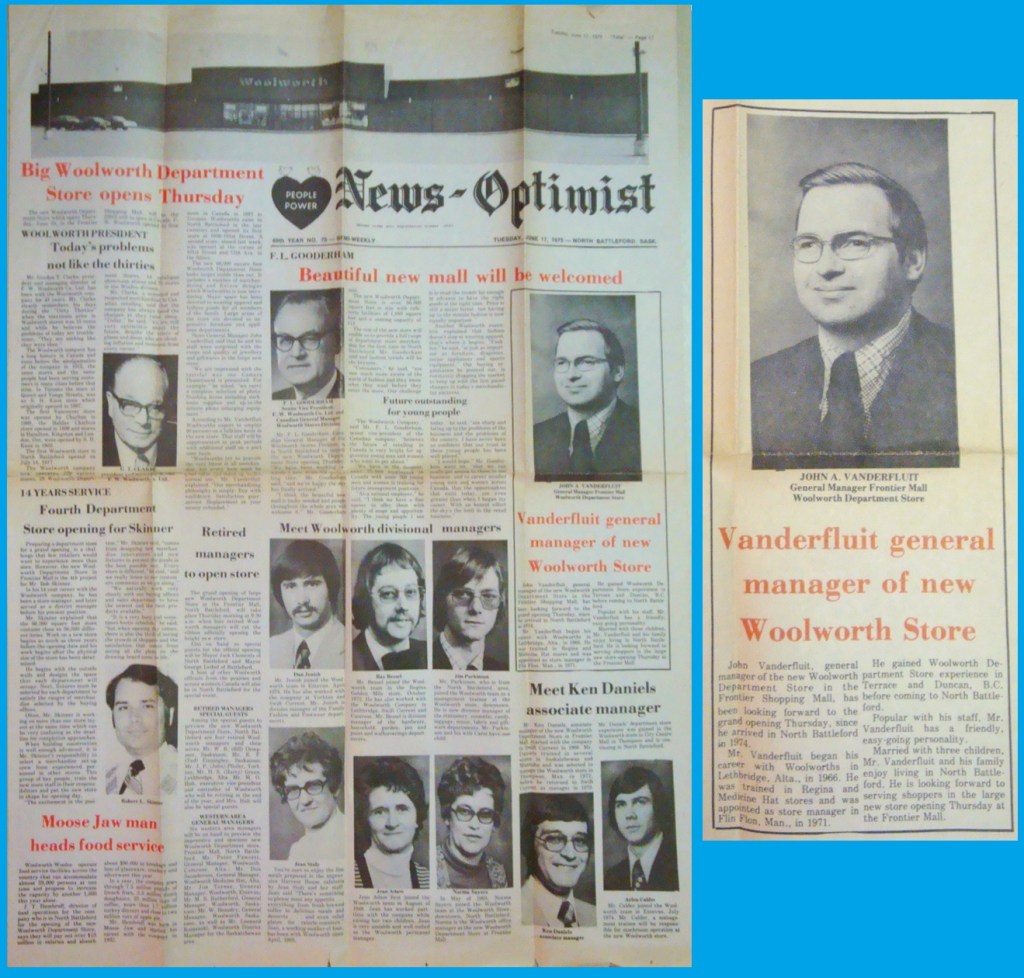
Big news in a small town.

Dad quit in the early 80s and went into business as a sales agent for a furniture company. The new career was not what dad anticipated, and he did not enjoy being separated from his family as the job entailed a great deal of travel. He returned to Woolworth’s a few months later. As he had been replaced at the North Battleford store, he was assigned to the Woolworths in Swift Current, Saskatchewan. He commuted from North Battleford to Swift Current, a distance of about 320 kilometres. Dad was there until he was transferred to Terrace, British Columbia six months later.

Four years later, the company transferred dad to William’s Lake, B.C. In 1989 Woolworth’s converted all of its larger Woolworth stores into Woolco stores, which included the Williams Lake location.

Until last Christmas, I had no idea my mom still had these.

In August 1991, dad was transferred to the Woolco in Chilliwack. In March 1994, Woolworth’s sold its Woolco stores to Wal-Mart. Wal-Mart transferred Hans to Hinton, Alberta that same month. Dad left the company in August 1994. My parents and younger siblings then moved to Lethbridge, where we still had a fair amount of family. My dad briefly went into sales before he and my mother bought a small motel in southern Alberta. My dad has now been a motelier longer than he was a Woolworths manager. My youngest sibling and I have had much different fathers!

One of my brothers had this on his bedroom door for years.

52W Mark III – Week 17: War

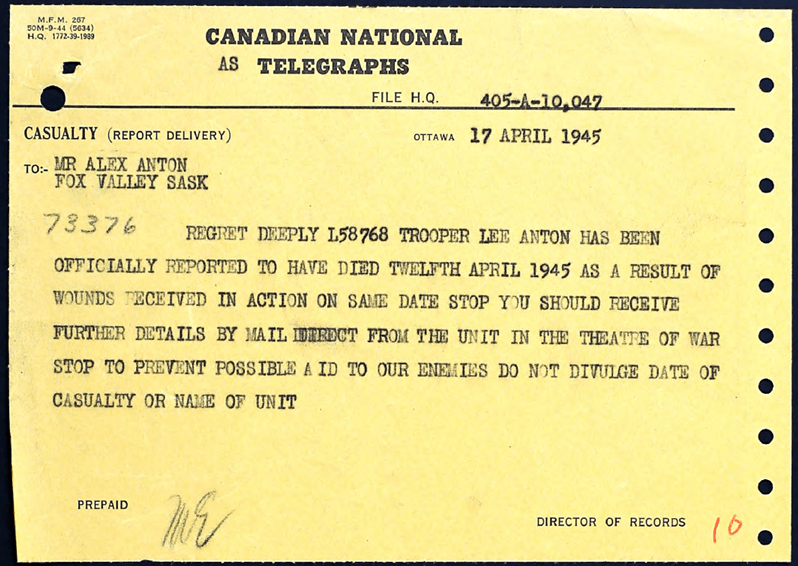
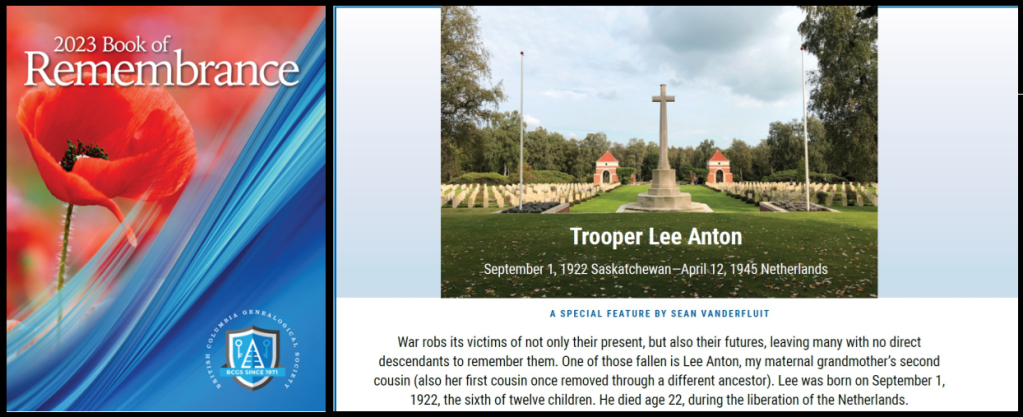
In Week 45 of the 2022 52 Ancestors Challenge, I wrote about my maternal grandmother’s cousin Lee Anton. I also wrote about Lee as one of the Featured Articles for the 2023 Book of Remembrance published by the British Columbia Genealogical Society. With this week’s writing prompt, I’d like to share what I’ve learned since writing these two pieces.

              The cover of the book.                                        Feature about Lee on page 98.

First, to recap, Lee was a Trooper of the 8th Reconnaissance Regiment (14th Canadian Hussars, also known as the 8th Recce) R.C.A.C. Lee was killed in action on April 12, 1945, age 22, less than a month before V-E Day, in the northern part of the Dutch province of Drenthe, the day before the start of the Battle of Groningen. Along with many of Canada’s other fallen soldiers, Lee is memorialized in two very special ways.

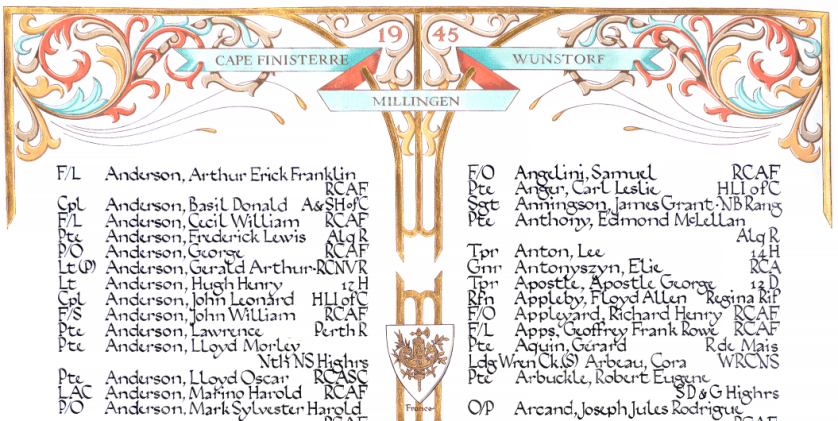
One is through the Second World War Book of Remembrance for the Second World War. Lee is commemorated on page 491.

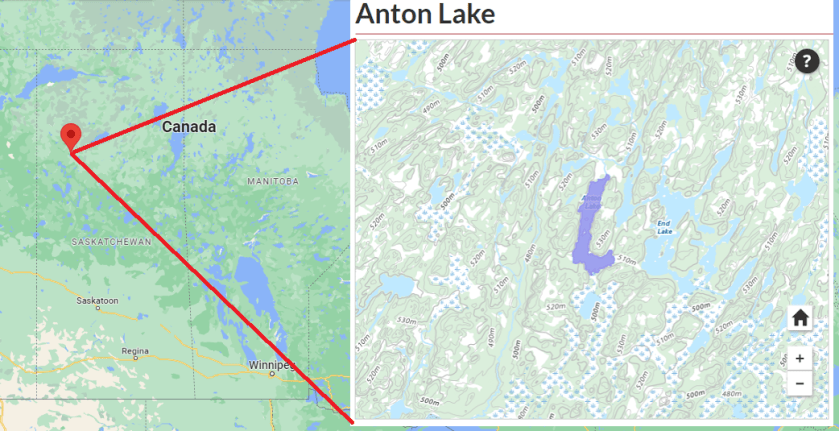
Lee was also memorialized through Saskatchewan’s “Geo-Memorial” program. You can see Anton Lake, which was named after Lee, on Google Maps. This project is documented in the book, Their Names Live on: Remembering Saskatchewan’s Fallen in World War II.

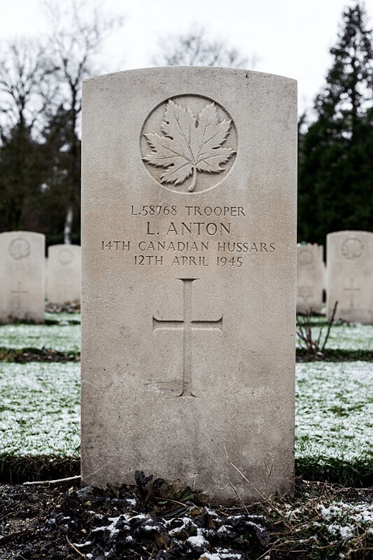
Lee is interred at the Holten Canadian War Cemetery, located just outside of Holten, Overijssel, Netherlands. It is not far from where Lee was killed.

It was only a few weeks ago that the significance of the date on which Lee had been killed dawned on me. April 12, 1945 is the day that Canadian troops liberated Camp Westerbork. It was the transit point where the Nazis gathered Dutch Jews before sending them to the death camps. It was the first place they interred Anne Frank after she and her family were betrayed.

Going through the regimental diaries for Lee’s regiment, I discovered that it was the 8th Recce that liberated the camp, which the Germans had abandoned hours beforehand.

Entry from the War Diary of the 8th Reconnaissance Regiment for April 12, 1945 documenting the liberation of Camp Westerbork.

Based upon the chronology set out in the diaries and other war records, advancing on the camp was the first thing Lee’s regiment did that day. It means that the fighting in which Lee was killed occurred after the camp was liberated. While the entire regiment was not involved, there were at least 100 members of the regiment present at the camp, so there is a good chance that Lee was present for the liberation of Westerbork.

Lee’s grave as seen on Find a Grave

52 W Mark III – Week 16: Step

A “steppe” is a geographic and ecological region consisting of grassy plains. Some steppes are referred to as savanna and prairie. The largest steppe in the world, the Great Steppe or Eurasian Steppe, stretches from Ukraine to China. The Canadian prairies and the American great plains are other examples of of steppes.

My maternal ancestors originated in the western German states that formed part of the Holy Roman Empire, which came to an end with Napoleon’s conquest of the region. In the nineteenth century, my German ancestors sought a paradise on the steppe, first in Imperial Russia and later in North America. I wrote about these Germans from Russia only a few weeks ago, in Week 7.

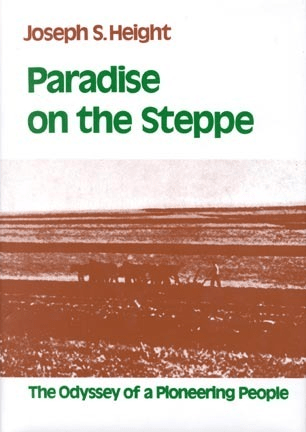
A seminal work documenting the history and culture of these Germans is Paradise on the Steppe by Dr. Joseph S. Height. Dr. Height’s book is well-known amongst family historians who trace their roots to Germans from Russia.

Dr. Height was born in Tramping Lake, Saskatchewan in 1909. In university he specialized in foreign languages. He spent three years in Germany studying philosophy and German. He attended the University of British Columbia and earned degrees in those two disciplines. Dr. Height spent the last fifteen years of his career as a professor at Franklin College in Indiana. Dr. Height passed away in Indianapolis in 1979.

In addition to his academic works, Dr. Height published several books about the history of the Germans from Russia. In addition to Paradise on the Steppe, his works on this topic include Homesteaders on the Steppe, Memories of the Black Sea Germans, and Folksongs of our Forefathers. Dr. Height also translated a portion of The Emigration from Germany to Russia in the Years 1763 to 1862, by Karl Stumpp, another book of great importance to genealogists researching this area of family history.

Based upon twenty years’ research, Paradise on the Steppe sets out the historical, economic, social, and political forces that pushed these Germans from their homelands and pulled them to the Russian and Ukrainian steppe starting in the late 18th century. Dr. Height tells of the hardships the colonists faced from the moment they left their homes through to the hardships they faced in the late 19th and early 20th centuries, with growing oppression by the last Czars, the Bolshevik Revolution, Stalinist suppression, and Nazi invasion.

Dr. Height also details the colonists’ successes, joys, and achievements. He includes chapters about language, folksongs, festivals, holidays, courtship and marriage, food, school life, and church life. Dr. Height also goes into great detail about how the colonists governed themselves. Of course, the book would have been incomplete without its extensive look at the colonists agricultural activities.

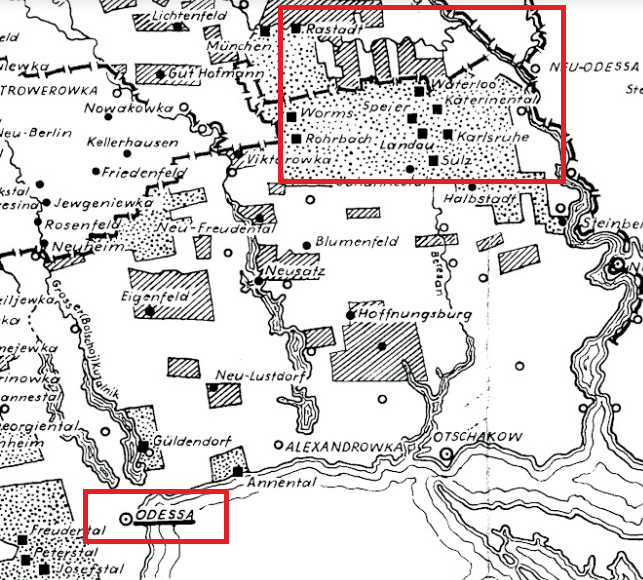
While Paradise on the Steppe provides a look at the collective whole, it also provides important information about the founding colonists of the first colonies and their “daughter” colonies. For example, several of my direct ancestors and related families are included in the lists for the Beresan colonies of Rastadt and Karlsruhe.

The German colonies in the Beresan district in 1890, as seen in relation to Odessa. All four of my maternal grandmother’s grandparents came from Rastadt and Karlsruhe, located in the upper right-hand corner.

By the 1950s, little was left of the German colonies, through decades of emigration or exile to the Soviet Union’s holdings in central Asia and Siberia. Many of the emigrants relocated in places with similar geography and environment – the American great plains, the Canadian prairie, and the pampas of Argentina, to name a few. My grandmother’s paternal line left the Russian Empire in 1893, first settling in Texas and later in Saskatchewan. My grandmother’s mother left Russia with her parents and siblings in 1912.

Paradise on the Steppe is available at many libraries, especially family history libraries. It is also available for loan through the Internet Archive.

52 Weeks Mark III – Week 7: Immigration

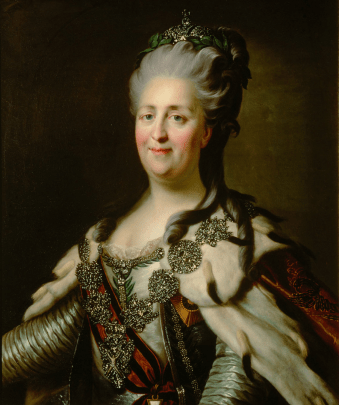
My mother’s maternal line are all Germans from Russia. The Russian Empire expanded significantly during the 18ths century. When Catherine the Great came to power in 1763, she encourage immigration, partly to re-establish farming in regions that had laid fallow during periods of warfare, modernize the country, and to populate regions the Empire had absorbed.

Catherine the Great

Catherine’s manifesto inviting settlers bears some resemblance the homestead schemes introduced in the United States and Canada over a century later.

Among other things, she promised land, free transportation to Russia, and economic incentives (including freedom from taxes for a period of time and interest-free loans for the purchase of equipment). As well, settlers were promised that they could freely practice their religion, retain their language, and be free from military service. The settlers were also promised a degree of self-government.

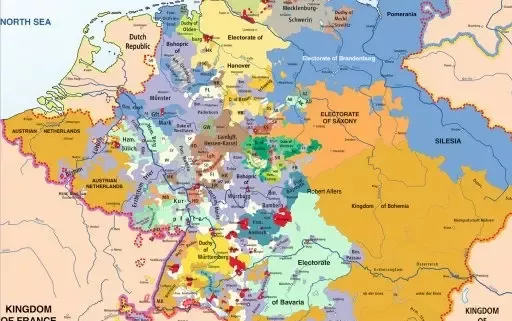
While settlers came from several places in Europe, a majority were Germans. At the time, there was no “Germany”. Rather, the region was primarily composed of a multitude of principalities, dutchies, and other small states. While Catherine’s promises provided a significant pull, economic and political conditions in the German states provided a significant push.

Germany in 1789

The first wave of settlers formed colonies in the Volga region (“Volga Germans”). The next wave occurred after Catherine’s grandson, Alexander I, issued a similar manifesto with many of the same promises. My ancestors were part of this wave of settlers, who formed colonies in what is now southern Ukraine, particularly in the area north of Odessa (“Black Sea Germans”).

The German colonies in the Beresan district in 1890, as seen in relation to Odessa. All four of my maternal grandmother’s grandparents came from Rastadt and Karlsruhe, located in the upper right-hand corner.

The German colonies were usually composed of members of the same religion. The main colonies were Catholic, Lutheran, and Mennonite. These colonies thrived for decades. However, in 1871, Czar Alexander II repealed the manifestos of Catherine and Alexander I. The German colonists lost many of their privileges. Shortly afterwards, they lost their exemption from military service. The next Czar, Alexander III, took further steps to incorporate the German population into general Russian society, which included discouraging the German language and encroaching on the school system established by the colonists.

Needless to say, this immediately sparked waves of emigration of the German colonists, many of whose families had been in Imperial Russia for decades. Many of these Germans left for the United States and Canada, relocating to the plains stretching from Texas to Saskatchewan. Other colonists left for Argentina and Brazil.

My grandmother’s paternal line originally settled in Texas, starting with my great great grandparents, Michael Lerner and Barbara Schmidt and their six children. They came over in 1893 on the S.S. Lahn, which landed at Ellis Island – less than 18 months after it had opened. Michael and Barbara had six more children after settling in Texas, the first of whom was my great grandfather, Heronimus “Jerome” Lerner. Over time, many of their children relocated to Saskatchewan, including Jerome. Michael and Barbara ultimately made the same move themselves, leaving behind several of their adult children.

My grandmother’s maternal grandparents,  Jacob Anton and Margaretha “Margaret” Heck, came directly to Canada in 1912 with all their children and settled in Saskatchewan. This included my great grandmother, Emelia Anton, who was nine years old at the time. She lived to be 94 and I knew her well.

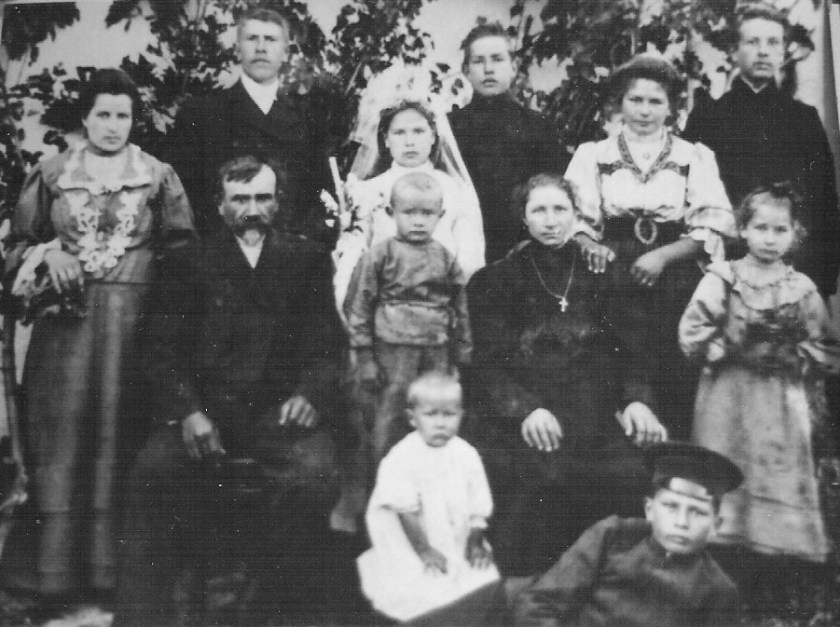
The Anton family, circa 1910. Likely taken in Selo Suchoi, Veronesch, Russia. My great grandmother, Emelia, is the little girl standing at the edge of the right side of the photo.

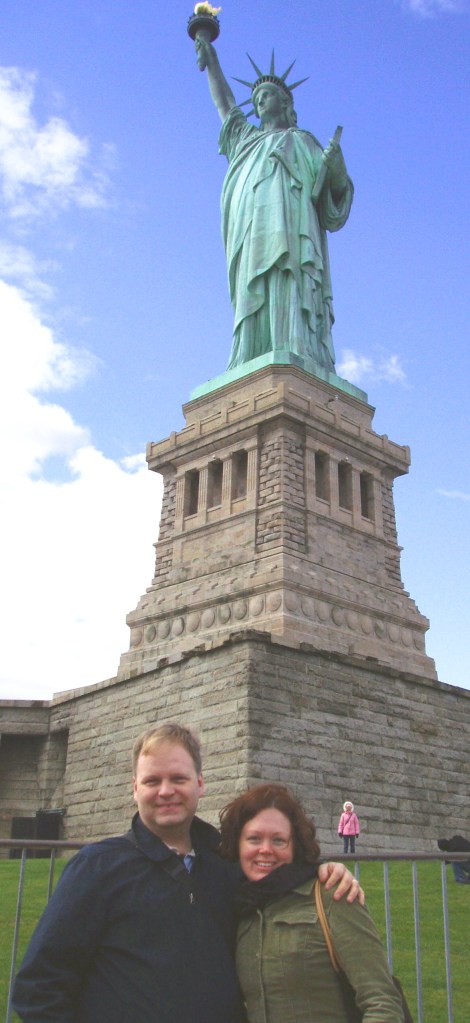
Emelia had not had much schooling before coming to North America, but was very religious. She said that she was frightened and nervous during the journey, as she did not know anything about where she was going and did not fully understand what was going on. However, on reaching New York, she said her fears subsided when she saw “the Madonna”. When she saw that, she knew she would be safe and all would be well. Of course, the “Madonna” was the Statue of Liberty. As she had never heard of it before, she thought it was a statue of the Virgin Mary.

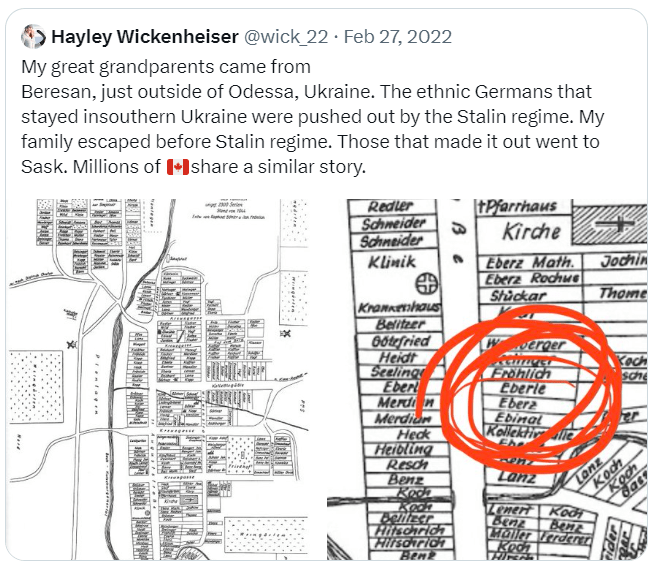
There are many well-known descendants of the Germans from Russia. They include Lawrence Welk, who married my grandmother’s fourth cousin. While I am generally disinterested in celebrity, I was excited to learn that Hayley Wickenheiser is a descendant of Germans from Russia. Her great grandparents lived in Rastadt, where Mike and Barbara had lived before emigrating. However, her family was there decades after mine left, as the did not leave until they fled Stalin’s regime.