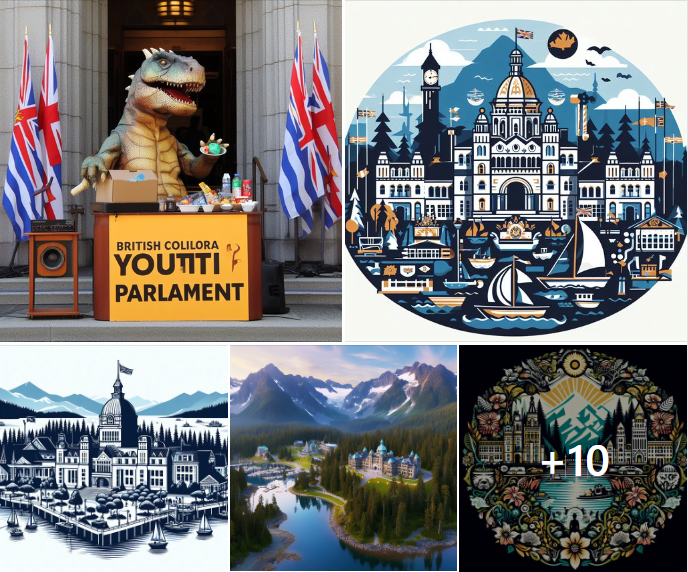
About a week ago, I learned of the Bing Image Creator through a friend who I met in the British Columbia Youth Parliament many years ago. On the BCYP Alumni Facebook page, he posted images he generated with a search of the term “British Columbia Youth Parliament”:
Every image was generated through artificial intelligence, without any human intervention. Needless to say, my favourite is the one with the dinosaur.
Later in the day I thought I would give it a try. However, I couldn’t remember the link he had posted and had logged out of Facebook. All I remembered was that it was through a Microsoft website, so I Googled: “Bing AI image generator”, which took me to the Bing Image Creator. It was only earlier today that I realized that my friend had used Microsoft Designer. That explains why he got so many more image results than I was getting.
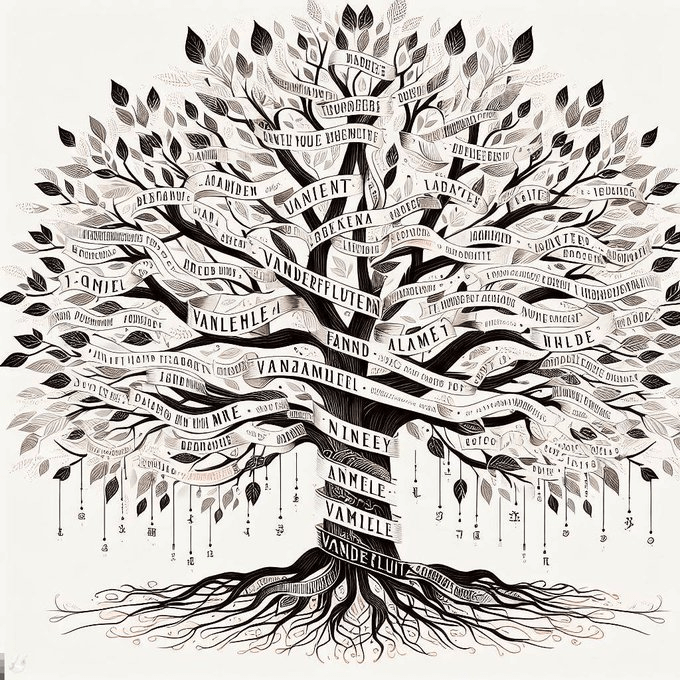
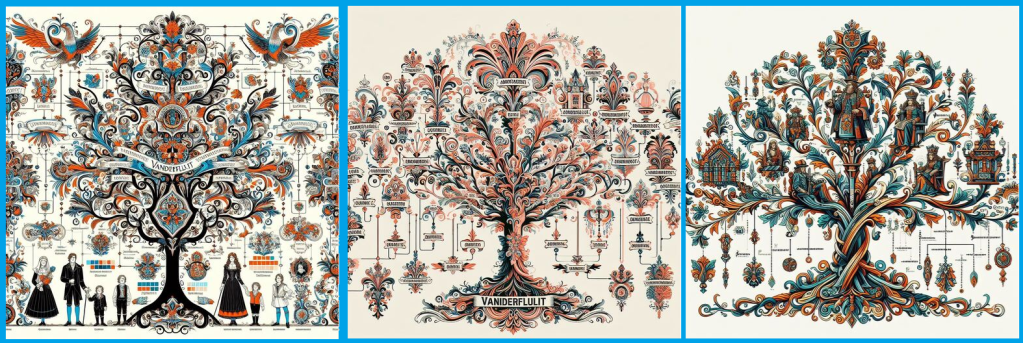
Needless to say, my first go at it was genealogical, and I entered “Vanderfluit family tree”. Of the four images that were generated, this was my favourite at the time.
However, the more I look at it, the creepier it seems. It is also an odd quirk of the AI that it messes with depicting words and phrases. There are lots of variations of “Vanderfluit” in the image, but the closest to correct spelling is at the bottom of the tree, where it says “Vandefluit”.
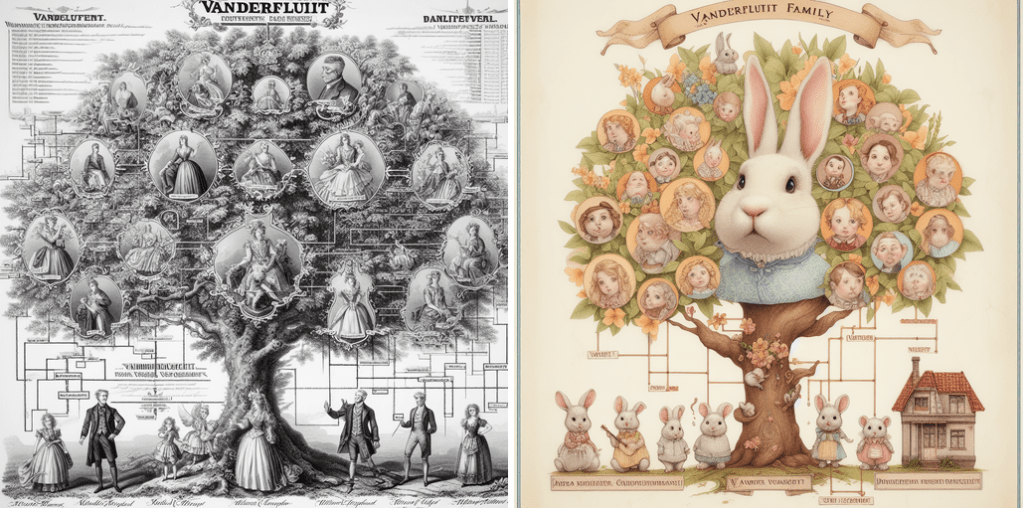
Having just discovered Microsoft Designer, I tried the same term there:
Apparently, the family patriarch or matriarch is a bunny.
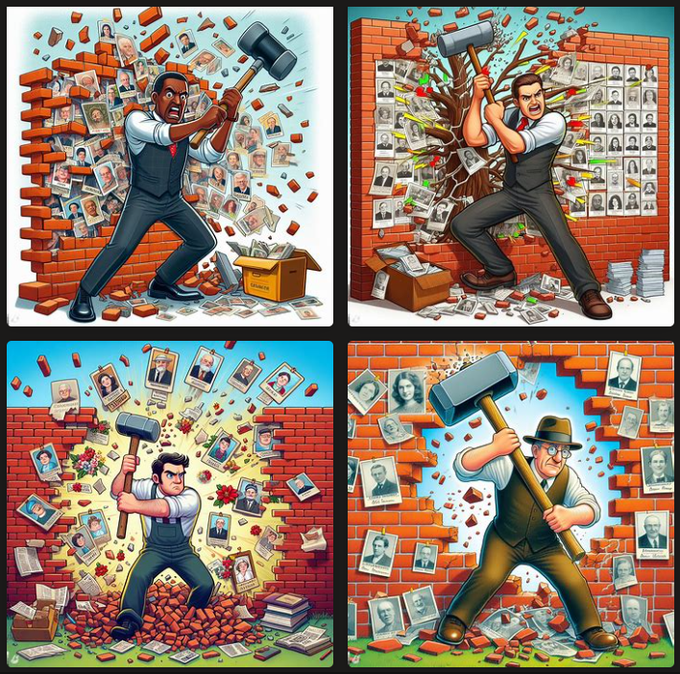
Back to my initial foray into the Bing Image Creator, the next term I entered was “genealogist breaking down brick walls”:
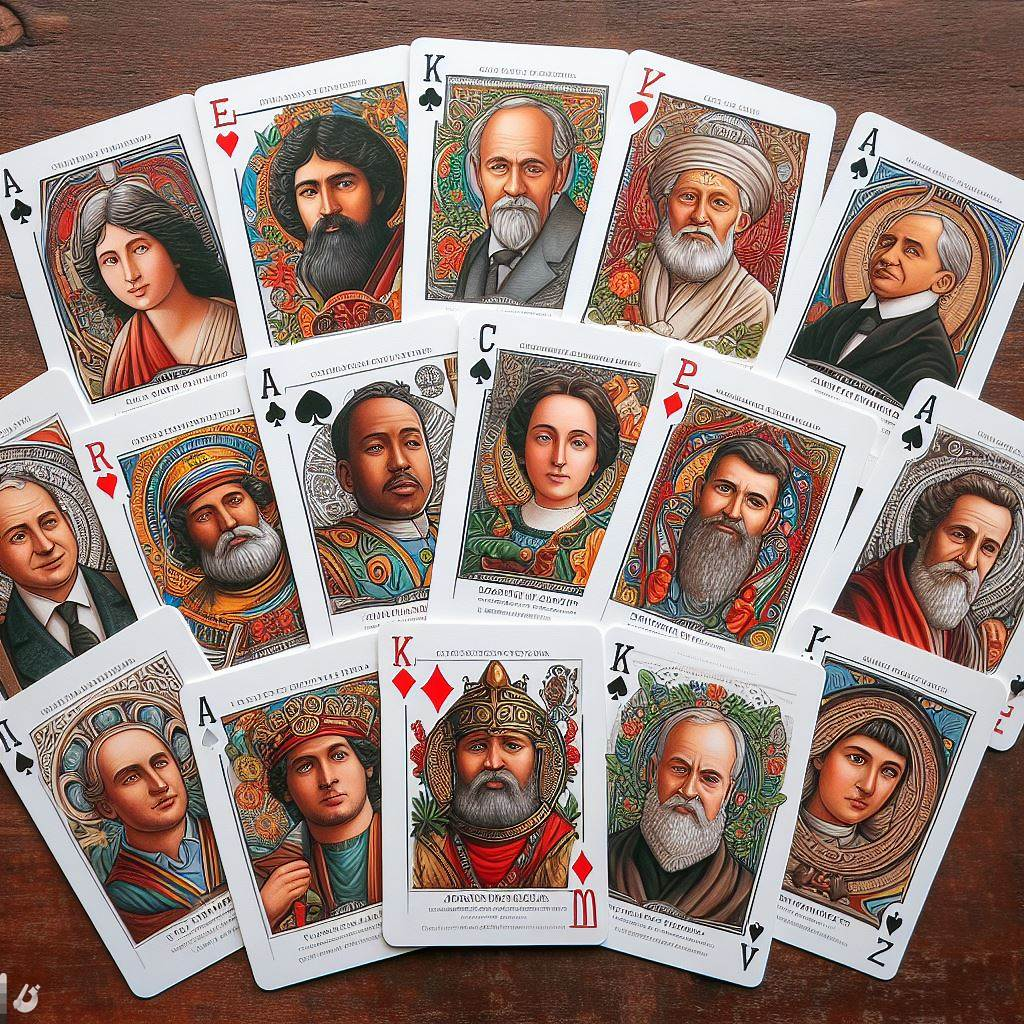
Of course, I had to try out the name of this blog, “A Deck of Ancestors”:
Of these, I liked this one best:
However, I found it interesting that the one image suggests I have a lion as an ancestor:
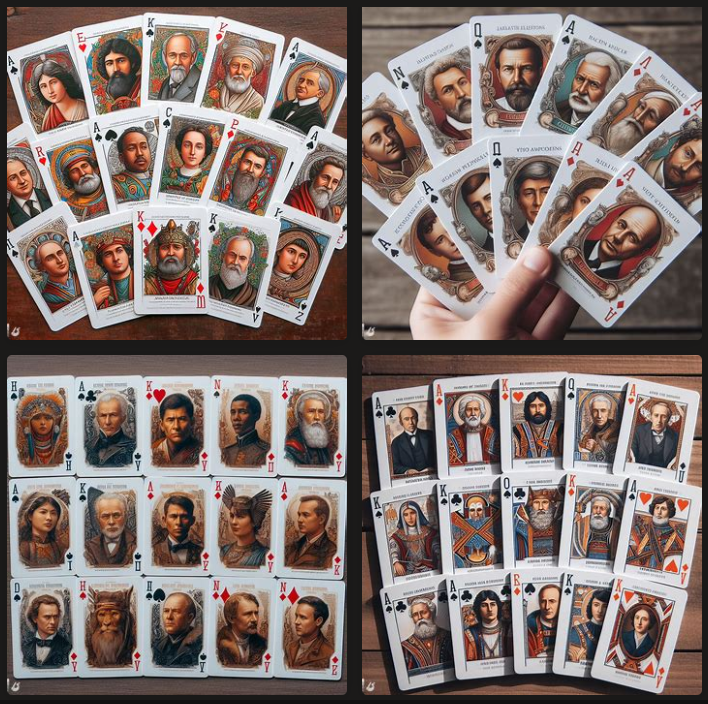
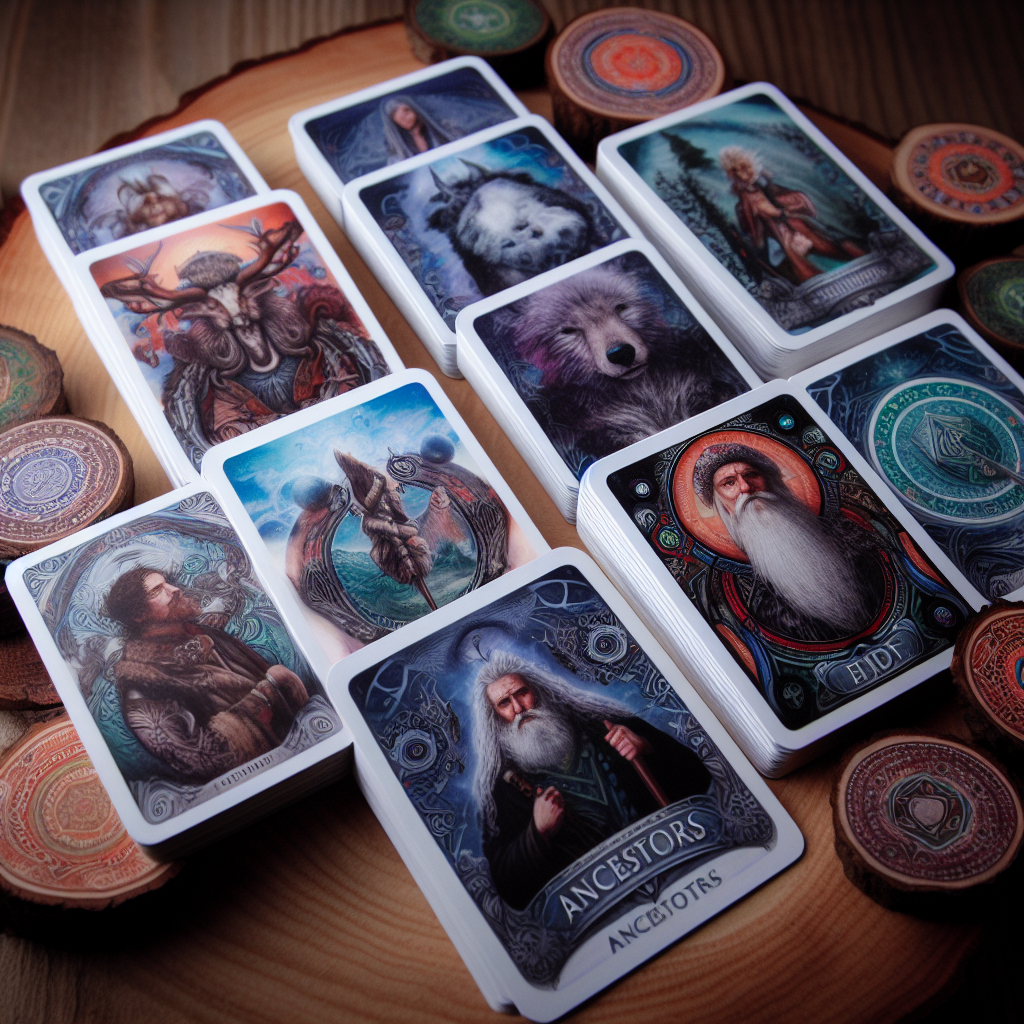
Meanwhile, Microsoft Designer went with a tarot card theme for “A Deck of Ancestors”:
Finally, I entered my name into the Bing Image Generator. It told me the results were blocked. Microsoft Designer didn’t object and provided these results:
Old newspapers are a great resource for genealogists. However, I do more than read just the item I’m looking for. I enjoy seeing what else was in the news on the same day as an ancestor’s birth, marriage, death, or other newsworthy action. Not only because it provides context for the familial event, but also because there are some really fun or interesting items to be found. There are all sorts of things you wouldn’t believe.
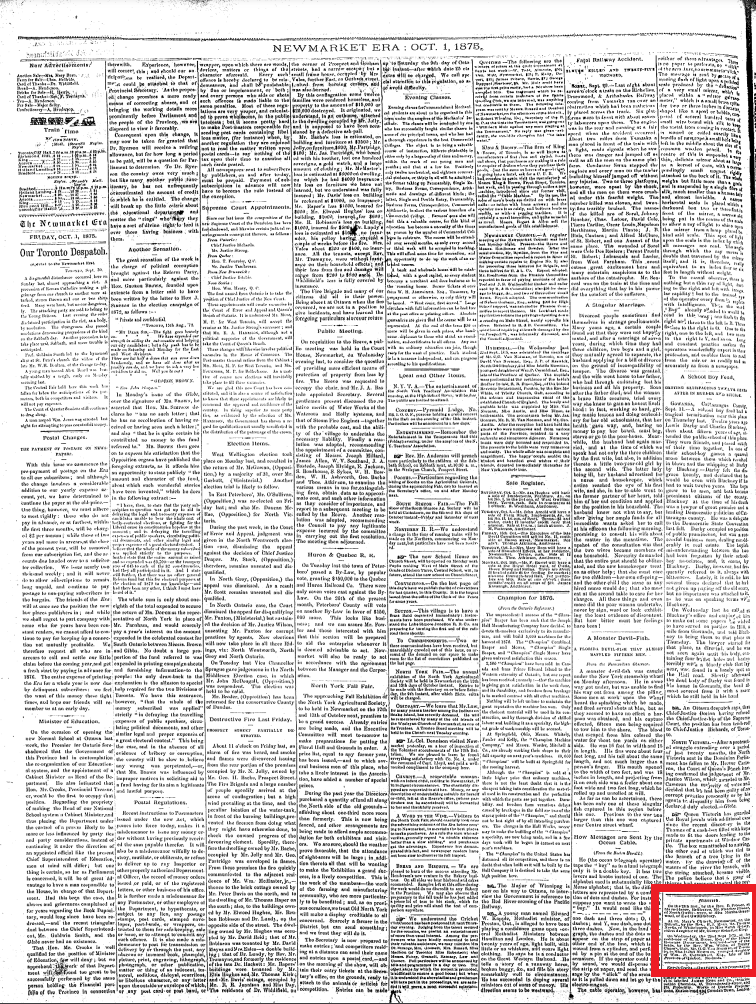
This is page two of the Newmarket Era (Newmarket, Ontario) for October 1, 1875.
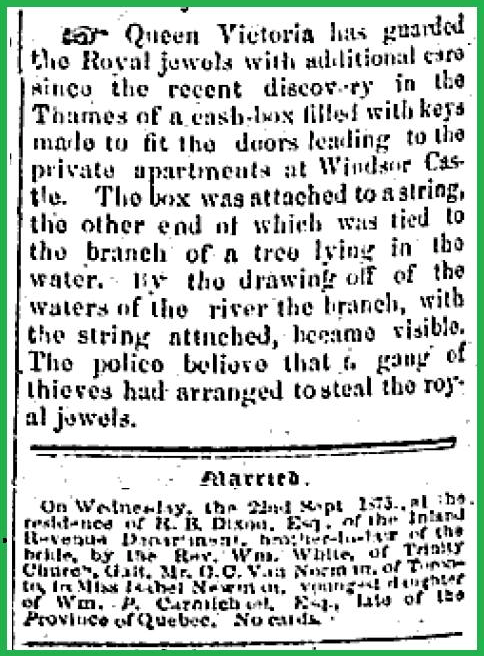
The item I was interested in is found in the bottom right-hand corner, marked in red. It announces the marriage of our sons’ great great great grandparents, Charles Crittenden Van Norman and Isabella Newman Carmichael.
However, there are lots of fun, interesting, and odd bits on the rest of the page. The first thing I noticed is immediately above the marriage notice: a great bit about what appears to have been a foiled plot to rob Windsor Castle, when Queen Victoria was on the throne.
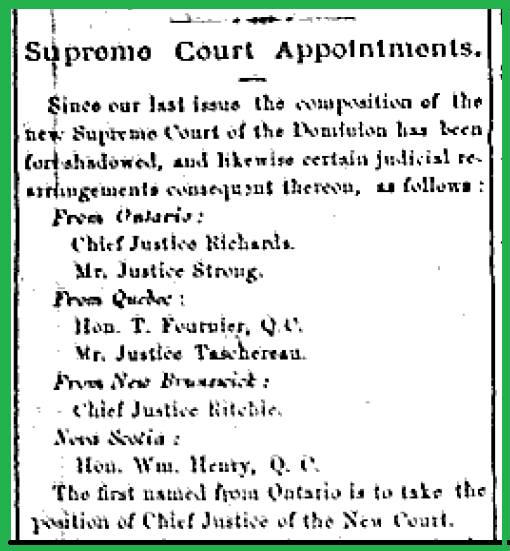
Buried elsewhere on the middle of the page was an item about the first appointees to the newly created Supreme Court of Canada. Note that there were no appointees from west of Ontario, although the only western provinces at the time were Manitoba and British Columbia.
That’s right, you wouldn’t believe it, the Supreme Court of Canada did not come into existence until seven years after Confederation. It wasn’t even front page news. The placement of the item in the middle of the page, in the third column, below a piece on new regulations for local postmasters, indicates the relevant unimportance of the court at that time. It wasn’t even the highest court for the country. That role was held by the Judicial Committee of the Privy Council in the UK until 1949 – 82 years after Confederation. Elsewhere on the page is an item noting that the first choice for Chief Justice of the new court turned down then offer – he preferred to remain in his position as the head of one of the provincial appeal courts.
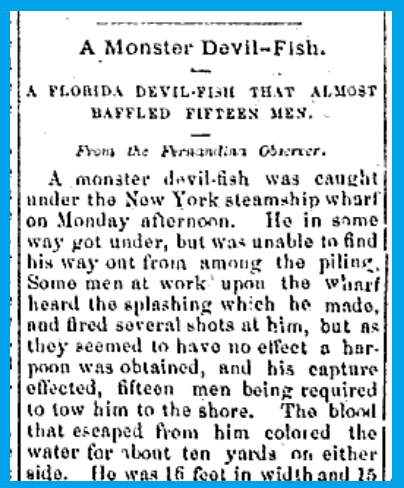
A few columns over is an item that you wouldn’t believe – “A Monster Devil Fish”. An incredible story about “A Florida Devil-Fish That Almost Baffled Fifteen Men”! The item ends by noting that “only only of these singular fish” had been captured before, “previous to the war.” Obviously, readers at the time would have known what war the story was referring to. Today, given that the item came from an American wire service, it’s most likely the reference was to the American Civil War.
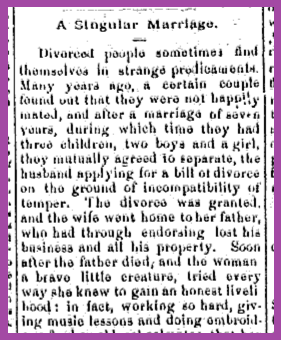
Above the Devil-Fish item is another story that not only you wouldn’t believe, you probably would not want to believe. “A Singular Marriage” tells the story of a divorced single mother of three (a “brave little creature”). She ended up in such a state of poverty that she was left with the prospect of begging, starving or going to the poor-house, unless she took a job as the housekeeper and nanny for her ex-husband, his new wife, and their two-year old daughter. “All these things and even more did the poor woman undertake, never by sign, word or look exhibiting the least evidence of discontent. But bitter her feelings must have been!”
Years ago on The Great Canadian Baking Show, one of the contestants said that she was using her *great* grandmother’s recipe. I have all sorts of recipes from my grandmothers (and copious notes on the recipes they didn’t write down that I’ve spent years trying to recreate). However, it never crossed my mind to think about my great grandmothers’ cooking. So the episode inspired me to ask my mother and mother-in-law if they had any of their grandmothers’ recipes.
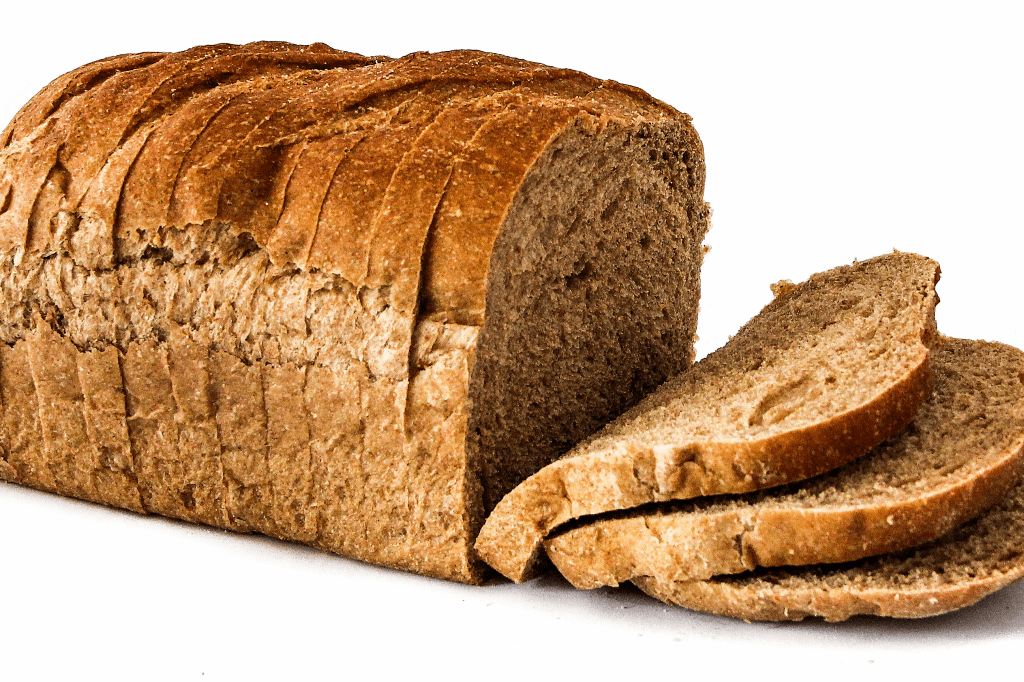
My mother-in-law responded first and provided me with her maternal grandmother’s recipe for brown bread. I’m happy to have it, but I doubt I’ll ever make it. It not only calls for nine cups of flour, it also requires two cups of rolled oats. I know that nine cups of flour isn’t outlandish for two loaves of bread, but adding in all those oats, it strikes me as a lot. However, the real impediment is that while I love to cook, I do not enjoy baking – despite the fact I am a pretty good baker. Nevertheless, I am thrilled to have a recipe that our kids can say was their great great grandmothers! (In fact, writing that last sentence has me thinking that maybe I should make this recipe…)
My mother responded by saying that she didn’t think she had any. She reminded me that her maternal grandmother was not a very good cook. The one exception was that her grandmother made fantastic raisin drop cookies, which all the grandchildren loved. My mother doesn’t have the recipe, which is fine by me. The only thing more boring than raisin cookies is oatmeal cookies.
This past summer we participated in a 16-week Community Supported Agriculture (CSA) program through a local Richmond farm, Sweet Digz Farm. Overall, we had a very positive experience. What became apparent very early on was that a lot of the produce we were receiving lent itself to a lot of Dutch dishes. In particular, we had a lot of potatoes and kale, the key components of boerenkool stamppot (the Dutch were eating kale decades before it was cool and trendy in North America). My paternal grandmother often made stamppot, and it was awful. I knew I could do better.
My youngest and I went to a local butcher in Steveston Village and he selected the sausage for the recipe. (Sometime I will have to write about the Steeves family of New Brunswick, after whom the west coast village is named. My kids are Steeves descendants.) I also was a bit non-traditional with my stamppot. While there are no hard and fast rules, stamppot is usually potatoes and kale, while a combination of potatoes, onions, and carrots is hutspot. I was a rebel and not only used potatoes, carrots, and kale in the same dish, I used a few kohlrabi in place of a couple potatoes.
If I say so myself, it turned out amazing, and needless to say, much better than my grandmother’s. Not only that, but everyone in the family loved it and wanted seconds. While my family are generally not picky eaters, there are very few things that appeal to all of them. There’s always something I can tell someone is less than thrilled with. Even moreso with the Dutch foods I make – there’s always one who loves it and one for whom the dish is not for them. Pity, because in the winter months I really could go for some snert. A few days later I made shepherds pie (another universal favourite), but used leftover stamppot instead of the typcial mashed potatoes. Another win!
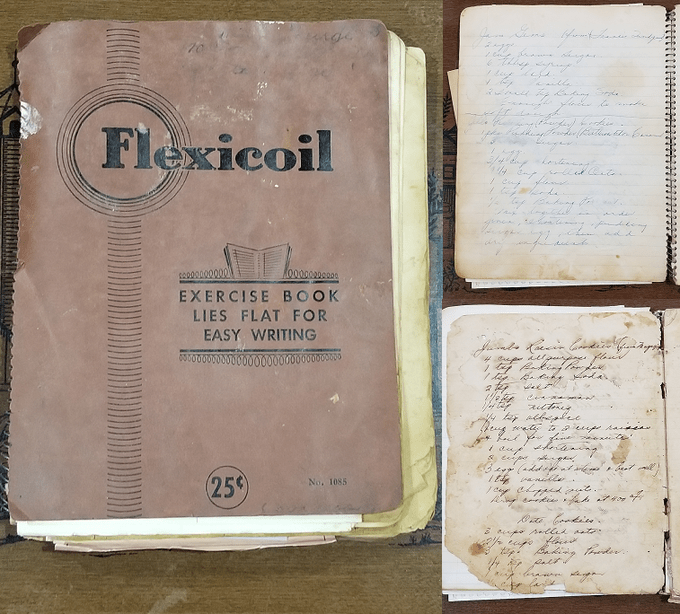
The biggest score, however, was during a visit to my mother’s a year ago. She distractedly removed an item from the back of a shelf and casually said, “oh, it’s my mother’s recipe book.” Yes, my head exploded. I had been asking her for years if she would find it for me sometime. I immediately absconded with it and photographed every page. The vast majority of the recipes were her desserts and sweet dishes but very few of her savoury dishes. However, a few of the savoury dishes seemed familiar – they were things my mother made, but in a whole different way. I could see how my mother adapted and changed her mother’s recipes over time – just as I do with my mother’s recipes!
My maternal grandmother’s recipe book.
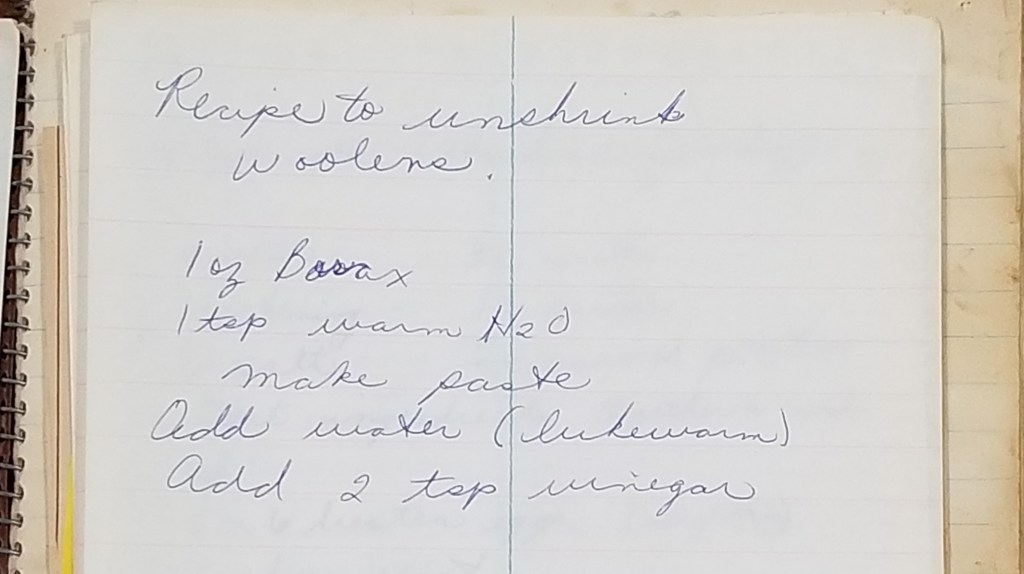
My grandmother also wrote down a few non-culinary recipes, such as this Recipe to Unshrink Woolens:
There were also a lot of clippings of recipes from magazines and product packaging. This was an advertisement on the reverse side of a recipe my grandmother clipped from a magazine in the 1970s:
I suspect those scientists – and their successors – remained frightened, and rightfully so.
Two “Troublemakers” come to mind for this week’s 52 Ancestors challenge. They are both ancestors of our children.
David Van Norman (Our Kids’ Gx4 Grandfather)
Up until the 1830s, the colonies of Upper Canada and Lower Canada (roughly modern-day Ontario and Quebec) were ruled by oligarchic elites. In Upper Canada, they were disparagingly called the Family Compact; in Quebec, they were called the Château Clique (even though they were largely anglophones, one of whom was John Molson, founder of the brewery company). Their rule was largely self-serving and the government was run through patronage. Discontent was further fueled by economic depression.
A Reform movement developed in both colonies. The Reformers initially tried to change the system politically, from within, including electing Reformers to the colonial legislatures. When this failed, rebellions broke out in both colonies in 1837: in Lower Canada in November and Upper Canada in December.
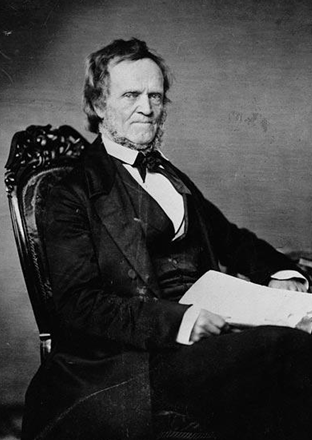
Reformer and Rebel William Lyon Mackenzie
William Lyon Mackenzie was the leader of the rebels in Upper Canada. He was a journalist, member of the colonial legislature, and the first Mayor of Toronto. He was also the grandfather of the longest serving Canadian Prime Minister, William Lyon Mackenzie King. After losing re-election to the legislature in 1836, he concluded that political change could only occur through conflict. His small militia was quickly defeated. Mackenzie and some followers fled to the United States. In mid-December, the rebels established the Republic of Canada on Navy Island in the Niagara River. The British attacked and the rebels retreated to the US, where Mackenzie was arrested and jailed for violating the its Neutrality Act, which prohibited attacks against any country at peace with the United States. President Van Buren pardoned Mackenzie, who returned to Canada after reforms had been instituted and the colonies of Upper and Lower Canada had been merged to form the Province of Canada.
David Van Norman was born to Loyalist parents in Kingston, Upper Canada, in 1815. The Loyalists were those who supported the British crown during the American Revolution. After the war, many migrated to Canada. David began his working life as a school teacher. Later in life he turned to farming. David was sympathetic to the Reformers. David was imprisoned during the 1837 rebellion; however, I have been unable to determine whether he actually participated in the fighting. Whatever the circumstances, the government clearly considered him to be a troublemaker.
Apparently David knew Mackenzie and the two remained good friends until the latter died in 1861. David passed away in Keswick, Ontario.
Richard Newman (Our Kids’ Gx10 Grandfather)
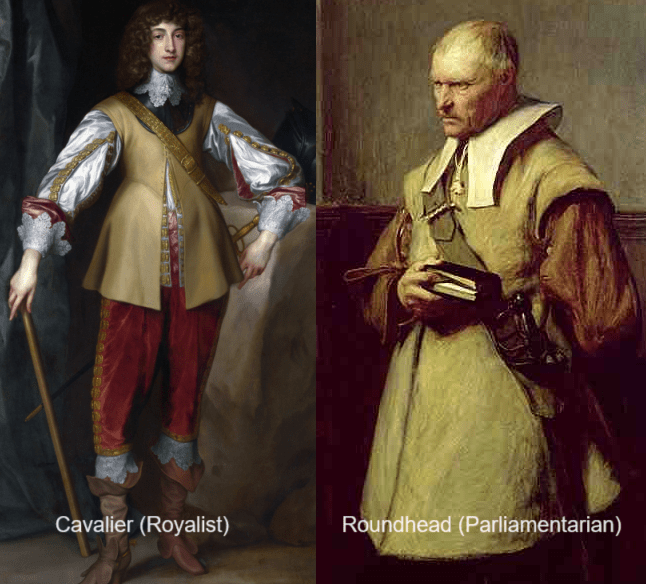
Richard Newman (c. 1620 – 1695) was a barrister who supported King Charles I during the English Civil War between the Royalists and the Parliamentarians led by Oliver Cromwell (also referred to as the Cavaliers and Roundheads). Richard’s aid to the King included financial support by way of loans. Richard was appointed High Steward of Westminster during the Civil War.
Richard also fought alongside the King’s heir, Prince Charles (later Charles II) at the Battle of Worcester in 1651. Richard served with the rank of colonel. After the Royalist loss there, Richard assisted the Prince by helping him to escape to France and by sending him money during his exile. Richard was imprisoned by Cromwell for his troublemaking. Richard was later released, presumably when Charles II returned to the throne in 1660.


 A Deck of Ancestors