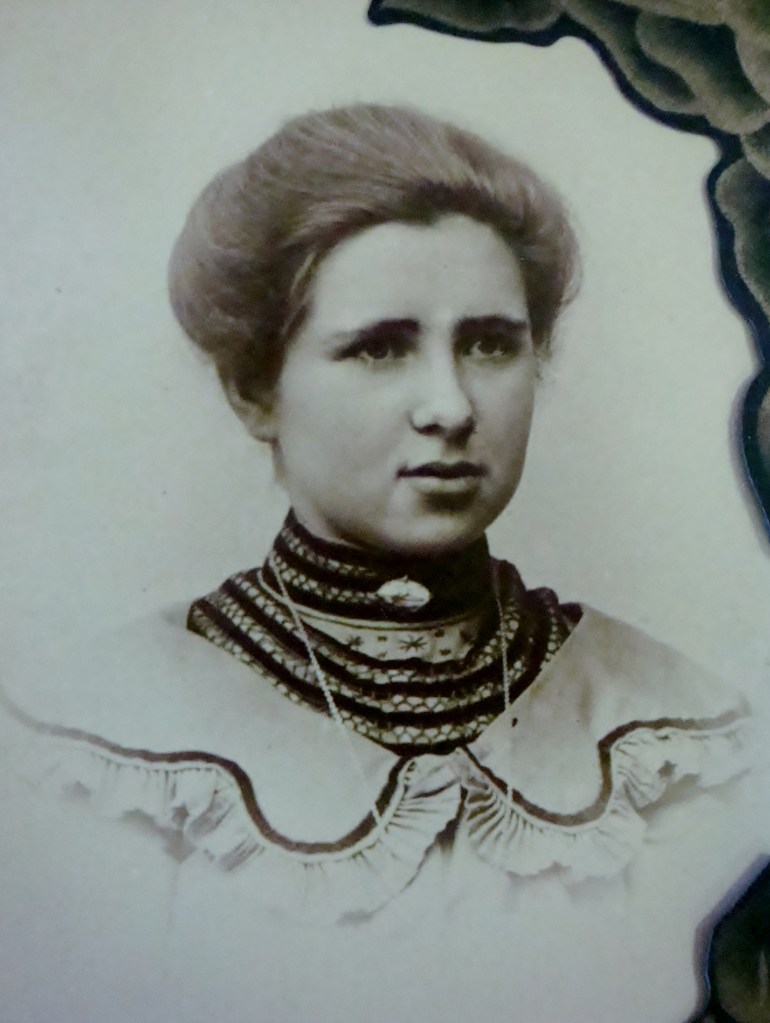
Margaretha (“Margaret”) Heck (1 April 1868-21 October 1946)
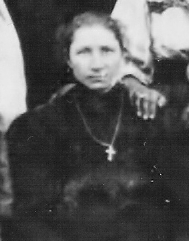
My mother shares a birthday – April Fools’ Day! – with her mother’s maternal grandmother, Margaretha (“Margaret”) Heck. In fact, my grandmother gave my mother Margaret as a middle name in honour of her grandmother.
My grandfather always called my mother “Maggie”, which of course is a derivative of her middle name. When I asked my mother why he preferred to do so, she said that her mother had wanted to give her Margaret as her first name, since my mother shared a birthday with her great grandmother. However, her father objected because people would call her Maggie, so my grandmother agreed to give my mother Margaret as her middle name.
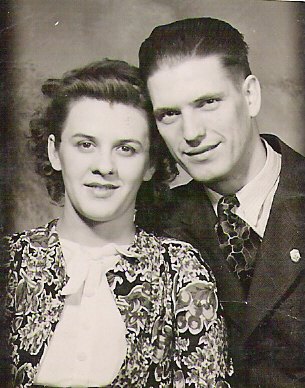
My mother’s parents, Leo Burgess and Helen Lerner. Margaret Heck was Helen’s maternal grandmother.
Milton Burgess: “There’s Maggie!”
When my mother’s parents brought her home, her paternal grandfather was there and said, “there’s Maggie!” Since that time, Lorraine’s father and grandfather called her Maggie. Later, the immediate family and some of her cousins came to call her Maggie.
Of course, my mother was often teased by being called an April Fool because of her birthday. When we were kids, the tradition was that the time for pranking ends at 12 noon. My mother was adamant that she wasn’t an April Fool because she was born in the afternoon.
Once we were at my grandparents on April Fools’ Day and everyone was giving my mother grief about being an April Fool. My mother repeated her defense that she was born in the afternoon. My grandmother interjected and called out from the other room, “no you weren’t, you were born in the morning!”
Grandmothers: always siding with their grandchildren. Very funny!
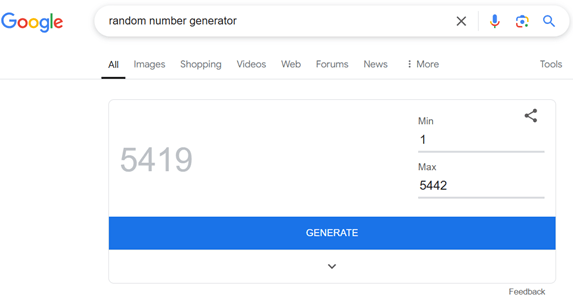
This week’s prompt for the 52 Ancestors Challenge is “Random Number”. At present, I now have 5,442 individuals in my primary RootsMagic database, which assigns each person a unique Record Number. That’s 148 more people than there were as of July 8, 2024, when the theme was “Random“. So, using the same method as last time, I generated a random number between 1 and 5,442. The result was 5,419.
There was a 0.018% chance of this coming up.
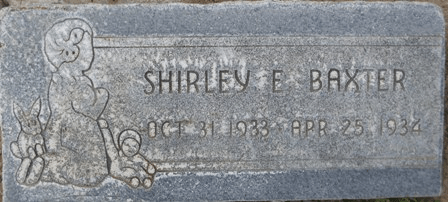
Shirley Elizabeth Baxter is #5419 in my database. Shirley is my first cousin twice removed. As with the result I obtained last time I did this, Shirley did not have a very long life. She was born October 31, 1933 in Goshen, Utah and died April 25, 1934 – not quite six months old. Thus, it bears repeating what I said in last year’s post:
One might think that this is an unfortunate result, in that there is not much to say about someone who lived such a short life. However, I was quite happy with the result. To me, it’s important to remember those who never really got to live their lives. Not only were their lives dismally short, they’re often forgotten as a result. They might not have been long in this world, but their time on Earth should be noted.
Shirley was born to John Grant Baxter and Sarah Florilla (“Rilla”) Burgess, who married on October 12, 1911 in Nephi, Utah. Rilla was my grandpaLeoBurgess‘s aunt. Shirley was the ninth of ten children and the only one not to survive infancy. Her eldest brother Evan was 22 years old when Shirley was born.
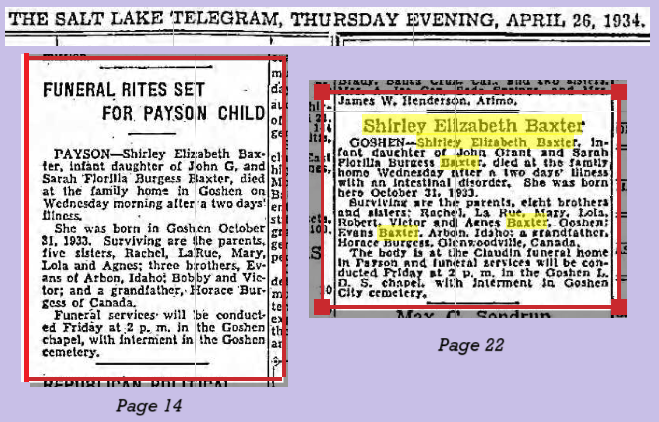
One of the main sources of information I have for Shirley comes from an item in the Salt Lake City Telegram published on April 26, 1934. In fact, the evening edition contained two separate items.
Horace Burgess, who is mentioned in both these items, is the most recent common ancestor that I share with Shirley. He was her grandfather and my great great grandfather.
The other place where I found information about Shirley was Find A Grave. Her entry includes a photo of her headstone.
Since starting this post, I thought I’d see what else I could find about Shirley. After all, one of the elements of the Genealogical Proof Standard is requires reasonably exhaustive research to have been conducted.
At FamilySearch, I found Shirley’s death certificate. Because there are contract restrictions, one cannot print or download the image. However, it corroborates what I already knew about Shirley, including her cause of death. I couldn’t read the physician’s handwriting (how stereotypical!), but I showed it to my sister who is a medical doctor. She confirmed that it says “gastroenteritis”.
Other than discovering her grave is also included at BillionGraves, I have not found anything else about her.
Everyone dies twice. Once when you take your final breath, and then again the last time someone says your name.
Attributed to everyone from the ancient Egyptians to Banksy
I say the name “Shirley Elizabeth Baxter” and she lives on.
My wife and I dread December. Not only is the whole month a whirlwind of activity leading up to Christmas, both our children have December birthdays. My brother-in-law is Jewish, and we’re always welcomed into the Hannukah festivities. The worst year was when a birthday, Christmas, and first night of Hannukah all occurred on the same day – something that is happening again this year. Plus, of course, we celebrate Sinterklaas.
Sinterklaas is a traditional holiday generally celebrated in the Netherlands and its former colonies, Belgium, and parts of Germany and France. It takes its name from its central figure who, like Santa Claus, has his origins in St. Nicholas, an early Christian bishop who lived in what is now Turkey. In fact, Santa Claus owes much of his origin to Sinterklaas.
Sinterklaas has much in common with Christmas. However, unlike Christmas, Sinterklaas is celebrated on December 6, the feast day of St. Nicolas in the Christian calendar. Both Sinterklaas (also called “Sint”) and Santa deliver gifts the night before their respective holidays, Sinterklaas often arrives in the Netherlands in mid-November and travels around the country visiting children, participating in parades, and handing out treats and gifts.
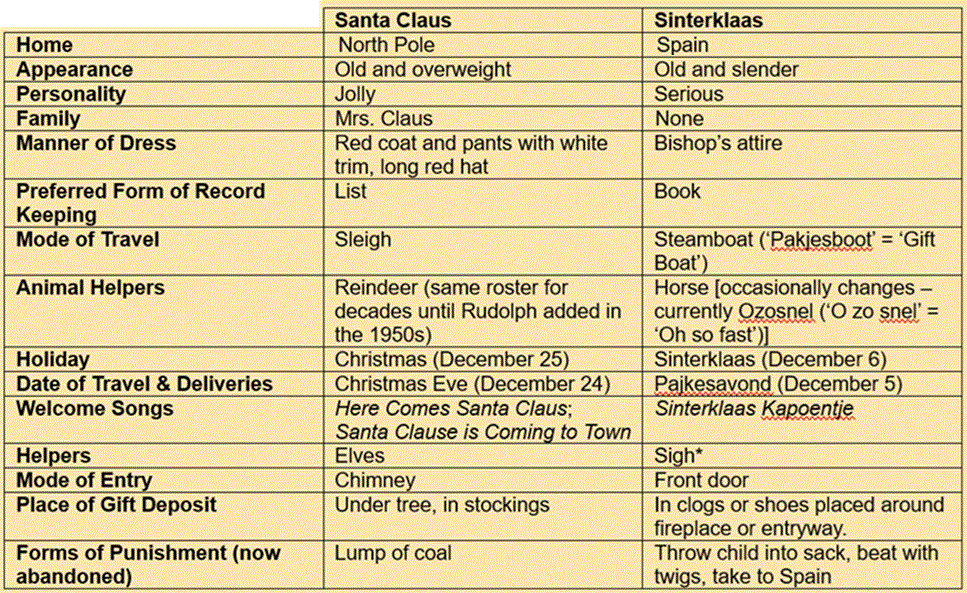
While Sint and Santa have much in common, they have many differences. Sint lives in Spain (probably rooted in the fact that the Netherlands was part of the Spanish empire until the 16th century), travels by steamboat, and rides a horse. As well, Sint’s appearance is rooted in his church origins, so he is dressed like a bishop.
A Few Differences Between Santa and Sint
Elizabeth Bakker
Since only my father is Dutch, we did not observe many of the Dutch cultural traditions, and definitely not in the way they do in the Netherlands. My great grandmother, Elizabeth Bakker (1888 – 1976), always sent us a package of goodies for Sinterklaas. However, at the time I didn’t know it was for Sinterklaas. I never even heard of Sinterklaas until well after my great grandmother died. I thought the package was for Christmas and that she sent it early in the month so it would get to us in time.
I loved those packages – they always contained many of the traditional Sinterklaas treats: pepernoten, kruidnoten, taai taai, and speculaas (all forms of spiced cookies, somewhat like gingerbread, although the former two are quite small); marzipan; borstplaat; and, of course, chocoladeletters (“chocolate letters”)!!
The letters originated centuries ago as baked goods, but are now almost exclusively made of chocolate. It is traditional to receive a chocolate letter of the initial of your first name. When we were kids, there was always an argument that some letters were bigger than others so they had more chocolate. The truth is that, while the surface area of each letter might differ, they are manufactured in different thicknesses so that every letter contains the same amount. The other problem is finding letters that are uncommon initials for names in the Netherlands, although that is less of a problem than it used to be.
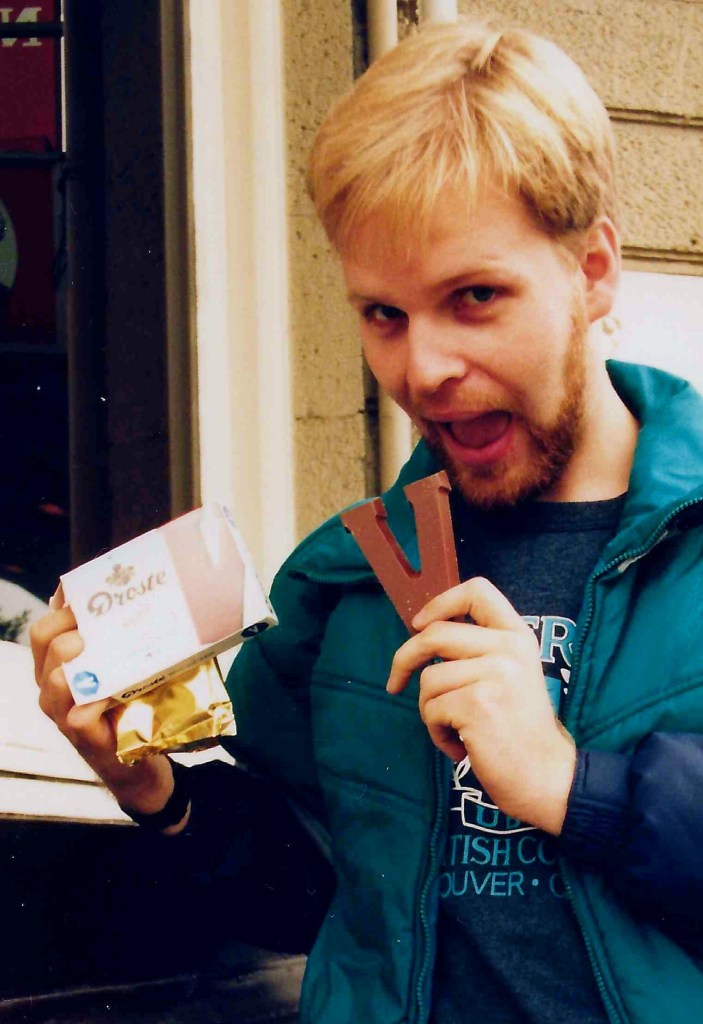
I found a Droste store in Amsterdam!
Chocolate letters are another item for which, outside the Netherlands, the availability seems to change over time. When I was a kid, they seemed to be available everywhere. Purdy’s made their own for a while, but I haven’t seen them there in a long time. In recent years, the only place I could find them were in Dutch stores. Even then, I could not find Droste letters – the absolute best ones, bar none – anywhere. You could only find the secondary brands. I once asked a vendor if Droste no longer shipped to Canada, and was told they were simply too expensive to carry. Luckily, a couple years ago I found Droste chocoladeletters in a Dutch store in Lethbridge.
Fortunately, chocolate letters seem to be getting easier to find again, as I saw them being sold in many mainstream supermarkets and shops last Christmas. I first noticed them showing up a couple years ago in a local independent grocery store that specializes in Asian foods and ingredients of all places. Plus, in our neighbourhood of Steveston, there is a chocolatier that makes them – in every letter!
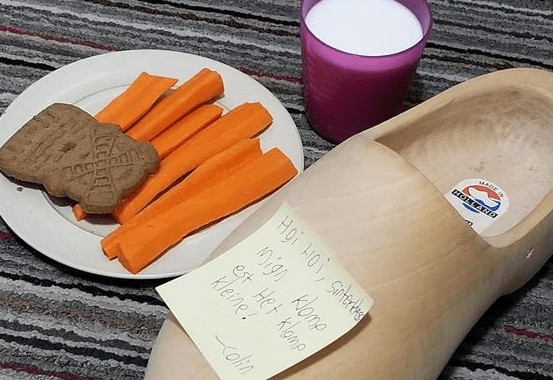
I have no idea where my son learned the Dutch he wrote on the note. There are a couple small mistakes, but it says “Hi, my clog and the little clog” (the small one’s not in the photo).
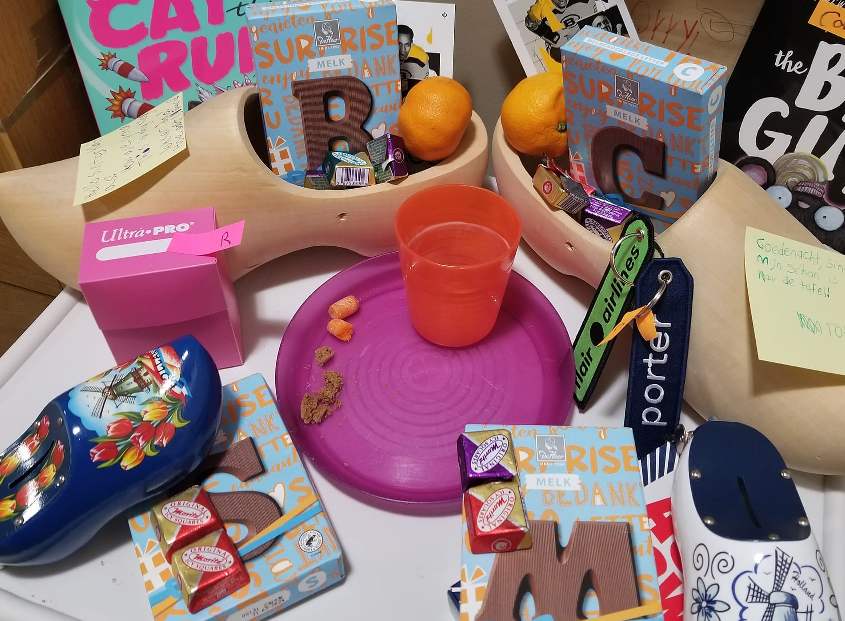
Our kids are more immersed in Sinterklaas. We’ve been marking it every year since our eldest was born. In fact, we thought he might arrive on Sinterklaas! Every year, the kids will put out their shoes along with some klompen (clogs), as well as a snack for Sint and his horse. The last few years they’ve also left notes. Then we’ll watch a few YouTube videos with Sinterklaasliedjes (“Sinterklaas songs”) and then off to bed.
The kids didn’t do too bad last year.
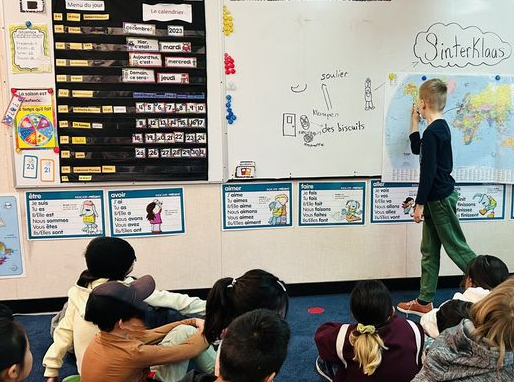
When our eldest was in second or third grade, he made a presentation to his class about Sinterklaas. He asked for help with that, and I gave him a few things he could take to school. Our youngest did the same thing last year – except I had no idea he was doing it until after the fact! He had asked me to email his teacher a video of a Sinterklaas song, but I didn’t know what it was for or that it was part of his presentation. His teacher emailed us to say that he knocked it out of the park!
Sharing Sinterklaas with his class!
Of course, anyone even vaguely familiar with Sinterklaas has probably heard of Zwarte Piet (“Black Piet”). For decades, Zwarte Piet was seen as Sint’s delightful helper. The association many people have with a beloved childhood memory likely makes it difficult to accept the unsavory fact that Piet is anything other than a negative stereotype. I don’t buy any of the arguments defending this outdated and offensive figure, which are based on fallacies, myths, and disregard for history. It’s often a waste of breath to argue and about this time of year I have to mute my social media feeds connected to the Netherlands.
While Piet remains a polarizing topic, in recent years it seems that attitudes are changing and the popularity of Zwarte Piet as traditionally depicted has begun to decrease dramatically. Over the last ten years or so, there has also been a shift to reforming or rebooting the character, with the emergency of Roetveegpiet (“Sooty Piet”) (characters with dirty faces due to the soot of the chimney) and Kleurenpiet (“Coloured Piet”) (characters with faces of all colours of the rainbow).
Meanwhile, Sinterklaas is less than a month away – better start planning for another busy December!
“Sinterklaas Kapoentje” – You can see the lyrics, English translation, and history of the song here.
I’ve written a fair amount about my Aunt Diana (Helen Diana Burgess 1951 – 1999), but usually I’ve focused on her scientific side. However, I’ve always considered her a true Renaissance Woman, because the arts were just as important to her. It’s why her scientific pursuits lead her into the colourful world of art conservation.
Helen loved paper and textiles, flowers, beautiful ceramics and glass, and cats. She was often teased by her friends for picking flowers wherever she could find them, including, in one instance, the Faculty Club garden at Queen’s. Helen enjoyed painting flowers and donated several of her watercolours to the Lupus Society.
Diana took me to the first movie I ever saw in a cinema, Bedknobs and Broomsticks. Going to that movie was also the first time I rode a city bus. She also had some marvelous record albums, which included the original edition of Jesus Christ Superstar. I remember listening to it over and over again while reading all of my uncle’s comic books whenever we visited my grandparents.
This is the copy my Aunt Diana gave me, which my sons now have.
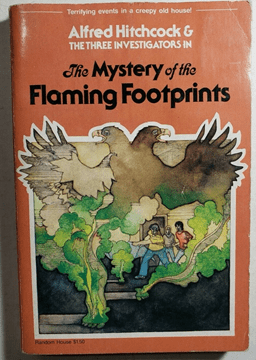
Books were often a welcome gift from her, often titles I had never heard of but came to love. Diana had a huge library of fiction and non-fiction books. In particular, she loved detective novels. The best book she gave me was from the Alfred Hitchcock and the Three Investigators series, Mystery of the Flaming Footprints. The books are about three boy detectives, which were everything boring old Hardy Boys books were not. I went on to buy many more from the series. I’ve passed them all on to my sons, who have read them all several times over.
When I was in undergrad, Diana introduced me to L.R. Wright and her first novel, The Suspect. That book quite blew my mind – a detective novel not only set in Canada rather than the US or UK. Moreover, it wasn’t someplace like Toronto, rather, it was set in the small town of Sechelt, only a short drive away from where live. It’s now been turned into a TV series, Murder in a Small Town.
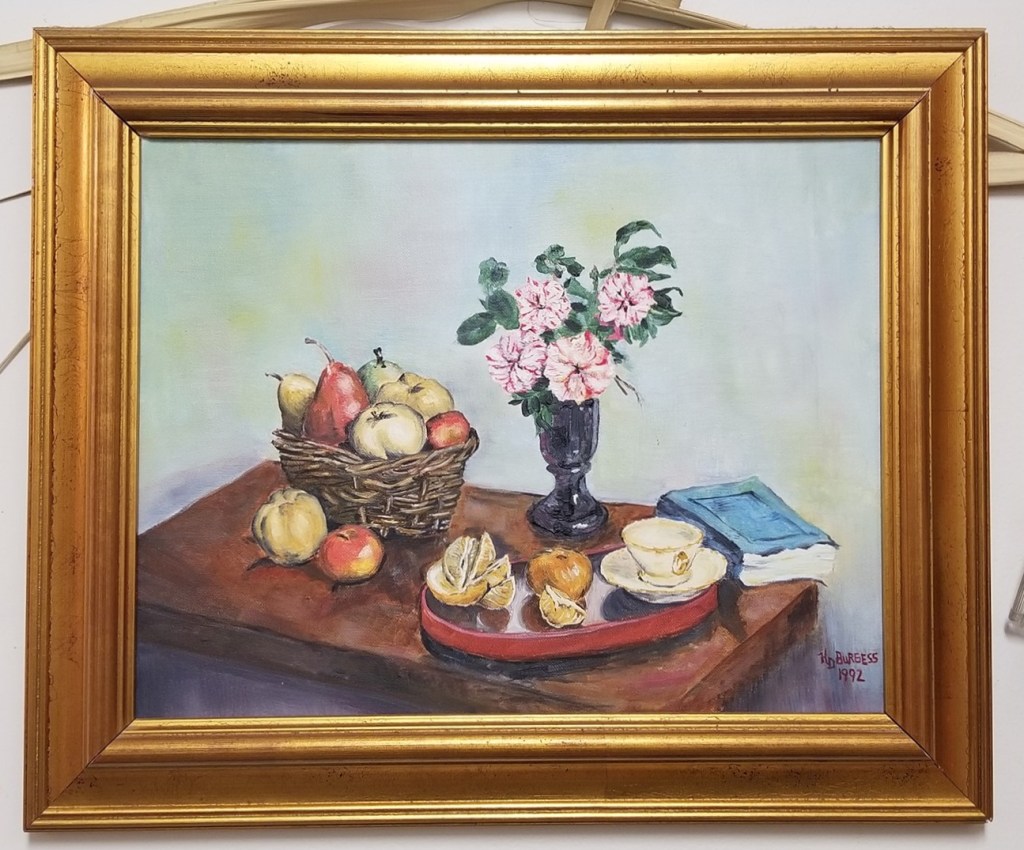
Diana took me on tours of art galleries, including the National Gallery of Canada in Ottawa and the Vancouver Art Gallery. It was wonderful having someone so knowledgeable about art as my guide. Diana loved to paint as well. When I was 10, she gave me my first set of oil paints, along with a small canvas, brushes, turpentine, and linseed oil. It didn’t take long for me to accidentally spill some on the gold shag carpet in our living room. Oops. At least it was purple, which pairs well with gold.
She mostly painted still life, often in vibrant or bright colours, although sometimes she used a more muted palate. My mother has a few of her works, one of which now hangs in her living room.


 A Deck of Ancestors