52 Weeks – Week 25: Broken Branch

For this week’s 52 Ancestors Challenge, Amy Johnson Crow wrote “Are you researching a branch that it feels like there is nobody else in the world who is researching them? What about a collateral line that seems to have gotten lost?”

Turns out that line was mine!

Through sheer chance, through a random encounter with a farmer in the middle of nowhere, I discovered that my great grandfather, Heronimus (“Jerome”) Lerner and his descendants had “gotten lost”. I thought I was looking for them, it turns out they were actually looking for me!

Jerome Lerner was born in Henrietta, Clay County, Texas on March 12, 1895. His parents, Michael Lerner and Barbara Schmidt, were Germans from Russia. They lived in one of the many German colonies in Imperial Russia, in what is now part of Ukraine. These colonies usually bore the names of the places in Germany the original settlers had come from. After Michael and Barbara married, they lived in the village of Rastadt, where their first six children were born. In 1893, the family emigrated to the United States and settled in Henrietta, Clay County, Texas. Jerome was the first of eight children Michael and Barbara had after coming to America.
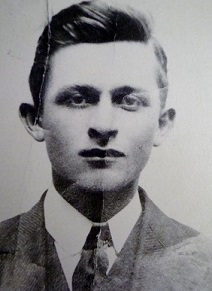
During the mid-1910s, members of the family began moving between Texas and Saskatchewan. Jerome was one of the first. Ultimately, Jerome, his parents, and at least four of his siblings ended up permanently moving to Canada and settled in the area of Fox Valley, Saskatchewan.

Jerome married my great grandmother, Emelia Anton, in 1920. They separated sometime around 1937. As far as I can tell, they never formally divorced. I thought that being Catholic, they might have simply separated without divorcing. However, my great aunt Adeline (their third child) told me that it was more due to the difficulty in obtaining a divorce at the time. Prior to 1968, divorces in Canada were granted through a private act of Parliament, through a difficult and expensive process.
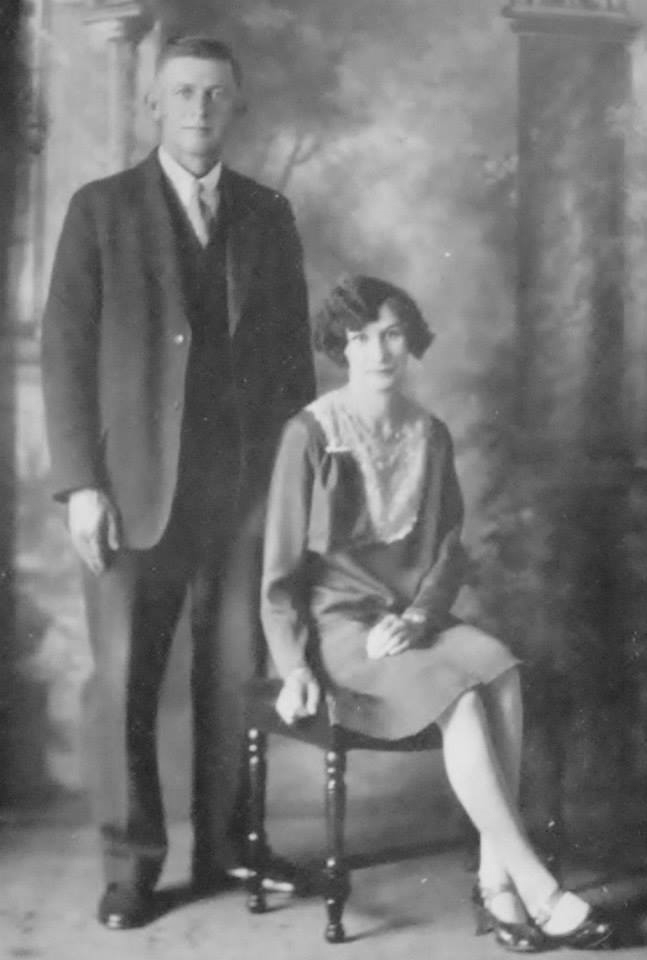
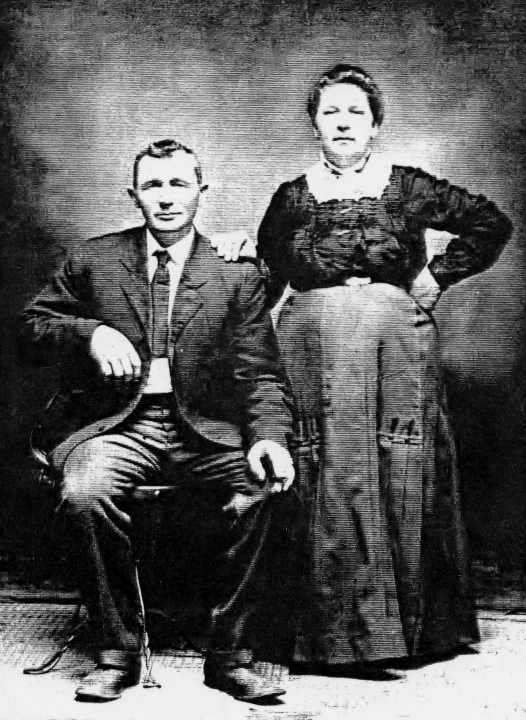
Jerome and Emelia, likely sometime around 1931.

I’d known my great grandmother since I was born. We visited her almost every time we went to my parents’ hometown. As she lived until I was thirty, she was the great grandparent I knew best. I’ve written quite a lot about my Anton ancestors in this blog. They were also Germans from Russia. They came to Canada in 1912 and settled in Rastadt, Saskatchewan. All that is left of Rastadt is the schoolhouse and the cemetery.
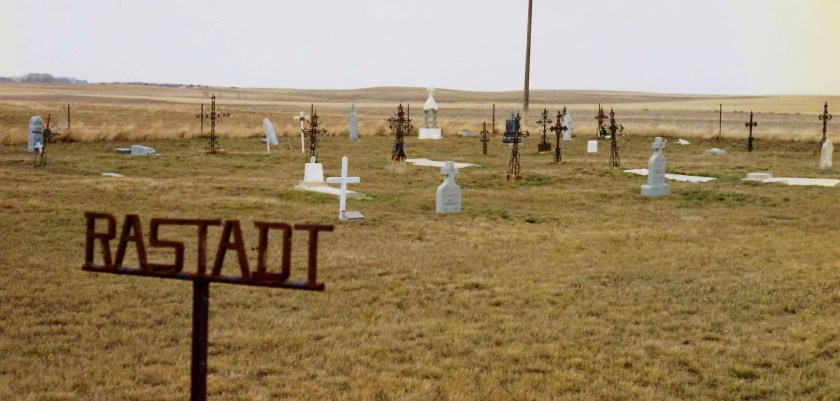
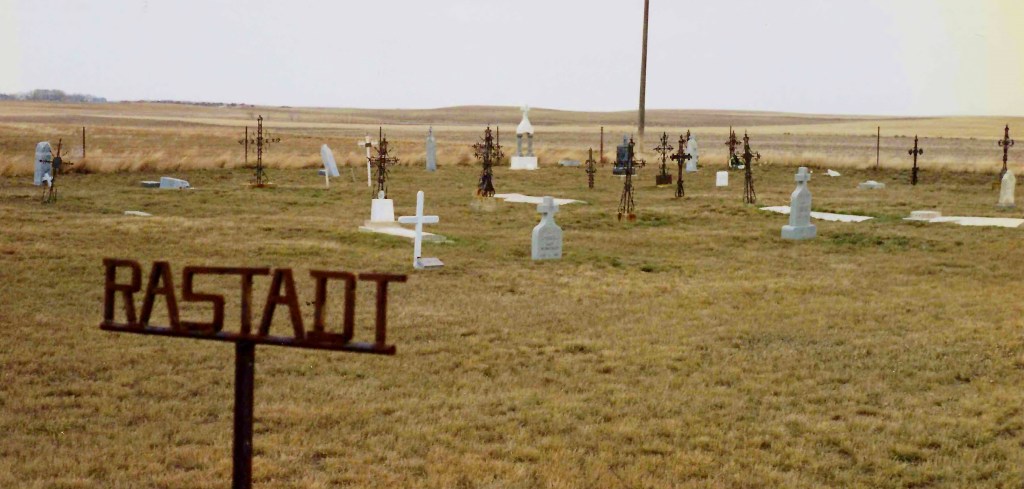
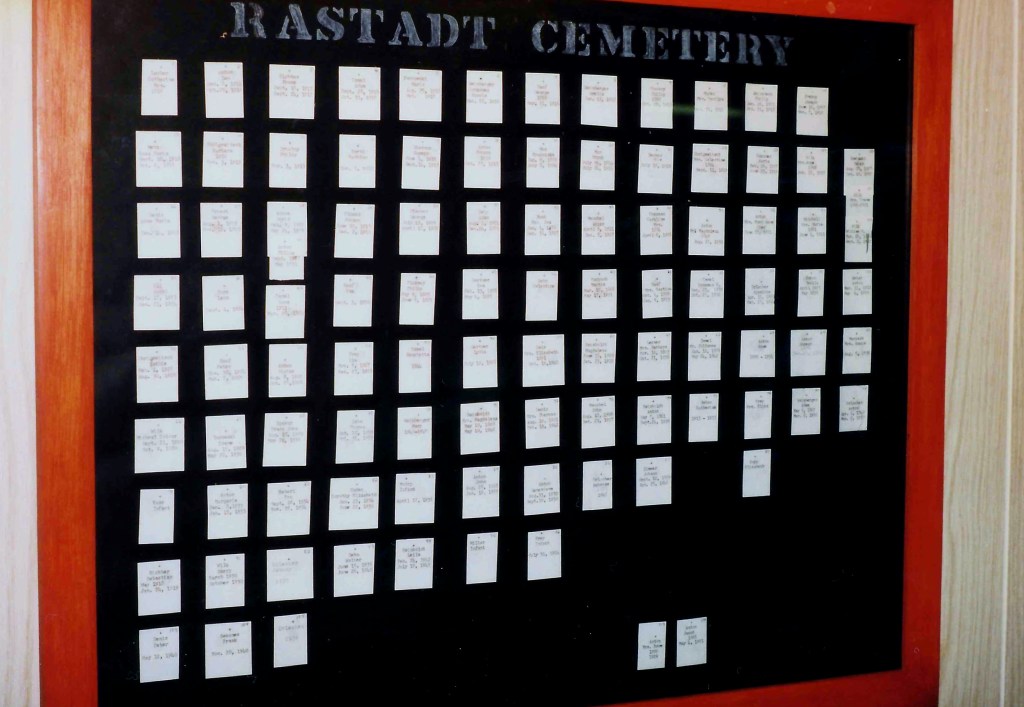
Rastadt, Saskatchewan Cemetery, April 1, 1997. 

While I knew Emelia, I never met Jerome. He died in 1954. My mother never even met him. From what I know, Jerome may have had some mental health problems from sometime around the time he and Emelia separated. As well, from what my mother has told me, the Lerner side of the family was none too pleased with Emelia after she and Jerome separated.

After the separation, Emelia moved to Alberta. I doubt she had much contact with her former Lerner relatives, although it sounds like my grandmother and her siblings might have. Nevertheless, it is easy to see how the Lerner branch of the family might have lost track of Emelia and Jerome’s family. As well, while I know my grandmother, her siblings, and my mother all seem to have been in close contact with their Anton relatives, the fact that branch of the family relocated may have made for a much looser connection. So it seems that Jerome and Emelia’s branch of the family became lost, or lost-ish, to both the Lerners and the Antons.

How were we “rediscovered”?

First, the Antons. In the mid-90s, I made contact online with a Paul Antone of Washington state. It was the early days of online genealogy, so we probably met on a message board or something similar. I wasn’t even using Netscape yet! Paul’s father was one of Emelia’s first cousins. I don’t know if they knew each other. Paul and I sporadically exchanged emails. Through him, I learned of Gordon Anton, a nephew of Emelia’s. At the time, he was compiling a history of the Antons. I don’t know if Gordon ever met Emelia, but it was apparent he didn’t know much about her branch of the family. Apparently he had been in contact with one of Emelia’s sons, my great uncle Herb, but he never got much information through that contact. Gordon ultimately published a history of the Antons, but it was pretty sparse when it came to Emelia and her descendants. Gordon was hoping to publish a second edition, but it never came to be.

Nowadays, finding a lost branch online – even if you are the missing branch being found – is hardly unique or exciting. In comparison, the rediscovery by the Lerner side was largely a matter of coincidence, even though it was because I had been in the right place at the right time. Even today, it would be an unusual occurrence.

In 1997, I left a long-term job and was taking a few months off before embarking on a short-term gig and a return to university. One of the things I did during that time off was visit my parents, who had returned to living in southern Alberta. I had not been to Fox Valley since I was a child, so I suggested to my mother that we go there for a daytrip.

Upon arrival in Fox Valley, we stopped at the village hall where we gathered a wealth of information. Among other things, I was able to discover the exact place where my grandmother was born. After visiting the Rastadt schoolhouse and cemetery, my mother and I made our way to the place where my grandmother was born.
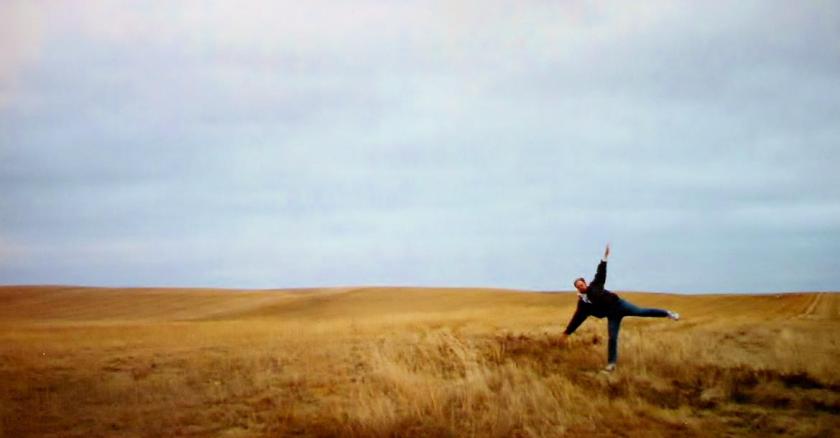
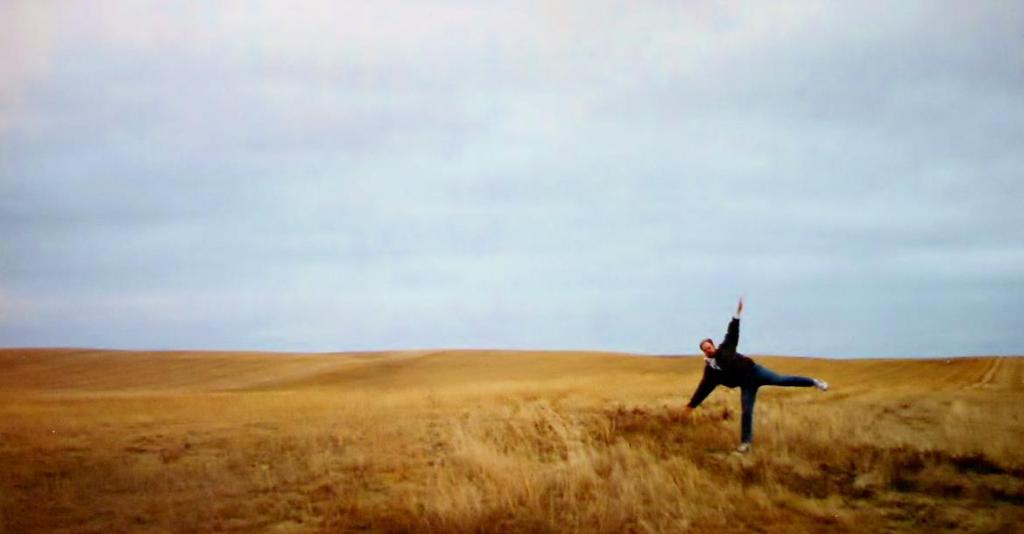
Beautiful downtown Rastadt, Saskatchewan. Actually, this is suburban Rastadt, but no one really is counting. If the middle of nowhere has a middle of nowhere, this is it. Where I am standing once stood the farmhouse where my maternal grandmother, Helen Lerner, was born.

I was not surprised at all to find nothing but a field of wheat. We snapped some photos of the site and decided it was time to head back to Alberta. We drove a bit down the narrow road to find a place to turn around. We soon found a farmhouse with a driveway that provided the opportunity to turn around. After I pulled in, the farmer who lived there saw me and came out, thinking anyone he didn’t know who was out there must be lost.

He seemed surprised that we actually meant to be in his part of the world. We got to talking. It turned out he was a cousin of my grandmother’s. He and his wife invited us in for coffee and they showed us all sorts of interesting family photos and mementos. Talk about serendipity! He even told me the farmhouse my grandmother was born in still existed – a farmer had bought the building and moved it to his land.

Even more fortuitous, he told me that a family history was being put together of the Boechler family. Jerome’s maternal grandmother was a Boechler. The farmer gave me the contact information for the author. My timing was another stroke of luck. I made the call not long afterward and learned that the book was being finalized and would be going to press in a matter of days. It also turned out that Jerome and Emelia’s branch of the family was a huge mystery to the authors. I was able to supply most of the information about Jerome and Emelia’s branch in time for publication.

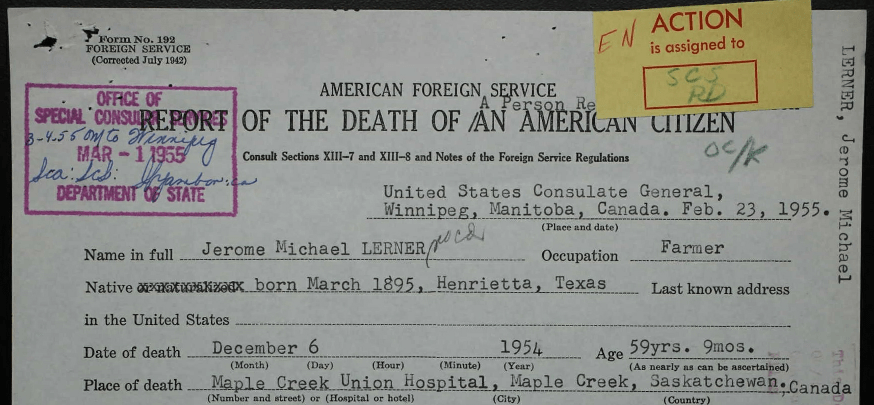
Not only was Jerome’s branch lost to the family, he seems to have been lost by both the United States and Canada. Upon learning of Jerome’s death, the US consulate in Winnipeg submitted a “Report of the Death of An American Citizen” to the American Foreign Service. The Foreign Service stated that it did not have any evidence that Jerome had American citizenship beyond the statement in the registration of death issued by the province of Saskatchewan. This, despite the fact the United States issued Jerome a passport when he first left for Saskatchewan in 1916. Meanwhile, there is no indication that Jerome was ever naturalized as a Canadian (or, at the time, as a British subject in Canada) or that he had renounced his American citizenship (which he was, as evidenced by his US passport).
52 Weeks – Week 14: Check It Out

Not Quite “Fun With Flags With Sheldon Cooper”, it’s “Fun With Pedigree Charts”!

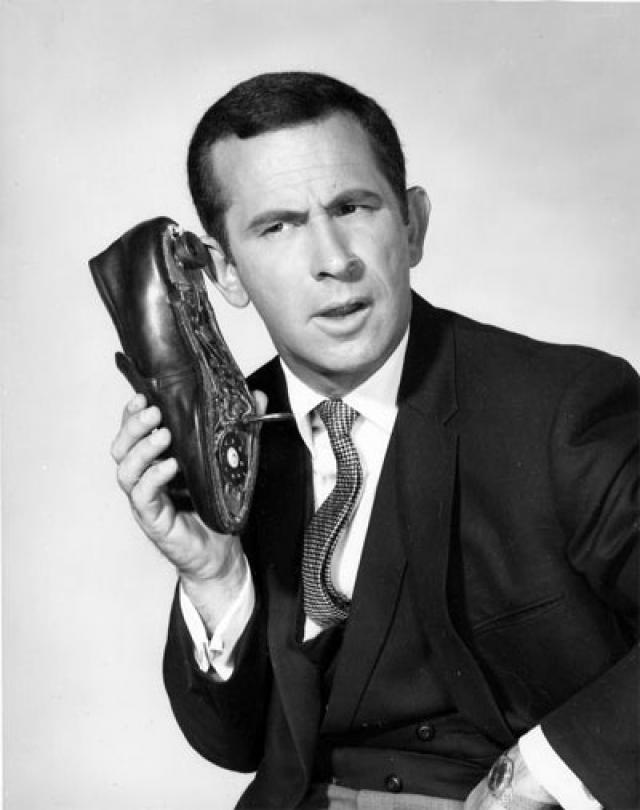
Not Sheldon Cooper
(Image from Wikimedia Commons)

Check It Out was a gawd-awful Canadian sitcom that ran on CTV in the mid-80s. When it first aired, I only watched it because it starred Don Adams, better known for his role on Get Smart as Agent 86 Maxwell Smart. Get Smart was my absolute favourite show when I started watching it in reruns when I was four. My mother tells me that in kindergarten I would not respond to my teacher unless she called me “Max”, something I can actually remember doing. I own the entire series on DVD. Unfortunately, Check It Out was as terrible as Get Smart was terrific. How Check It Out got Don Adams is beyond me. Not every Canadian sitcom can be Corner Gas or Schitt’s Creek.

“Check it Out” is also the theme for Week 14 of the 52 Ancestors Challenge. Like the Flowers theme of Week 11, this week’s theme didn’t really inspire me at first. However, in the Facebook post introducing the theme, “check it out” could be a direction to look at something that might be “something neat”. This reminded me of something I was thinking of posting to this blog outside of the 52 Ancestors Challenge.

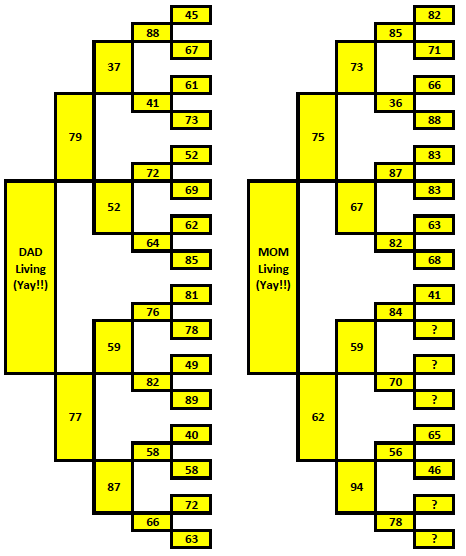
In a Twitter post six years ago, David Allen Lambert, Chief Genealogist at New England Historic Genealogical Society, suggested creating a “longevity pedigree”, a pedigree chart showing the ages ancestors lived to rather than their names. I thought that was pretty neat, so I created my own. At the time most people, myself included, simply created hand-written charts that we tweeted. For this blog, I tidied it up.

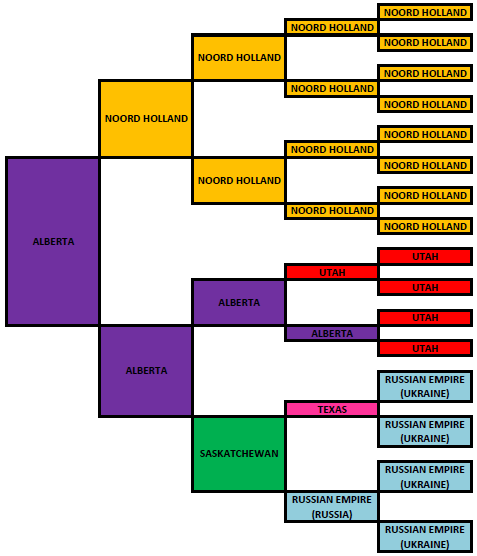
Shortly afterwards, the idea was adapted for birthplace. Here is mine.

It’s interesting how homogenous it is on my father’s side compared to my mother’s. While it is much more varied on my mother’s side, the variety increases as you go back along my paternal grandfather’s line.

Of course, looking only at a person’s birthplace can be deceptive. For my ancestors born in the Russian Empire, they were neither Russian nor Ukrainian. They were Germans who settled in what is now Ukraine in the 19th century, forming part of a larger group known as Germans from Russia. I have mentioned these ancestors in this blog several times before.

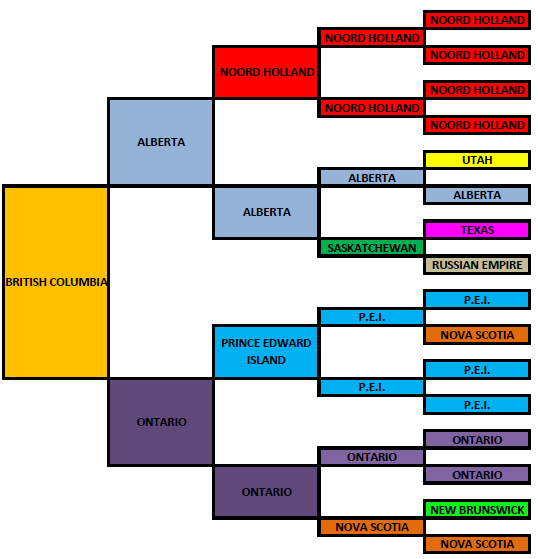
For fun, I did a birthplace pedigree for our kids.

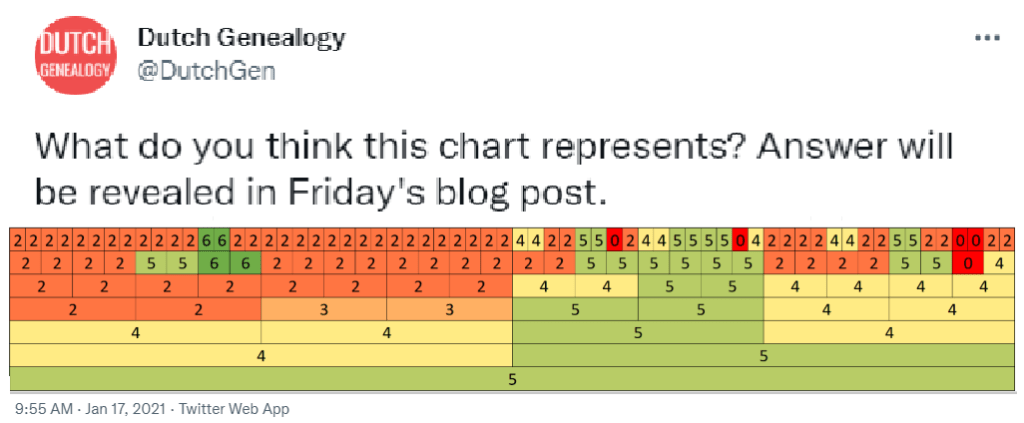
There are all sorts of other kinds of pedigrees like these that you can make. One example I’ve seen is people creating pedigrees for their ancestors’ religions. Another I’ve seen is an occupation pedigree. Then there was this mysterious pedigree Yvette Hoitink posted to Twitter:

It was her introduction of the Level-Up Challenge, which involves improving the evidentiary foundation for each ancestor in your family tree. While I haven’t “officially” undertaken the Level-up Challenge, I find I’ve been sort of doing it for a few of my lines without actually setting out to do so.

What kinds of interesting variations of a pedigree chart have you created?

52 Weeks – Week Seven

Landed

I’m starting to realize that when I choose a topic for the theme of the week for the 52 Ancestors Challenge, I should look ahead to see what other topics are coming up. That way I can avoid getting to a topic like this week’s, “Landed”, and seeing that I’ve written on the topic before. Then again, a little repetition here and there won’t hurt.

If I had approached this topic a few hours ago, I would probably be sitting here casting about in my mind as to what “landed” means to me. Fortunately, our eldest son inadvertently gave me a focus to write about. During dinner, out of the blue, he asked “besides Opa, did any of our ancestors come to Canada on steamships?”

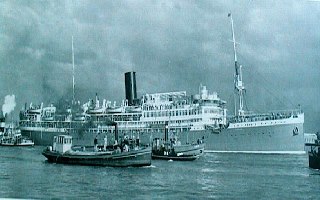
The Sibajak, which brought my father and his family to Canada.
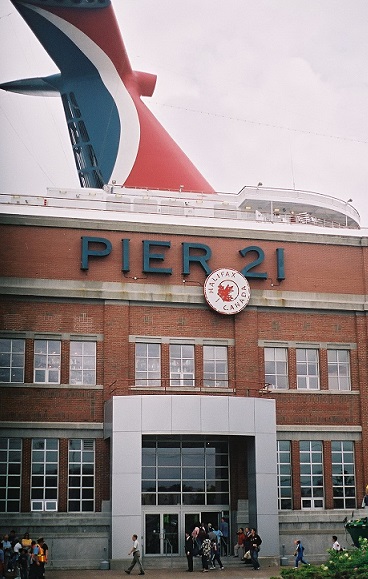
Pier 21, Halifax

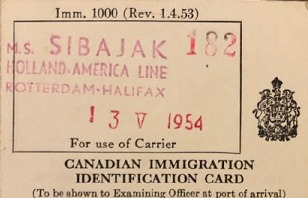
Opa is my father, the Dutch side of my family. I’ve already written about his coming to Canada on the Sibajak. He and his family came in early May 1954, travelling from Rotterdam to Halifax. They landed at Pier 21, which could be described as the Canadian equivalent of Ellis Island. My father’s aunt and uncle came over four months earlier, in January 1954 on the Groote Beer, while another aunt and uncle followed in late May 1954, on board the Castel Felice.

While it was a Holland America ship during his crossing, built and originally operated by Rotterdam Lloyd, along with other ships that they mainly used to go to the East Indies. Built in 1927, the Sibajak served as a troop ship during World War II. After the war, the Sibajak was one of a number of ships operated by Holland America that were used almost entirely for Dutch emigrants, along with the Grote Beer, Waterman, and Zuiderkruis. It was sold and scrapped in Hong Kong in 1959. When I was in Hong Kong in 1996, while travelling around the harbour and between its islands, I wondered how close I might have come to what scraps of it might remain.

This is a fascinating short documentary about a voyage the Sibajak made to Australia carrying Dutch emigrants. The video is in Dutch, but the images convey a lot of meaning.

In the late 1990s, my parents went on an Alaskan cruise on a Holland America ship. During the trip, my father, who loves to talk to people, fell into a conversation with one of the older hands on deck. My father mentioned having come to Canada on the Sibajak. After a few questions from the crew member, my dad learned that the man had been on the Sibajak during my father’s trip, in his first year or two of service.

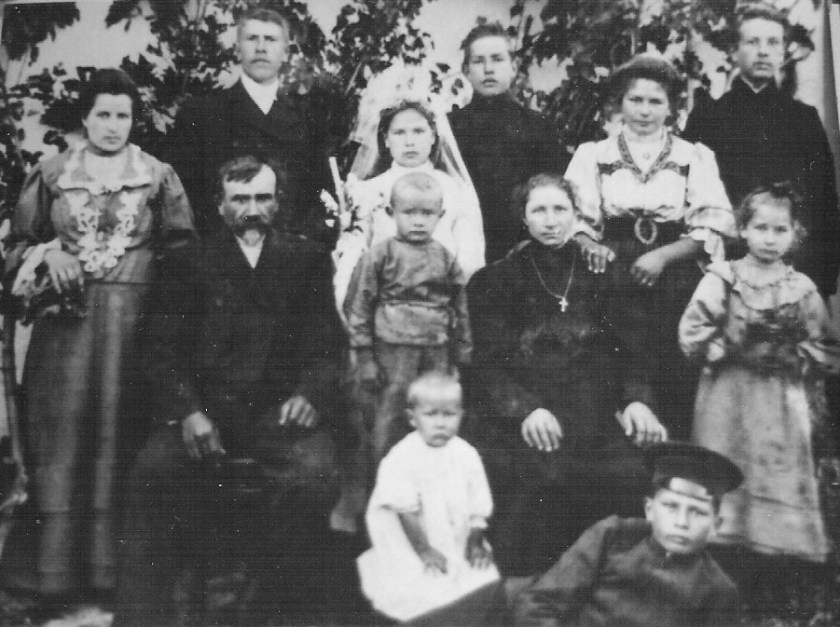
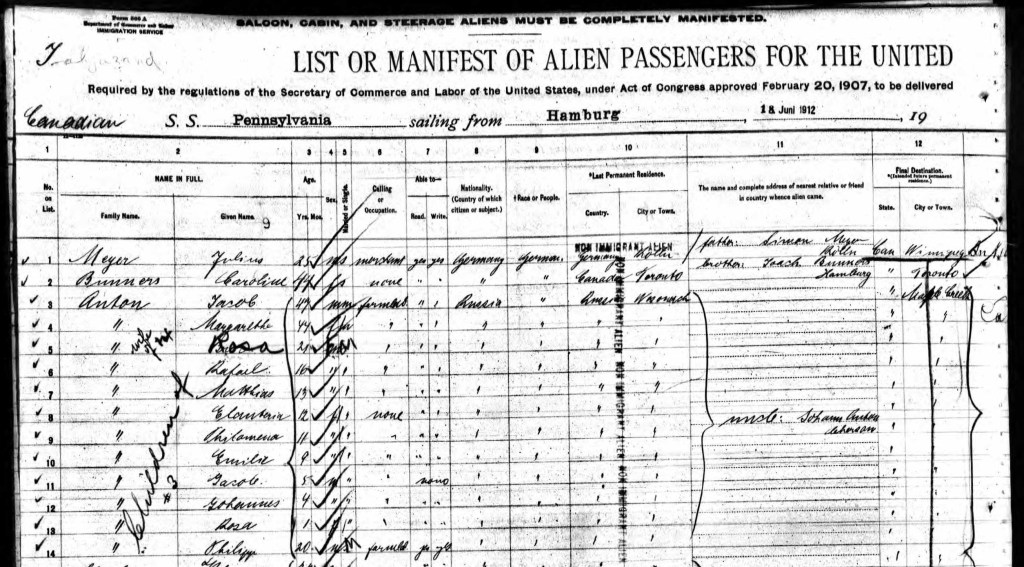
On my mother’s side, the most recent ancestor to arrive by steamship was my great grandmother, Emelia Anton. She came to Canada at the age of nine, with several of her siblings and her parents, Jacob Anton and Margaretha “Margaret” Heck. They were Germans from Russia. The family sailed out of Hamburg on June 18, 1912 aboard the S.S. Pennsylvania. They arrived at the Port of New York (Ellis Island) on July 1, 1912. Their declared destination was Maple Creek, Saskatchewan, to join Emelia’s older brother, Rochus. The passenger manifest stated that Jacob paid for the entire family’s transport, other than that of one of his daughters-in-law, whose passage had been paid by her father.

The Anton family, circa 1910. Likely taken in Selo Suchoi, Veronesch, Russia.

Emelia had not had much schooling before coming to North America, but was very religious. She said that she was frightened and nervous during the journey, as she did not know anything about where she was going and did not fully understand what was going on. However, on reaching New York, she said her fears subsided when she saw “the Madonna”. When she saw that, she knew she would be safe and all would be well. Of course, the “Madonna” was the Statue of Liberty. As she had never heard of it before, she thought it was a statue of the Virgin Mary.

Passenger list for the S.S. Pennsylvania showing the Antons.
Jerome Lerner (1895-1954)
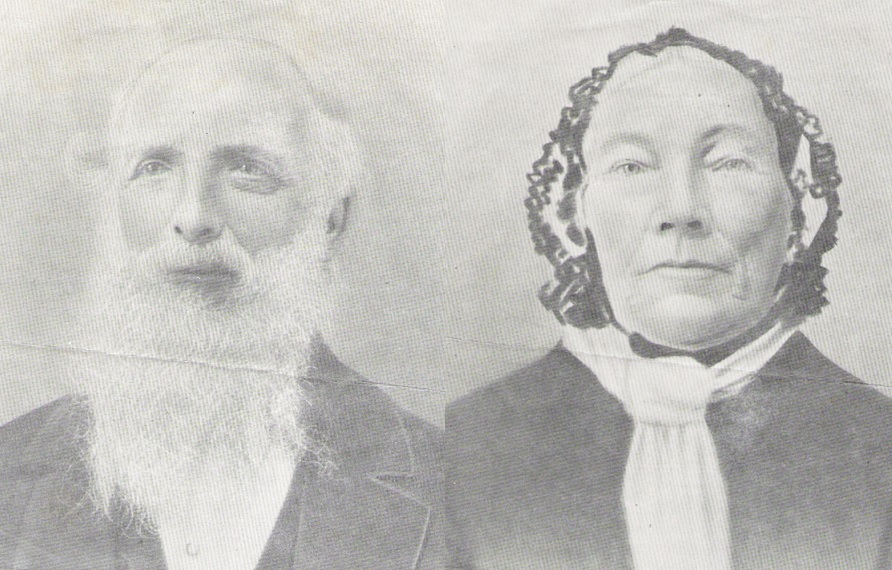
Michael Lerner (1862-1947) and Barbara Schmidt (1865-1936)

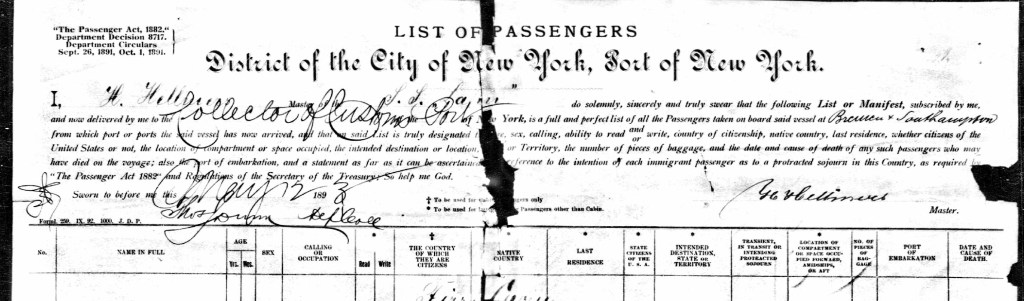
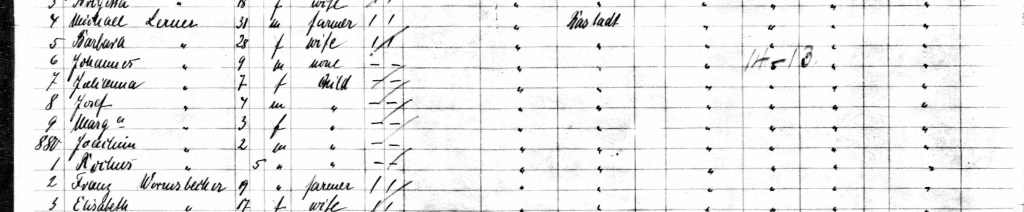
Emelia’s husband, Heronimus “Jerome” Lerner, was born to parents who were also Germans from Russia, Michael Lerner and Barbara Schmidt. Michael and Barbara came to the United States in May 1893 aboard the S.S. Lahn, with the five children they had at the time. They landed at Ellis Island and made their way to Clay County, Texas. Jerome was the first child born to Michael and Barbara in the United States. They had seven other children in Texas after Jerome was born. Jerome moved to Saskatchwan in 1917, preceded by an older brother. Jerome’s parents followed a year later. Other siblings came north at other times.

Passenger list for the Lahn showing the Lerners

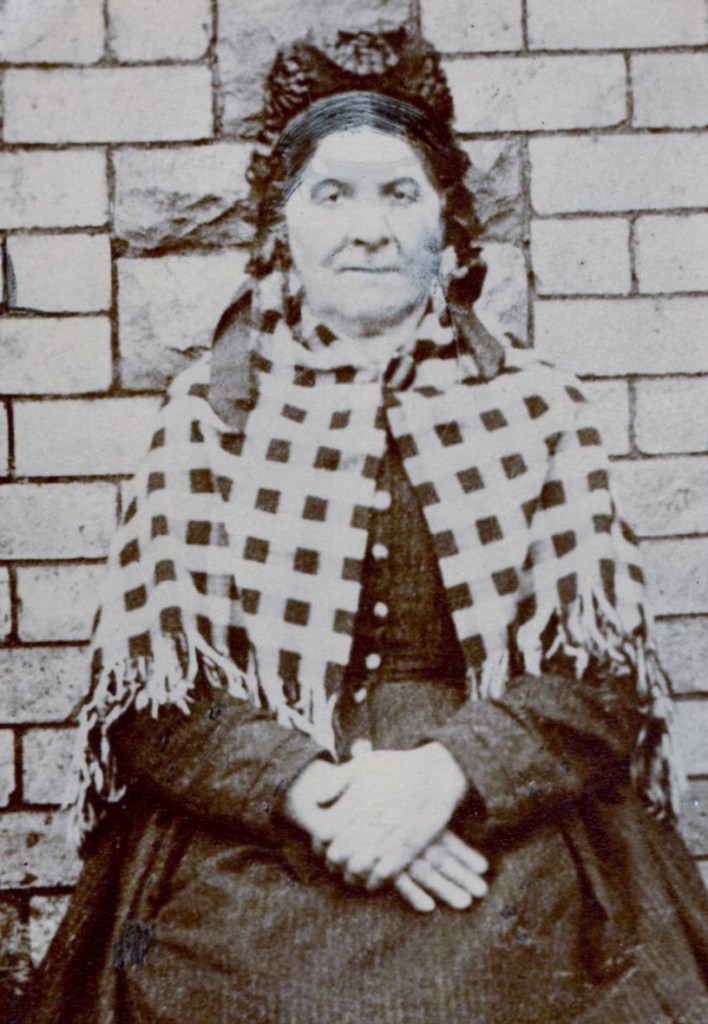
The ancestors furthest back in time that I can find who came to North America on a steamship were my great x3 grandparents, Robert Nelson and Elizabeth Joseph. They were both born in Muff, Donegal, Ireland in 1818 and married there in 1842.

Joseph Nelson (1818-1902) and Elizabeth Joseph (1818-1902)

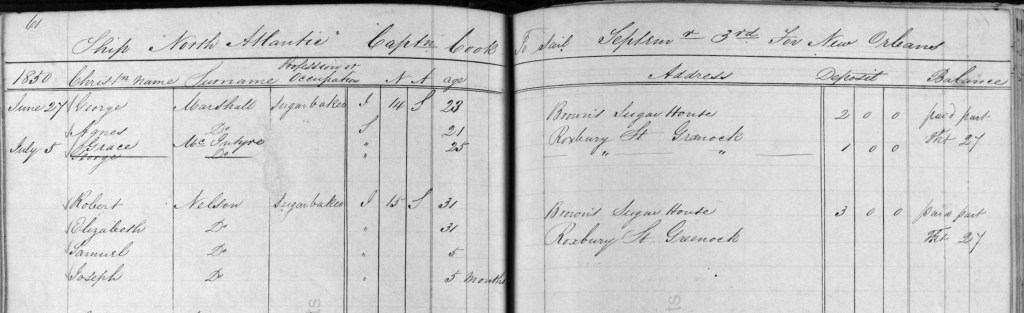
Sometime in the early 1840s they had moved to Linwood, Renfrew, Scotland. They were there at least by January 1844, when their first son, Samuel, was born. By 1850, Robert was working at Brown’s Sugar House, on Roxburgh Street in Greenock, Scotland as a sugar baker. Sugar bakers usually refined muscovado sugar, an unrefined brown sugar imported from Barbados.

On September 3, 1850 Robert and Elizabeth, along with their three children, departed Liverpool on board the ship “North Atlantic” bound for New Orleans. For a long time I had been confused by references I had seen to them coming over on “the north Atlantic”, thinking it meant the route they travelled. It wasn’t until I came across the passenger list that I realized that “North Atlantic” was the name of the ship. Having a name like that makes it difficult refine a search to distinguish the ship from where it sailed. However, while I have not found very good sources, it appears that the North Atlantic was a steam powered ship.

Passenger list for the North Atlantic showing the Nelson family

The records show that there was at least one other family headed by a sugar baker from Brown’s on the same voyage. Robert and Elizabeth were part of a company of Latter Day Saints (Mormon) converts travelling from the United Kingdom to Utah. The family spent a short period of time in Missouri, where in 1852 Elizabeth had her first child born in America. By late 1854 they were in Farmington, Utah, where my great great grandfather John Alexander Nelson was born.

Looking at my pedigree for this post, I realized I might have one other ancestor who might have travelled from the United Kingdom to the United States by means of a steam powered ship. That would be my great x3 grandmother, Maria Hadlond, who was born in Cheltenham, Gloucester, England in 1838 and who emigrated sometime in the 1850s. I have not really researched this branch of my family beyond collecting names and basic vital stats. For whatever reason, it has never caught my interest.

Susan Turple (1818-1906)

I also have a great x3 grandmother, Susan Turple, whose family had been in Nova Scotia since the 18th century, who would have travelled by means of a ship with sails. In 1849, Susan joined the Mormon church in 1849. In 1852, she went from Halifax to Boston to join a westward migration of Mormons. It is most likely that the initial part of Susan’s travels was by means of steam powered ship.

Before these people, any ancestors I have who crossed the Atlantic would have done aboard ships with sails.

Speaking of looking ahead, I see that next week’s theme is “Courting”. Since I am writing this on February 14, I wonder if that should have been this week’s theme!

52 Weeks – Week Six (Part One)

Maps – Part One

Week six of the 52 Ancestors Challenge has us navigating maps. Like the Favourite Photo challenge, I had a hard time choosing. So this week I’ll be doing two entries.

Where I stand once stood the farmhouse where my maternal grandmother was born.
Beautiful downtown Rastadt, Saskatchewan. If the middle of nowhere has a middle of nowhere, this is it.
(Actually, this is suburban Rastadt, but no one really is counting.) Where I am standing once stood the farmhouse where my maternal grandmother, Helen Lerner, was born.
(Section 7, Township 17, Range 24, West 3)

My maternal grandmother, Helen Lerner, was born at the family farmhouse near Rastadt, Saskatchewan, which is about 16 kilometers (10 miles) east of Fox Valley. It’s where her her parents and grandparents – Germans from Russia – settled upon moving to Canada. There’s nothing left of Rastadt now other than the old schoolhouse and the cemetery.

Rastadt, Saskatchewan Cemetery, April 1, 1997. Located at 50°30’00.9″N 109°15’32.3″W
You can find the cemetery listing here.

In early 1997, I had a few months off after having left a job for a new endeavor. I visited my folks, who live in southern Alberta, during that time off. I had not been to Fox Valley since I was a kid, so while visiting my folks I thought it might be a fun family history road trip to do with my mother.

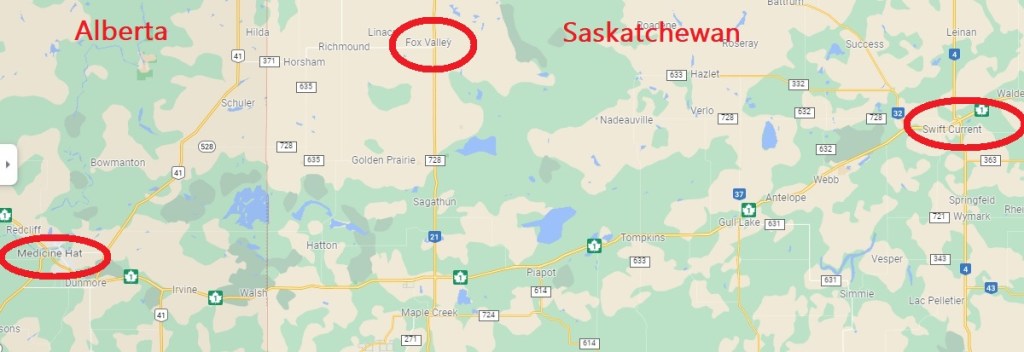
Fox Valley is about midway between Medicine Hat, Alberta and Swift Current, Saskatchewan.

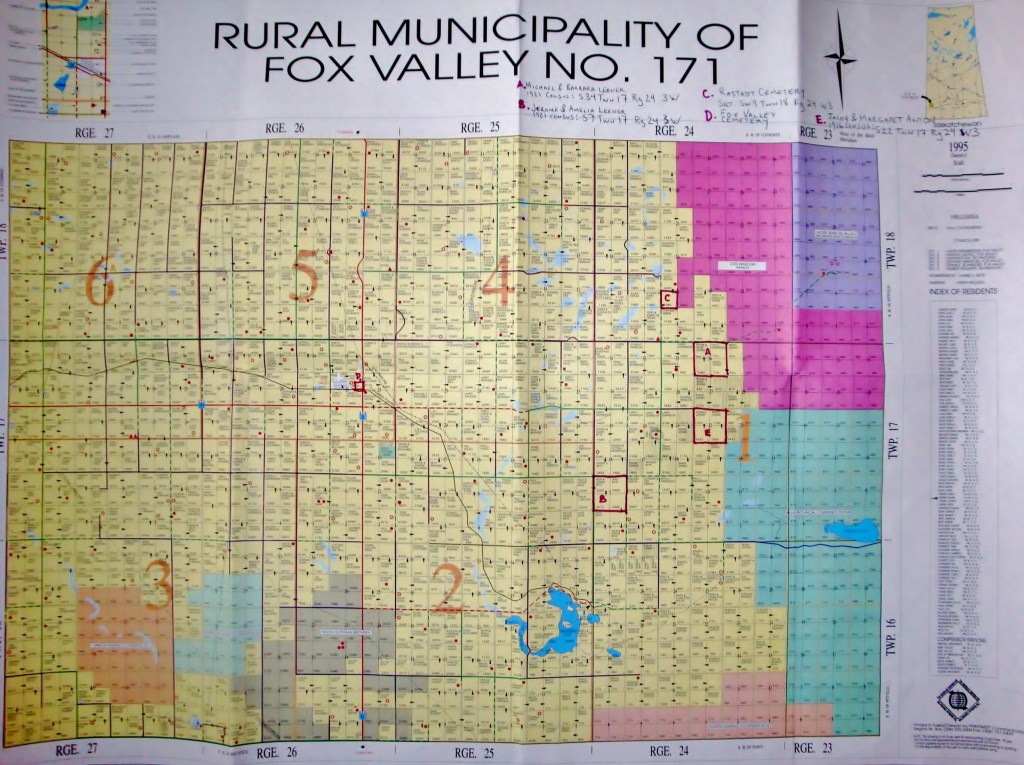
One of the first things I did upon arriving at Fox Valley was visit the village hall. It was a wise decision. Not only were the staff extremely helpful, they had maps of all the farms in the district, labelled with the current owners and occupants of each section of land. It was an amazing thing to see, because many of the surnames on the map were in my family tree database.

Map of the farms and residents surrounding Fox Valley, Saskatchewan as of 1997. Fox Valley is just below and to the right of the large number “5”. While not easy to see, the Fox Valley Cemetery is marked with a small red box labelled “D”. The larger boxes to the east are where my great grand parents and great great grandparents farmed, along with the Rastadt Cemetery.
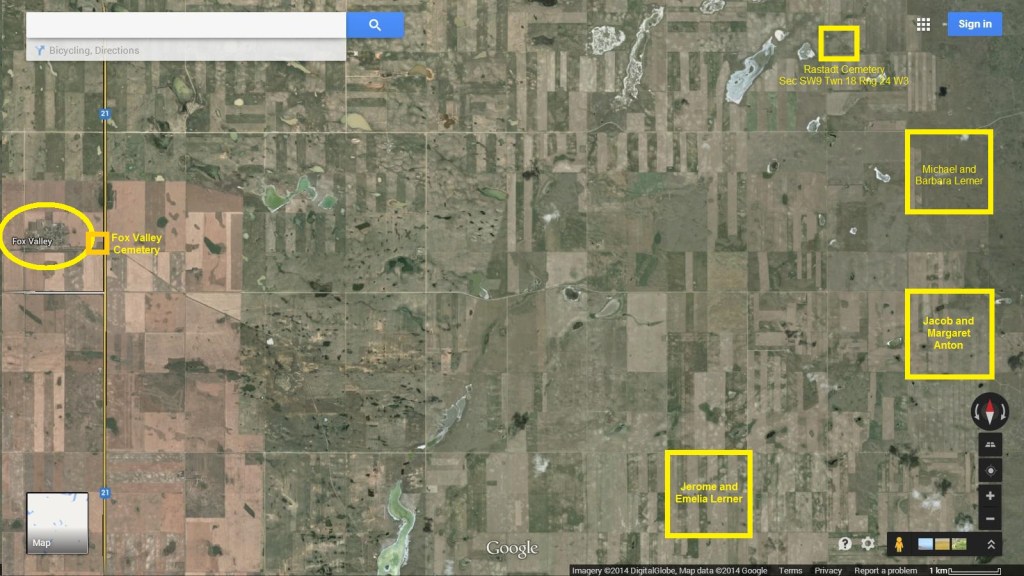
The same area, as seen on Google Maps. Fox Valley is in the oval on the left. My ancestors’ farms are on the right, along with the Rastadt Cemetery.

A history of Fox Valley was published in 2004, Fox Valley and Liebenthal, Saskatchewan: Remember When… In addition to the family history of the village’s residents, this extremely useful book includes a section in which it records all the residents of these parcels of land throughout most of the 20th Century. In conjunction with this map, the book, and census records, I’ve been able to plot out where my ancestors lived and farmed.

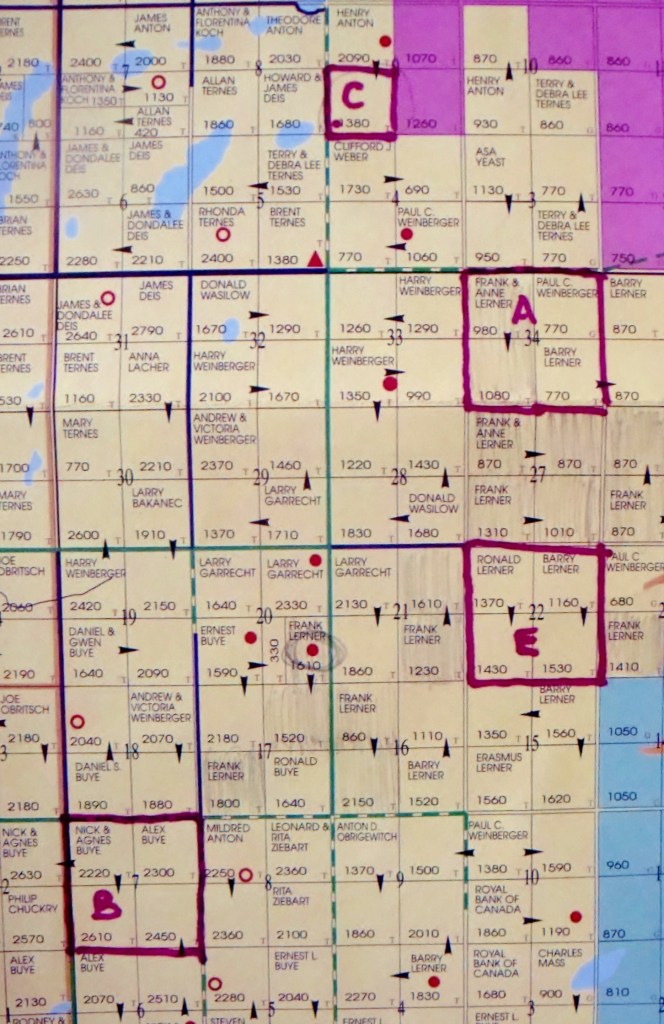
Detail from the map above.

The locations I’ve marked are based upon the 1921 census, except for Jacob Anton, who died a month before that census was taken. For him I used the 1916 census. My grandmother’s parents were Jerome and Emelia Lerner, whose farm is the southernmost one marked on the map.

A: Michael Lerner and Barbara Schmidt (my grandmother’s paternal grandparents)

B: Heronimus “Michael” Lerner and Emelia Anton (m grandmother’s parents, and where my grandmother was born.

C: The Rastadt Cemetery. (D, not seen in the detail, is the Fox Valley Cemetery.)

E: Jacob Anton and Margaretha (“Margaret”) Heck, my grandmother’s maternal grandparents.

Serendipity

My mother and I used this map to visit the schoolhouse, cemetery, and plot of land where my grandmother’s house had once been. After taking the photo of me, we drove a bit down the road where I used a driveway of a farmhouse to turn around. The farmer who lived there saw me and came out, thinking anyone he didn’t know who was out there must be lost.

After explaining that I actually meant to be in his part of the world, we got to talking. It turned out he was a cousin of my grandmother’s. He and his wife invited us in for coffee and they showed us all sorts of interesting family photos and mementos. Talk about serendipity! He even told me the farmhouse my grandmother was born in still existed – a farmer had bought the building and moved it to his land.

Even more fortuitous, he told me that a family history was being put together of the Boechler family, the Boechler Family History. Barbara Schmidt’s mother was a Boechler. The farmer gave me the contact information for the author. My timing was another stroke of luck. I made the call not long afterward and learned that the book was being finalized and would be going to press in a matter of days. It also turned out that Emelia’s branch of the family – from which I am descended – was a huge mystery. I was able to supply most of the information about Emelia and her descendants in time for publication.

Another form of map. This was taken inside St. Mary’s Church in Fox Valley, showing the location of each person interred at the Rastadt Cemetery.

In Part Two, I’ll be looking at another piece of prairie farmland, this time in Alberta on my mother’s paternal side.