52W Mark II – Week 41: Travel

I knew I’ve written a lot about travel for the 52 Ancestors Challenge over the two years I’ve been participating, but I was surprised to discover just how much when I went back through past posts to ensure I wasn’t repeating myself. I’ve written many times about my ancestors’ migrations, as well as my own genealogical travels: Fox Valley and Rastadt, Saskatchewan; Waarland, Noord-Holland; Leidschendam-Voorburg, Zuid-Holland; Brant, Alberta; and Cardston, Alberta, to name a few.

So seeking inspiration and a different perspective on the theme, I looked at our kids’ maternal side and their Gx3 grandfather, Charles Crittenden Van Norman. He was a merchant and businessperson and was involved in a number of enterprises. Charles’s many business interests involved a great deal of travel. To that end, Charles was an early member of the Commercial Travellers’ Association of Canada and he remained so for thirty years.

Charles was born on August 10, 1849, in Keswick, York, Canada West, Province of Canada. Charles began working around the age of 16. His earliest work included the wholesale and retail book and stationery trade. The 1891 census said he was a “greens clerk”. Later, he became a wholesale manufacturer of boots and shoes, retiring from that endeavour in 1902. Later in his career, he was a director of the Ontario, Manitoba & Western Land Company and was Vice-President of the McElroy Manufacturing Co. Charles also had a significant interest in the Alberta Farm & Cattle Company, in which he was Vice-President. Charles also had an interest in banking, primarily as a shareholder. While I have not yet verified it, Charles may have been a director as well.
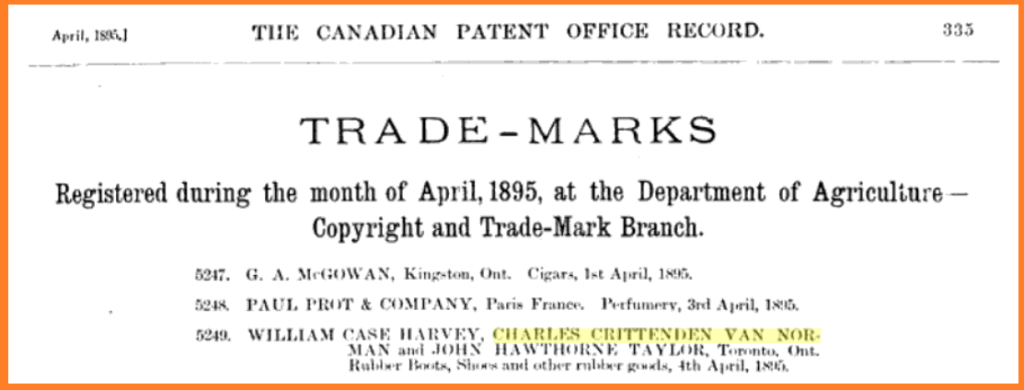
The Canadian Patent Office Record and Register of Copyrights and Trade-Marks, Volume 23, 1896. Charles and his partners held a trade-mark in rubber boots, shoes, and other rubber goods.

Amongst his many endeavors, Charles was an executive and director of a number of insurance companies. From about 1880 to 1920, Charles was a manager and vice president of the Metropolitan Fire Insurance Company in Toronto. During the same period, he was a director and vice president of the Equity Fire Insurance Company in Toronto. From 1904 to about 1920, Charles was the president and managing director of the Independent Fire Insurance Company in Toronto, of which he was one of the founders. Despite his high position in these companies, for the 1911 Canadian census Charles modestly reported his occupation as “insurance agent”.

Charles retired in 1921, at the age of 72. He died on February 2, 1939 in Toronto.

The Commercial Travellers’ Association of Canada was founded in 1874. Its purposes included providing its members with travel and insurance benefits. Charles joined in 1880 and remained a member until 1910. He was a director and a vice president of the organization for many years and served two terms as its president.

The Commercial Travellers’ Association also provided what we would now call networking opportunities and frequently had banquets and social gatherings for its members. Its members had a considerable amount of influence, such that it was common for a Prime Minister or cabinet ministers to be in attendance. In 1989, the organization changed its name to the Canadian Professional Sales Association.

While he was a prominent and successful business person with many commercial interests, what I enjoy most is Charles’s occupation set out in the Marriage Affidavit and Certificate for his daughter Madeline (our children’s great great grandmother): “Gentleman”.
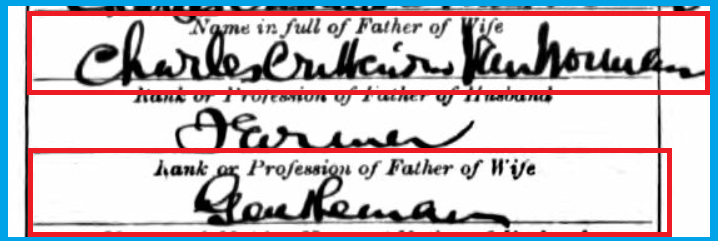
Extract from the Marriage Affidavit for the marriage of Madeline Van Normand and Robert Willan Mann, who married in Toronto on September 6, 1911.

52W Mark II – Week 40: Longevity

With this week’s 52 Ancestors Challenge theme of “Longevity”, I suspect the inclination would be to write about those who have lived the longest, or perhaps were married the longest. I’ve tried to think about this from another perspective involving length of time spent.

To that end, I’ve tried to determine who might have experienced longevity in their occupation. I have many ancestors who spent their entire lives in a single occupation, particularly farming or agricultural work, or as labourers. However, what I have been pondering is someone who remained in the same occupation at the same place the longest, preferably with the same employer.

Of those who worked outside of farmwork and labouring, two ancestors stood out to me, both on my father’s side of the family: Cornelis Jan Bakker (my Gx2 grandfather) and Reijer Ran (my Gx4 grandfather).

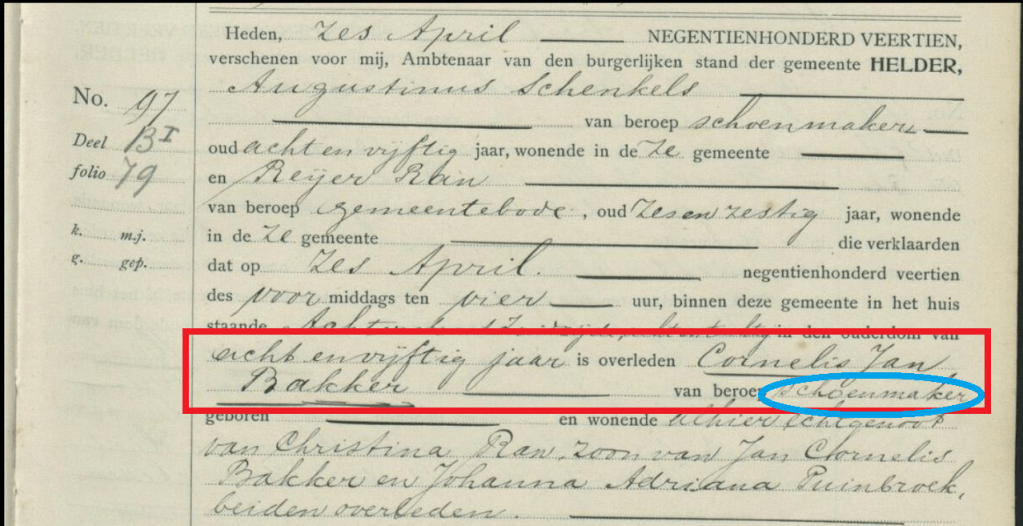
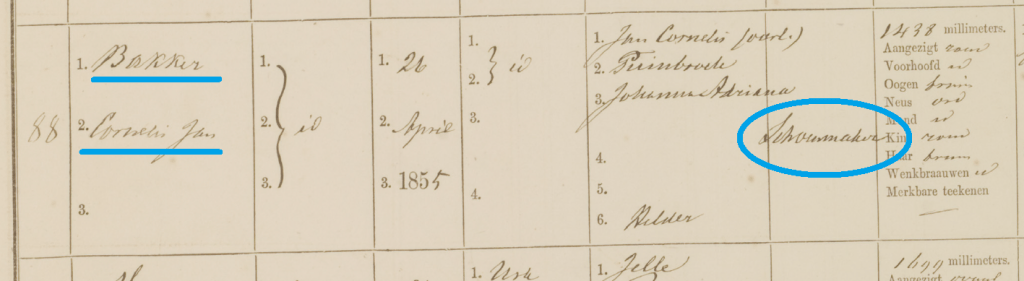
Cornelis (1855-1914) was a cobbler and shoemaker in Den Helder, Noord Holland, Netherlands. Despite this description, I doubt that Cornelis did anything similar to that of a cordwainer. A cobbler largely repaired old shoes, while a cordwainer makes new shoes from new material, usually based on patterns they design themselves. I have few details of Cornelis’s work, other than he carried out his trade in Den Helder. His occupation is simply listed as a fact in various records. Cornelis was a cobbler from at least 39 years, from about 1875 to 1914, when he passed away.

Record of Cornelis’s conscription into the military showing his occupation as a shoemaker. While conscripted, he was released from service.
Cornelis’s death registration, showing his occupation as shoemaker.

Reijer (1792-1860) was a sailor. It appears that his largely worked as a harbour and channel pilot. He was born and raised on Texel, the largest of the Wadden Sea islands on the north coast of the Netherlands, although he was living in Den Helder when he died. However, I am unable to determine whether he was based out of Texel or Den Helder, the mainland city closest to Texel. Like Cornelis, the information I have about Reijer’s occupation is largely a statement of fact in various birth, marriage, and death records. Reijer was a sailor for at least 41 years, from 1813 to 1854. It is possible that Reijer worked later than 1854, that is simply the last year I have mention of him still working as a sailor.

52W Mark II – Week 39: Surprise!

Okay, I added the exclamation point to the theme of this week’s  52 Ancestors Challenge. However, the first thing that came to mind is what you’d yell for the guests of honour when they arrive for a party they weren’t expecting. So of course you need the exclamation point!

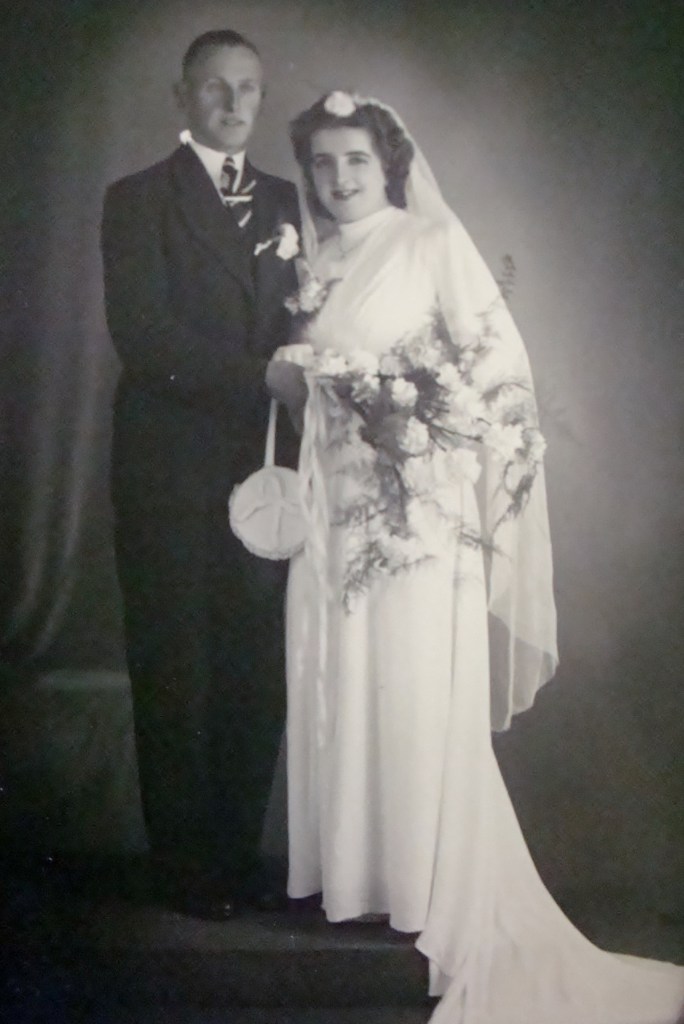
Adrianus Joseph “Arie” van der Fluit (1923 – 2002) and Christina Komen (1923 – 2000)

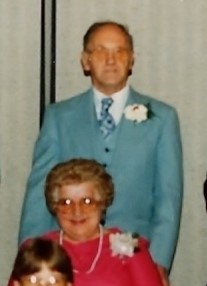
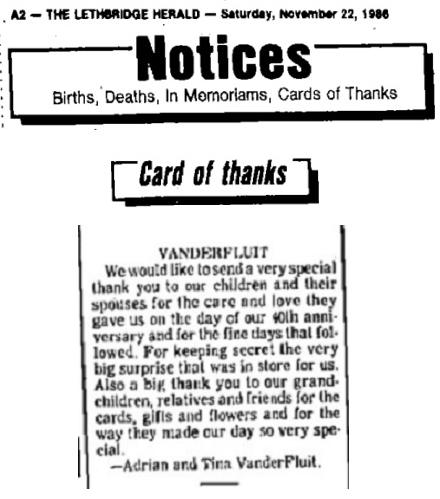
My paternal grandparents married on November 7, 1946, almost 77 years ago. For their fortieth anniversary, my aunts and uncles arranged a surprise party. All their children were in attendance, as were most of their grandchildren. I was attending second year university in Vancouver at the time, so I flew out for the event. As well, some of my father’s cousins (my grandparent’s nieces) came to Canada for the celebration.

This is cropped from the group photo taken during the celebration. I had neither the time not the interest in asking everyone’s permission to post the photo online.

While I grew up in the Canadian prairies and northern British Columbia, by my second year I had gotten used to the mild Vancouver weather and forgot to bring proper winter gear with me. Brrr!! Why on Earth did my grandparents marry in November? Why did they not marry in May? (For what it’s worth, their eldest child – my father – was born over a year after my grandparents married!)

52W Mark II – Week 38: Adversity

In which my grandparents unwittingly recreate the Four Yorkshiremen sketch

My paternal grandparents were 16 and 17 years old when the Nazis invaded the Netherlands in 1940. The occupation was a difficult one. My grandfather and his brothers were all rounded up to work as forced labourers in Germany; somehow my grandfather escaped. Only a few weeks ago I found records about one of my great uncle’s time as a forced labourer through the Arolsen Archives – International Center on Nazi Persecution. I was surprised to find that discovery, only because I was expecting to find records about one of the other brothers.

Needless to say, my grandparents rarely spoke about the war in my presence. In particular, the two times I ever heard my grandmother speak about it were astonishing because it was so rare it was for her to do so. My grandfather must have spoken about it more often, because I have heard several stories about the hardships he endured and the close scrapes he had with the Nazi occupiers. My father also tells the tale of when he was a boy, after his family had immigrated to Canada, about walking in a farm field with my grandfather. While they were walking, a small airplane flew overhead. My grandfather instinctively dove to the ground for cover. The war would have been over for at least ten years at the time, but clearly it had left its scars.

While the war was generally a proscribed topic, much to my amazement it came up during a visit I had with them in the late 90s, shortly before my grandmother passed away. I can’t remember how the topic came up, but I remember being absolutely gobsmacked that it did. It was particularly stunning that my grandmother participated in the discussion. Even more amazing was that the topic of conversation was the Hongerwinter (“Hunger Winter”), a famine the Nazis imposed on the Netherlands during the last winter of the war. However, what started off as a very somber recollection of their experience quickly spiraled into the famous Monty Python sketch.

The Allied strategy in the Netherlands was to get to Germany as quickly and directly as possible. This meant bypassing large parts of the northwest part of the country, including Amsterdam and the province of Noord-Holland. The Germans retained control of those areas until they surrendered on May 5, 1945. Over the winter of 1944-1945, which was particularly harsh, the Nazis deliberately blockaded the food and fuel supplies into the occupied portions of the Netherlands, resulting in the Hongerwinter. Malnutrition was rampant and about 22,000 people died of starvation.

My grandparents both lived in the central part of Noord-Holland and experienced full effects of the Hongerwinter. The famine occurred before they were married, so they experienced the hardship with their families.

When the topic came up, my grandparents began discussing how hard that winter had been and how they had each suffered. What caused the discussion to go sideways was when my grandmother said to my grandfather, “At least you lived on a farm!”

My grandfather countered by acknowledging the fact, but adding that my grandmother’s family was much better off economically. My grandmother reciprocated by pointing out some other advantage she believed my grandfather had that she did not. I am certain that my grandfather added that his mother was raising the family on her own, as his father had passed away in 1932.

They then began countering with what foodstuffs the other had access to, which they themselves did not. Finally, one of them said, “all we had to eat was the white beans!”, to which the other responded in a somewhat overdramatic voice, “oh, if only we had the white beans!”

I am certain that the competition to outdo the other’s hardship was black humor that served to ameliorate the trauma they had both experienced, even though it had been fifty years in the past.

I feel nothing but love and empathy for my grandparents when I think back on this. To this day, whenever I am in a Dutch store (my favourites are the Holland Shopping Centre in New Westminster and Coombs Wooden Shoe on Vancouver Island), I always make a point of buying a jar of white beans in their honour.

White Beans