52W Mark II – Week 37: Prosperity

This week’s theme for the 52 Ancestors Challenge is “Prosperity”. While for the most part my ancestors over the centuries were largely working class and labourers, I have some that might have been described as “comfortable”. Thinking about it, the only ancestors who I might describe as “prosperous” are largely on the maternal branch of my family tree.

Despite this, the couple that come to mind for this week’s challenge are my Gx3 Grandparents on my father’s side of the family, Jan Gerritsz Veldman and Trijntje Stoop. I think of them primarily because of the amount of time I spent translating a pair of newspaper items describing their estate. Not only was it somewhat difficult because the items were written in an older form of Dutch, but because there was more to interpret than just the foreign language. In particular, the values were reported in guilders, the Dutch currency prior to the introduction of the euro; as well, the land was measured in terms that were not immediately familiar.
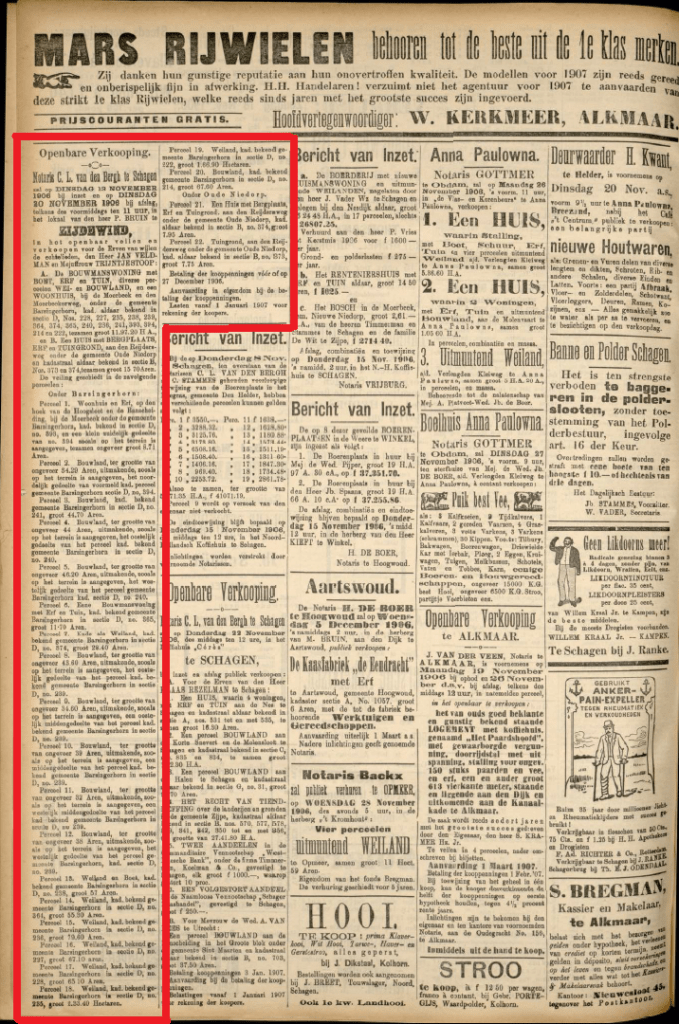
Schager Courant, Schagen, Noord Holland, Netherlands, November 11, 1906, page 4.
“Openbare Verkooping” (“Public Sale”). This is an itemized list of the two pieces of property, consisting of 20 and 2 lots respectively, that went up for public auction after Trijntje died.

Trijntje was born October 30, 1832 in Haringhuizen, Noord Holland, Netherlands. Jan was born November 27, 1835 in Nieuwe Niedorp, Noord Holland, Netherlands. The two villages are about five kilometers apart. They married in Nieuwe Niedorp on May 1, 1858. They were living in Nieuwe Niedorp as late as 1866, when their fifth child was born. However, by 1873, they were living in Barsingerhorn, Noord Holland, Netherlands, where their tenth and last child was born. Barsingerhorn and Haringhuizen are relatively close to each other, situated about a kilometer and a half apart.

Jan died on May 21, 1897 while Trijntje passed away on January 27, 1906. The couple owned two pieces of property which Trijntje still possessed at the time of her death. One was a house comprised of two lots in Oude Niedorp, Noord Holland, Netherlands, together measuring 15.7 ares (just under 0.4 acres). [“Are” = 100 square meters. 100 Ares = 1 hectare. 1 hectare is just under 2.5 acres.] The other was a farm consisting of 2o lots in Barsingerhorn, which included a farmhouse, pastures, farmland, and a boat, totalling 11.9 hectares (just under 3o acres).
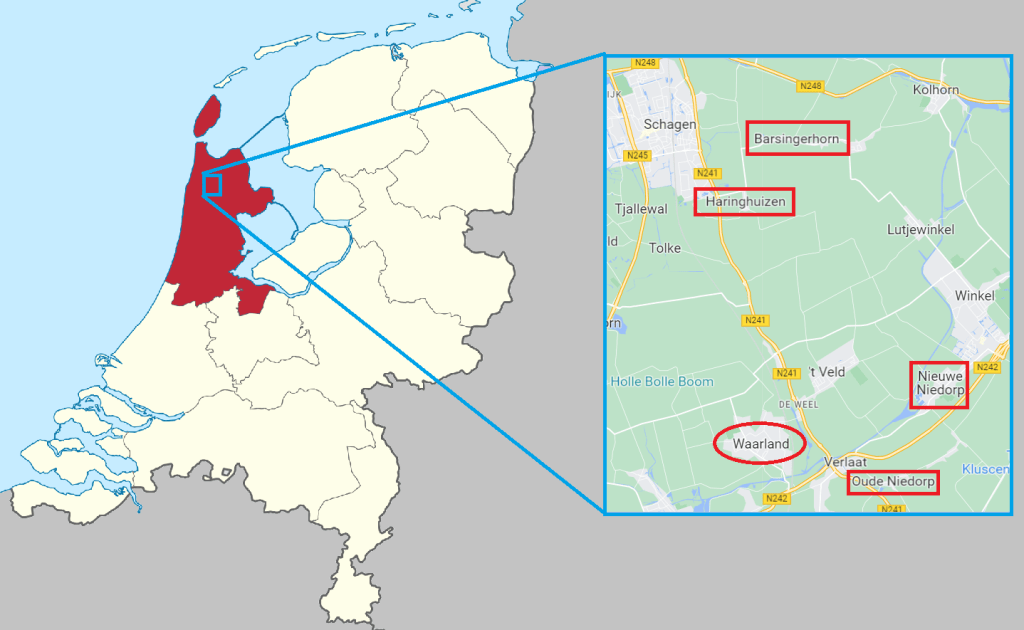
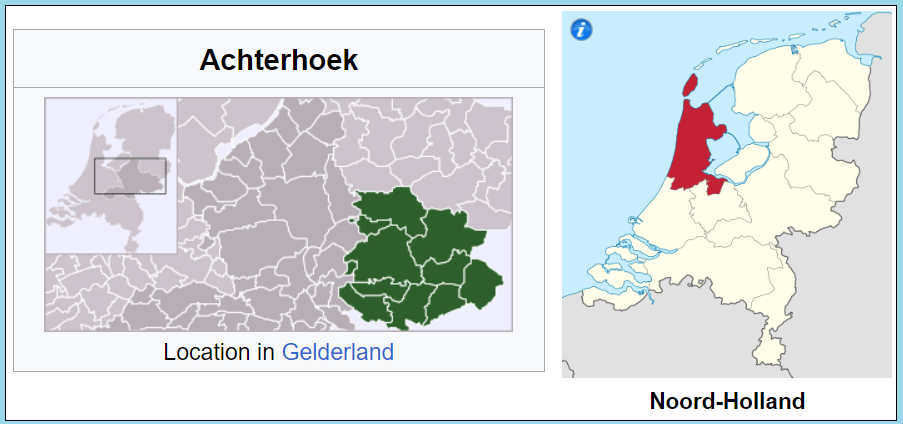
Map of the Netherlands with the province of Noord-Holland in red. The inset shows where Jan and Trijntje lived and owned property. I’ve circled Waarland because that is where my father was born. He did not live far from where his great great grandparents lived.
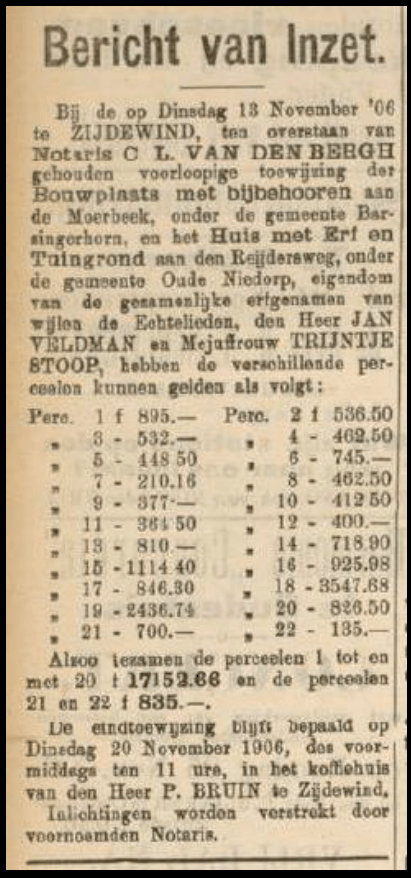
Schager Courant, Schagen, Noord Holland, Netherlands, November 18, 1906, page 4.
“Bericht van Inzet” (“Notice of Commitment”).

According to both articles, the auction was scheduled to begin on November 13, 1906, although the second indicated that it was to have remained open until November 20, 1906. The second article set out the proposed value of each lot. Lots 1 to 20, the Barsingerhorn farm, had a total proposed value of ƒ17,152.66. Lots 21 and 22, the house in Oude Niedorp, were ƒ835.

By my calculations, these currently amount to €269,971.80 and €13,142.87 respectively, for a total of €283,114.67. (CDN$389,369.30 and CDN$18,955.42. Total: $408,324.72.) That might seem like a lot, but that’s barely enough to get a 500 square foot (0.01 acre) one bedroom condo apartment in Vancouver.
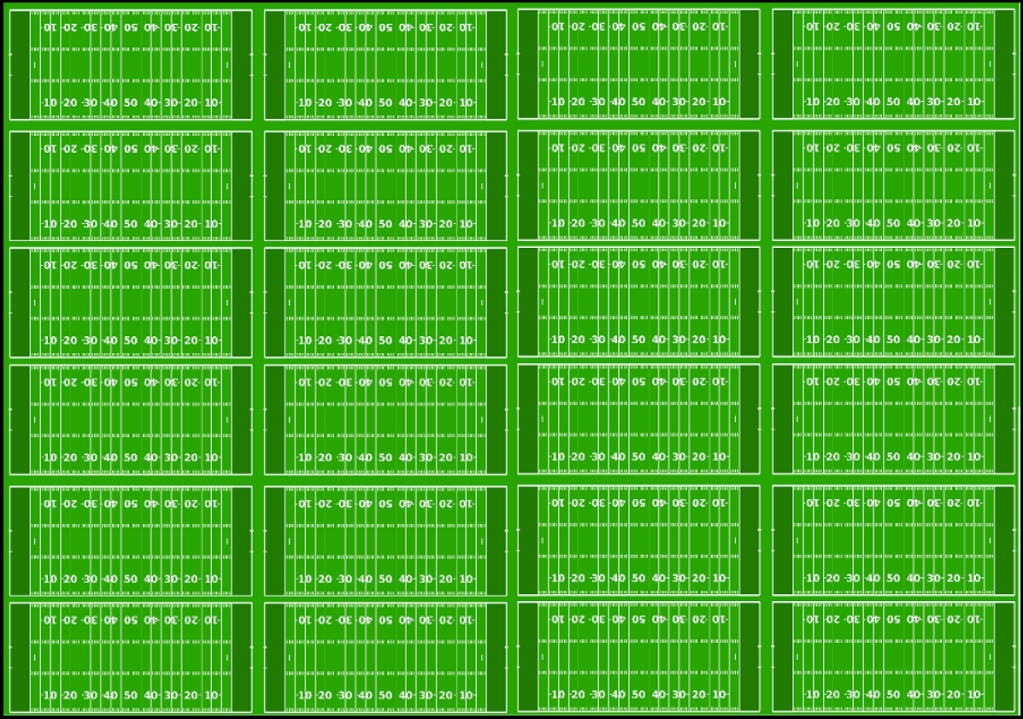
Approximate size of total land on offer: 24 American football fields (FYI, Canadian football fields are longer.)

52W Mark II – Week 36: Tradesperson

The vast majority of my ancestors on both sides of my family were farmers or labourers. Not all the labourers were agricultural workers, but it was still hard work and far from what might be considered a trade.

There are a few interesting exceptions. Cornelis Jan Bakker, my great great grandfather, was a cobbler. I also discovered that my Gx9 grandfather, Gregory Cooke, was a cordwainer. A cordwainer is a shoemaker who specializes in fine, soft, new leather shoes, in contrast to a cobbler, who works with old shoes. I’ve also written about my great great grandmother, Ella Elizabeth Thomas, who was a midwife in Cardston, Alberta, for more than 40 years.

What caught my eye in thinking about the topic for this week’s 52 Ancestors Challenge, “Tradeperson”, was an interesting branch of my family on the Dutch side of my family tree.

Almost all of my Dutch ancestors who I have identified to date are from the provinces of Zuid-Holland and Noord-Holland, which prior to 1840 were one province, Holland. So I was quite surprised to learn early last year that I have a branch of my family that originates in the Achterhoek (literally, “back corner”), the easternmost part of the province of Gelderland that pokes into Germany.

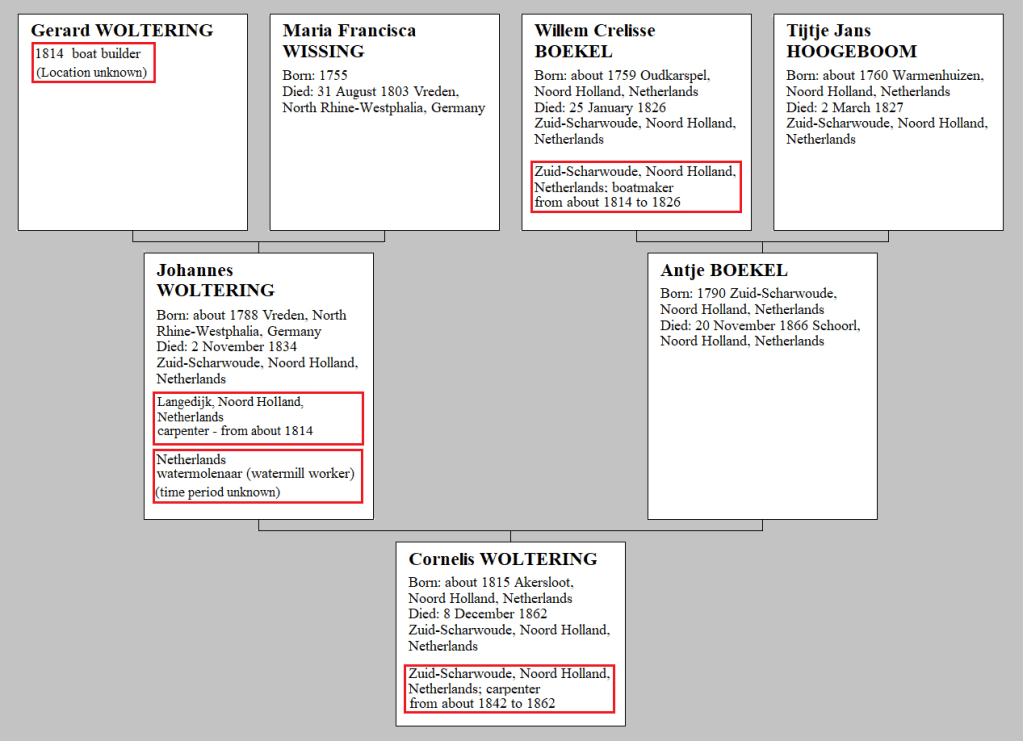
My paternal grandmother was Christina Komen. Her paternal grandmother (my great great grandmother) was Antje (“Anna”) Woltering. Anna’s father, Cornelis, is one of my few ancestors who can be described as a tradesperson. As far as I have discovered, he was a carpenter almost all of his entire adult life. The earliest mention of his occupation was in the registration of his marriage to his wife Neeltje Smit, which occurred on May 8, 1842. It is most likely that Cornelis was a carpenter, or a carpenter’s apprentice, for many years before he married.

While it seems that Cornelis spent most of his life, including his years as a carpenter, in Zuid-Scharwoude, Noord-Holland, he was born about 15 kilometers to the south in the village of Akersloot. How this came to be I have no idea. His parents, Johannes “Jan” Woltering and Antje Boekel, had married in Noord-Scharwoude in 1814 and all of Cornelis’s younger siblings were born in Zuid-Scharwoude. However, it appears that Jan had been living in Akersloot prior to marrying Antje. It may be that the couple returned to Jan’s residence after they married and relocated to Antje’s home town of Zuid-Scharwoude shortly after Cornelis was born.

The bigger surprise to me was that Cornelis’s father, Jan, my Gx4 grandfather, was born in 1788 in what is now Vreden, North Rhine-Westphalia, Germany. Vreden is about three kilometers from the Dutch border and the Achterhoek. Sometime before September 1814, when he married Antje, Jan literally moved across the Netherlands to Noord-Holland. I have no idea why he moved, which was incredible because it was unusual for people to move such distances at that time. Even now it’s about a three-hour drive, which to many of my Dutch relatives is an astounding distance. (For a Canadian, not so much!)

I have not yet determined where Jan’s parents, Gerard Woltering and Maria Francisca Wissing (Cornelis’s paternal grandparents), were born. Gerard and Maria married on April 26, 1787, in Vreden. However, prior to the marriage, Gerard had been living in Buurse, Overijssel, Netherlands. Buurse is three kilometers from the German border and twelve kilometers due north of Vreden. Meanwhile, Maria had been living in Enschede, Overijssel, which is a city about 20 kilometers north of Vreden.

What is more surprising is that Gerard’s occupation was boatbuilder. I am unsure where he carried out that trade, given that the closest large body of water to where he lived and married is at least 100 kilometers away.

Cornelis’s maternal grandfather, and Antje’s father, was Willem Crelisse Boekel, was also a boatmaker. However, unlike Gerard, Willem lived rather close to the water, as he spent his entire life in Noord-Holland.

52W Mark II – Week 35: Disaster

This year marks the 70th anniversary of the North Sea Flood of 1953. A combination of high tides and winter storms on the evening of January 31 and the morning of February 1 resulted in a massive flood that affected England, Scotland, Belgium, and the Netherlands. It was one of the worst floods to hit the Netherlands since 1916.

The southern provinces of Zeeland and Zuid-Holland were particularly hard hit, with the highest death tolls for the country. In the province of Noord-Holland, where my father lived, Red Cross and other sources indicate that there were fewer than a dozen deaths. In addition to the dead and missing, thousands were displaced from their homes and there was massive property damage.

My father was just a boy when the flood struck, but he remembers it well. It is apparent that when he recalls his childhood in the Netherlands, it is one of his clearest memories. The Netherlands still had not yet recovered from World War II and the flood was devastating. While the reasons for emigrating are multifaceted and complex, the devastation of the flood of 1953 was one of the many things that prompted my grandparents to think about leaving the country.

While this video is in Dutch, it is the images that tell the tale. It also primarily shows the devastation in the south of the country. (“Watersnood” is “flood” and “ramp” is “disaster.)

52W Mark II – Week 34: Newest Discovery

In Week 21 of this year’s 52 Ancestors Challenge, I wrote about one of my brick walls, Anne (“Annie”) Pitre, our children’s great x3 grandmother. The biggest questions were whether her surname at birth was actually “Pitre” or “Peters, and whether she was Acadian. Last week, I found a nugget of information that suggested that Anne was in fact born “Pitre” and that it is more likely that she was Acadian.

Still looking for Anne Pitre!

We just spent two weeks in The Maritimes, where my wife has deep roots. As the trip was primarily to visit family and to acquaint our children with their Maritime heritage, there was precious little time for genealogy research. I was able to get in a few minutes’ time here and there in places like the Nova Scotia Legislature Legislative Library and Pier 21 in Halifax. I had less opportunity to do so in Charlottetown, but a rainy day and change in plans gave me an unexpected hour and a half in the Charlottetown Library.

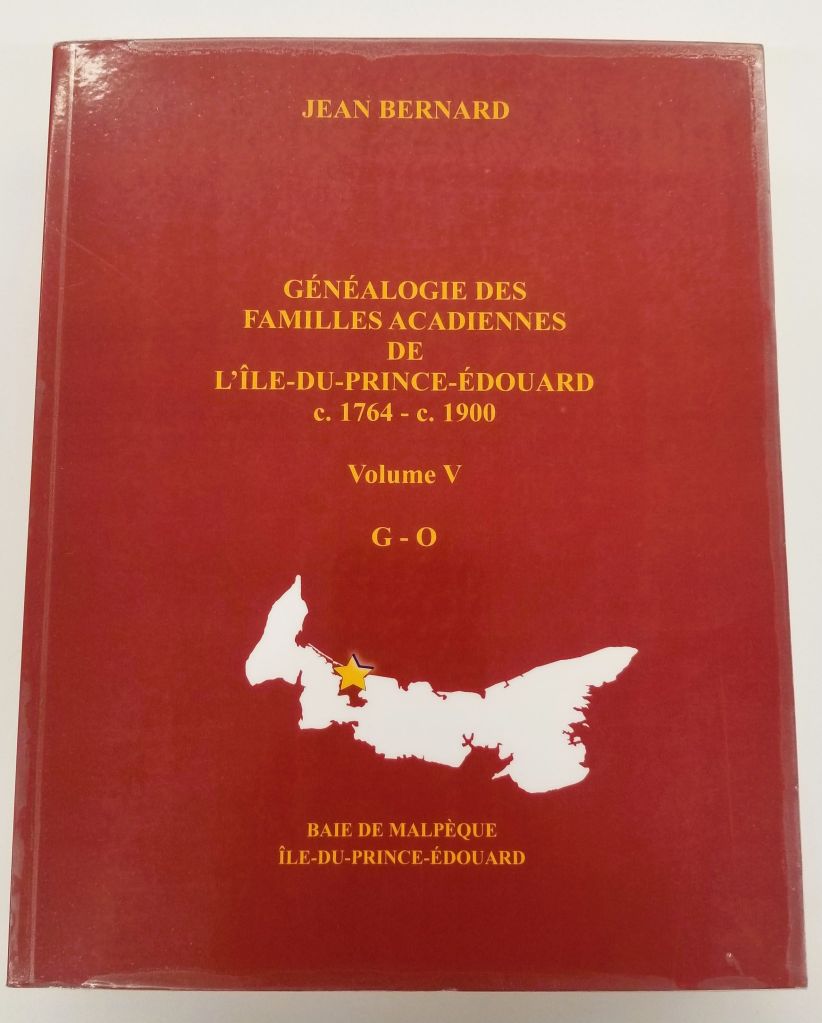
Years ago, before COVID, I had ordered Volume VI of Jean Berard’s Généalogie des Familles Acadiennes de L’Île-Du-Prince-Édouard from the Charlottetown Library through interlibrary loan, which covers surnames starting with the letter “P”. I thought the work was a collection of births, marriages, and deaths, which is why I ordered that volume. However, I was dismayed to discovered it was sorted by marriages, which meant I wouldn’t find Anne under her birth name. Rather, if she was in Berard’s collection, she would be found under “M” with her husband Patrick McKenna. So what I really needed was Volume V.

Before returning the book, I poured through every entry for “Pitre”, but did not find any that included a daughter named Anne that was born anytime near where our Anne was likely to have been born. At least my rusty French got a workout.

I didn’t order Volume V at the time due to several reasons. However, like anything that’s put at the bottom of a to-do list, it tends to stay there.

Fast forward a few years to my time in the Charlottetown Library, which naturally had every volume of Berard’s work on its reference shelf – including Volume VI.

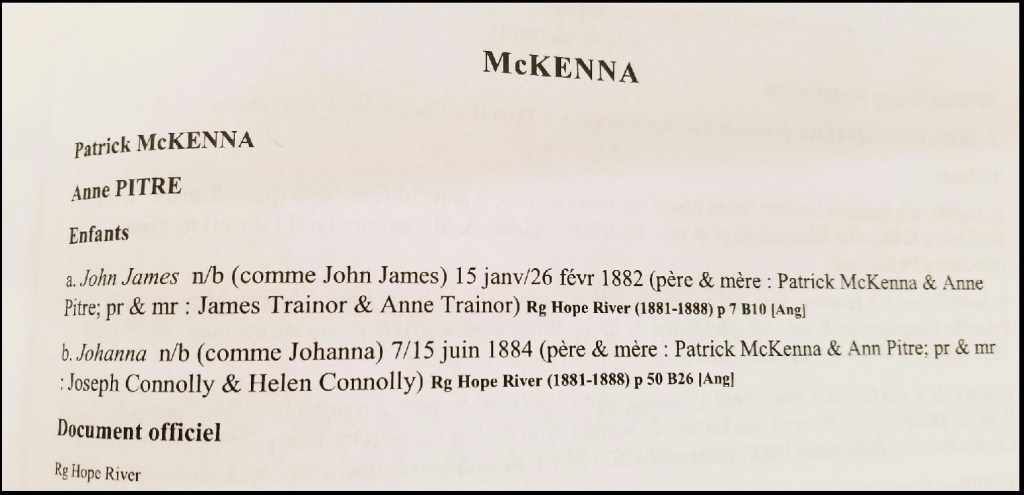
The entry for Patrick McKenna and Anne Pitre, showing the birthdates and baptismal dates of two of their twelve children.

What was exciting about this was that it appeared to confirm that Anne’s surname at birth was Pitre. However, once I translated it into English, I realized that the entry was for the baptisms of two of Patrick and Anne’s children. I had already found these children in the Prince Edward Island Baptismal Index. The only new information here is the inclusion of the children’s godparents. The problem is that I have also previously found some of Patrick and Anne’s other children in the same index, which recorded Anne’s surname at birth as Peters.

One positive thing I can take from this discovery is the fact Anne is even to be found in this collection. Her inclusion in a collection of Acadians strongly supports the conclusion that Anne was Acadian.