52 Weeks – Week 23: Mistake

More of a misunderstanding than a mistake, really…

It’s week 23 of the 52 Ancestors Challenge, on the topic of “Misteak”, er “Mistake”. (See what I did there?)

Creative Commons 3 Licence – CC BY-SA 3.0
Original Author: Nick Youngson https://www.picpedia.org/chalkboard/e/error.html

A few weeks before I turned 19, I visited Ottawa for the first time, during a student conference. I took the opportunity to visit my aunt, who by that time was well-established in the capital. I had already been actively working on my family tree for at least ten years by then, so our conversation turned to our family history.

We ended up talking about our Nelson ancestors. I knew nothing about them beyond my great great grandfather, John Alexander Nelson. My family and I had gone to a family reunion of his descendants in Big Fork, Montana when I was 13.

John A. Nelson, circa 1930s.

My aunt told me that John’s parents, Robert Nelson and Elizabeth Joseph, had emigrated from Scotland to the United States. My aunt then volunteered two pieces of information that I found particularly exciting.

Joseph Nelson (1818-1902) and Elizabeth Joseph (1818-1902)

First, she said that the belief was that the Nelson name in Scotland had Viking origins. Vikings? That was even cooler than if she had told me they were descended from pirates. Second, she said that through the Nelson line we might be descendants of Robbie Burns. I was thrilled by that possibility, because Burns was one of my favourite poets.

I knew enough at the time not to accept the idea unconditionally. I had already honed an overdeveloped sense of skepticism. I already knew a few family legends and their lack of veracity, so I had no reason to believe these legends would turn out to be any different. Moreover, while the initial development of the Genealogical Proof Standard was many years in the future, I was well into my undergraduate degree in history and knew full well the importance of proof.

However, I received these pieces of information back at a time when genealogy was done the old-fashioned way. Personal computers were still largely a relatively new and novel thing and it would be a few years before most of us even heard of the internet. It would have taken a lot of time and effort to verify or debunk what I had learned. Besides, the ideas were so cool that I was really not in a hurry to burst the bubble.

In the meantime, I reveled in the prospect of a Scottish connection. I learned that the Nelsons had connections to Clan Gunn. Shortly afterwards, I spotted a necktie patterned on the Gunn tartan and bought it mostly out of amusement. Plus, I enjoyed bewildering people as to why someone with a Dutch surname was wearing a tartan tie.

Alas, all good things come to an end.

While Robert and Elizabeth had lived in Scotland, they weren’t Scottish. They were Irish. They were both born in Muff, Donegal in 1818 and married there in 1842. Sometime in the early 1840s, likely around 1844, they relocated to Renfrewshire, Scotland. By 1850, Robert was working at Brown’s Sugar House, on Roxburgh Street in Greenock, Scotland as a sugar baker. Sugar bakers usually refined muscovado sugar, an unrefined brown sugar imported from Barbados. In 1848, they joined the Latter Day Saints (“Mormons”). On September 3, 1850 Robert and Elizabeth, along with their three children, departed Liverpool on board the ship “North Atlantic” bound for New Orleans. By 1854, they had settled in Salt Lake City where John, my great great grandfather, was born.

Passenger list for the North Atlantic showing the Nelson family travelling from Liverpool to New Orleans.

As for the Burns connection, it really did not take much to dispel that myth. Robert Nelson’s mother was a woman named Martha Burns. Martha was born in 1787. So while her surname was Burns and she was born at a time Robbie Burns was busy fathering numerous children, that is where the correlation ends. None of Burns’ children – legitimate and illegitimate – were named Martha. Moreover, Martha was born in Muff, Donegal, not Scotland.

Sad trombone

52 Weeks – Week Thirteen: Sisters

My mother has told me, several times, that before I was born my father had hoped to have five daughters. As the first born, I quickly put paid to that. It was probably in my father’s best interest. Back in my teens when my father had hair, I liked to tell him that all the grey ones were entirely due to his daughters and none of his sons.

Hazel and Irene Nelson in the Alberta Birth Index

When I saw the topic for this week’s  52 Ancestors Challenge, the first sisters who immediately came to mind were my great grandmother and her sister. They are amongst the very few twins I actually have in my family tree. Unfortunately, they were sisters who never had the opportunity to know each other or to share a childhood together.

Hazel and Irene Nelson were born to John Alexander Nelson and Ella Elizabeth Thomas on December 15, 1899. The girls were the tenth and eleventh of twelve children. Given that Hazel was registered first, I take it that she was born first.

John and Ella were amongst the earliest settlers of Cardston, Alberta, which was founded in 1887 by members of the Latter Day Saints (Mormons). The Nelsons arrived in 1890 and began farming nearby.

This is where my great great grandparents, John and Ella Nelson, first farmed when they settled in Cardston, Alberta

Hazel and Irene Nelson were the first twins born in Cardston. Sadly, Irene passed away five weeks later. I’ve been to the cemetery where she is buried. Unfortunately for me, I only discovered where she is interred after my trip. While I did not realize it at the time, Irene is buried next to her parents. The grave marker is damaged. Information for the Cardston Cemetery on the Town of Cardston website confirms that Irene’s grave is the one beside her parents. Irene’s brother is interred in the plot below hers.

Irene Nelson is buried beside her parents John and Ella, whose grave marker is the white one in the foreground. Irene’s grave is the one with the damaged headstone. The black marker on the left is Irene’s brother Seth Henry Nelson and his wife Mabel.
Hazel Nelson, about 1904

Hazel, on the other hand, lived to be 67. She and her husband, Milton Leo Burgess, had nine children, the oldest of whom was my grandfather, Leo. Milton died in 1964. Eight weeks before she died, Hazel married a widower, Walter Beaves. They met in the seniors’ home where they both lived, which Hazel called “the old fools’ home”.

Hazel passed away three days before I was born. My mother pretty much went from her grandmother’s funeral to the hospital for my arrival.

Hazel’s obituary in The Lethbridge Herald

52 Weeks – Week Seven

Landed

I’m starting to realize that when I choose a topic for the theme of the week for the 52 Ancestors Challenge, I should look ahead to see what other topics are coming up. That way I can avoid getting to a topic like this week’s, “Landed”, and seeing that I’ve written on the topic before. Then again, a little repetition here and there won’t hurt.

If I had approached this topic a few hours ago, I would probably be sitting here casting about in my mind as to what “landed” means to me. Fortunately, our eldest son inadvertently gave me a focus to write about. During dinner, out of the blue, he asked “besides Opa, did any of our ancestors come to Canada on steamships?”

The Sibajak, which brought my father and his family to Canada.
Pier 21, Halifax

Opa is my father, the Dutch side of my family. I’ve already written about his coming to Canada on the Sibajak. He and his family came in early May 1954, travelling from Rotterdam to Halifax. They landed at Pier 21, which could be described as the Canadian equivalent of Ellis Island. My father’s aunt and uncle came over four months earlier, in January 1954 on the Groote Beer, while another aunt and uncle followed in late May 1954, on board the Castel Felice.

While it was a Holland America ship during his crossing, built and originally operated by Rotterdam Lloyd, along with other ships that they mainly used to go to the East Indies. Built in 1927, the Sibajak served as a troop ship during World War II. After the war, the Sibajak was one of a number of ships operated by Holland America that were used almost entirely for Dutch emigrants, along with the Grote Beer, Waterman, and Zuiderkruis. It was sold and scrapped in Hong Kong in 1959. When I was in Hong Kong in 1996, while travelling around the harbour and between its islands, I wondered how close I might have come to what scraps of it might remain.

This is a fascinating short documentary about a voyage the Sibajak made to Australia carrying Dutch emigrants. The video is in Dutch, but the images convey a lot of meaning.

In the late 1990s, my parents went on an Alaskan cruise on a Holland America ship. During the trip, my father, who loves to talk to people, fell into a conversation with one of the older hands on deck. My father mentioned having come to Canada on the Sibajak. After a few questions from the crew member, my dad learned that the man had been on the Sibajak during my father’s trip, in his first year or two of service.

On my mother’s side, the most recent ancestor to arrive by steamship was my great grandmother, Emelia Anton. She came to Canada at the age of nine, with several of her siblings and her parents, Jacob Anton and Margaretha “Margaret” Heck. They were Germans from Russia. The family sailed out of Hamburg on June 18, 1912 aboard the S.S. Pennsylvania. They arrived at the Port of New York (Ellis Island) on July 1, 1912. Their declared destination was Maple Creek, Saskatchewan, to join Emelia’s older brother, Rochus. The passenger manifest stated that Jacob paid for the entire family’s transport, other than that of one of his daughters-in-law, whose passage had been paid by her father.

The Anton family, circa 1910. Likely taken in Selo Suchoi, Veronesch, Russia.

Emelia had not had much schooling before coming to North America, but was very religious. She said that she was frightened and nervous during the journey, as she did not know anything about where she was going and did not fully understand what was going on. However, on reaching New York, she said her fears subsided when she saw “the Madonna”. When she saw that, she knew she would be safe and all would be well. Of course, the “Madonna” was the Statue of Liberty. As she had never heard of it before, she thought it was a statue of the Virgin Mary.

Passenger list for the S.S. Pennsylvania showing the Antons.
Jerome Lerner (1895-1954)
Michael Lerner (1862-1947) and Barbara Schmidt (1865-1936)

Emelia’s husband, Heronimus “Jerome” Lerner, was born to parents who were also Germans from Russia, Michael Lerner and Barbara Schmidt. Michael and Barbara came to the United States in May 1893 aboard the S.S. Lahn, with the five children they had at the time. They landed at Ellis Island and made their way to Clay County, Texas. Jerome was the first child born to Michael and Barbara in the United States. They had seven other children in Texas after Jerome was born. Jerome moved to Saskatchwan in 1917, preceded by an older brother. Jerome’s parents followed a year later. Other siblings came north at other times.

Passenger list for the Lahn showing the Lerners

The ancestors furthest back in time that I can find who came to North America on a steamship were my great x3 grandparents, Robert Nelson and Elizabeth Joseph. They were both born in Muff, Donegal, Ireland in 1818 and married there in 1842.

Joseph Nelson (1818-1902) and Elizabeth Joseph (1818-1902)

Sometime in the early 1840s they had moved to Linwood, Renfrew, Scotland. They were there at least by January 1844, when their first son, Samuel, was born. By 1850, Robert was working at Brown’s Sugar House, on Roxburgh Street in Greenock, Scotland as a sugar baker. Sugar bakers usually refined muscovado sugar, an unrefined brown sugar imported from Barbados.

On September 3, 1850 Robert and Elizabeth, along with their three children, departed Liverpool on board the ship “North Atlantic” bound for New Orleans. For a long time I had been confused by references I had seen to them coming over on “the north Atlantic”, thinking it meant the route they travelled. It wasn’t until I came across the passenger list that I realized that “North Atlantic” was the name of the ship. Having a name like that makes it difficult refine a search to distinguish the ship from where it sailed. However, while I have not found very good sources, it appears that the North Atlantic was a steam powered ship.

Passenger list for the North Atlantic showing the Nelson family

The records show that there was at least one other family headed by a sugar baker from Brown’s on the same voyage. Robert and Elizabeth were part of a company of Latter Day Saints (Mormon) converts travelling from the United Kingdom to Utah. The family spent a short period of time in Missouri, where in 1852 Elizabeth had her first child born in America. By late 1854 they were in Farmington, Utah, where my great great grandfather John Alexander Nelson was born.

Looking at my pedigree for this post, I realized I might have one other ancestor who might have travelled from the United Kingdom to the United States by means of a steam powered ship. That would be my great x3 grandmother, Maria Hadlond, who was born in Cheltenham, Gloucester, England in 1838 and who emigrated sometime in the 1850s. I have not really researched this branch of my family beyond collecting names and basic vital stats. For whatever reason, it has never caught my interest.

Susan Turple (1818-1906)

I also have a great x3 grandmother, Susan Turple, whose family had been in Nova Scotia since the 18th century, who would have travelled by means of a ship with sails. In 1849, Susan joined the Mormon church in 1849. In 1852, she went from Halifax to Boston to join a westward migration of Mormons. It is most likely that the initial part of Susan’s travels was by means of steam powered ship.

Before these people, any ancestors I have who crossed the Atlantic would have done aboard ships with sails.

Speaking of looking ahead, I see that next week’s theme is “Courting”. Since I am writing this on February 14, I wonder if that should have been this week’s theme!

More Than a Full Deck

Here’s the deal…

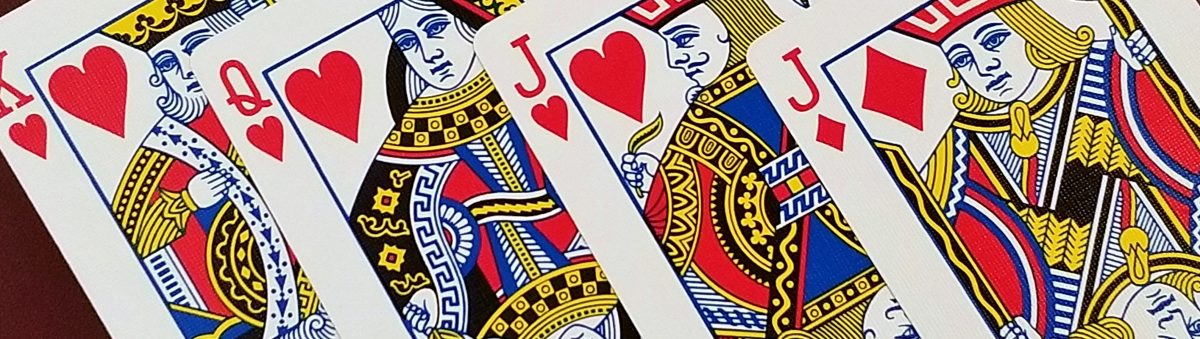
Three years in a row, I signed up for Amy Johnson Crow’s “52 Ancestors in 52 Weeks“. The first two times, that was as far as I got. Hopefully, third time’s the charm. Hence this blog, only a quarter century behind the times. As someone who enjoys games as much as genealogy, I naturally associated the number of weeks of the challenge with the number of cards in a deck.

I’d love to figure out how to centre this image – and justify this caption. [Edit: I figured it out!]

Despite the association with a deck of cards, I’ve identified more than 52 ancestors. In fact, I’ve managed to identify 55 out of my 64 great great great grandparents. So it seems I am playing with more than a full deck.

My interest in genealogy began when I was about eight years old. It was prompted along the way by questions I had as a child that, to me, had odd answers. When I was in elementary school, I asked my mom why my school principal always asked if I was Belgian. She said, “because you have a Dutch last name”. At the time, I thought Belgium was an entirely French-speaking country, so that answer made no sense. In grade eight, I switched from taking French to German. One day while visiting my great grandmother, my mother said, “Grandma, Sean is taking German in school.” I was bewildered why a woman who I thought was of English origin would care. I was even more surprised when she started speaking to me in fluent German.

Literally my first genealogy book, which I bought when I was 8 or 9.

My father’s side of the family is Dutch, going back generations, mostly from the part of the Netherlands that is now the provinces of North Holland and South Holland. However, several weeks ago I discovered connections to the Achterhoek, the easternmost part of the province of Gelderland that pokes into Germany. I have also recently been investigating a branch of the family that originates in Zeeland and what is now Oost-Vlaanderen (East Flanders). Sometime in the early 19th century, one of those Zeelanders ended up in the northernmost part of North Holland. His daughter, my third great grandmother, married into a family that has deep roots on the island of Texel.

My mother’s side is much more of a mix. Her mother’s side of the family are what is known as Germans from Russia. One branch came to Canada by way of Texas, the other branch came directly to Canada. My mother’s paternal side has roots in the United States, several branches of which go back to colonial times, including the Mayflower and Salem. My maternal grandfather’s direct paternal line goes back to a Hessian mercenary who initially fought for the British in the American Revolution, but later switched sides. That branch of the family were also some of the original members of the Latter Day Saints (the Mormons). They joined the church in its infancy, moving from New York to Ohio to Illinois. They were also part of the migration along the Mormon Trail to Salt Lake City.

I’ve also done a lot of work on my wife’s side of the family. At present, my intention with this blog is to focus on my side of the family. However, I will probably delve into my wife’s side from time to time because there are some fairly interesting stories there. Our eldest child, who shares my love of genealogy, is fascinated with a branch of his mother’s family that has deep roots on the island of Jersey. To be honest, I find it fascinating as well.