52W Mark II – Week 49: Family Recipe

Years ago on The Great Canadian Baking Show, one of the contestants said that she was using her *great* grandmother’s recipe. I have all sorts of recipes from my grandmothers (and copious notes on the recipes they didn’t write down that I’ve spent years trying to recreate). However, it never crossed my mind to think about my great grandmothers’ cooking. So the episode inspired me to ask my mother and mother-in-law if they had any of their grandmothers’ recipes.

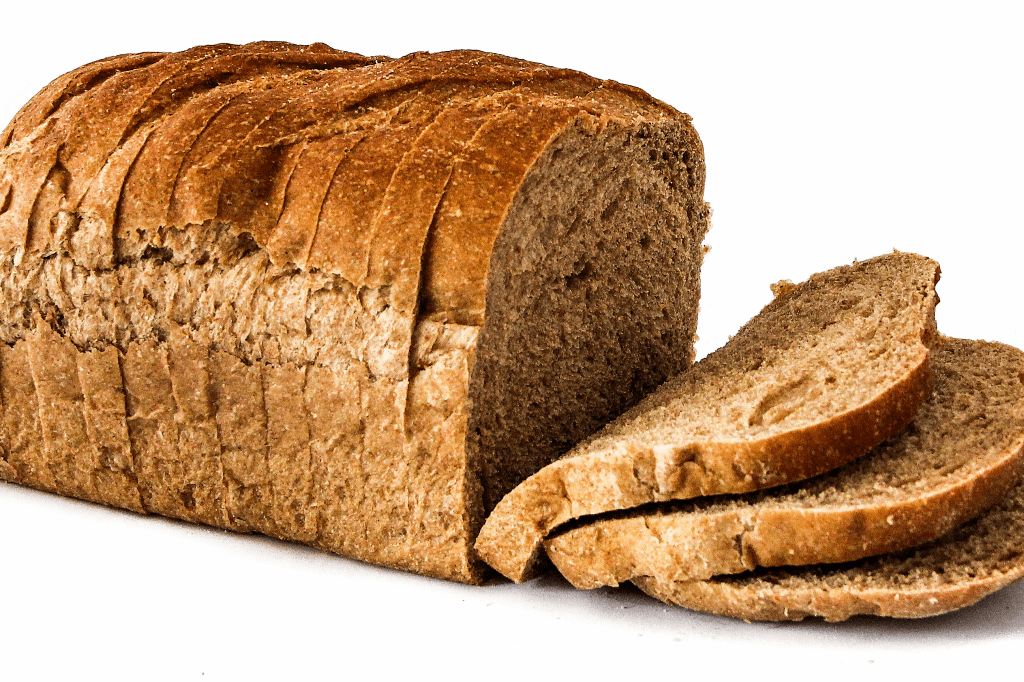
My mother-in-law responded first and provided me with her maternal grandmother’s recipe for brown bread. I’m happy to have it, but I doubt I’ll ever make it. It not only calls for nine cups of flour, it also requires two cups of rolled oats. I know that nine cups of flour isn’t outlandish for two loaves of bread, but adding in all those oats, it strikes me as a lot. However, the real impediment is that while I love to cook, I do not enjoy baking – despite the fact I am a pretty good baker. Nevertheless, I am thrilled to have a recipe that our kids can say was their great great grandmothers! (In fact, writing that last sentence has me thinking that maybe I should make this recipe…)
My mother responded by saying that she didn’t think she had any. She reminded me that her maternal grandmother was not a very good cook. The one exception was that her grandmother made fantastic raisin drop cookies, which all the grandchildren loved. My mother doesn’t have the recipe, which is fine by me. The only thing more boring than raisin cookies is oatmeal cookies.

As for my grandmothers, I’ve written about their cooking in some detail before, but I can add a bit of an update.

This past summer we participated in a 16-week Community Supported Agriculture (CSA) program through a local Richmond farm, Sweet Digz Farm. Overall, we had a very positive experience. What became apparent very early on was that a lot of the produce we were receiving lent itself to a lot of Dutch dishes. In particular, we had a lot of potatoes and kale, the key components of boerenkool stamppot (the Dutch were eating kale decades before it was cool and trendy in North America). My paternal grandmother often made stamppot, and it was awful. I knew I could do better.

My youngest and I went to a local butcher in Steveston Village and he selected the sausage for the recipe. (Sometime I will have to write about the Steeves family of New Brunswick, after whom the west coast village is named. My kids are Steeves descendants.) I also was a bit non-traditional with my stamppot. While there are no hard and fast rules, stamppot is usually potatoes and kale, while a combination of potatoes, onions, and carrots is hutspot. I was a rebel and not only used potatoes, carrots, and kale in the same dish, I used a few kohlrabi in place of a couple potatoes.

If I say so myself, it turned out amazing, and needless to say, much better than my grandmother’s. Not only that, but everyone in the family loved it and wanted seconds. While my family are generally not picky eaters, there are very few things that appeal to all of them. There’s always something I can tell someone is less than thrilled with. Even moreso with the Dutch foods I make – there’s always one who loves it and one for whom the dish is not for them. Pity, because in the winter months I really could go for some snert. A few days later I made shepherds pie (another universal favourite), but used leftover stamppot instead of the typcial mashed potatoes. Another win!

The biggest score, however, was during a visit to my mother’s a year ago. She distractedly removed an item from the back of a shelf and casually said, “oh, it’s my mother’s recipe book.” Yes, my head exploded. I had been asking her for years if she would find it for me sometime. I immediately absconded with it and photographed every page. The vast majority of the recipes were her desserts and sweet dishes but very few of her savoury dishes. However, a few of the savoury dishes seemed familiar – they were things my mother made, but in a whole different way. I could see how my mother adapted and changed her mother’s recipes over time – just as I do with my mother’s recipes!
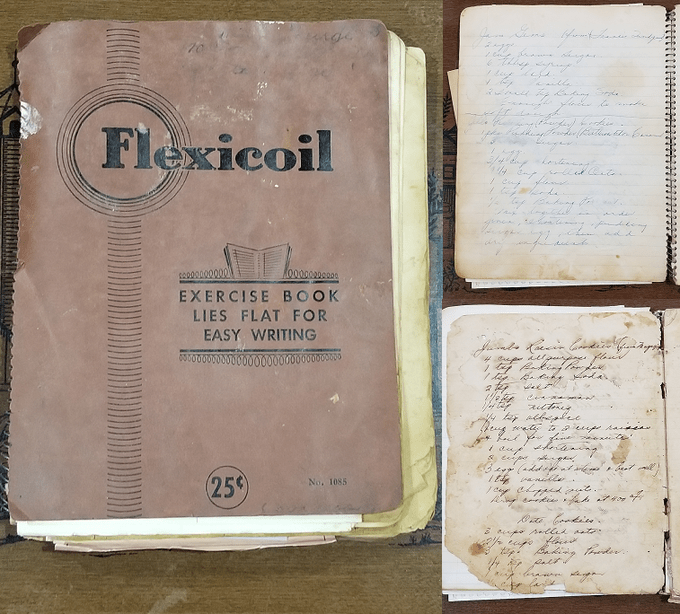
My maternal grandmother’s recipe book.

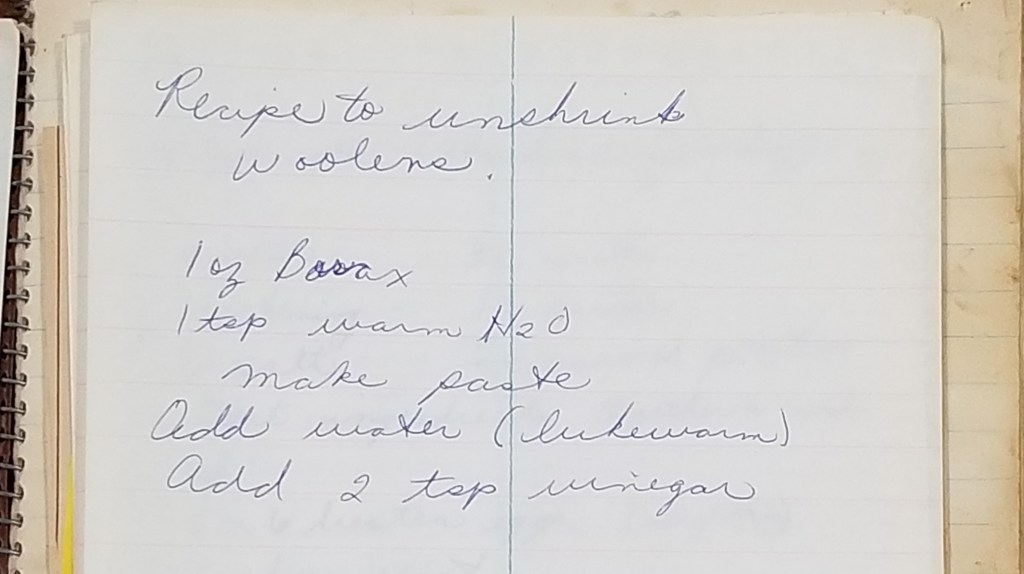
My grandmother also wrote down a few non-culinary recipes, such as this Recipe to Unshrink Woolens:
There were also a lot of clippings of recipes from magazines and product packaging. This was an advertisement on the reverse side of a recipe my grandmother clipped from a magazine in the 1970s:
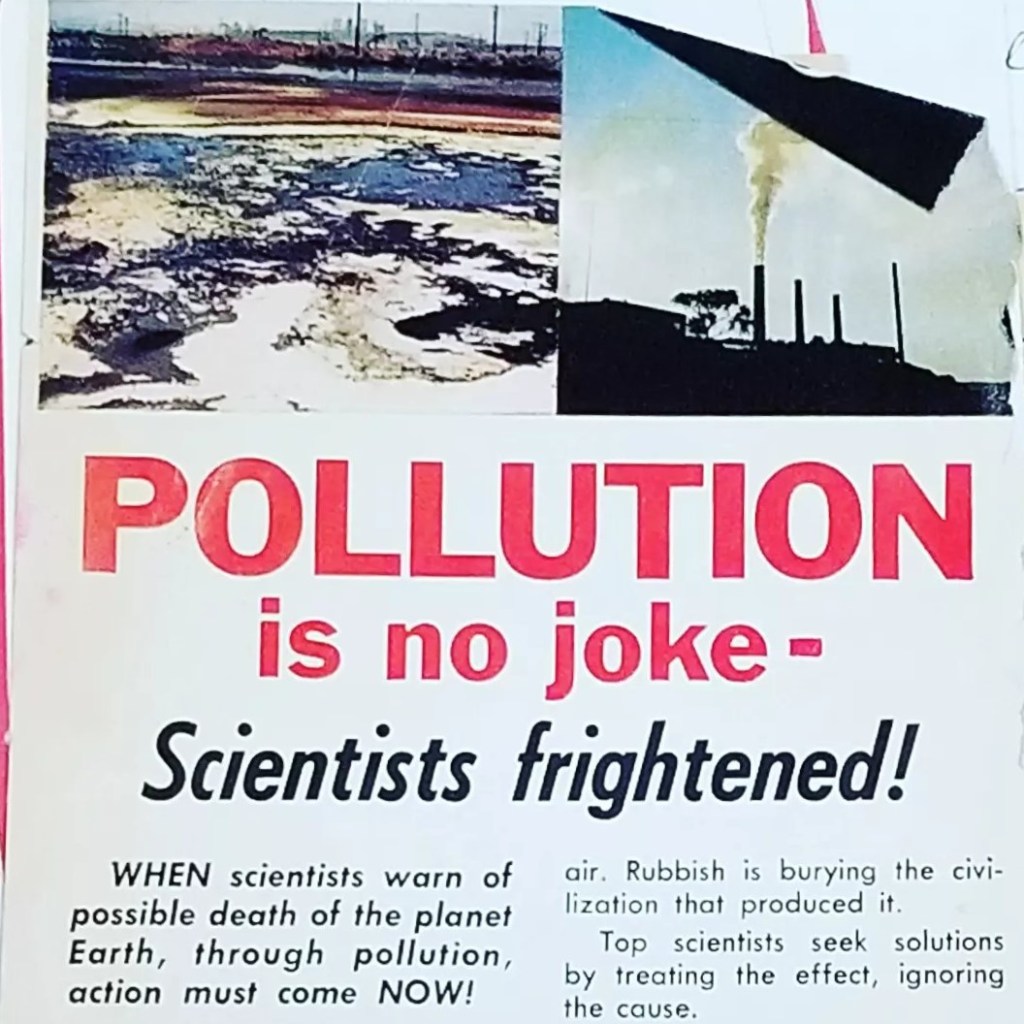
I suspect those scientists – and their successors – remained frightened, and rightfully so.
52W Mark II – Week 43: Dig A Little Deeper

Most of my ancestors have been labourers. Many of them did a lot of digging as part of their work, especially since a lot of them were agricultural workers. Some may have only deep enough to plant crops, while others may have dug a little deeper.

I’ve already speculated about  my 4x Great Grandfather, Petrus Pieterszoon “Pieter” van der Fluit and the possibility that the reason he relocated from Zuid Holland to Noord Holland was to work digging canals and other work related to polder construction and waterworks. Unfortunately, the timing does not seem quite right. Furthermore, and of greater importance, I’ve yet to discover any real evidence to support the theory.

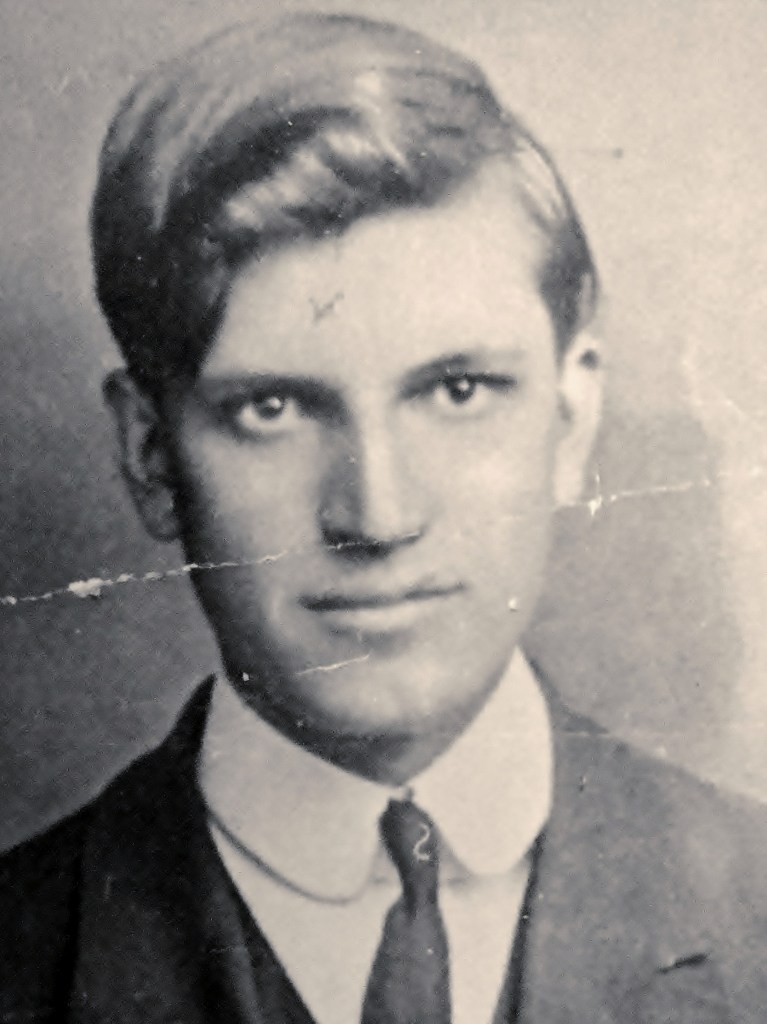
Turning to my mother’s side of the family, my great grandfather Milton Leo Burgess was a man of many occupations over his working life: farmer; plumber; and woolen mill worker (where he lost a finger of his left hand due to a work injury). Unique amongst the labouring jobs held by my ancestors, apparently Milton spent a short period of time sometime around 1950 working as a gravedigger. The only source I have for this is my mother. While she knew her grandfather well, if he was a gravedigger in the early 1950s she would have been too young to have had any memories of the time he held that job. It is something he likely told her when she was older.

Milton Leo Burgess in an undated photo.

52W Mark II – Week 40: Longevity

With this week’s 52 Ancestors Challenge theme of “Longevity”, I suspect the inclination would be to write about those who have lived the longest, or perhaps were married the longest. I’ve tried to think about this from another perspective involving length of time spent.

To that end, I’ve tried to determine who might have experienced longevity in their occupation. I have many ancestors who spent their entire lives in a single occupation, particularly farming or agricultural work, or as labourers. However, what I have been pondering is someone who remained in the same occupation at the same place the longest, preferably with the same employer.

Of those who worked outside of farmwork and labouring, two ancestors stood out to me, both on my father’s side of the family: Cornelis Jan Bakker (my Gx2 grandfather) and Reijer Ran (my Gx4 grandfather).

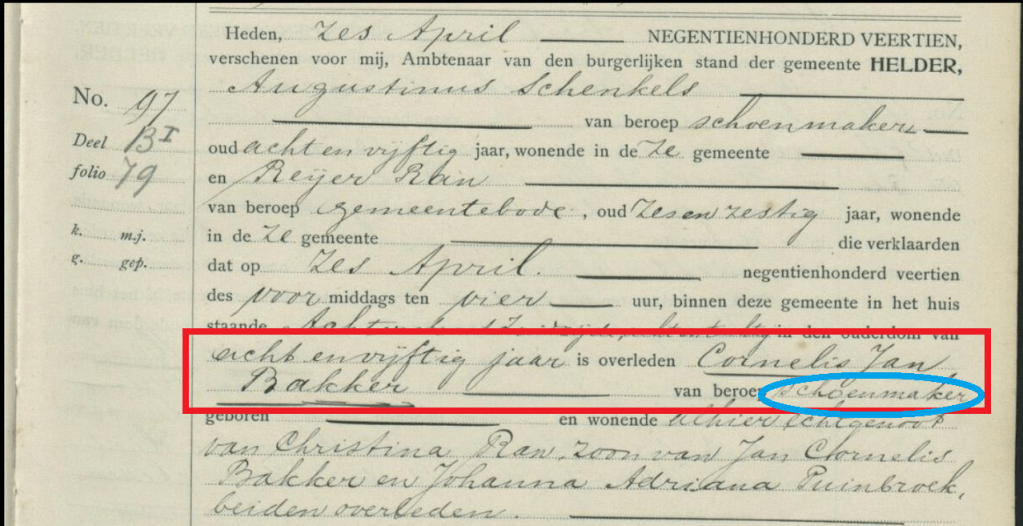
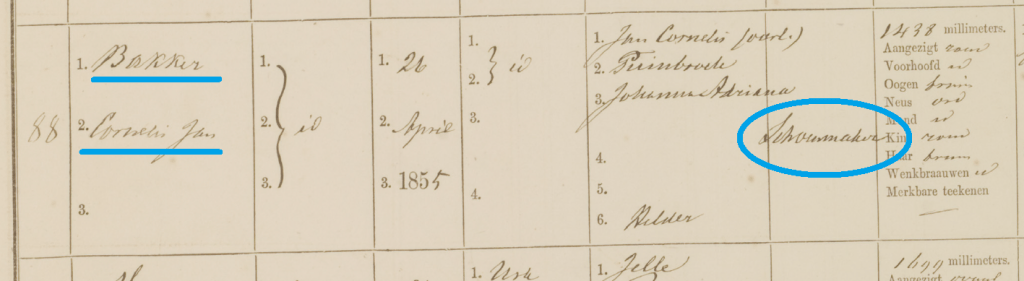
Cornelis (1855-1914) was a cobbler and shoemaker in Den Helder, Noord Holland, Netherlands. Despite this description, I doubt that Cornelis did anything similar to that of a cordwainer. A cobbler largely repaired old shoes, while a cordwainer makes new shoes from new material, usually based on patterns they design themselves. I have few details of Cornelis’s work, other than he carried out his trade in Den Helder. His occupation is simply listed as a fact in various records. Cornelis was a cobbler from at least 39 years, from about 1875 to 1914, when he passed away.

Record of Cornelis’s conscription into the military showing his occupation as a shoemaker. While conscripted, he was released from service.
Cornelis’s death registration, showing his occupation as shoemaker.

Reijer (1792-1860) was a sailor. It appears that his largely worked as a harbour and channel pilot. He was born and raised on Texel, the largest of the Wadden Sea islands on the north coast of the Netherlands, although he was living in Den Helder when he died. However, I am unable to determine whether he was based out of Texel or Den Helder, the mainland city closest to Texel. Like Cornelis, the information I have about Reijer’s occupation is largely a statement of fact in various birth, marriage, and death records. Reijer was a sailor for at least 41 years, from 1813 to 1854. It is possible that Reijer worked later than 1854, that is simply the last year I have mention of him still working as a sailor.

52W Mark II – Week 38: Adversity

In which my grandparents unwittingly recreate the Four Yorkshiremen sketch

My paternal grandparents were 16 and 17 years old when the Nazis invaded the Netherlands in 1940. The occupation was a difficult one. My grandfather and his brothers were all rounded up to work as forced labourers in Germany; somehow my grandfather escaped. Only a few weeks ago I found records about one of my great uncle’s time as a forced labourer through the Arolsen Archives – International Center on Nazi Persecution. I was surprised to find that discovery, only because I was expecting to find records about one of the other brothers.

Needless to say, my grandparents rarely spoke about the war in my presence. In particular, the two times I ever heard my grandmother speak about it were astonishing because it was so rare it was for her to do so. My grandfather must have spoken about it more often, because I have heard several stories about the hardships he endured and the close scrapes he had with the Nazi occupiers. My father also tells the tale of when he was a boy, after his family had immigrated to Canada, about walking in a farm field with my grandfather. While they were walking, a small airplane flew overhead. My grandfather instinctively dove to the ground for cover. The war would have been over for at least ten years at the time, but clearly it had left its scars.

While the war was generally a proscribed topic, much to my amazement it came up during a visit I had with them in the late 90s, shortly before my grandmother passed away. I can’t remember how the topic came up, but I remember being absolutely gobsmacked that it did. It was particularly stunning that my grandmother participated in the discussion. Even more amazing was that the topic of conversation was the Hongerwinter (“Hunger Winter”), a famine the Nazis imposed on the Netherlands during the last winter of the war. However, what started off as a very somber recollection of their experience quickly spiraled into the famous Monty Python sketch.

The Allied strategy in the Netherlands was to get to Germany as quickly and directly as possible. This meant bypassing large parts of the northwest part of the country, including Amsterdam and the province of Noord-Holland. The Germans retained control of those areas until they surrendered on May 5, 1945. Over the winter of 1944-1945, which was particularly harsh, the Nazis deliberately blockaded the food and fuel supplies into the occupied portions of the Netherlands, resulting in the Hongerwinter. Malnutrition was rampant and about 22,000 people died of starvation.

My grandparents both lived in the central part of Noord-Holland and experienced full effects of the Hongerwinter. The famine occurred before they were married, so they experienced the hardship with their families.

When the topic came up, my grandparents began discussing how hard that winter had been and how they had each suffered. What caused the discussion to go sideways was when my grandmother said to my grandfather, “At least you lived on a farm!”

My grandfather countered by acknowledging the fact, but adding that my grandmother’s family was much better off economically. My grandmother reciprocated by pointing out some other advantage she believed my grandfather had that she did not. I am certain that my grandfather added that his mother was raising the family on her own, as his father had passed away in 1932.

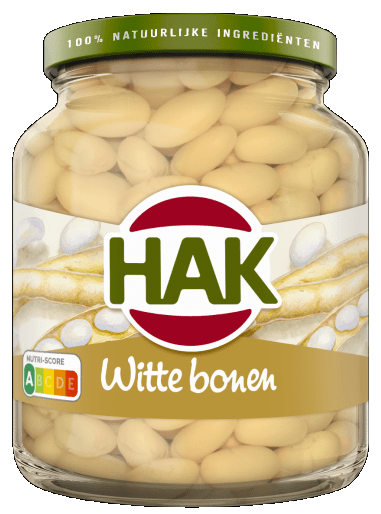
They then began countering with what foodstuffs the other had access to, which they themselves did not. Finally, one of them said, “all we had to eat was the white beans!”, to which the other responded in a somewhat overdramatic voice, “oh, if only we had the white beans!”

I am certain that the competition to outdo the other’s hardship was black humor that served to ameliorate the trauma they had both experienced, even though it had been fifty years in the past.

I feel nothing but love and empathy for my grandparents when I think back on this. To this day, whenever I am in a Dutch store (my favourites are the Holland Shopping Centre in New Westminster and Coombs Wooden Shoe on Vancouver Island), I always make a point of buying a jar of white beans in their honour.

White Beans