52W Mark II – Week 36: Tradesperson

The vast majority of my ancestors on both sides of my family were farmers or labourers. Not all the labourers were agricultural workers, but it was still hard work and far from what might be considered a trade.

There are a few interesting exceptions. Cornelis Jan Bakker, my great great grandfather, was a cobbler. I also discovered that my Gx9 grandfather, Gregory Cooke, was a cordwainer. A cordwainer is a shoemaker who specializes in fine, soft, new leather shoes, in contrast to a cobbler, who works with old shoes. I’ve also written about my great great grandmother, Ella Elizabeth Thomas, who was a midwife in Cardston, Alberta, for more than 40 years.

What caught my eye in thinking about the topic for this week’s 52 Ancestors Challenge, “Tradeperson”, was an interesting branch of my family on the Dutch side of my family tree.

Almost all of my Dutch ancestors who I have identified to date are from the provinces of Zuid-Holland and Noord-Holland, which prior to 1840 were one province, Holland. So I was quite surprised to learn early last year that I have a branch of my family that originates in the Achterhoek (literally, “back corner”), the easternmost part of the province of Gelderland that pokes into Germany.
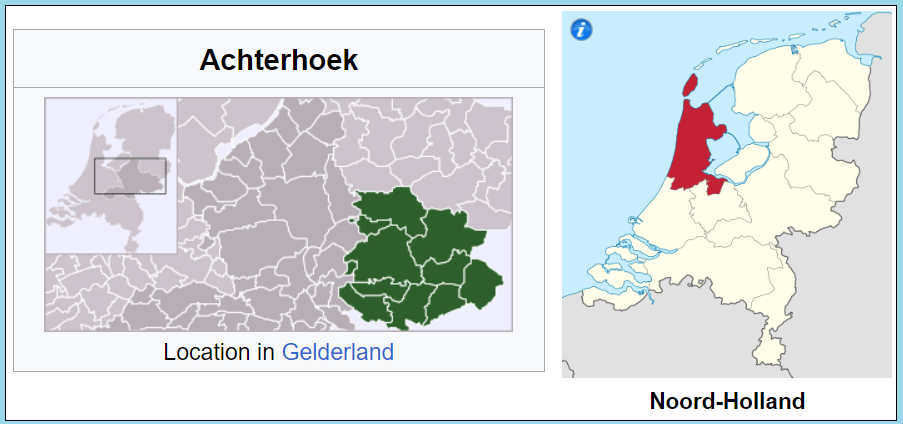
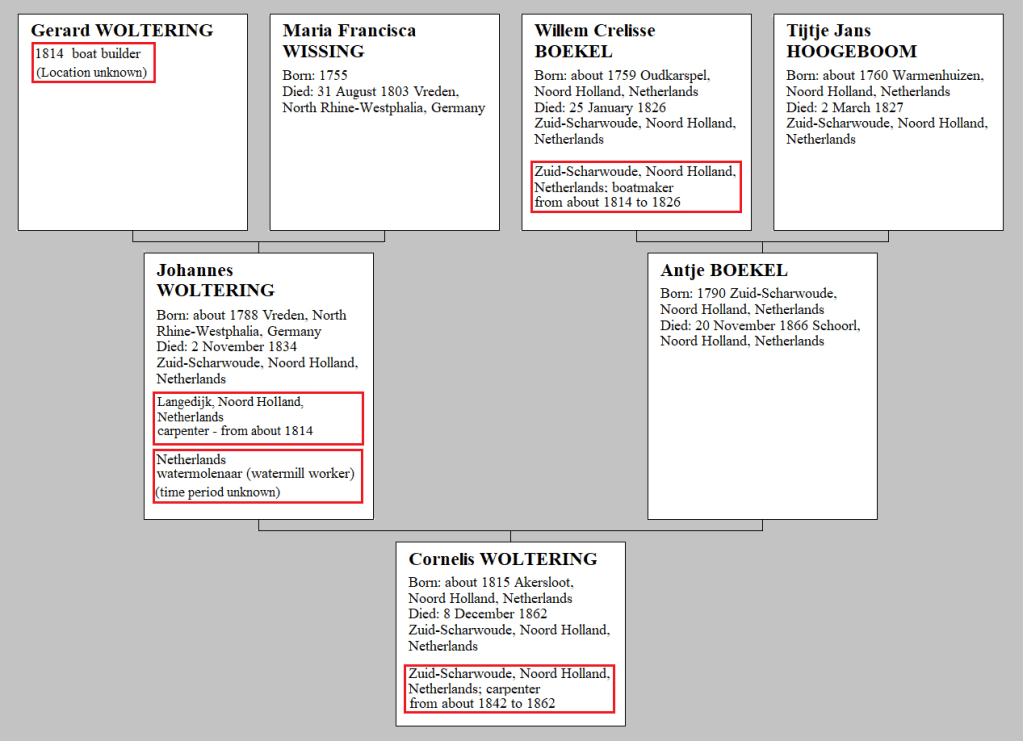
My paternal grandmother was Christina Komen. Her paternal grandmother (my great great grandmother) was Antje (“Anna”) Woltering. Anna’s father, Cornelis, is one of my few ancestors who can be described as a tradesperson. As far as I have discovered, he was a carpenter almost all of his entire adult life. The earliest mention of his occupation was in the registration of his marriage to his wife Neeltje Smit, which occurred on May 8, 1842. It is most likely that Cornelis was a carpenter, or a carpenter’s apprentice, for many years before he married.

While it seems that Cornelis spent most of his life, including his years as a carpenter, in Zuid-Scharwoude, Noord-Holland, he was born about 15 kilometers to the south in the village of Akersloot. How this came to be I have no idea. His parents, Johannes “Jan” Woltering and Antje Boekel, had married in Noord-Scharwoude in 1814 and all of Cornelis’s younger siblings were born in Zuid-Scharwoude. However, it appears that Jan had been living in Akersloot prior to marrying Antje. It may be that the couple returned to Jan’s residence after they married and relocated to Antje’s home town of Zuid-Scharwoude shortly after Cornelis was born.

The bigger surprise to me was that Cornelis’s father, Jan, my Gx4 grandfather, was born in 1788 in what is now Vreden, North Rhine-Westphalia, Germany. Vreden is about three kilometers from the Dutch border and the Achterhoek. Sometime before September 1814, when he married Antje, Jan literally moved across the Netherlands to Noord-Holland. I have no idea why he moved, which was incredible because it was unusual for people to move such distances at that time. Even now it’s about a three-hour drive, which to many of my Dutch relatives is an astounding distance. (For a Canadian, not so much!)

I have not yet determined where Jan’s parents, Gerard Woltering and Maria Francisca Wissing (Cornelis’s paternal grandparents), were born. Gerard and Maria married on April 26, 1787, in Vreden. However, prior to the marriage, Gerard had been living in Buurse, Overijssel, Netherlands. Buurse is three kilometers from the German border and twelve kilometers due north of Vreden. Meanwhile, Maria had been living in Enschede, Overijssel, which is a city about 20 kilometers north of Vreden.

What is more surprising is that Gerard’s occupation was boatbuilder. I am unsure where he carried out that trade, given that the closest large body of water to where he lived and married is at least 100 kilometers away.

Cornelis’s maternal grandfather, and Antje’s father, was Willem Crelisse Boekel, was also a boatmaker. However, unlike Gerard, Willem lived rather close to the water, as he spent his entire life in Noord-Holland.
52W Mark II – Week 13: Light a Candle

Hard to believe that we’re now a quarter of the way through this year’s 52 Ancestors Challenge! I feel like I’m still at the starting gate.

This week’s theme is “Light a Candle”. Amy says, “Candles are often lit in remembrance, in prayer, or when the power goes out for 5 days because of an ice storm. Be creative with this prompt!” So I’ll be creative!

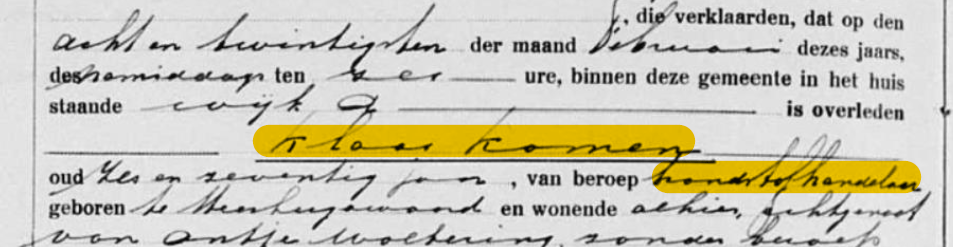
All candles need fuel for the fire, which in their case is the wax. Thinking of fuel reminded made me think of an occupation of one of my ancestors, which has intrigued me many, many years: “brandstoffenhandelaar”. It’s Dutch for “fuel merchant” or “fuel dealer”. My great great grandfather, Nicolaas “Klaas” Komen was a brandstoffenhandelaar in Zuid-Scharwoude, Noord Holland, starting sometime around 1920 up to when he died in 1929.

From the civil register of deaths for Zuid-Scharwoude for Klaas Komen (1852 – 1929), noting his occupation as a brandstoffenhandelaar.

Back in the days before Babelfish or Google Translate, and when my Dutch was still at its most rudimentary as I struggled to teach it to myself, I would often puzzle over what it meant or what the job actually involved. I couldn’t find it in any of the Dutch-English dictionaries I had. However, I knew it was a compound noun. By breaking it down to its component parts I was able to determine that it had something to do with fire and trading or mercantile.

Many years later, I learned that it meant “fuel merchant”, but what exactly did it mean? It’s a term you can find in common use today, especially in the petroleum industry. However, its current use could not possibly mean what Klaas had likely been doing in the 1920s.

Years ago, I trick I figured out for translating unusual or difficult to understand words is to use Google Image Search. Like they say, a picture says a thousand words. I did this for the term “brandstoffenhandelaar“. Not only did that search show the modern usage of the word, but it also showed century-old photos of people with carts or wagons transporting various kinds of fuels, such as coal, oil, and peat. It struck me that those images likely depicted Klaas’s occupation, particularly given that he was a labourer for most of his life. Operating a cart or wagon would be quite consistent with the other work he performed and his station in life.

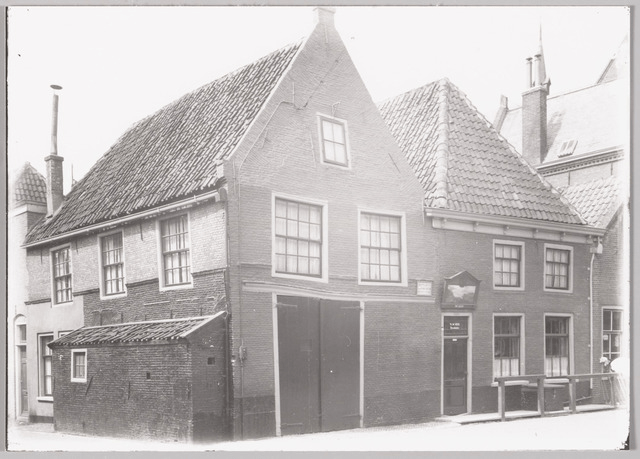
One of my Google Image Search results for brandstoffenhandelaar resulted in this photo in the collection of Regionaal Archief Alkmaar (Alkmaar Regional Archive). This was the warehouse of Dirk Veer, a brandstoffenhandelaar in Alkmaar, which is only a couple kilometers from Zuid-Scharwoude. The image was taken in 1925, so it’s possible Klaas might have known of this place.

In recent years, I discovered the Dutch Genealogy group on Facebook. I posted a query asking whether my understanding of brandstoffenhandelaar was correct, or whether it was more nuanced. The responses led me to believe that I was more or less correct. Several of the responses confirmed that back in Klaas’s day, a brandstoffenhandelaar might be someone transporting fuel by cart, wagon, or small truck, most likely coal, peat, or heating oil.

On occasion, I’ll try to find out what it was that Klaas actually did as a brandstoffenhandelaar. In preparing this post, I thought I’d give Delpher a try. Delpher is a fantastic resource, where you can find historical newspapers, magazines, books, and other publications. The only down-side to Delpher is that the site is only in Dutch, with no English interface. Even if it had one, the search results would be documents that are only in Dutch, so some knowledge of the language is necessary. I get a great language lesson every time I use it!

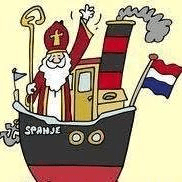
My goal with Delpher was to see if Klaas had placed any ads or notices for his services in the local paper. Delpher has great advanced search features, but I was still stymied in my search. In addition to being a surname, “komen” is also the verb “to come” in Dutch. On top of that, searching for an exact phrase using variations of Klaas’s first name (Nicolaas, Klaas, Nic) with his surname produces a lot of items about Sinterklaas coming to town. Even expressly excluding “sint” or “sinter” from the search didn’t filter them all out.

Hier komt Sint!

Despite the quirks of my search terms, I never found anything for Klaas or his work in the papers I searched. Nevertheless, my curiosity remains fueled.

52W Mark II – Week 11: Lucky

I’ve already written about the two luckiest genealogical breaks I’ve had: meeting Nol van den Hurk on an online forum, resulting in the foundation of much of my Dutch family history research; and using a random farm driveway in the middle of nowhere to turn around, thus stumbling upon and meeting a cousin in time to contribute to a family history book project. So it took a bit of thinking to come up with something new for this week’s them of “Lucky” for the 52 Ancestors Challenge.

When most people hear the word “luck” or “lucky”, the assumption is usually good luck. I started off with that premise in mind, only to discover that the example I came up with involves both good and bad luck.

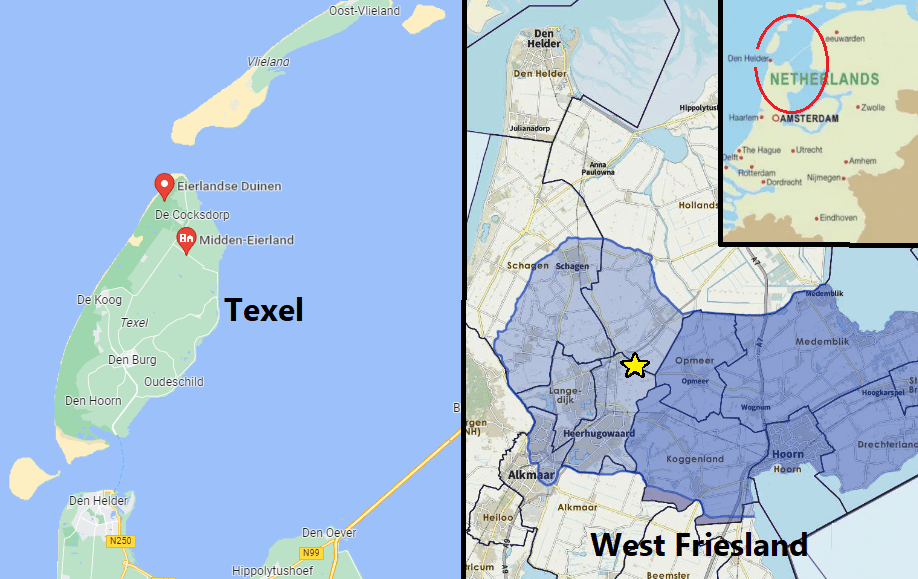
Sometime in the early 1860s, Pieter Jansz van der Fluit, my first cousin four times removed, relocated from Oude Niedorp to Eierland. Oude Niedorp is in the centre of West Friesland (which is actually in the province of Noord Holland). Eierland (“Egg Land”), is located at the northernmost tip of Texel, the largest of the Wadden Sea Islands (or Frisian Islands), which stretch from the western Netherlands to Denmark. Until the 13th century, Eierland was part of the neighbouring island of Vlieland, when natural changes separated the two. In the 1600s, a sandbar developed between Eierland and Texel, which was dammed, merging the two. In the 1840s, developers enlarged this area to create a polder, resulting in new farmland.

I first learned about Pieter in August 1997, in an email from Nol summarizing many birth, marriage, and death registrations. In that email, he wrote that one of the records described Pieter’s occupation as “Farm”, as opposed to “Farmer”, suggesting that he owned his farm in Eierland. In the decades that followed, these archival records have been scanned and posted online. However, the only records I’ve found for Pieter say that he was a “farmer”.

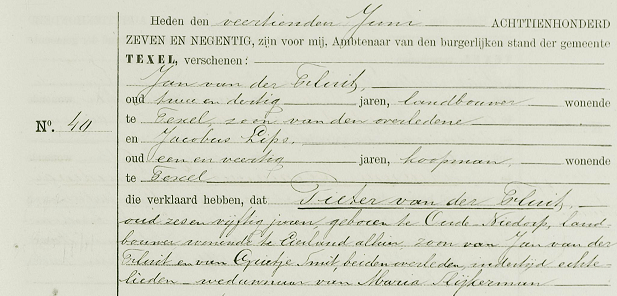
Death registration for Pieter van der Fluit, showing his son Jan as the declarant. It shows that Pieter and Jan were both farmers at Eierland. No mention of Het Fortuin (“The Fortune”), which apparently was the name of the farm.

The farm was later taken over by Pieter’s son Johannes Pietersz (“Jan”) van der Fluit. In an a September 1998 email to me, Nol reported that Pieter’s occupation was “farmer on Texel”, at Eierland. Nol added that the farm was named Het Fortuin (“The Fortune”). However, it seems that good fortune was not with Jan, as Nol said that Jan went broke. Nol told me that Jan was 75 Guilders short to pay an unspecified debt. Nol said that this was about the price of three sheep. I don’t know if Jan farmed sheep, but Texel is famous for a breed of sheep developed there. After going broke, Jan relocated to Amsterdam and became a police officer.

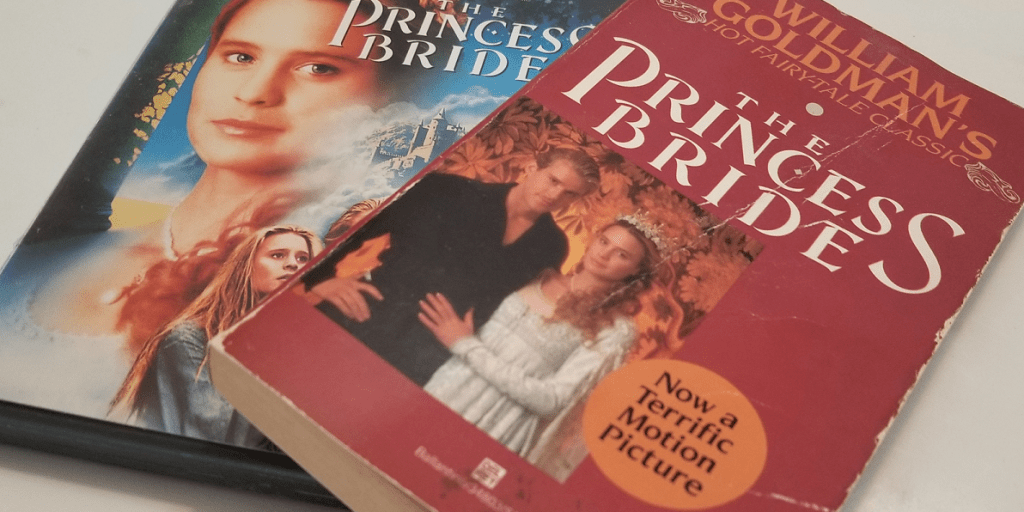
The Dutch guilder was originally called the “gouden florijn” (“golden florin”). The florin was an old Florentine coin. The Dutch coin was alternatively called a “guilder” or “florin”, but soon came to most commonly be known as the guilder. Its symbol was “ƒ” (e.g. ƒ100, or 100 guilders). These names will be familiar to the fans of The Princess Bride: Florin and Guilder were sworn enemies. Prince Humperdink’s scheme was a means of creating an excuse for Florin to attack Guilder.

I’ve found records showing Pieter and Jan farming at Eierland and Jan relocating to Amsterdam and becoming a police officer. Good luck! Unfortunately, I have been unable to find any of the sources Nol might have been looking at confirming that the farm was named Het Fortuin or Jan’s financial woes. Bad luck.

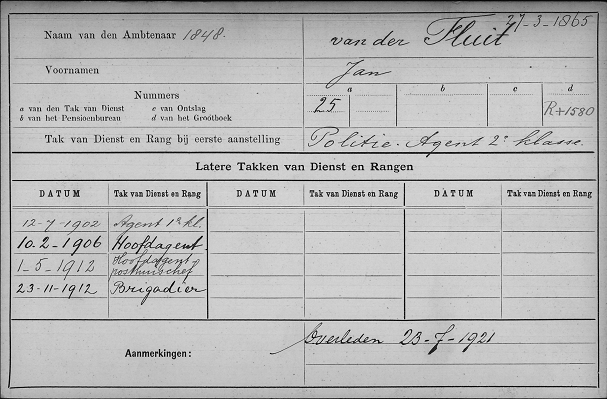
Jan’s Pensioenkaart (Retirement Card) showing his career as a police officer, starting as a police agent second class and ending as a brigadier.

“Het Fortuin” was also the name of a ship that sailed from Texel in September 1723, bound for Indonesia. It was the ship’s maiden voyage. It reached the Cape of Good Hope (South Africa) in January 1724. The ship and its crew of 225 men set sail two weeks later and was never seen again. Not very good luck at all.

52W Mark II – Week 9: Gone Too Soon

I’ve written many times about my aunt, Helen Diana Burgess. Coincidentally, I wrote a significant piece about her for Week 9 of the 2022 52 Ancestors Challenge. Sadly, she left us too soon, at age 48. Despite the short period of time I had her in my life, Aunt Diana made an incredible impact on me. Even though she died 23 years ago, it is rare for a day to go by in which I do not think of her. Whether it’s a favourite book, a memento, or piece of art, there is always something that brings back fond memories of my aunt. I am frequently sharing stories of her with my wife and children.

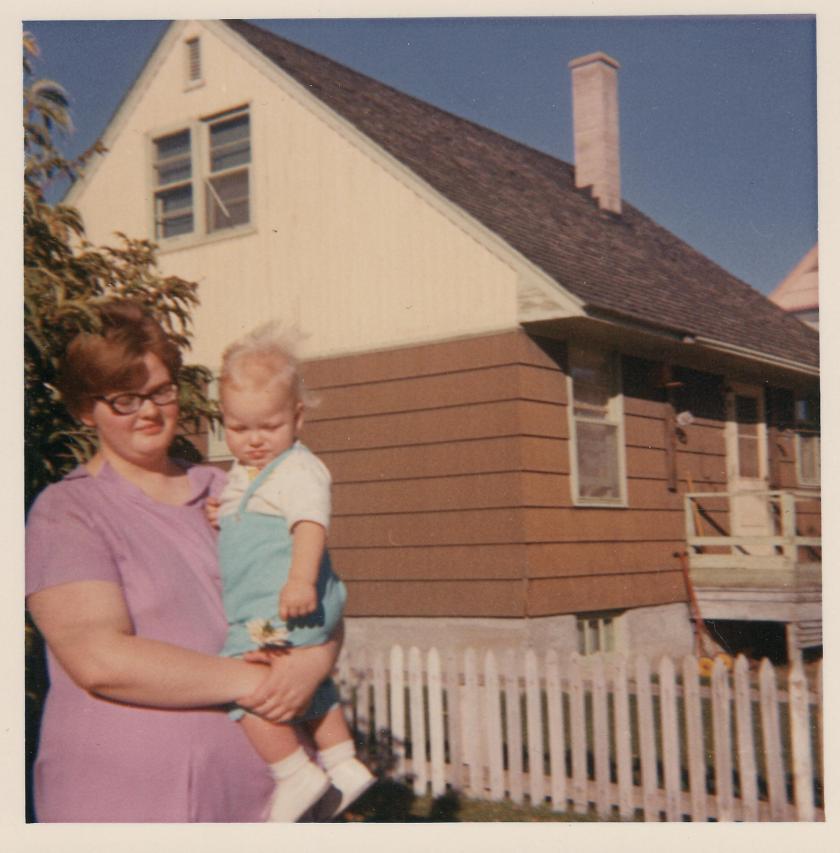
My Aunt Diana and me.

Moreover, as an avid genealogist, I frequently see queries on social media asking about paper preservation and proper storage of family heirlooms. Diana was a leading conservation scientist, whose expertise included paper, so these queries always remind me of her. I wrote about this last year in Week 40, “Preservation”.

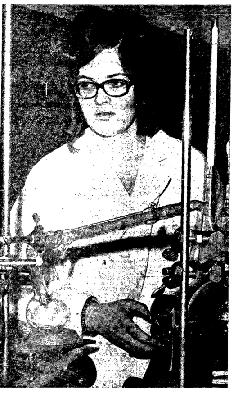
Science!!

Unfortunately, in the early 1990s, when she was at the height of her career, Diana developed lupus. She was a senior conservation scientist at the Canadian Conservation Institute at the time, but was forced into early retirement by the effects of the disease in 1998. Aunt Diana passed away a year later. At the annual conference of the Western Association for Art Conservation following her death, several of the presentations were dedicated to her memory.

Diana was also godmother to one of my brothers.

Many of my interests that Aunt Diana nurtured in me I have passed on to our children. Some of the most treasured books I have from my childhood were gifts from her. I still have those books and my kids have read and re-read them voraciously. While Diana could not have known it, not only did she foster my development as a person, but that of my kids as well.