52W Mark IV – Week 32: Card B6 William Burgess

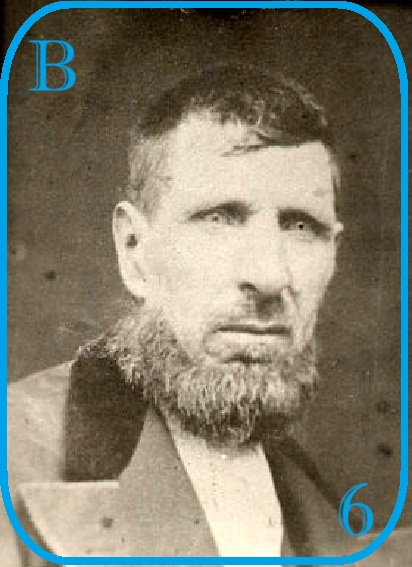
William Burgess, Jr. (1822-1904)

The Church of Jesus Christ of Latter Day Saints – the Mormons – was founded by Joseph Smith in April 1830 in Fayette, New York. In July 1832, Harrison Burgess of Putnam, New York, heard a Mormon missionary by the name of Simeon Carter. Harrison converted to the new religion and was baptized in October 1832. By the end of that year, Harrison’s parents and siblings (of whom there were at least nine at the time) also joined the Mormon church.

This included my Gx3 Grandfather, William Burgess Jr., who was about nine years old at the time. He was born on March 1, 1822, in Putnam. He was the sixth of twelve children born to William Burgess Sr. (1794-1880) and Violate Stockwell (1794-1880).

The Mormons relocated to Kirkland, Ohio in 1831. By September 1833, William was living there with his family. However, according to secondary sources, William Jr. lived in Joseph Smith’s house for a considerable period of time.

In the meantime, Smith was trying to establish Missouri as the church’s headquarters. However, between the Governor of Missouri driving the Mormons out of the state and a financial scandal involving the Kirtland Safety Society, a joint stock company intended to become a bank, the Mormons relocated to Nauvoo, Illinois in 1839. The Burgess family joined the fledgling church there by 1841, if not earlier.

While in Nauvoo, William joined the Third Company, Fifth Regiment of the Nauvoo Legion, a state-authorized militia that existed from 1841 to 1845. During his time with the Nauvoo Legion, William attained the rank of Colonel. As well, William was ordained as a “Seventy”, a level of priesthood within the Mormon church. He also participated in constructing the Latter Day Saints’ temple in Nauvoo.

William married his first wife, Maria Pulsipher, in September 1840 in Lima, Illinois. More accurately, William entered into a legal marriage with Maria. His next two wives were polygamous unions. Early church leaders secretly began the practice while the church was in Nauvoo. The church did not openly start the practice until 1852, after Joseph Smith had died and it had established itself in Salt Lake City. William and Maria remained married until her death in 1892. They had nine children together.
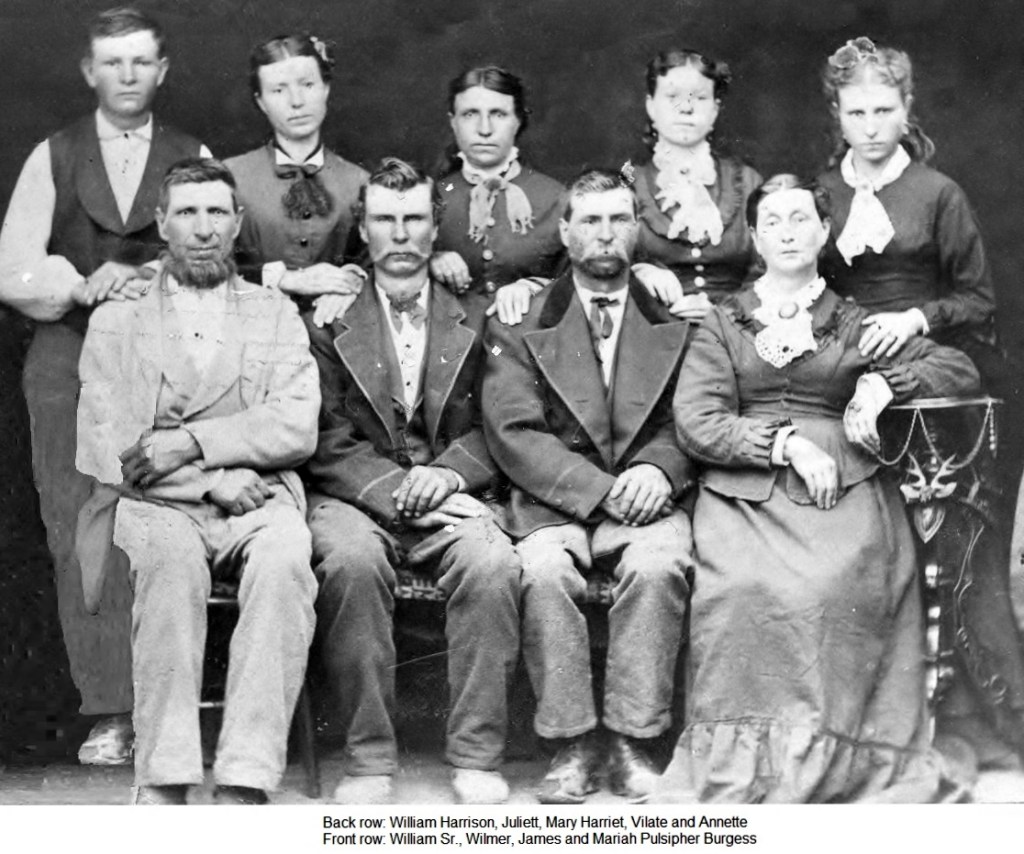
William with his first family.

The Mormons were driven out of Nauvoo in 1846, which marked the beginning of the Mormon Migration to Utah. During the westward migration, over the winter of 1846-1847, about 2,500 church members encamped at Winter Quarters, which was just north of where Omaha, Nebraska came to be. The first settlers arrived in what is now Salt Lake City in July 1847, in what was still Mexican territory.

William and Maria were part of this great migration. They were in Winter Quarters from at least September 16, 1846 to May 1848. They set out as members of Brigham Young’s company, which consisted of about 1,220 people. William arrived in Utah by September 1848 and settled in Huntington, about 175 kilometers southeast of Salt Lake City.

William was not in Huntington for long. By the next year, 1849, he was in Salt Lake City where he joined the militia. Upon enlisting he was made a captain; by 1853 he was a colonel. William also took up farming near Salt Lake City.
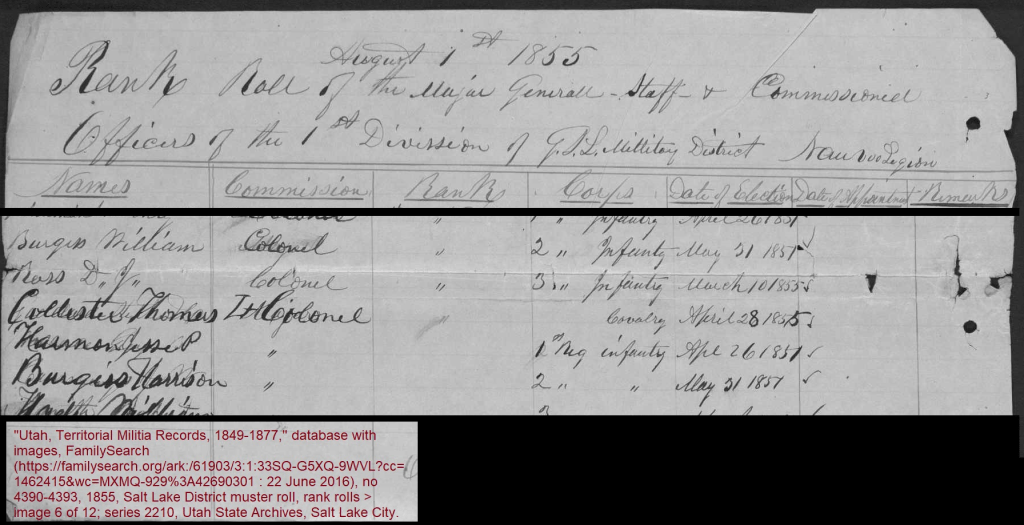
Militia record showing both William and his older brother Harrison.

While in Salt Lake City, William entered into a polygamist marriage with my Gx3 grandmother, Charlotte Liggett, on June 3, 1852. William was more than twice Charlotte’s age at the time – he was 30 and she was 14. Sadly, that kind of age gap, and the incredibly young age of the girls, was not uncommon with the early Mormon polygamists.

Shortly after marrying Charlotte, William entered into a mission. It appears that he may have or was to have carried out his mission in Great Britain; however, it is more likely that he performed his mission within the United States. At or around the time William completed his mission, he was ordained as President of the Ninth Quorum of Seventies.

By the start of 1854, William and family were living in Lehi, Utah, which is about 40 kilometers due south of Salt Lake City. The city of Lehi established a school board on February 17, 1854 and held an election for trustees three days later. Three men were elected: William, Preston Thomas, and Daniel Collett. Sixty five years later, William’s grandson, Milton Burgess, married Preston’s granddaughter, Hazel Nelson. Milton and Hazel are my great grandparents.
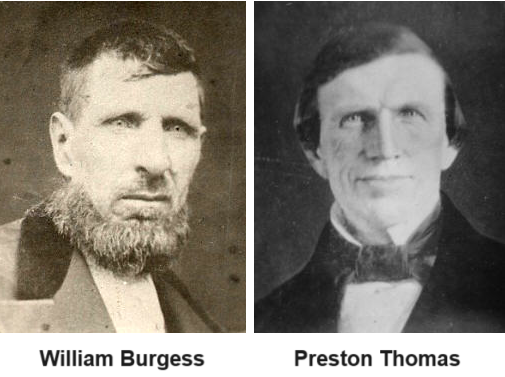
Lehi school board trustees, 1854.

A month after William was elected to the Lehi school board, he was elected an alderman of Lehi. In addition to his electoral positions, William was one of the founders of the Lehi Dramatic Club, which was established in 1855. Its first productions were plays called “Priestcraft in Danger” and “Luke the Labourer”. The club performed in Lehi’s log schoolhouse, using tallow candles for footlights and painted wagon covers for scenery and curtains. I doubt William actually performed on stage. Rather, I believe he was one of the people overseeing the operations of the club. For example, William obtained the licence required by the town for operation of the club. Nevertheless, it is entirely possible that he may have been treading the boards!
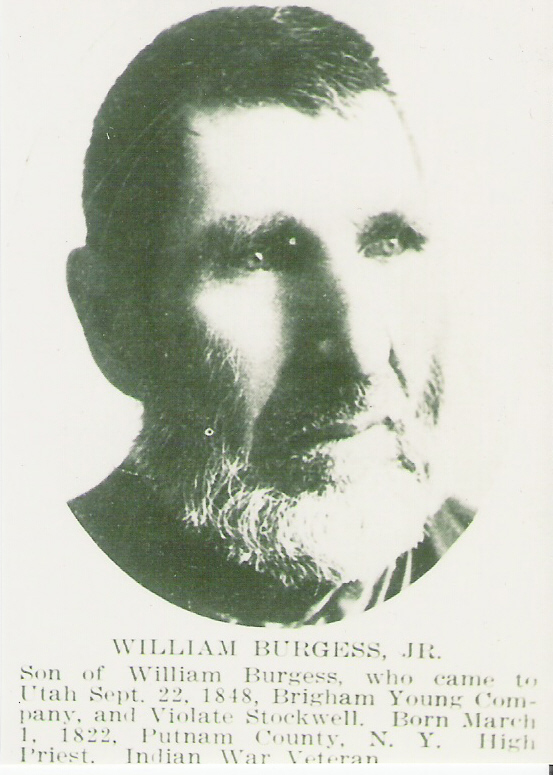
William did not complete his term as alderman in Lehi. He resigned in March 1855, because he and his family moved to Salmon, Idaho, not far from where Sacagawea was born. While in Salmon, William embarked on a three-year mission for the church. The mission was based out of Fort Lemhi, a Mormon mission located about 40 kilometers south of Salmon. Initially, the mission consisted of twenty-seven sent to Lemhi by Brigham Young. At its peak, the mission grew to about 200 people. The Mormons were forced to abandon the mission due to conflict with the Bannock and Shoshone.

Sometime around or after moving to Salmon, likely in 1857, Charlotte left William. The marriage lasted long enough for them to have had one son, which was lucky for me, because he was Horace Burgess, my Gx2 Grandfather. By some accounts, the marriage ended because Charlotte did not get along with Maria; by others, it was because she was disenchanted with polygamy. Some sources indicate that the couple divorced. However, being a polygamous marriage, there may have been no formal civil registration of the marriage and, therefore, no formal divorce. While at the time of their marriage William and Charlotte had been “sealed” (a Mormon ritual meant to bind familial relationships for eternity), Charlotte had the sealing annulled in 1890.

After the Lemhi mission came to an end, William and family moved to Parley’s Canyon, which is now on the outskirts of Salt Lake City, where he had been granted 10 acres of land. William built a sawmill where he milled shingles for use at the nearby fort and for houses. William’s father and his brothers Harrison, Horace, and Melanchton also worked at the mill.

On February 21, 1858, William married Catherine Chamberlain, who was 18 years old at the time. Catherine had been previously married, at age 16, to a fellow by the name of William Randolph Teeples. Catherine and William had at least one child together. I have not researched the circumstances as to when Catherine and William separated, if they did at all. All the while, William was still married to Maria, who was 35 years old by this time. In fact, each of Maria’s last two children were born within a few months of each of Catherine’s first two children with William. Catherine ultimately had four children with William. This means that William fathered 14 children in total.
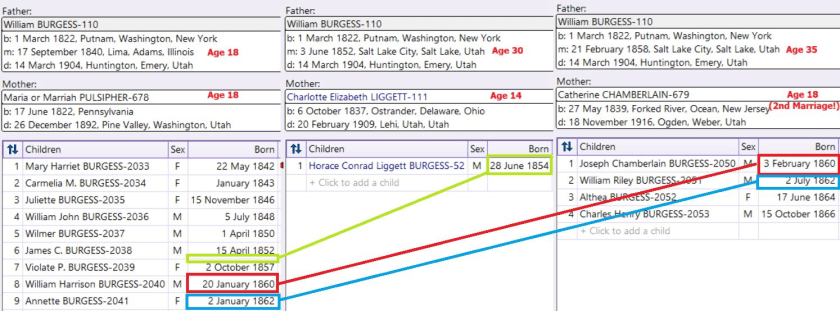
A rough sketch showing the ages of William and his three wives at the time of each marriage. As well, I’ve highlighted the relative times at which William fathered some of his 14 children, including the timing of Maria’s last two children and Catherine’s first two.

In 1862, William established a sawmill in Pine Valley, Utah, which furnished most of the lumber for southern Utah (then referred to as “Dixie”). It was one of the first sawmills in the region. The mill was a seasonal operation, so until 1880 William divided his time between Pine Valley in the summer and St. George, Utah, in the winter. The Pine Valley sawmill provided the lumber that was used to build the pipe organ for the local church. As well, apparently some of the lumber William milled was used for the construction of the Salt Lake Tabernacle.

In 1880, William relocated to Thurber, Utah, where he spent five years. Finally, around 1885, William settled back in Huntington, where he had begun life in Utah, and spent the rest of his life there. William had many business endeavours in Huntington. He was a bee keeper, which is fitting because Utah is known as the Beehive State. William also bought into the Co-op Mercantile Company as one of the principal stockholders and served as its president for seven years. He also worked as a carpenter, farmed, and raised cattle.
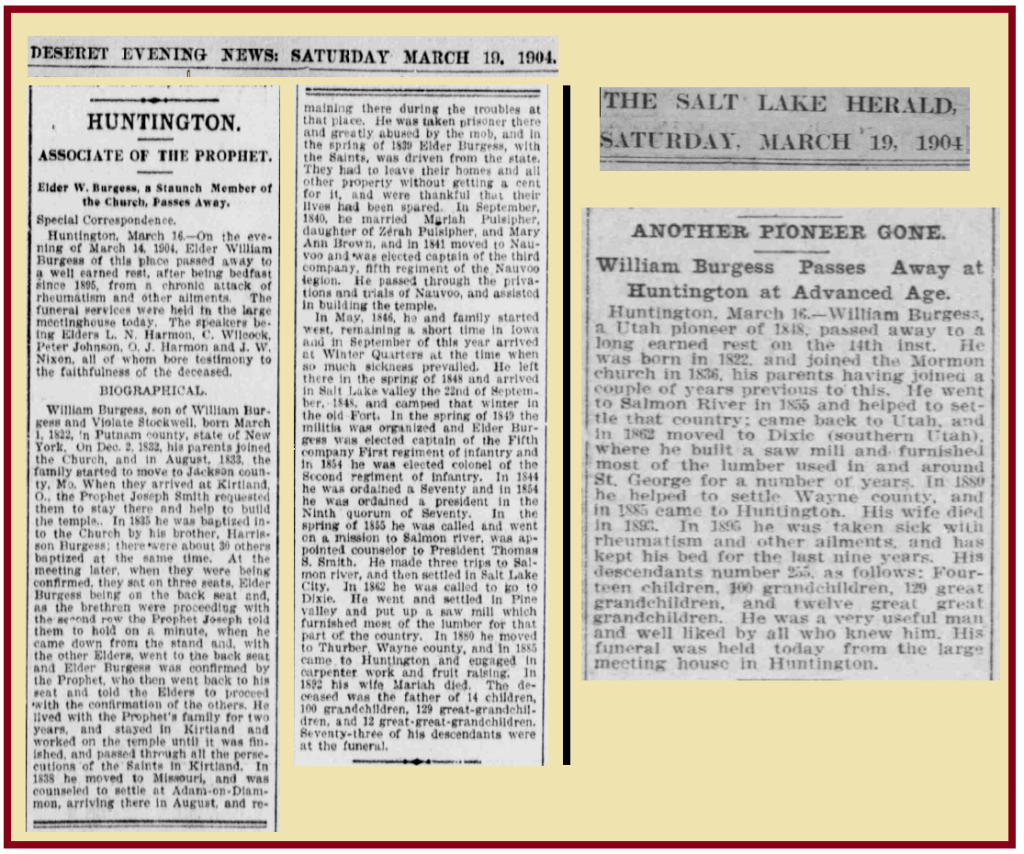
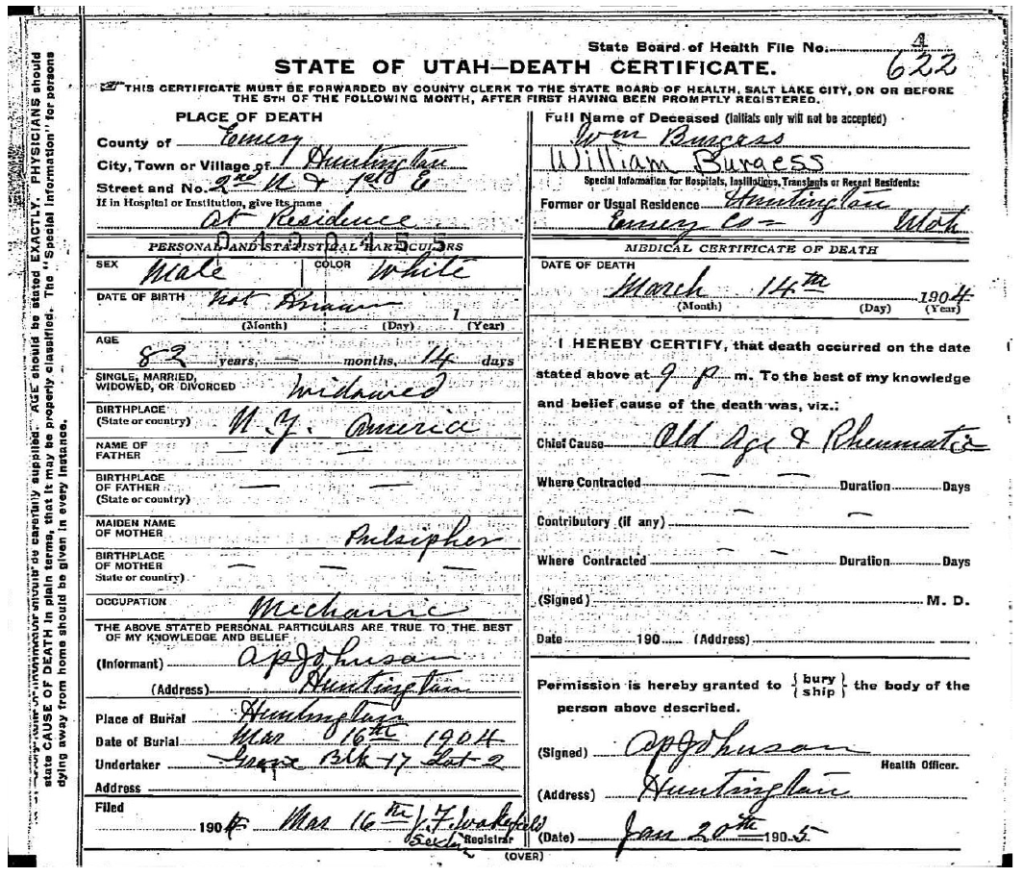
William died on March 14, 1904 after having been bedridden for nine years due to rheumatism and other ailments. He is buried at the Huntington City Cemetery.
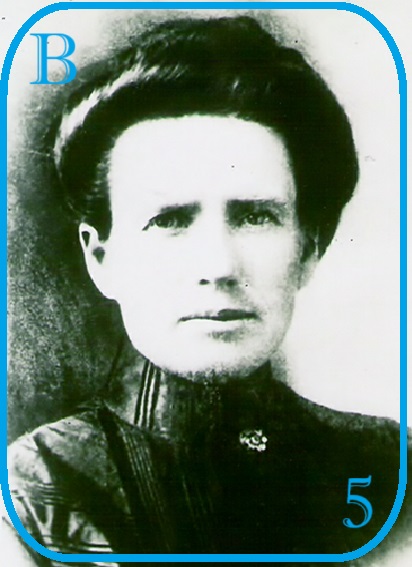
52W Mark IV – Week 31: Card B5 Ella Elizabeth Thomas

Ella Elizabeth Thomas (1859-1941)

My Gx2 Grandmother, Ella Elizabeth Thomas, is a rarity amongst my direct female ancestors, as she was one of the few with an occupation outside of the home. Ella was a midwife and nurse for about 40 years, serving the town of Cardston, Alberta and the surrounding community.

Ella was born in Lehi, Utah on October 9, 1859. Her father, Preston Thomas, was originally from North Carolina. Her mother, Maria Hadlond, was from England and emigrated to the States with her family when she was a teen.

When Ella was about 18 months old, her family moved nearly 200 kilometers north to Franklin, Idaho, which is located right on the Utah border. It was the first non-Indigenous settlement in Idaho. In fact, when the town was founded, the original settlers thought they were within the boundary of Utah. Another fun fact about Franklin is that its county, also named Franklin, is the only county by that name in the United States that is not named after Benjamin Franklin. Rather, it was named after Franklin Richards, a Mormon leader.

Somehow, by 1879, when she was 19, Ella was living in Salt Lake City. It is not clear what events in her life led her to be there. Salt Lake City is a fair distance south of Franklin. Her father died in 1877, so it may have been that her mother relocated to the city after becoming a widow. That’s a matter for further research.

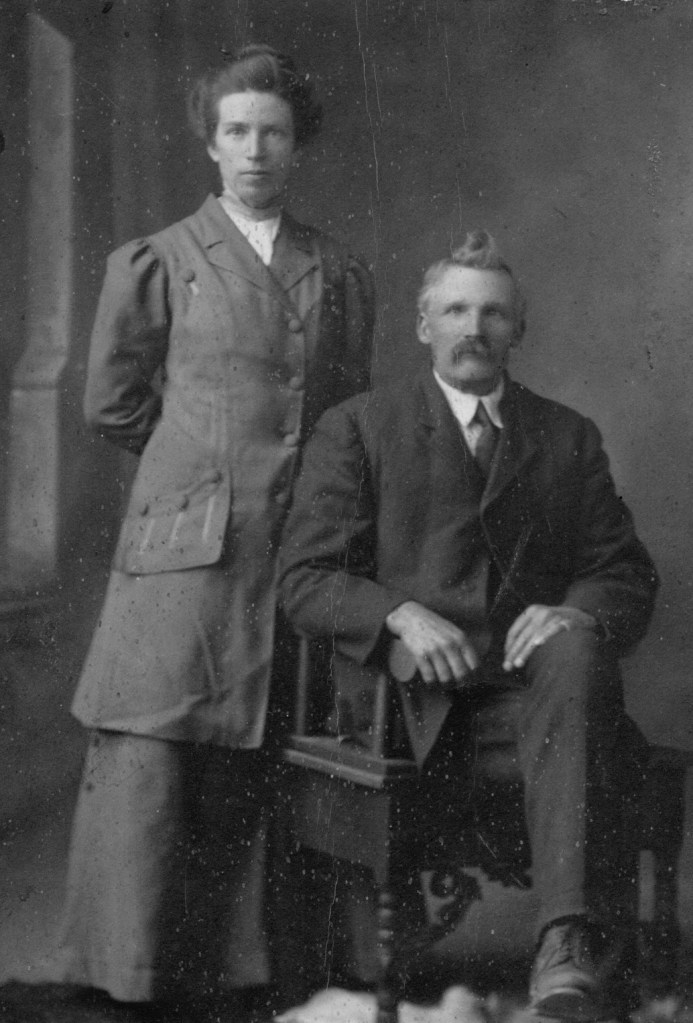
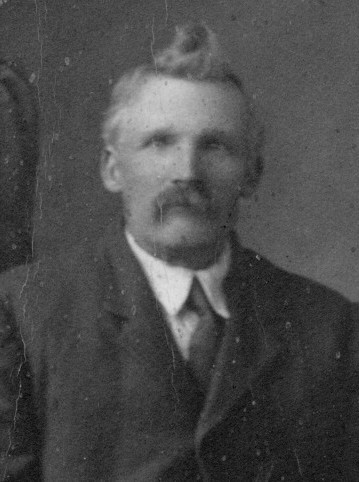
Ella and John. One source I’ve seen says this is their wedding photo, but I have a hard time seeing a 19-year-old and a 24-year-old. Of course, the stern expressions, style of dress, and fact it’s black and white all serve to age them.

In Salt Lake City, Ella married John Alexander Nelson on January 9, 1879. After marrying, the couple relocated to Smithfield, Utah, which is relatively close to Franklin. They remained there for about ten years, where Ella gave birth to the first six of their twelve children. In September 1890, the family moved to Canada. They were part of the earliest wave of Mormons to settle Cardston, Alberta after it was founded in 1887.

While John was kept busy by a multitude of endeavors, Ella was soon called to a profession of her own after the family settled in Canada. As a new community, Cardston did not have any physicians or other kind of healthcare providers. The closest doctor would have been in Lethbridge, 80 kilometers away. Today that’s under an hour’s drive; in 1890, it was a long and difficult journey by horse or wagon.

The accounts of Ella’s training as a midwife differ. They all agree that Ella was called to study nursing and obstetrics in her early 30s and was sent to Salt Lake City for training. Several sources say that Cardston’s founder and stake president, Charles Ora Card, issued the direction himself. However, the various sources are inconsistent as to when Ella received her training.

An article about Ella in the Lethbridge Herald following her death said that she left her five eldest children at home, taking with her “a six months old baby”. Given there were five older children left at home, that baby would have been Seth Henry Nelson, who was born October 1891. Another article in an annual family newsletter, Nelson Talk, stated that the baby Ella brought with her was her son Cleveland, who was born in March 1893. Chief Mountain Country: A History of Cardston suggests that Ella “left behind seven small children for John to care for and run the home, only to find she was expecting another child.”

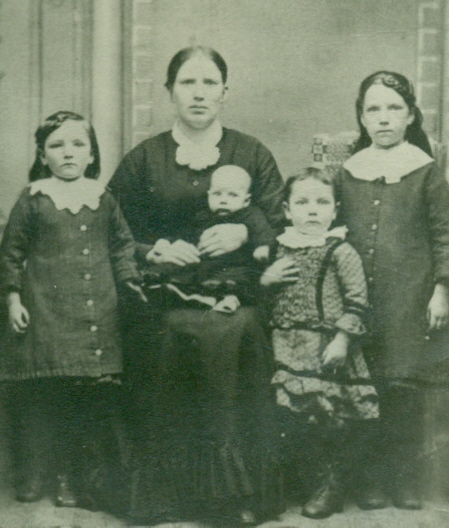
Ella with her four eldest children, Ella, Rachel, Lileth, and Maria. This photo would have been taken in Utah shortly before the family moved to Canada.

Together, these accounts are most consistent with Ella having attended her studies in Utah in 1892. Seth would have been about six months old at the time, and the child Ella learned she was expecting was most likely Cleveland. Of course, Nelson Talk most likely nailed it when it said that John and Ella’s eldest child, Maria, who was about 12 at the time, primarily took care of the other children in the family during their mother’s absence.

In Salt Lake City, Ella trained under a Dr. Shipp for about six months. When Ella returned, she was the only medical help that Cardston and area had for many years. The Herald article says that Ella “answered every call from 1892 to the time when the district was supplied with medical men, and after that time when there was more work than one doctor could do”.

Chief Mountain Country indicated that Ella often received no payment for her services, or would sometimes be paid in goods, such as produce. In a short biography of his mother’s life, Seth wrote that Ella’s regular fee for the delivery was $5 and $1 per day for nursing services after the delivery. However, she would often not receive anything for nursing.

Nevertheless, it seems that Ella did not forego payment easily. Seth said that her sons were often sent to collect on outstanding accounts, which sometimes required repeated trips. An account from another of Ella’s sons was that one woman deducted fifty cents on her own volition because she was paying in cash. Ella promptly sent her son back to get the full $5, who told the woman, “mother is not a storekeeper and does not give discounts!”

All the while, Ella had five more children after becoming a midwife. I have no idea who, if anyone, attended to her for those births. However, Seth wrote that at the time Ella began her service there were “a partially trained midwife or two” in Cardston.

Ella assisted in the delivery of hundreds of babies in her 40 years of service. According to Seth, his mother lost track after 400. Seth proudly said that Ella never lost a mother and rarely lost a baby.

When physicians first set up shop in Cardston, Ella would sometimes act as their nurse. Ella also helped those suffering from diphtheria, typhoid, and childhood diseases. Seth wrote that Ella continued to provide midwife services after physicians had established themselves in Cardston. However, Seth stated that after the Alberta “Medical Professional Act” came into effect, Ella was not permitted to charge a fee for her services.

This was most likely a reference to the Alberta Health Insurance Act enacted in 1935, when Ella was 76. She had already largely retired from working as a midwife and healthcare provider a few years earlier, when she was 73. By that time, Ella was not only a grandmother, but a great grandmother.

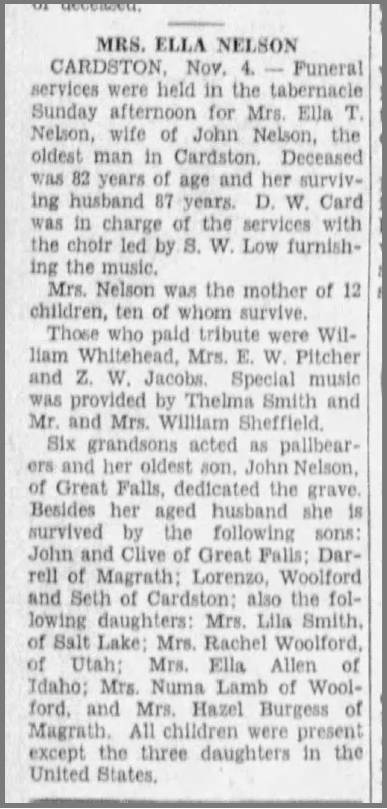
Ella passed away on October 30, 1941, almost a month after her 82nd birthday. The funeral service was held at the Latter Day Saints tabernacle in Cardston and Ella was interred at the Cardston Cemetery. Ella’s pallbearers were all grandsons: Leo Burgess (my grandfather), Grant Lamb, Rulon Lamb, Grover James, and Wilbur Nelson. Her granddaughters Ella Burgess, Julia Burgess, Fontella Burgess, Jean Nelson, Dorothy Nelson, Kathleen Nelson, and Jane Nelson all served as flower girls.

Ella is one of those ancestors for whom I have a lot of respect. When people query which of your ancestors you’d like to meet, Ella certainly comes to mind. It is somewhat strange and special to think of my personal connection with my grandfather, born over 100 years ago, who had a personal connection with someone born in the middle of the 19th Century. While musing over this, I also remembered that just as my grandfather was a pallbearer for his grandmother, I was one of his.

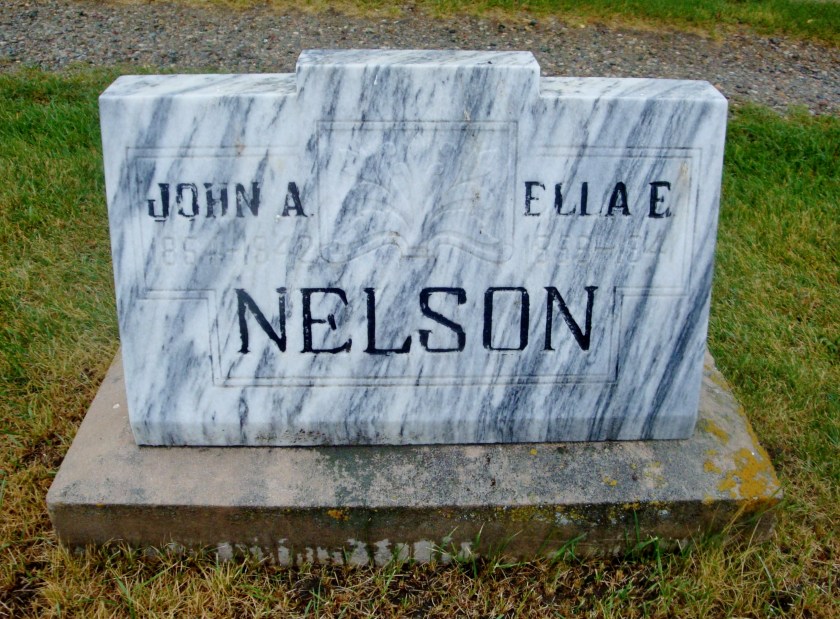
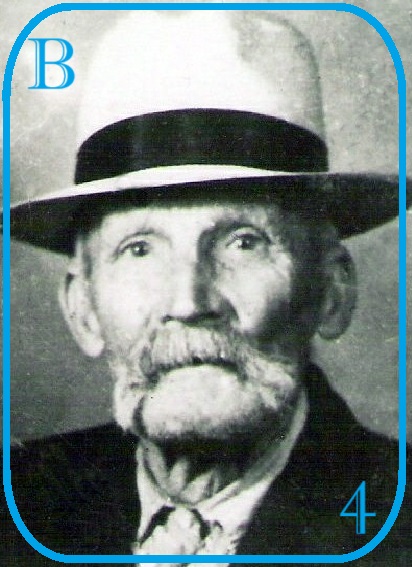
52W Mark IV – Week 30: Card B4 John Alexander Nelson

John Alexander Nelson (1854-1942)

When I was 13, we went to Montana for a family reunion of the descendants of John Alexander Nelson, my Gx2 Grandfather. Of course, we were also the descendants of his wife Ella, but there wasn’t a lot of talk of her that weekend, but there certainly seemed to be a lot of reverence and awe when people spoke about John.

The event made an impression on me in many ways. It was the first (and pretty much only) organized family reunion I’ve ever been too. While it wasn’t my first time to the States, at that time I had not been there many times, and it had never been to see relatives. At the time I didn’t really have much connection to or knowledge about my American relatives, nor were they particularly close to me – lots of second or third cousins, once or twice removed. As well, it was my first real exposure to my Mormon relatives. John was my grandfather Leo Burgess’s grandfather, and my grandfather really wasn’t much of a practicing Mormon. He had pretty much left the church and didn’t follow any of its practices, so I didn’t really know much about it at the time.

John was born in Farmington, Utah, on October 17, 1854 to Irish immigrant parents, Robert Nelson and Elizabeth Joseph, who had spent some time in Scotland before they joined the Mormon church and moved to America with their first three children. After arriving in the States, the Nelsons lived in Missouri for a couple years before continuing on to Utah in 1852. While he was Robert and Elizabeth’s second child born in the United States, John was the first of their children born in Utah.

Sometime between 1860 and 1862, when John’s youngest siblings were born, the family moved to Smithfield, Utah, almost 100 kilometers to the nouth of Farmington. While he married his wife, Ella Elizabeth Thomas, in Salt Lake City on January 9, 1879, he continued to reside in Smithfield, apparently until the family emigrated for Canada.

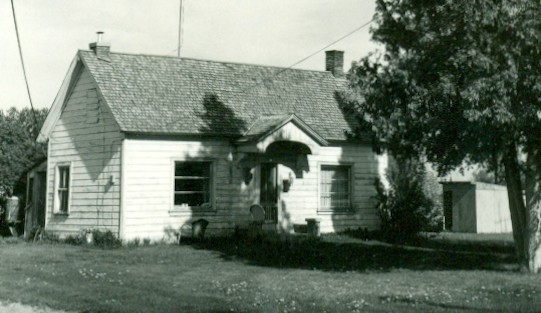
The house John built in Smithfield in 1879

It appears that John might have flirted with the polygamous practices of the Mormon church. On March 19, 1885, he was “sealed” (a Mormon ritual meant to bind familial relationships for eternity) to two sisters, Matilda Jane and Eliza Rankin. Sometime in 1892, John was sealed to Frances Rebecca Purser.

I received this information from my great aunt Fon Hogg (née Burgess), John’s granddaughter. Fon was an avid and proficient genealogist. As a member of the Mormon church, Aunt Fon had access to information that is not available to non-adherents. Fon stated that they were “only sealed,” suggesting there was no civil marriage. In any event, as a polygamous marriage, these unions would not be recognized by the civil authority. Fon also informed me that the sealing between John and Frances was “cancelled” in 1896.

In 1887, Charles Ora Card, a significant Mormon leader, founded the settlement that became Cardston. In part, Card was seeking to avoid arrest for bigamy and was hoping Canada would be more accepting of plural marriage. The Canadian government quickly quelled that prospect, but the settlement flourished. In 1889, he returned to Utah to recruit more settlers.

Lee Creek and the land John settled in 1890.

John and Ella answered the call, so they and their five children moved to Canada in September 1890. They travelled by covered wagon and brought 13 horses, 7 cows, 7 “other horned cattle”, and a pig. Upon arrival, John constructed a sod dugout on a 160 acre homestead on Lee Creek, which ran though the land and on to Cardston. The land is located on what is now Alberta highway 501. John and Ella were nationalized as British subjects domiciled in Canada in 1896 (there was no “Canadian” citizenship until 1947).

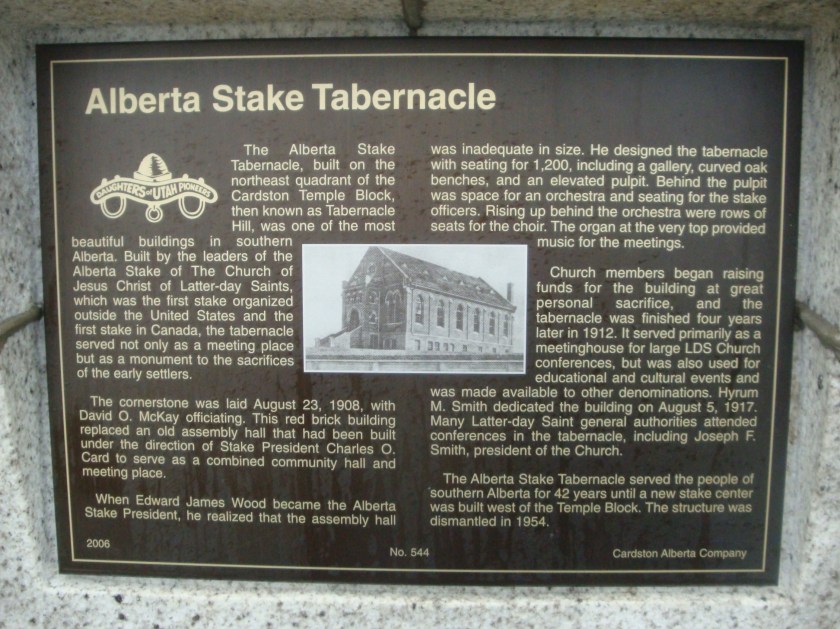
John’s land also had a quarry. Rock from his quarry helped build, among other things, included the Cardston courthouse and, reputedly, the Alberta Stake Tabernacle that stood from 1912 to 1954. The one structure for which John definitely did not supply the stone was Cardston’s first saloon. As if farming and operating a quarry was not enough, John was also a carpenter and operated the first lime kiln in the region. He also served as a school trustee in 1907.

In 1906, John and Ella moved to nearby Woolford, Alberta, where John continued farming. They briefly returned to Utah in the early 1920s, where John operated an orchard or fruit farm, but they returned to Woolford in 1924. John continued farming there for the rest of his working life.

John died on September 29, 1942, a year after Ella passed away. At the time of his death, John had 10 children, 54 grandchildren, and 25 great grandchildren, on both sides of the Canadian-US border. No wonder there were so many people at that family reunion in Montana!

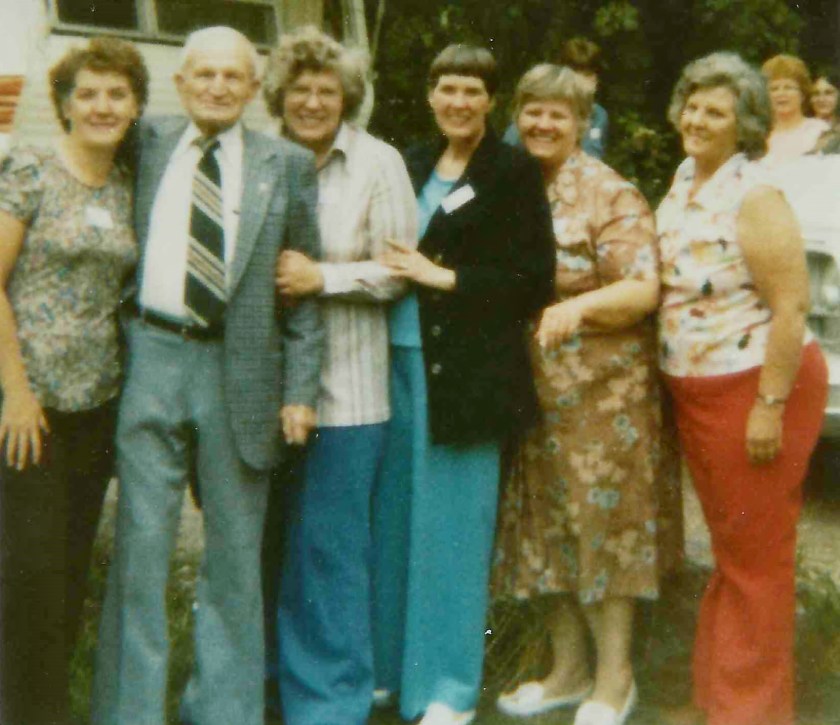
One of the big stars at the Nelson family reunion was Cleveland Nelson (1893-1982) , the last living child of John and Ella. He’s with five of his nieces, my grandfather Leo Burgess’s sisters: Fon, Cleve, Julia, Ella, Molly, and Irene. You can also see my mother over Irene’s shoulder.

52W Mark IV – Week 29: Card B3 Sarah Florilla Cook

Sarah Florilla Cook (1857-1894)

As is typical of many of our female ancestors, there are not many primary records for my Gx3 Grandmother, Sarah Florilla (“Rilla”) Cook. Most of my sources are second or third-hand – or worse. Rilla was born, married, and died before vital records were kept in Utah, which was not yet a state during her lifetime. The few times Rilla is mentioned in the records are some of the US censuses or in the death registrations of some of her children.

Rilla was born on November 3, 1857 in Cedar City, Utah, to Henry Lyman Cook and Susan Ann Elizabeth Turple. Both of her parents seem to have had colourful lives. Henry was married four times; the last three were polygamous, with Susan being the last of those three. Susan had been married once before, in Nova Scotia, to a musician from Massachusetts. Henry and Susan each moved to Utah after joining the Mormon church. Rilla was the second of four children born to Henry and Susan. While Henry passed away when Rilla was 12, Susan outlived her daughter by 12 years.

When she was 18 years old, Rilla married Horace Conrad Liggett Burgess in Goshen, Utah on March 3, 1876. They had their first child, William Henry, on August 4, 1877. Over the next 16 years, Rilla had eight more children. The youngest, also named Sarah Florilla and who also went by “Rilla”, was born on December 19, 1893.

Sadly, Rilla died two weeks later, on January 4, 1894. While it is largely a matter of speculation given the timing of her death, I would not be surprised if Rilla died due to some complication following childbirth. Rilla was only 36 when she died.

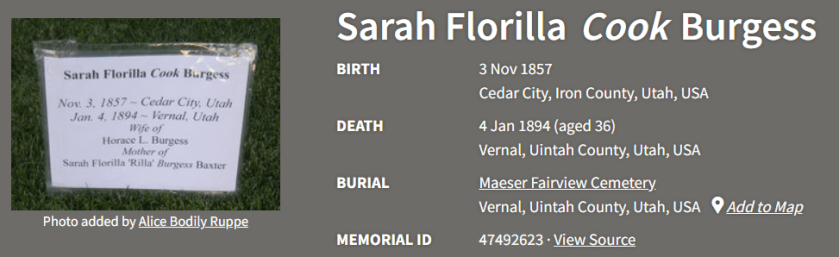
It doesn’t even appear that she has a permanent marker on her grave. The only result I could find after consulting a wide variety of online sources was on Find A Grave. There is a photo of a “temporary” marker, which was taken in 2011. It does not appear that anything more permanent has been installed in the following 14 years.

The photo in this screen shot of Rilla’s entry on Find A Grave was taken in 2011.