
52W Mark III – Week 15: School Days

I typically consider myself as a descendant of many, many farmers. However, I am always surprised to remember that I am also descended from many individuals for whom education was important. There are also several educators in my extended family, including a high school principal. One of my sisters was a school teacher before becoming a medical doctor. As well, my maternal grandmother, Helen Lerner, originally intended to become a school teacher until a nun steered her in another direction.

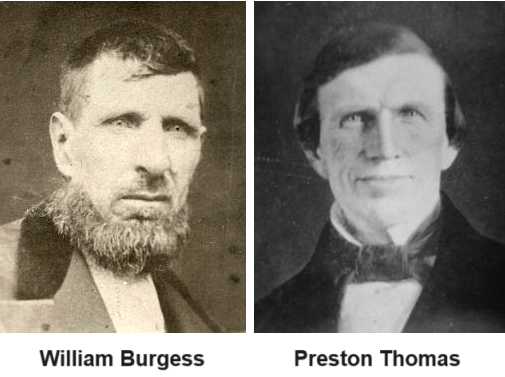
In particular, several of my direct ancestors were school board trustees. The earliest were my Gx3 grandfathers, William Burgess (1822-1904) and Preston Thomas (1814-1877). They served together on the first school board for the Lehi, Utah school district. The school district was created by the city of Lehi by resolution dated February 17, 1854. An election was held three days later, on February 20, 1854. Three school trustees were elected: William, Preston, and Daniel Collett.
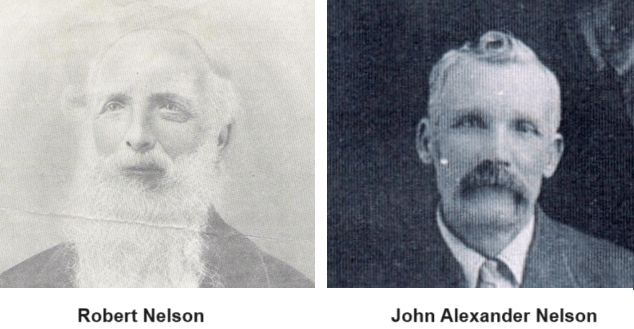
My Grandpa Burgess also had several other school trustees on his maternal line, the Nelson family. According to the 1880 US Census, his great grandfather (another of my Gx3 grandfathers), Robert Nelson (1818-1902) was a school trustee in Smithfield, Utah. Twenty-seven years later Robert’s son, John Alexander Nelson (my Gx2 grandfather) held the same office in Woolford, Alberta. John was one of the founders of the Woolford school board and was one of its first board members.
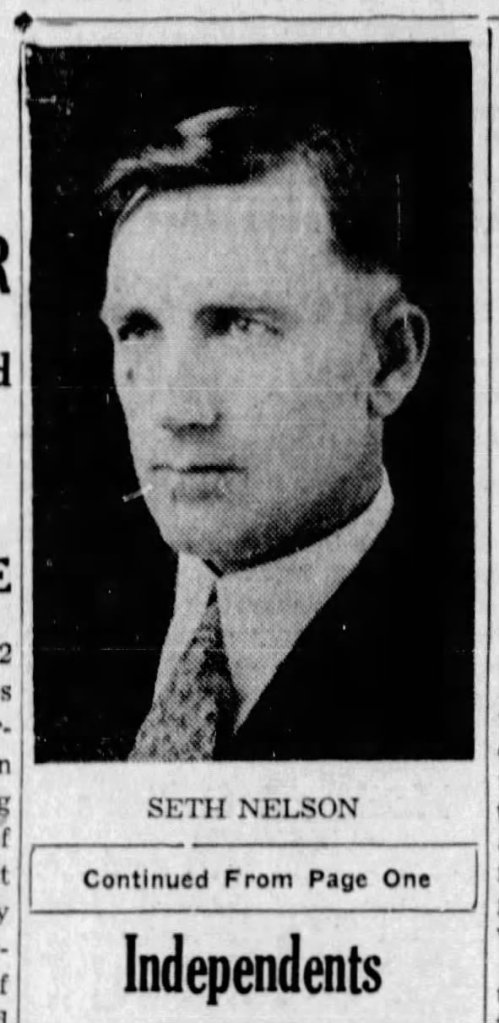
John’s son (my grandfather’s uncle), Seth Henry Nelson Q.C. (1891-1975), also served as a school board trustee in Cardston, Alberta. Seth was a school trustee for 15 years, from 1924 to 1939. Seth served as the Board’s Secretary for the last 10 years of his time in office. Following his last term as a school trustee, Seth made an unsuccessful run for a seat in the Alberta provincial legislature during the 1940 general election. Seth ran as an independent against the incumbent Social Credit candidate, Nathan Tanner. Tanner was a former Speaker of the legislature who was appointed to Cabinet in 1937. Despite running as an independent, it was a close race. Tanner defeated Seth in a two-way race, 2,160 votes to 1,808 (54.4% of the vote).

Education was also a facet of my wife’s side of the family, one of whom also served as a school trustee. Frank Eden (1839-1907), our children’s Gx3 grandfather, was a prominent Halifax, Nova Scotia merchant whose primary business was shoe manufacturing and sales. Frank served two non-consecutive terms as an alderman on the Halifax city council (1892-1893 and 1895-1896). Concurrent with both terms of office on city council, Frank served on the Halifax Board of School Commissioners.

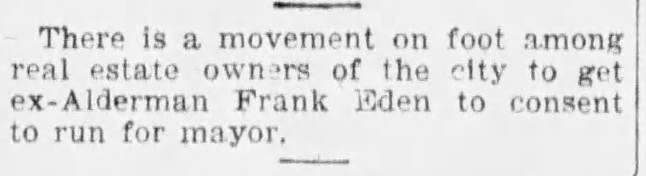
In 1902, there was an attempt to persuade Frank, who was still in the shoe industry, to run for Mayor of Halifax. As stated on page nine of the Halifax Herald, on January 1, 1902: “There is a movement on foot…to get ex-Alderman Frank Eden to consent to run for mayor.” As far as I’m concerned, all puns are intended.
52W Mark II – Week 33: Strength

I am not a member of the Latter Day Saints (“Mormons”), but my maternal grandfather, Leo Burgess, was. In fact, his direct paternal line were Mormons almost since the beginning. The early members of the church were required to draw on their strength as they faced persecution, exile, and hardship.

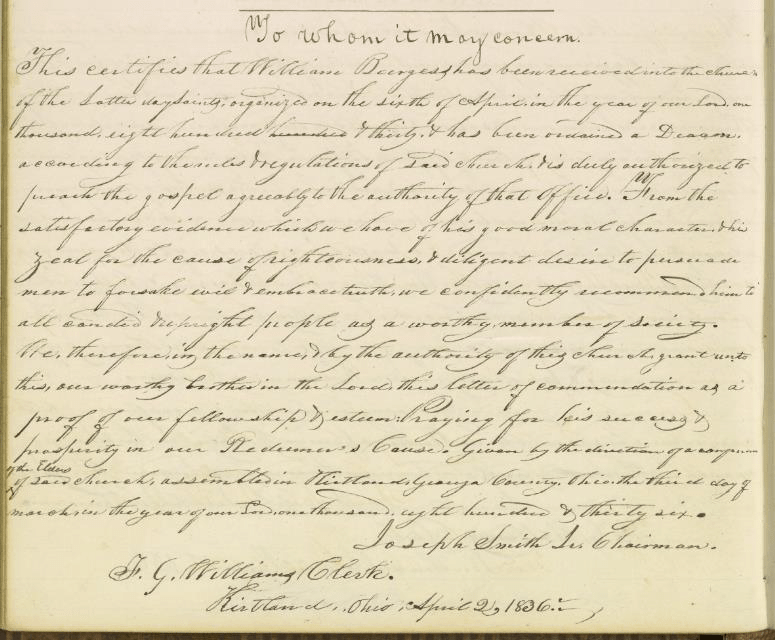
Most sources state that my Gx4 Grandfather, William Burgess (1794-1880) was baptised into the church in 1832, two years after it had been founded by Joseph Smith. However, the Kirtland Elders’ Certificates from the Joseph Smith Papers state that William joined the church and was ordained a deacon on April 6, 1830. All eight of my grandfather’s great grandparents had joined the church in the 1830s and 1840s.

“This certifies that William Burgess has been received into the church of the Latter-Day Saints, organized on the sixth of April, in the year of our Lord, one thousand, eight hundred hundred & thirty, & has been ordained a Deacon…

Joseph Smith Jr. Chairman.
F[rederick] G. Williams Clerk.
Kirtland, Ohio, April 2, 1836.”

Kirtland Elders’ Certificates, p. 84, The Joseph Smith Papers

While I am quite skeptical about much of the church’s dogma, I absolutely respect the strength of its early adherents, including many of my direct ancestors who were early members of the church. Many of them experienced and survived unnecessary suffering due to religious persecution. Several others endured an arduous – and for some,  deadly – journey from Illinois to Utah over the winter of 1846-1847.

Joseph Smith sought to create a “New Jerusalem”. He and his followers moved to Ohio and soon began building a settlement in Missouri. In 1833, church members were run out of Missouri and a failed banking venture crippled the Ohio settlement. The Mormons attempted a settlement elsewhere in Missouri, but were driven out upon an executive order of the governor, calling for them to be exterminated or expelled from the state. In 1939, the church regrouped in a new community, Nauvoo, Illinois, and began to build their Zion there.

Two years after Joseph Smith’s death in 1844, tensions with non-Mormons increased, such that the Mormons were driven out of their settlement once again. They upped stakes and began the migration to Utah. During the westward migration, over the winter of 1846-1847, about 2,500 church members encamped at Winter Quarters, which was just north of where Omaha, Nebraska came to be. The first settlers arrived in what is now Salt Lake City in July 1847, in what was still Mexican territory.

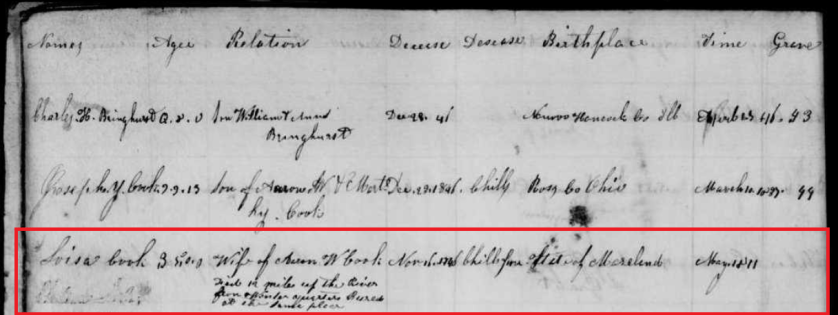
Many of the trekkers did not survive. There are varying accounts of the death toll at Winter Quarters. This is due, in part, to the lack of sufficiently complete and reliable records. It is also due to what was included in each account: some measure death only due to disease, others include deaths of all causes. The periods of time also vary: from a few months over the winter of 1846-1847, to longer periods of time, e.g.,1846 to 1848. Louisa Thomas, my 4x great grandmother, was one of those who perished at Winter Quarters. She died on November 16, 1846. An entry in the Winter Quarters sexton’s records shows that she died 19 miles up the river from Winters Quarters. Louisa’s daughter Charlotte, my Gx3 grandmother, was only nine at the time.

The entry for Louisa Thomas in the Winter Quarters sexton’s records, 1846-1848: “Loisa Cook. 36 years, 0 months, 0 days. Wife of Aaron W. Cook [her third husband]. Died 19 miles up the River from Winter quarters Bur[i]ed at the same place. [Died] Nov 16 1846. [Disease] chills fever. [Born] State of Mareland May 1811.”

To have survived long journeys to settle in new lands, religious persecution, and perilous migration took incredible strength – mental, physical, social, and spiritual. Their conviction and belief carried them through difficult times and experiences. For that I am grateful, because without their strength I would not have been.

52W Mark II – Week 3: Out of Place

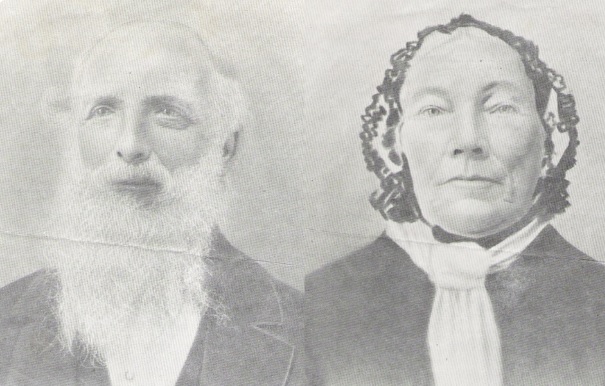
My great x3 grandparents, Robert Nelson and Elizabeth Joseph, were originally from Ireland. Shortly after they married in 1842, they moved to Scotland and lived in Renfrew. Their first three children were born there. In December 1848 Robert and Elizabeth joined the Mormon church. They emigrated in 1850, with the intention of travelling to Utah.

Robert Nelson (1818 – 1902) and Elizabeth Joseph (1818 – 1902)

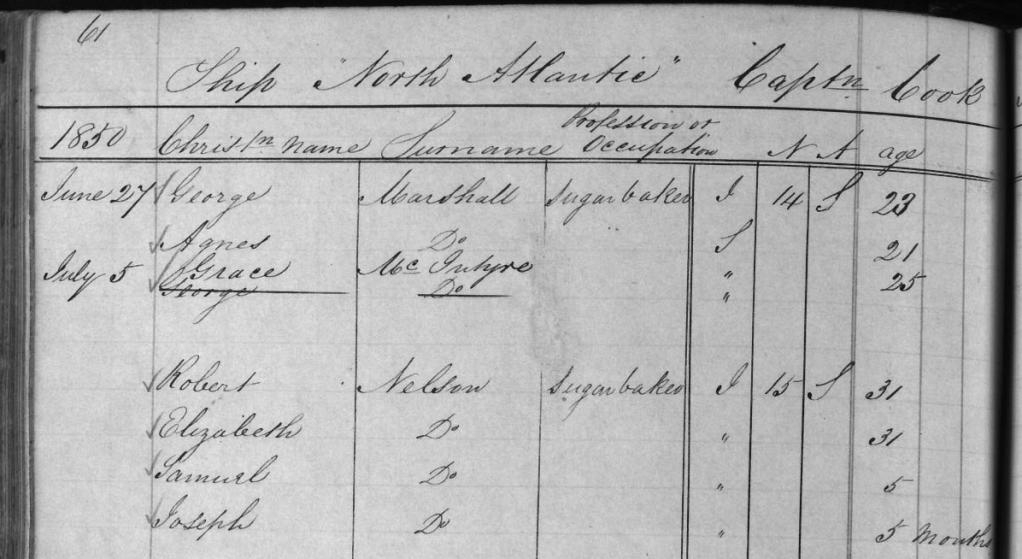
For years, the only information I could find was that they had travelled the North Atlantic. It was a few years before I learned that “North Atlantic” wasn’t their route – it was the name of the ship on which they travelled! The North Atlantic sailed from Liverpool to New Orleans.

Excerpt of the “Invoice of Passengers” for the ship North Atlantic, which left Liverpool on September 3, 1850

At first I was surprised to learn that the family had landed at New Orleans. Without giving it much thought, I had expected that they would have sailed to the Atlantic seaboard – someplace like Boston, New York, or Philadelphia. Sailing around Florida would have added thousands of miles to the trip. However, I quickly realized that New Orleans was closer to their ultimate destination and saved them hundreds of miles of overland travel.

After arriving in Louisiana, the family travelled up the Mississippi to St. Louis, Missouri, where they lived for a year or two. Robert and Elizabeth’s first daughter, Mary Elizabeth Nelson, was born in 1852 during the sojourn in St. Louis. Shortly afterwards, the family finally relocated to Utah. My great great grandfather, John Alexander Nelson, was Robert and Elizabeth’s first child born in Utah. Later in life, John found his place in Cardston, Alberta.

52 Weeks – Week 36: Exploration

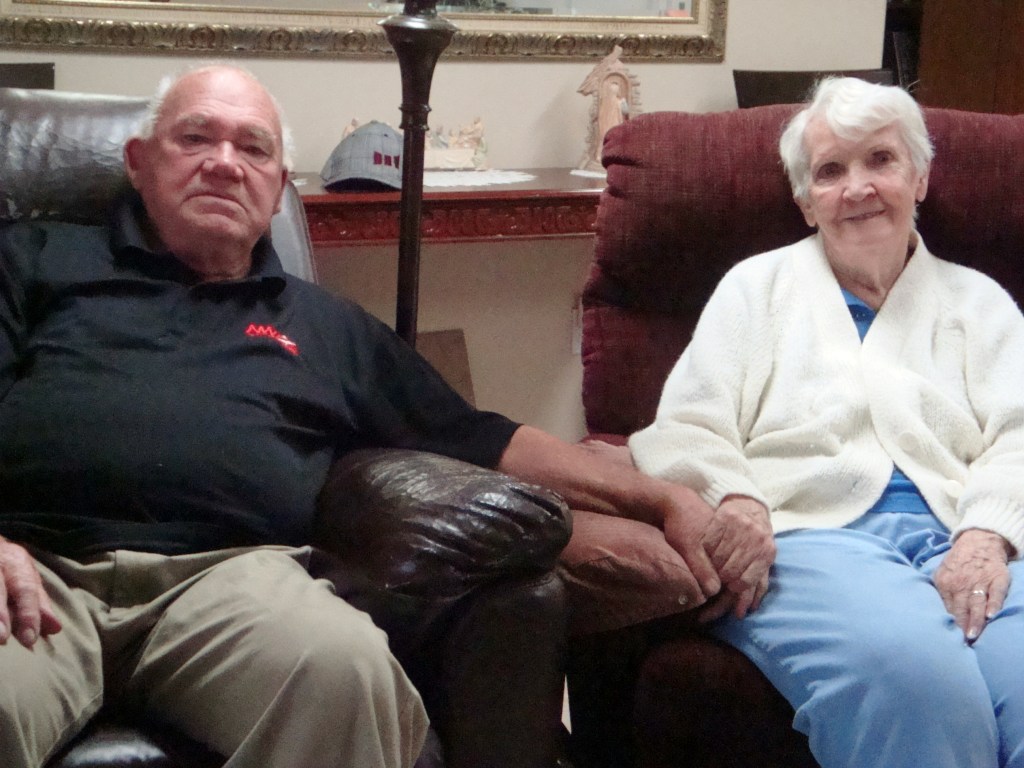
Looking back over past posts, I have come to realize that writing this blog as part of the 52 Ancestors Challenge has been an exercise in exploration. I also realized that I have written a lot about exploration, both my own and my ancestors’. In this post, I will be recounting my exploration of Cardston, Alberta in 2015, when I visited my great aunt Fon Hogg (née Burgess) and her husband Dave. Aunt Fon, who passed away in early 2021, was my maternal grandfather’s youngest sister and a dedicated genealogist.

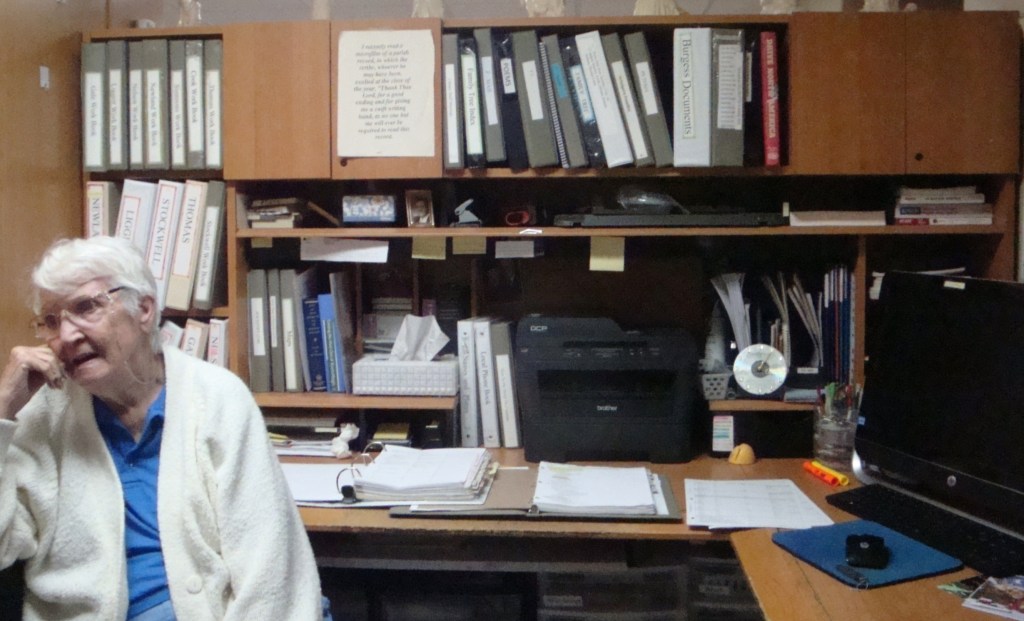
My aunt Fon in her amazing home office, which was primarily dedicated to genealogy and crafting.

I don’t often get the opportunity to visit ancestral homelands, so I was excited to undertake my adventure. One of the goals of my visit was to learn more about my great great grandparents – Aunt Fon’s grandparents – John Alexander Nelson and Ella Elizabeth Thomas. They were amongst the earliest settlers of Cardston, which was founded in 1887 by members of the Latter Day Saints (Mormons). John and Ella were both born in Utah a few short years after it became a territory of the United States.

Ella Elizabeth Thomas (1859 – 1941)
John Alexander Nelson (1854 – 1942)

John was born in 1854 to Irish immigrant parents. Ella was born in 1859. Her father was originally from North Carolina and her mother was from England. John had worked as a farm labourer in Utah before he married. John and Ella married in Salt Lake City in 1879. Shortly afterwards, John and Ella moved to Smithfield, Utah, where John continued to work in farming.

John and Ella came to Canada in September 1890. John and Ella had five children at the time. The family travelled to Canada by covered wagon. Their eldest daughter, Maria, said that she often drove the wagon team while her father managed the cattle. The family first settled in a sod dugout at “Lee’s Creek”, west of Cardston. They arrived with 13 horses, 7 cows, 7 “other horned cattle”, and a pig.

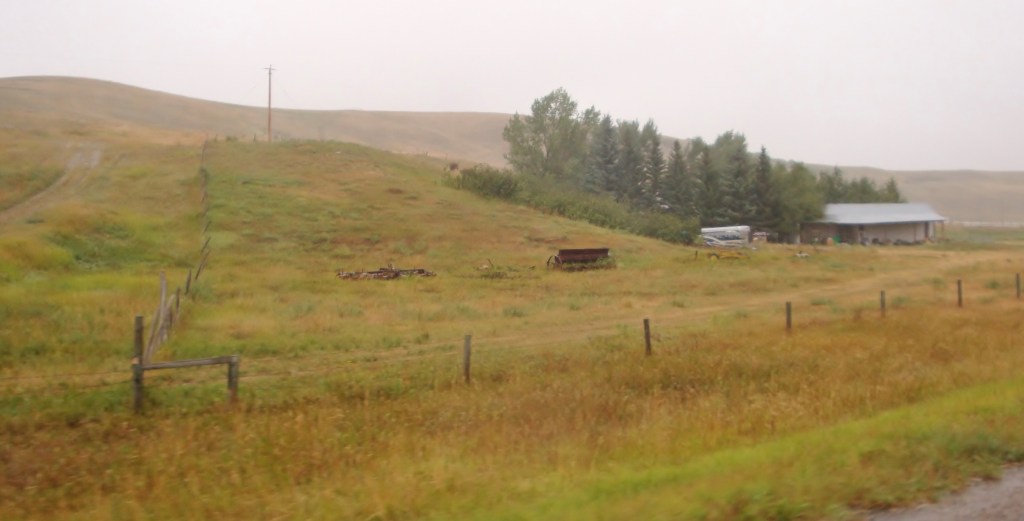
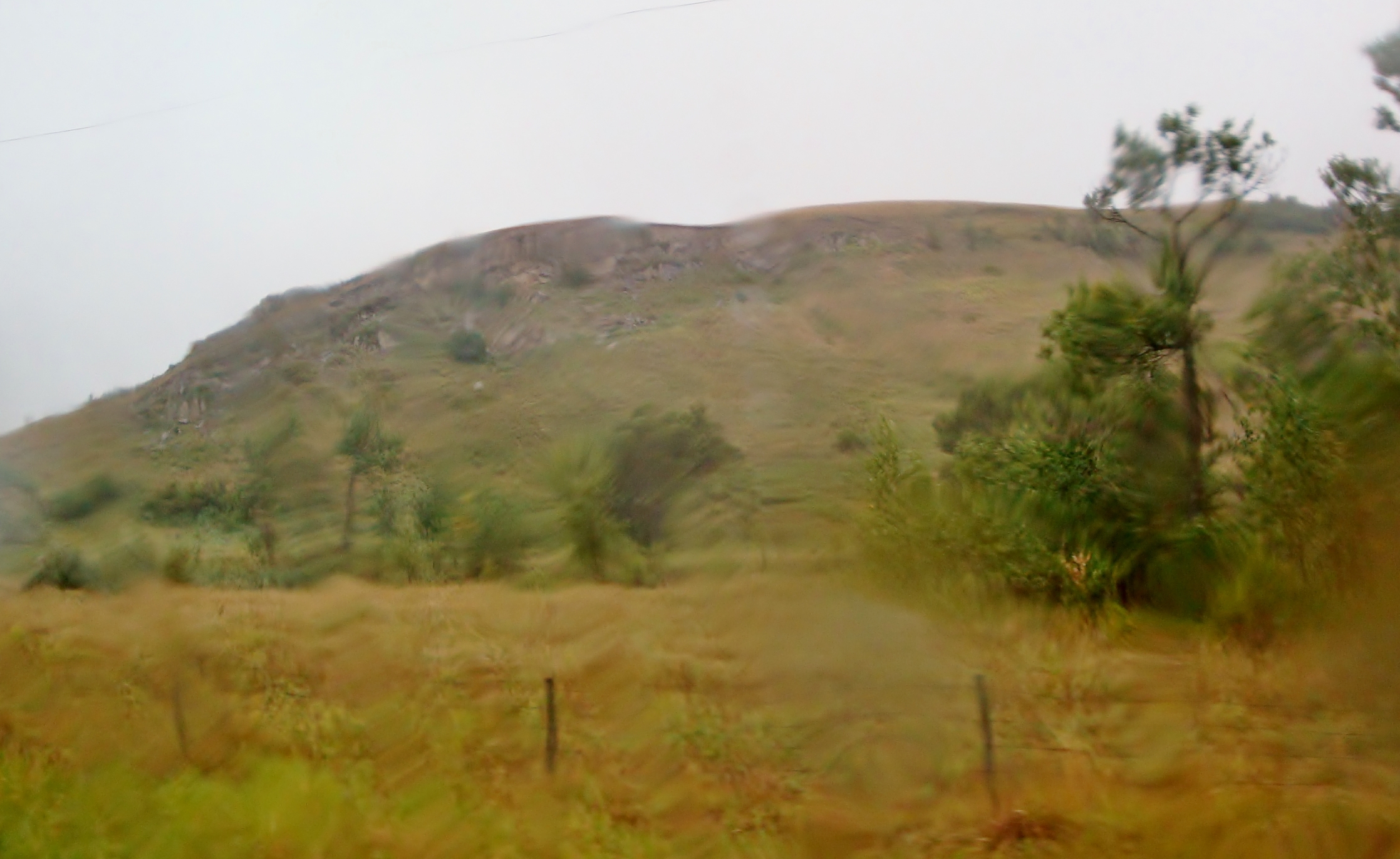
Aunt Fon told me that this was the land where John and Ella first settled in Canada, just west of Cardston, where the prairies meet the foothills of the Rockies.

The book, Alberta Past and Present, states that upon moving to Canada, John homesteaded on 160 acres of raw land. The homestead was located on Lee Creek, which ran through the property and into the centre of Cardston. The farmhouse was about four kilometers southwest of the town centre and is located on what is now Alberta highway 501.

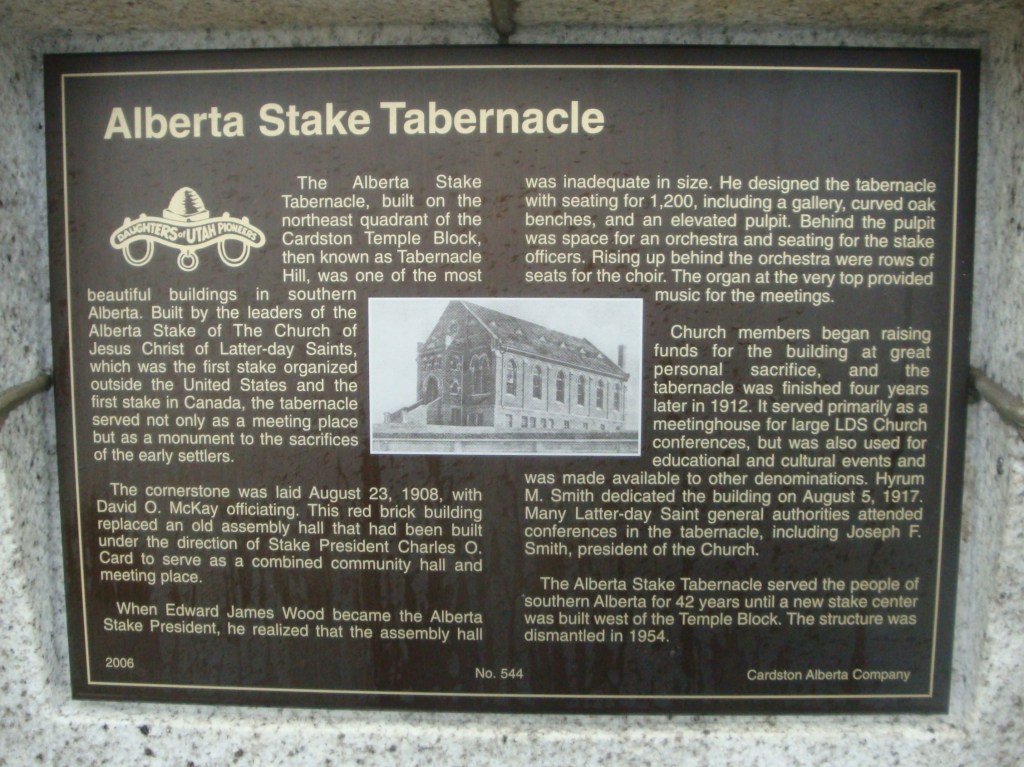
There was a quarry on the land, which supplied the stone for many of the buildings in Cardston, which, according to Alberta Past and Present, included the courthouse. According to John’s obituary, one building in Cardston built not using stone from his quarry was the first saloon built there – John refused to supply stone for that purpose. Aunt Fon told me that stone from the quarry was also used to build the foundation of the Alberta Stake Tabernacle. The Tabernacle stood from 1912 to 1954. Uncle Dave said that when the Tabernacle was demolished, people in Cardston used the stone for other projects. In fact, Uncle Dave told me that their first house originally had a fence built with stone from the Tabernacle.

In addition to farming, John also worked in carpentry. As well, John and a partner, John Turner, constructed and operated the first lime kiln in this part of the country. In 1906, John and Ella moved to nearby Woolford, Alberta, where John continued farming. John and Ella briefly returned to Utah in the early 1920s, where John operated an orchard or fruit farm, but they returned to Woolford in 1924. John continued farming the rest of his working life.

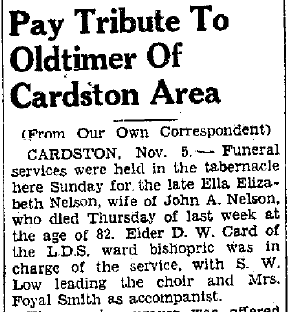
The Lethbridge Herald, November 5, 1941, page 11.

Meanwhile, Ella did not simply bide her time in the background as a farm wife and mother. According to a Lethbridge Herald article published after her death, in 1892 Charles Ora Card, Cardston’s founder and stake president, called to on Ella to study nursing and obstetrics. She was sent to Salt Lake City to study under the tutelage of a Dr. Shipp.  Ella left her five eldest children at home, taking with her “a six months old baby”. Based upon this timeline, the baby would have been Seth Henry Nelson, who was born in October 1891.

However, another source stated that Ella went to Utah in 1893 and that the baby she brought with her was her son Cleveland, who was born in March 1893. After six months’ training, Ella returned to Cardston and started her service. The Herald article says that Ella “answered every call from 1892 to the time when the district was supplied with medical men, and after that time when there was more work than one doctor could do”. Ella continued as a midwife until 1932, when she was 73.

John and Ella were nationalized as British subjects domiciled in Canada in 1896 (there was no “Canadian” citizenship until 1947).

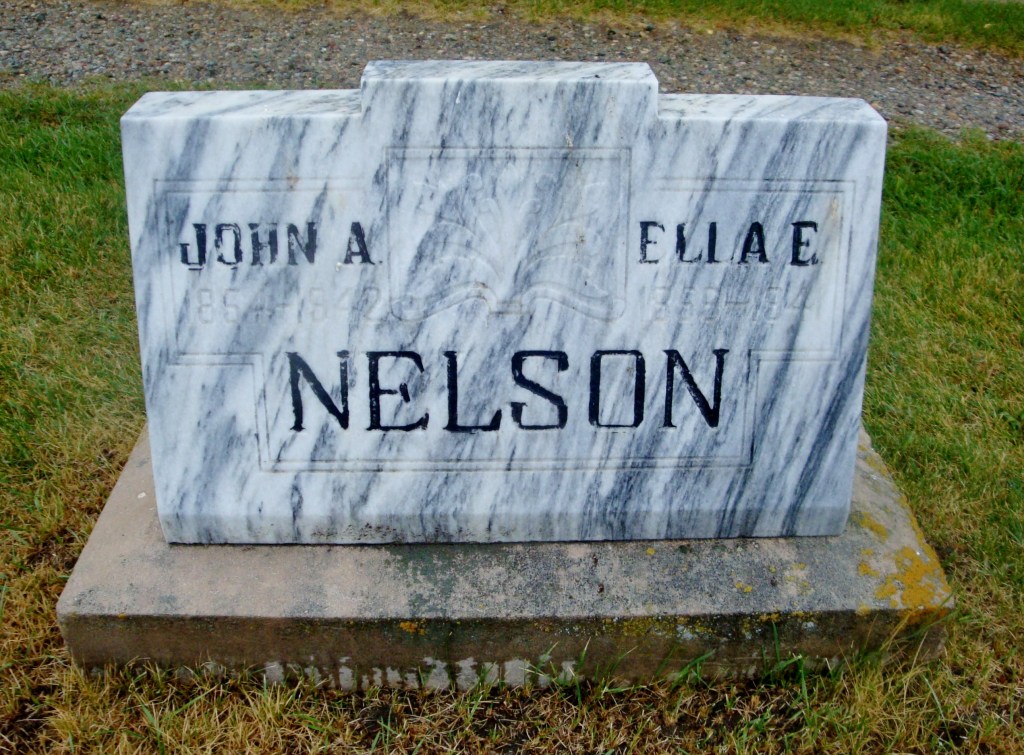
Together, John and Ella had twelve children, two of whom died in infancy. This included my great grandmother, Hazel Nelson, and her twin sister, Irene, who died at one month old. Ella died in October 1941. John died almost a year later, in September 1942. After I left Fon and Dave’s house, I drove to the Cardston Cemetery, where John and Ella are buried, along with other close relatives.

Unfortunately, while I often emailed Aunt Fon, my trip to Cardston was the last time I saw Fon and Dave. Dave passed away in October 2020 and Fon passed away five months later, in March 2021.

Dave and Fon Hogg, August 21, 2015.