Jan Pater was born on May 20, 1826 in Sint Maarten, Noord Holland, the eldest of five children born to Jacob Janz Pater and Antje “Anna” Lievendag. Sometime between the time Jan was three and seven, the family moved a few kilometers south to the adjacent gemeente (municipality) of Harenkarspel. According to his registration of marriage, Jan lived in Harenkarspel and was working there as a labourer until shortly before he got married.
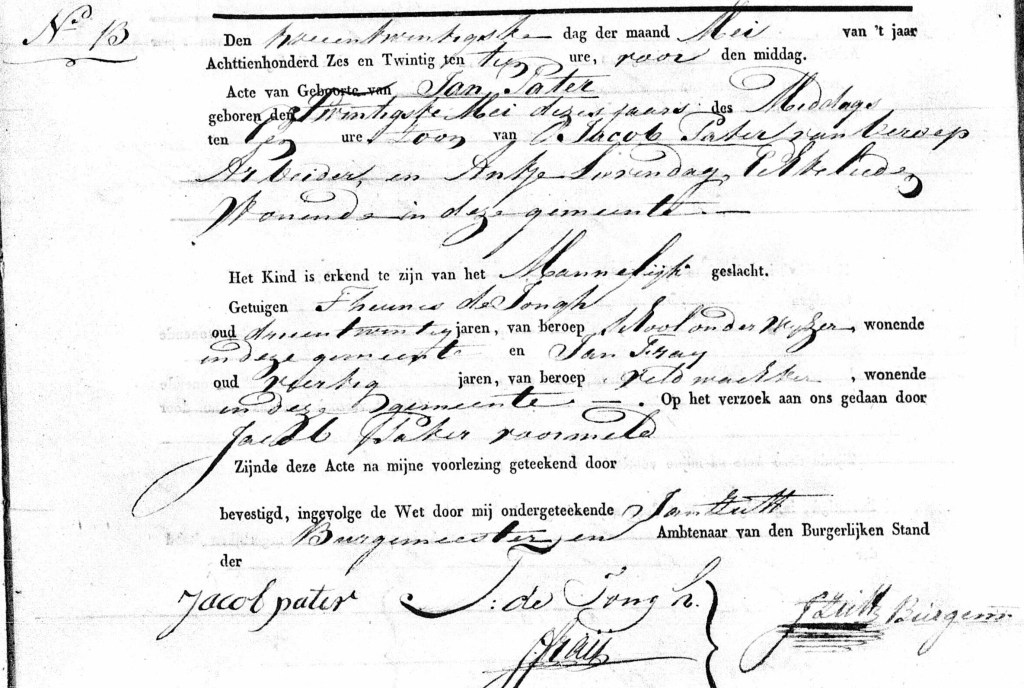
Jan’s birth registration.
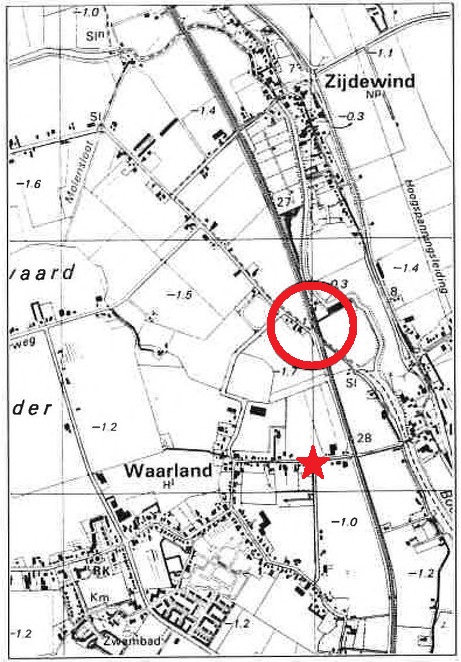
The circle shows where Jan lived with his wife and inlaws. The star is where my father was born.
Jan was 26 when he married Teetje de Groot on June 11, 1852 in Oude Niedorp. After they married, Jan and Teetje moved in with Teetje’s parents, Jan de Groot and Sijtje Sijbecarspel. They lived in Zijdewind, which at the time was part of gemeente Oude Niedorp.
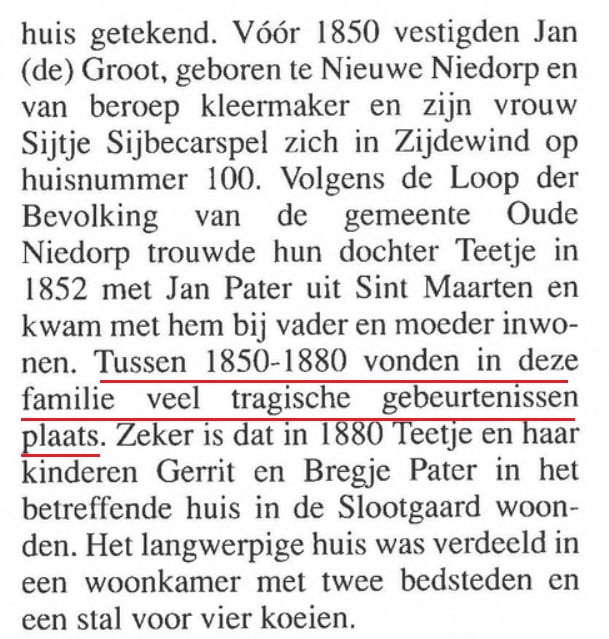
According to an article in Toendertoid: Stichting Waarland van Toen, “Many tragic events took place in this family between 1850 and 1880.” It then went on to describe the house they lived in, without providing any details about what happened.
Toendertoid, May 1994, page 12 WHAT HAPPENED?!?
Jan was a labourer almost his entire life, except for a brief period in 1872 when he was a “veldwachter”; literally, “field guard,” a kind of rural police or constabulary. The veldwachters originated as the “garde champêtre” during the Napoleonic era. They were very poorly paid, if at all, and largely relied upon other sources of income. There were few prerequisites to become a veldwachter and at Jan’s time it was much less than a professional police officer. What authority they had was limited to the municipality in which they served.
Jan was 46 when he was a veldwachter and he did not serve very long. It is not clear what qualification Jan had for the role. He was still described as a labourer when his daughter Maartje was born in March 1871. It was only the April 1872 death registration of his son, Jacob, that showed Jan as a veldwachter. Maartje died later that same year, in December, and her death registration recorded that Jan was a labourer at the time. Jan was still a labourer when he died in Zijdewind at age 52.
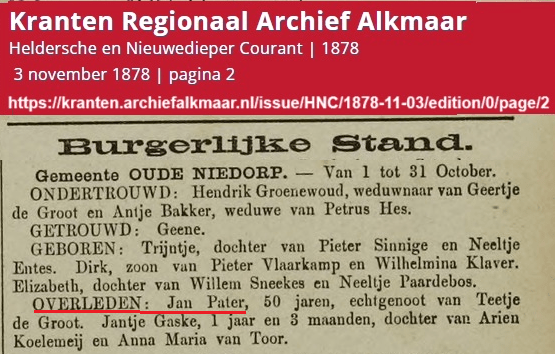
Burgerlijke Stand = Civil Register Died: Jan Pater, age 50, husband of Teetje de Groot.
I generally think of my Dutch ancestors – particularly the paternal side of my father’s family – as labourers, farmers, domestic workers, or similar. I suspect that the maternal side of my father’s family might have been better off, although by how much I cannot say. With a couple exceptions, I have to go five or six generations back to find something other than farmer or labourer, such as a cordwainer and a cobbler, a harbour pilot, or a sailor. Of those who worked the land, I doubt few of them actually owned their farms.
One exception is my Gx3 Grandfather, Jan Gerritsz Veldman. During the 52 Ancestors Challenge in 2023 , I described him and his wife Trijntje Stoop as “prosperous“. However, at one point in time he may have been even better off than I had previously thought.
Jan was born on November 27, 1835 in Nieuwe Niedorp, Noord Holland. He was the eighth of twelve children born to Gerrit Veldman and Maartje Cornelis Zijbecarspel. In 1855, when he was 20, he was drafted for the militia, as the Netherlands had mandatory military service until the 1990s. Many conscripts never actually served; rather, they were largely on-call, like a reserve. However, according to his marriage registration, Jan had “bought” himself a replacement.
According to my late friend Nol van den Hurk, this was a common practice “if you had money.” I asked if this meant Jan was well off, Nol responded:
Whether Jan was well to do or not I can’t tell you. The archives hold papers you had to show when you wanted to marry. One of the papers is an official document that showed that you had fulfilled your duty in the Army. In Jan’s case I saw a document, signed by the Queens commissioner’s clerk in the Province North Holland (who was responsible for those things in those days) that said that Jan had his military duties done by a replacement. This was not uncommon in those days, but it never stated who paid for it. It might have been the bride’s father, the groom’s father, the groom himself…. When he was the only son of a farmer, he did not have to join the army. If so, it was stated so in the document.
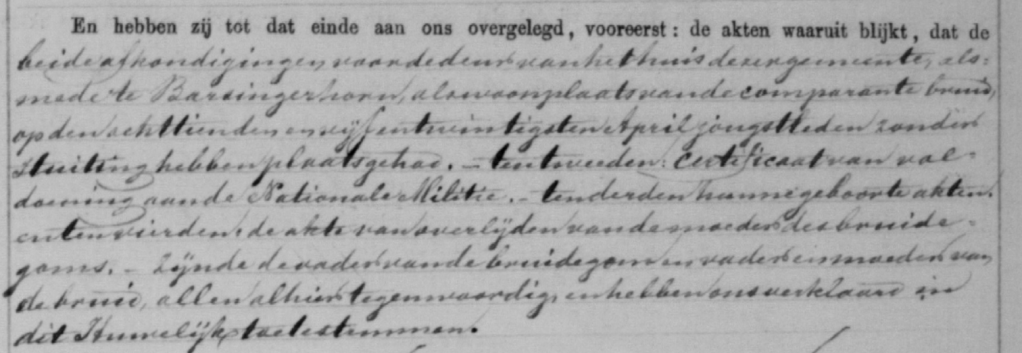
The passage from Jan and Trijntje’s marriage registration that speaks of Jan having discharged his obligation for military service.
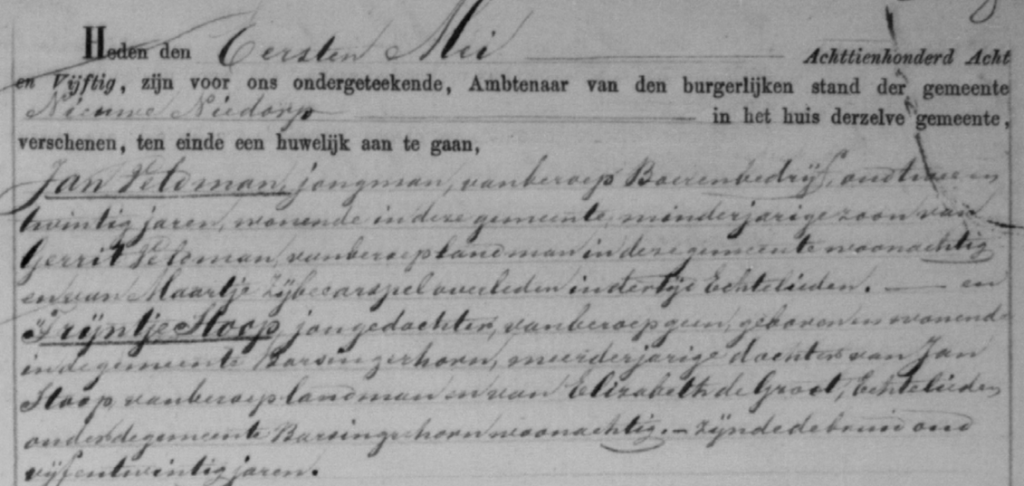
Jan and Trijntje married on May 1, 1858 in Nieuwe Niedorp. I have a copy of their marriage registration, but unfortunately I have not yet found a copy of their huwelijksbijlagen (marriage supplements) online. The marriage supplements are a set of documents the couple had to provide before they could marry, such as birth extracts and other vital records. As well, it used to include a record confirming that the groom had satisfied his mandatory military service. It would be nice if I could visit the Dutch archives in person, but I doubt I’ll be in the Netherlands in the foreseeable future.
The opening portion of Jan and Trijntje’s marriage registration, showing their names, ages, occupations, places of birth, residence, and parents, among other things.
At the time he married Trijntje, Jan was working as a farmer in Nieuwe Niedorp; however, their eldest child, Gerrit, was born in Harenkarspel in 1859. It is likely that Jan actually lived and worked in ‘t Veld, a village within gemeente (municipality) Nieuwe Niedorp, as reflected in the bevolkingsregister (“population register”) of Nieuwe Niedorp for 1860-1870. There was a subsequent bevolkingsregister for ‘t Veld for 1870–1880, which also listed Jan and his family. As for ‘t Veld, it later became part of gemeente Oude Niedorp. It is now within gemeente Hollands Kroon.
It appears that Jan and Trijnte did very well for themselves while living in ‘t Veld. I recently discovered that they were prosperous enough to have domestic servants in the late 1860s. The first, Jansje, worked for Jan and Trijntje until January 1868, but I do not yet know how long she had been there before leaving. The second, Brigitta, worked from February to December 1868.
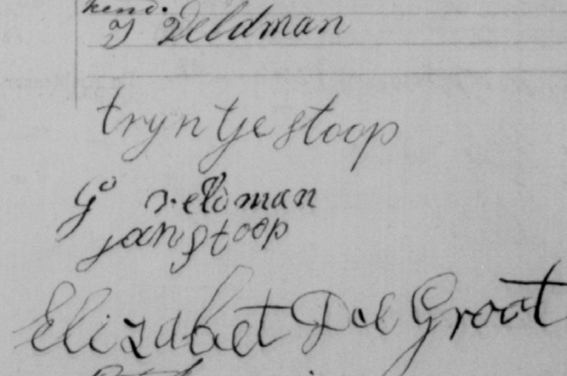
I love seeing the signatures of my ancestors from so long ago. Here are my Gx3 Grandparents, along with the bride’s parents, my Gx4 Grandparents, 167 years ago.
Jan and Trijntje had eight more children who were born in Nieuwe Niedorp. It appears that all but two children survived infancy and childhood. In May 1872, Jan, Trijntje, and their children moved to Barsingerhorn, which is about five kilometers north of ‘t Veld. There they had the last of their ten children, Aantje, born in 1873.
Upon relocating to Barsingerhorn, Jan and Trijntje began to acquire several pieces of farm properties, which together formed two separate properties. One property consisted of two lots in Oude Niedorp of about 0.157 hectares (about 0.4 acres), on which there was a house. The other property was a farm consisting of 20 lots in Barsingerhorn, totalling about 11.9 hectares (just under 3o acres). The farm property included a farmhouse, pastures, farmland, and a boat.
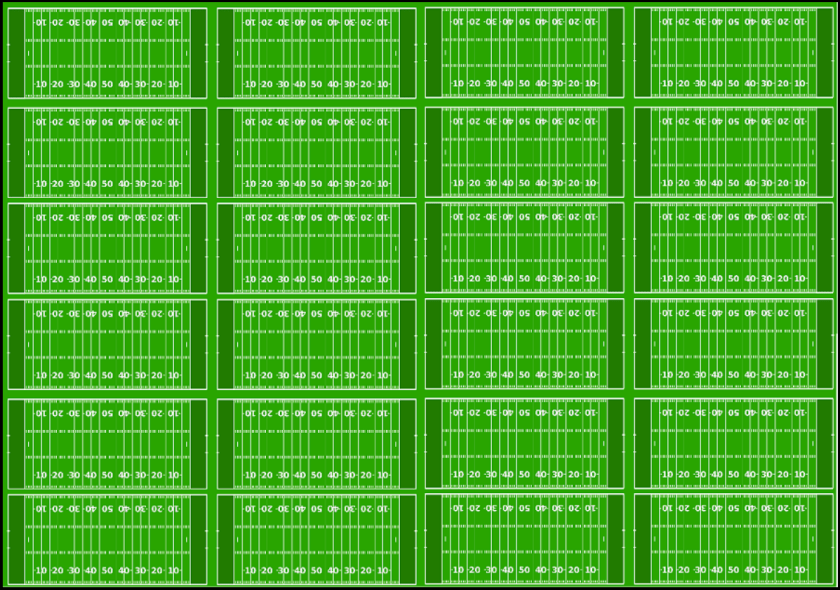
Approximate size of the total amount of land Jan and Trijntje owned: 24 American football fields (FYI, Canadian football fields are longer.)
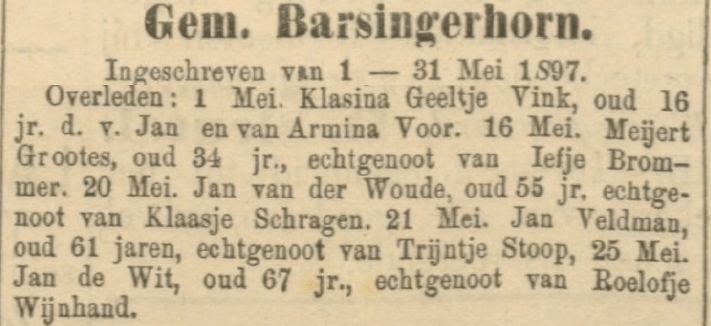
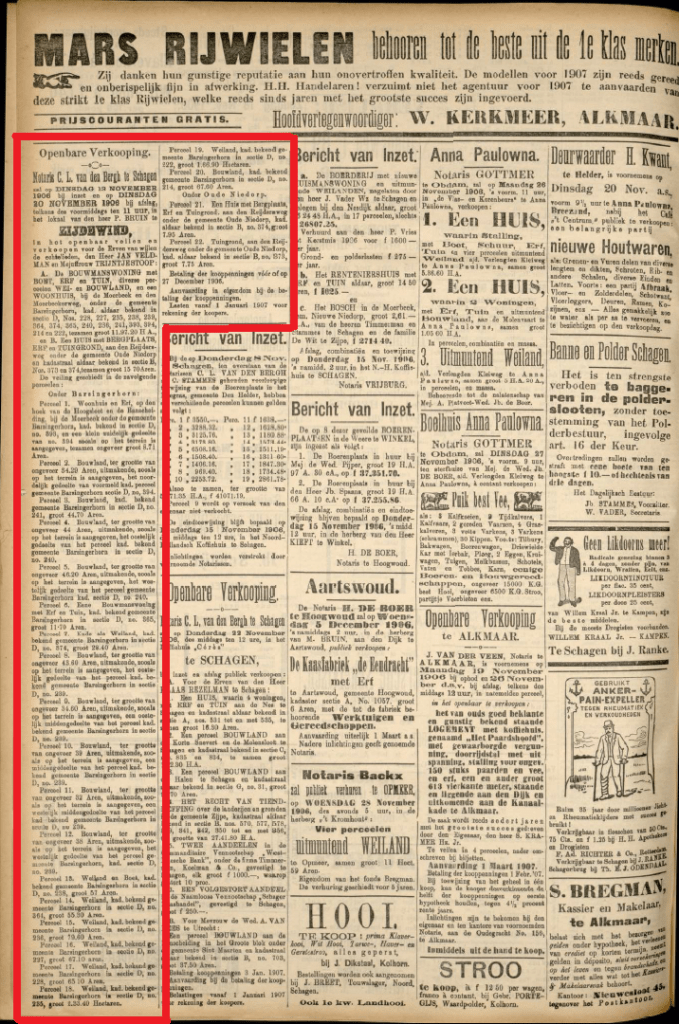
When Jan died on May 21, 1897, these pieces of property passed to Trijntje. Within a year after she died, on January 27, 1906, these properties were put up for auction. The auction noticed valued the first property at ƒ835, while the second property was valued at ƒ17,152.66. Together, they amounted to about CDN$427,958.27 in 2025 dollars.
Schager Courant, June 20, 1897, page 3: “Overleden” (Deceased), 21 May, Jan Veldman, age 61, husband of Trijntje Stoop
Schager Courant, Schagen, Noord Holland, Netherlands, November 11, 1906, page 4. “Openbare Verkooping” (“Public Sale”). This is an itemized list of Jan and Trijntje’s two properties that went up for public auction after Trijntje died.
While it’s still early days, I’m discovering that the different approach I am taking to this year’s 52 Ancestors Challenge is that it has prompted me to do a long-standing but long-languishing research goal: to bolster and verify the research I’ve done for the first few generations of my direct ancestors. While not quite the same, it’s similar to Yvette Hoitink’s “Level-up Challenge.” By focusing on individuals rather than topics, I’ve been discovering a lot of gaps in my knowledge and research for the 52 direct ancestors I’ve chosen to write about this year.
Take this week’s subject, Aaltje Klaase Stroet. A few weeks ago, I had little more than her birth, marriage, and death. Now I know a fair bit more – including a lot of information about the farm where she lived and worked with her husband Dirk.
Aaltje was the youngest and tenth child of Nicolaus Dirkszoon “Klaas” Stroet and Geertje Jansdochter Molenaar. Aaltje was born on June 18, 1813, in Nieuwe Niedorp, Noord Holland, just like all her older siblings.
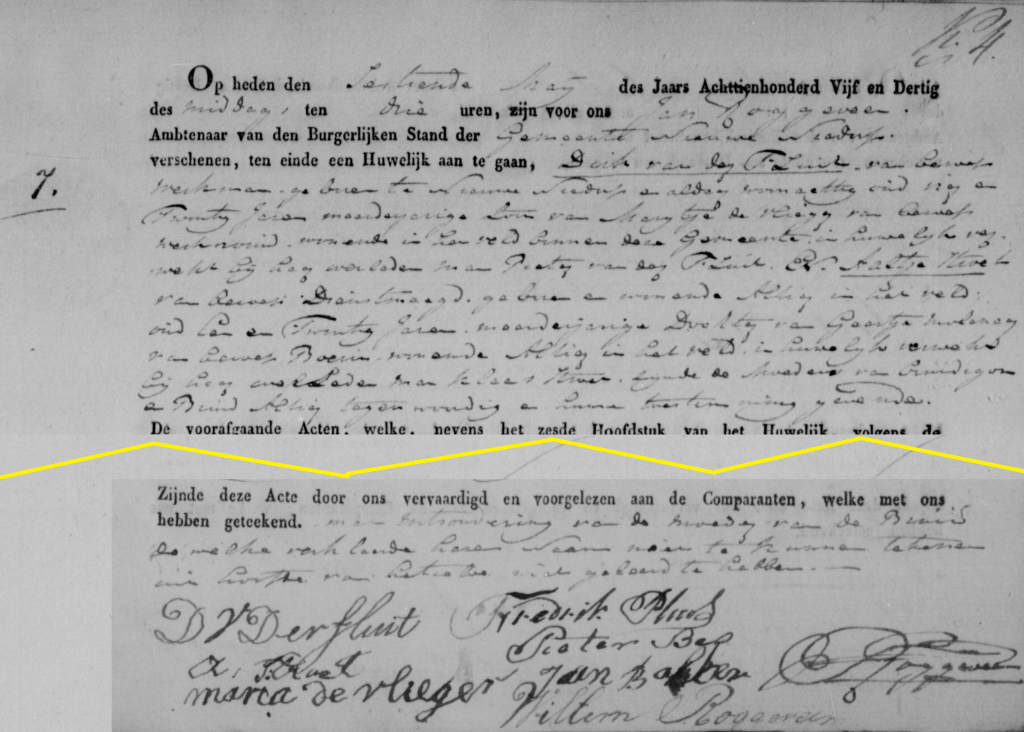
At the time Aaltje married in 1835, she worked as a housemaid in Nieuwe Niedorp; however, I have yet to find an entry for Aaltje in a Dienstboderegister (a register of domestic servants kept as part of a municipality’s Civil Registration Register). The most significant piece of evidence regarding Aaltje’s occupation as a housemaid is the registration of her marriage to Dirk Pietersz van der Fluit, which occurred on May 16, 1835 in Nieuwe Niedorp.
The top and bottom of Aaltje and Dirk’s marriage registration, which includes mention that Aaltje’s occupation was “dienstmaagd” (maid).
At the time Aaltje and Dirk married, Dirk was employed as a labourer. Dirk later took up farming. While he might have undertaken farming at an earlier time, in 1847 a stolpboerderij (“bell jar” or “covered” farm) in ‘t Veld, Noord Holland was registered in the names of Dirk and Aaltje. Until ‘t Veld was part of gemeente (municipality) Oude Niedorp; it is now within gemeente Hollands Kroon.
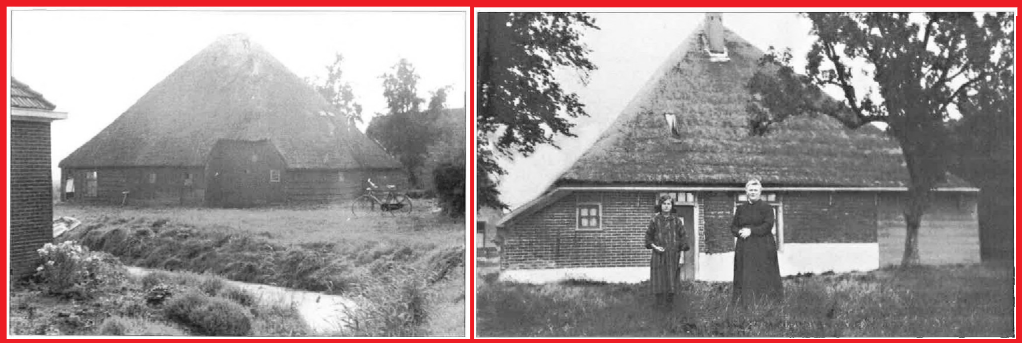
Two views of Aaltje and Dirk’s stolpboerderij from ‘t Is Mooi Weest magazine, December 2004. Both photos were taken after Aaltje’s death. The photo on the right shows Maria Veerman, the owner of the property after 1917, along with her daughter Geertje.
A stolpboerderij was a style of farmhouse that was common in the West Friesland area of Noord Holland. They were pyramid-like thatched roof buildings that served as a combination farm house and separate space for animals, hay, wagons, or tools.
The stolpboerderij that Dirk and Aaltje acquired already existed at the time the land registry in which it was registered was created, in 1832, so it is difficult to determine the time of its construction. In 1832, when the registry was created, the farm was owned by the Roman Catholic church of ‘t Veld. Aaltje remained on the farm after Dirk died in 1857, along with all their children, and it remained registered in her name.
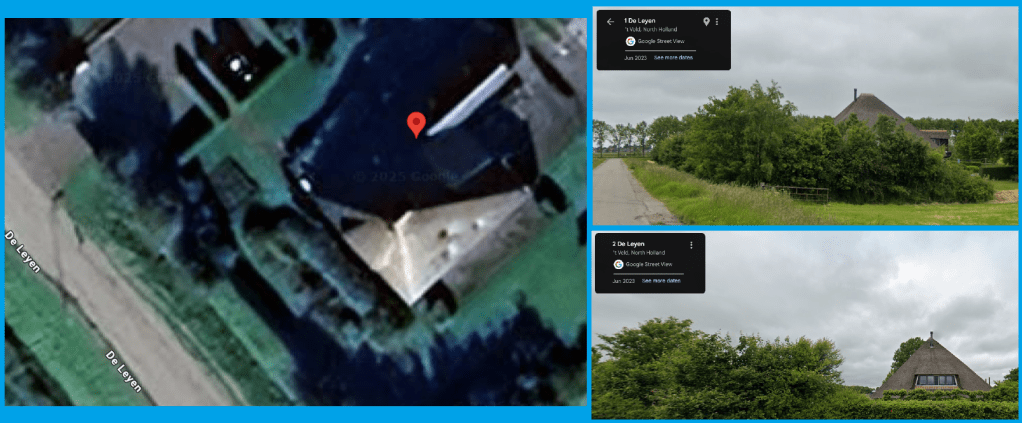
Based upon these views from Google Maps, the stolpboerderij where Aaltje and Dirk is still standing.
According to the Bevolkingsregister(population register) for Oude Niedorp for 1860-1885, some of Aaltje’s children remained at the farm after they reached adulthood. In fact, three of Aaltje’s grandchildren through her second son Nicolaas (1838-1876) were living at the farm, at least as late as 1880.
Aaltje died on March 6, 1881 in Oude Niedorp, most likely at the farm in ‘t Veld. An index for the Roman Catholic Parish of St. Martinus in ‘t Veld indicates that Aaltje’s heirs sold the farm by auction. The index suggests that the church council purchased the land, “called the Hofstede, in the Leijerpolder”. That indicates that the farm was less than two kilometers from where my father was born, in Waarland.
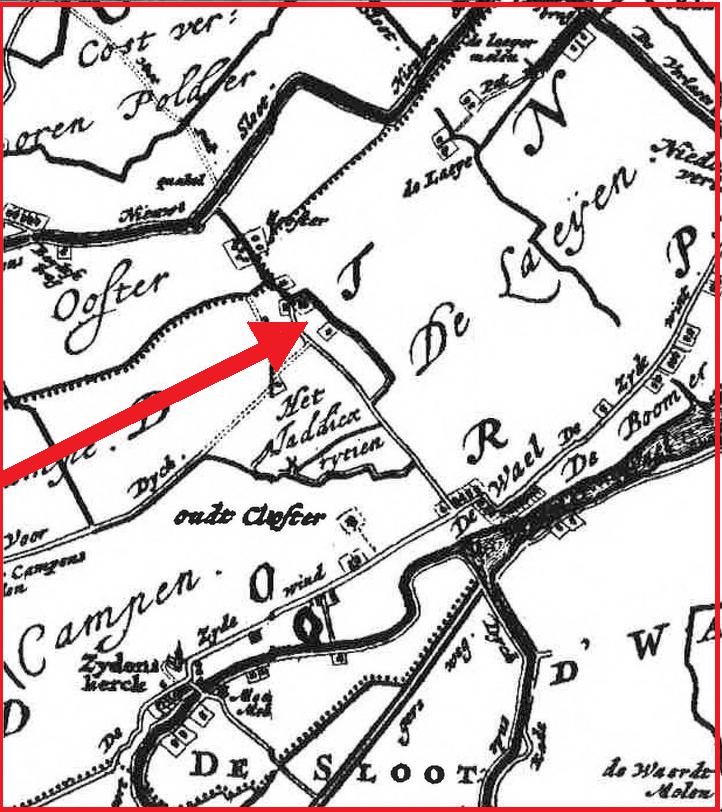
The location of Dirk and Aaltje’s stolpboerderij, shown in ‘t Is Mooi Weest magazine, page 9, December 2004.
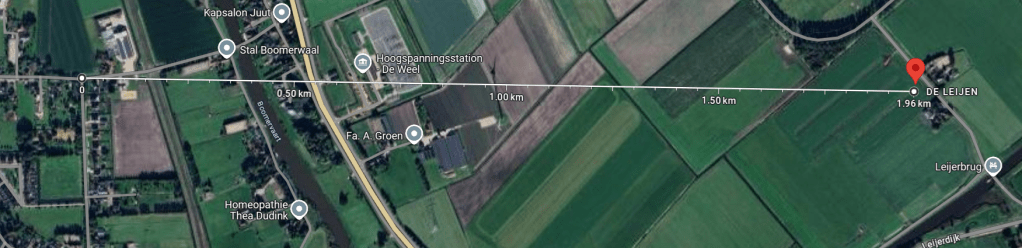
Dirk and Aaltje’s stolpboerderij was less than two kilometers due east of where my father was born. I see that I came within about 700 meters of this property, if not closer, during my last trip to the Netherlands. If only I had known!
However, another source shows that in 1882, a year after Aaltje died, the farm was sold by auction to Simon Groen and Marijtje Kuilboer.
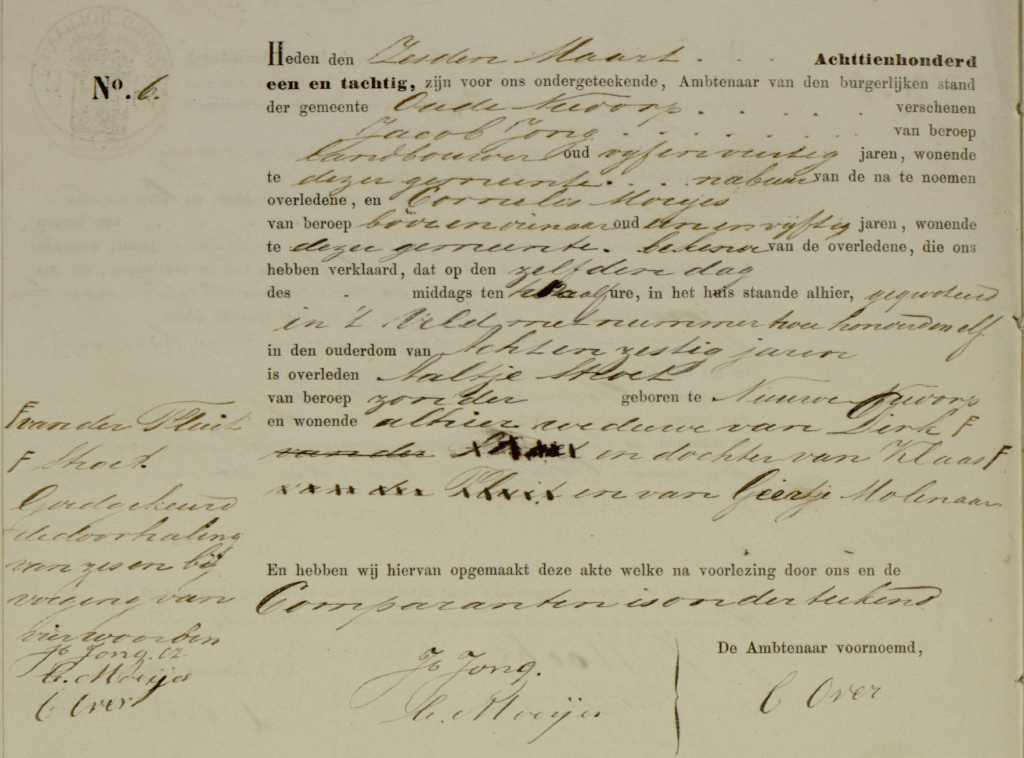
Death registration for Aaltje Stroet. There was a clerical error in that her husband Dirk was recorded as her father; it is the crossed out item. The margin corrected the error, naming Dirk as her husband.
Imagine changing municipalities several times in your life while living in the same house the entire time. With the ever changing municipal boundaries of the Netherlands, it can become All Mixed Up – which is the prompt for this week’s 52 Ancestors Challenge!
The Netherlands has thousands of villages, towns, and cities; however, the smallest administrative unit of government is the gemeente, which roughly translates as “municipality” or “local authority”. They are the third and lowest level of government after the national and provincial governments. Some gemeentes (in Dutch the plural is “gemeenten”) consist of a single community, such as gemeente Amsterdam. Many consist of multiple villages and towns.
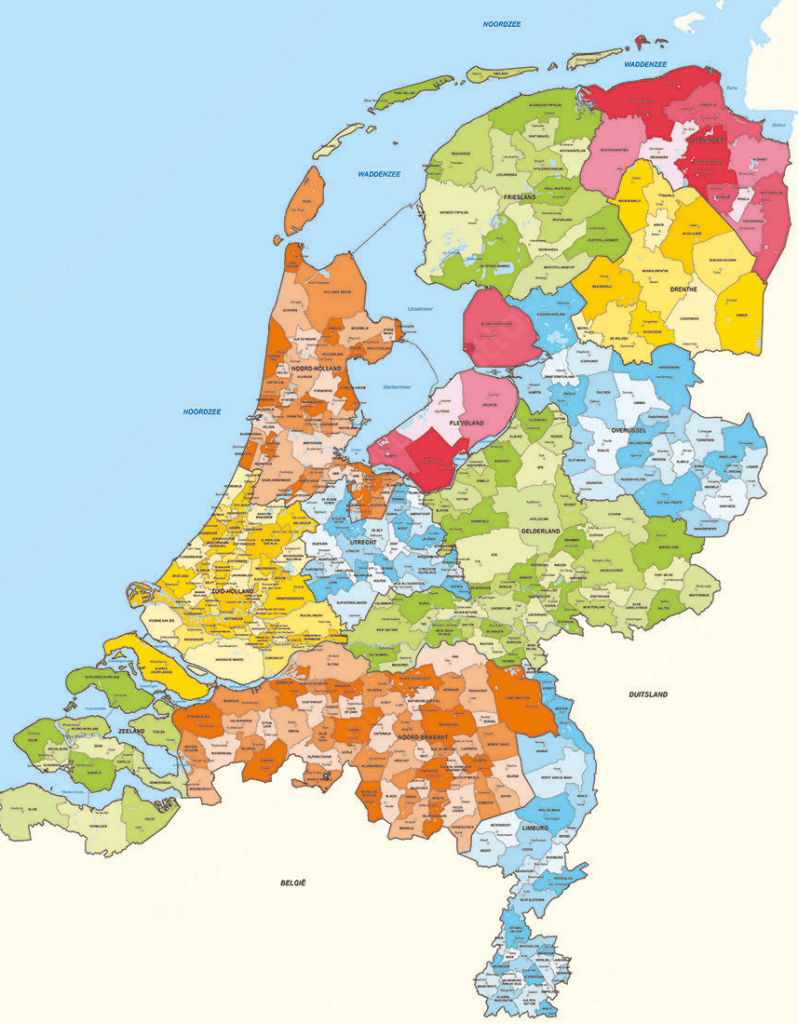
The gemeentes of the Netherlands as of 2024. The colour groups indicate the provinces of the Netherlands.
In 1812, immediately after the end of Napoleonic rule, the Netherlands had more than 1,100 gemeentes. I don’t know if that includes or excludes modern-day Belgium, which until 1830 was part of the Netherlands. Over the following two centuries, the municipal map was revised many times. Gemeentes expanded, shrank, divided, and merged, such that almost 1,700 different gemeentes have existed over time.
Since January 1, 2023, the most recent reorganization, there are 342 gemeentes in the European part of the Netherlands. There are three in the Caribbean Netherlands, except there they are a “Caribisch openbaar lichaam” (“Caribbean Public Body”).
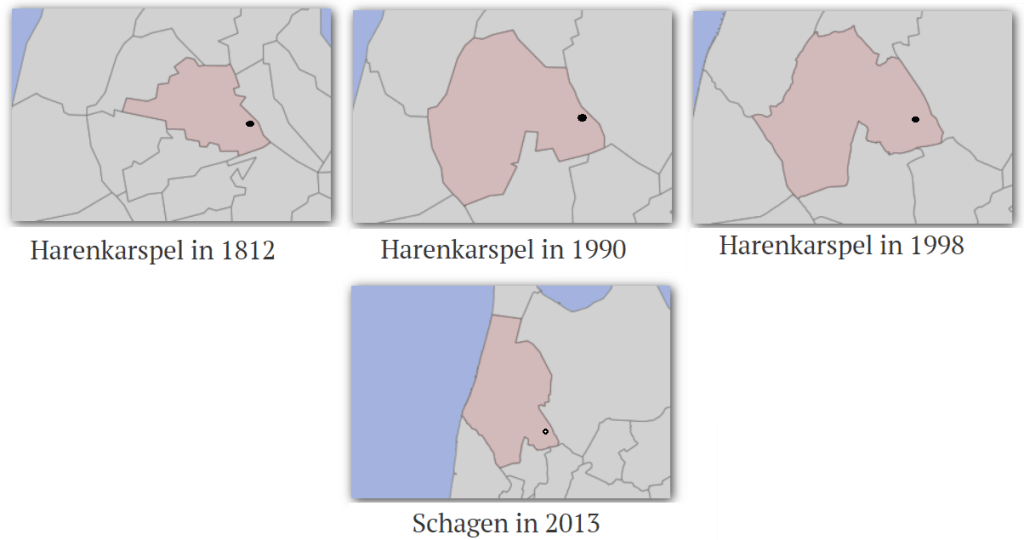
My father was born in Waarland, a village that currently has about 2,700 inhabitants. When my father was born, it was in gemeente Harenkarspel, which had been in existence for centuries. Its boundaries changed twice after my father was born.
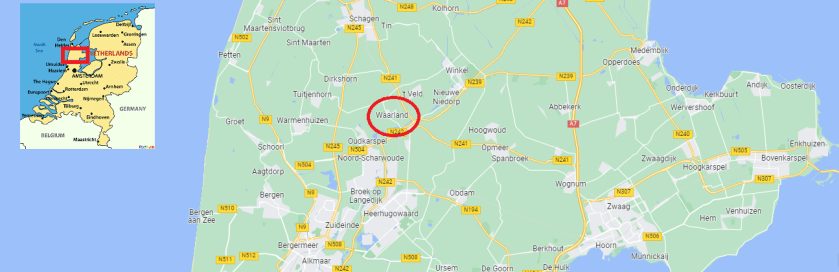
Waarland’s location in the Netherlands.
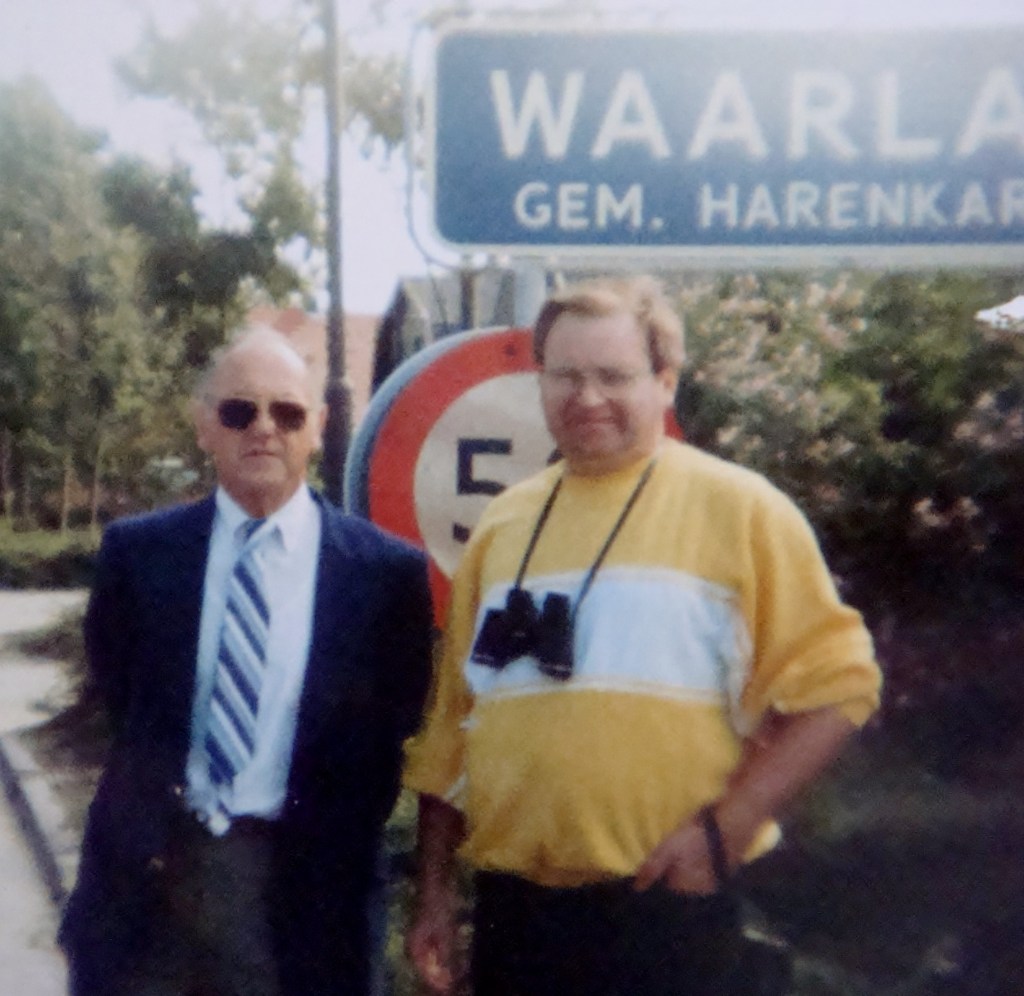
My grandfather and father visiting Waarland in the late 1980s. It was my father’s first time back since they emigrated to Canada. The sign says “Waarland Gemeente Harenkarspel”. Waarland was in Harenkarspel the first time I visited it; it was in Schagen the next time I was there.
In 2013, Harenkarspel merged with Zijpe and Schagen and ceased to exist as a separate gemeente. Since the merger, the gemeente is simply Schagen. Zijpe itself had six different iterations between its creation in 1817 and its merger with Schagen in 2013.
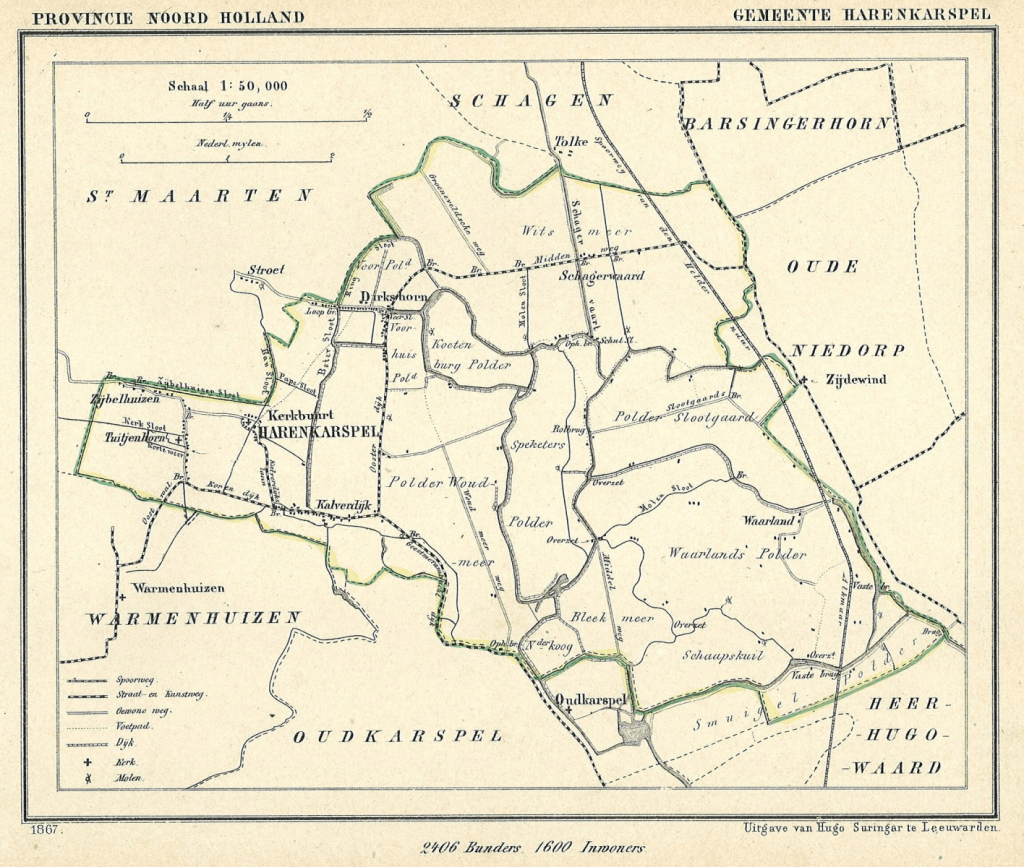
Harenkarspel in 1867. Waarland is in the south-east, near the border with Niedorp.
Waarland’s location within Harenkarspel and, now, Schagen.
When I enter a Dutch location into my database for any particular fact, I always use the smallest unit, even if it is not an independent administrative body. While gemeentes come and go, or expand and contract, the villages, towns, and cities largely stay the same. Thus Waarland is Waarland, regardless of what gemeente it is in. Fortunately, there is a website that helps track all the gemeentes that have existed “from ancient times” to present: “Gemeentegeschiedenis” (“Municipal History”). With it, you can find which gemeente a place might have been at any time in Netherlands history. No need to be all mixed up!

 A Deck of Ancestors