
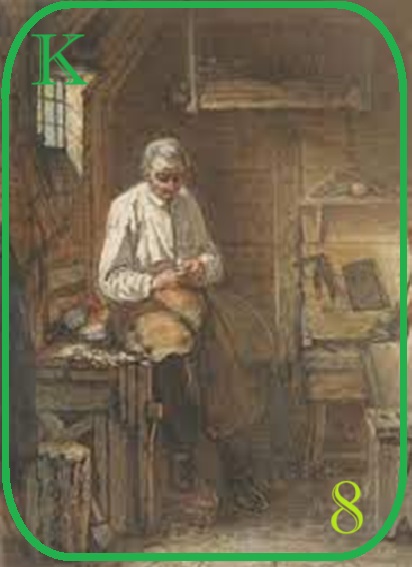
52W Mark IV – Week 23: Card K10 Jan Cornelis Bakker

Jan Cornelis Bakker (1819-1859)

I recently noted that most of my direct Dutch ancestors were farmers and labourers. Jan Cornelis Bakker is another exception to that generalization. For most of his short life, he worked as a sailor in Den Helder, Noord Holland. In fact, he was the descendant of sailors on both sides of his family.

Jan was born on January 16, 1819, in the village of Oost, located on the island of Texel in the province of Noord Holland, Netherlands. He was the second child of Cornelis Dirksz Bakker and Marijke Jans Kuiter, who had married a few years earlier in Texel, on April 25, 1815. Jan’s older sister, Naantje, had been born in July 1815, just months after their parents’ wedding.
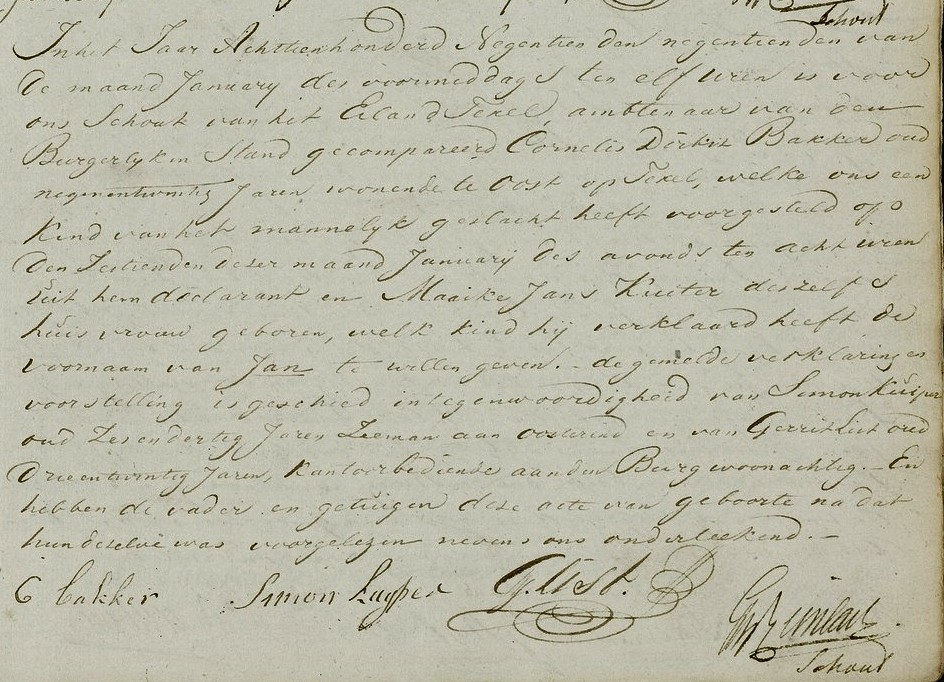
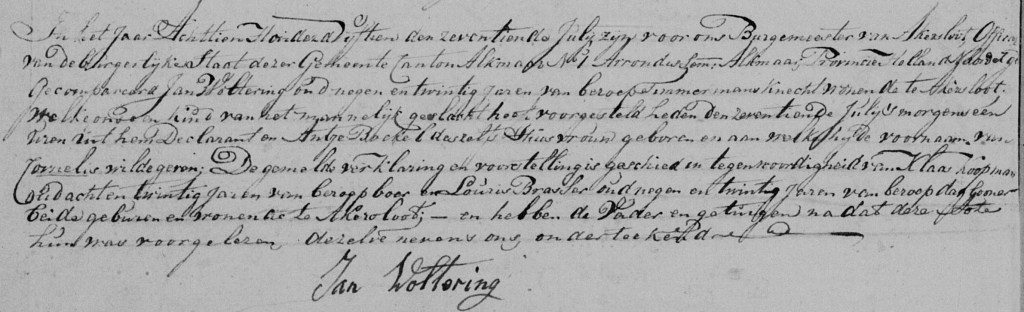
Jan’s birth registration

Both sides of Jan’s family have deep roots on Texel. I have traced both his lines back at least three generations. Jan’s mother, Marijke, was born on Texel around 1787. Her father, Jan Kuiter, was a sailor. Marijke passed away relatively young, on January 4, 1824, in Oost, when Jan was only five years old.

Jan’s father was a sailor on Texel. His father remarried in 1826 and moved the family from Texel to Den Helder sometime before 1833. Den Helder is a major Dutch port at the northwestern tip of the country and has been a major naval base since the 1700s. It seems that Cornelis gave up life at sea for life on the shore after moving to Den Helder. His recorded occupation was porter, most likely working on the docks.

When the family moved to the mainland, Jan Cornelis would have been in no more than his early teens. By 1847, Jan had followed in his father’s footsteps and was working there as a sailor. That year, he registered for compulsory military service but was not called to serve. Jan carried on in his profession as a sailor, which was how he spent the rest of his working life.

On June 3, 1847, Jan married Johanna Adriana Puinbroek in Den Helder. Johanna was born in 1822, in Heinkenszand, Zeeland, far to the south. Her parents were Johannes Puinbroek and Maria Theresia Letens. What brought Johanna’s family north to Den Helder is unclear, but her marriage to Jan firmly rooted her there. Together, Jan and Johanna had one child, my Gx2 Grandfather, Cornelis Jan Bakker, born on April 26, 1855, in Den Helder.

Sadly, Jan’s life was cut short. He died on November 13, 1859, at the age of 40, in Den Helder. His widow, Johanna, lived on for more than two decades after his death, passing away in 1881, at age 58. I have no idea as to how he died, but I’ve wondered whether it occurred as a result of his work as a sailor given how young he was at the time. However, I’ve found nothing in any of the sources I’ve consulted, including the online newspaper collections at Delpher and various Dutch archives.
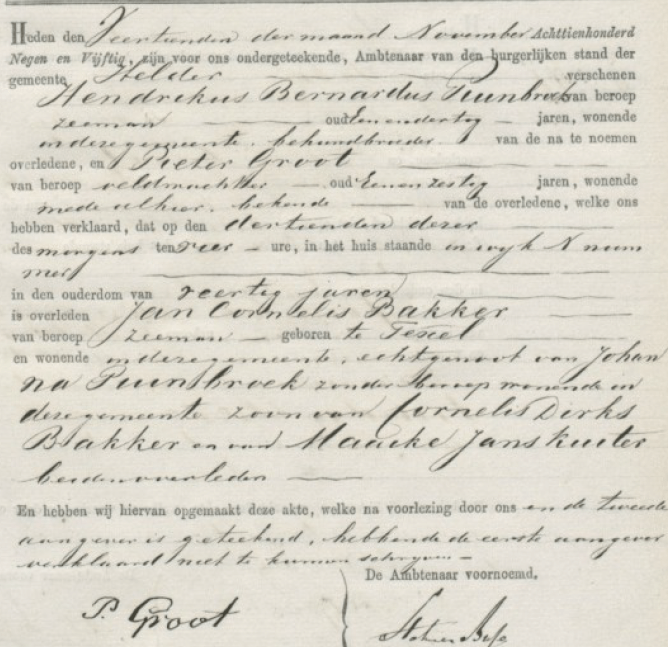
Jan’s death registration

52W Mark IV – Week 21: Card K8 Cornelis Woltering

Cornelis Woltering (1815-1862)

Cornelis Woltering was born on July 17, 1815, in the village of Akersloot, Noord Holland. He was born less than two months after the official establishment of the United Kingdom of the Netherlands and one month after the Battle of Waterloo.

Cornelis was the eldest of three children born to Jan Woltering and Antje Boekel. What I find surprising is that Jan was born in what is now Vreden, North Rhine-Westphalia, Germany, about three kilometers from the Dutch border. Sometime before he married Antje in 1814, Jan literally moved across the Netherlands to Noord-Holland. I have no idea what motivated the move, particularly given the significant distance.

Unlike the majority of my Dutch ancestors who were labourers or farmers, Cornelis was a tradesperson, working as a carpenter. It was the same occupation as his father and it was Cornelis’s profession his entire life.

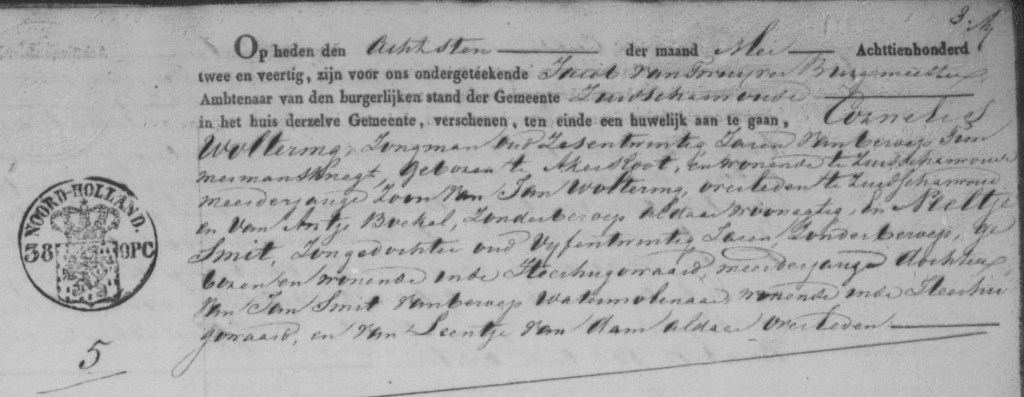
Cornelis was serving his apprenticeship when he married Neeltje Smit on May 8, 1842 in Zuid-Scharwoude. For the entirety of their marriage, the couple lived in Zuid-Scharwoude, where Cornelis carried out his work.

Cornelis and Neeltje’s marriage registration.

Cornelis and Neeltje had six children. The first born, Leentje, married and later ended up living in the province of Gelderland, most likely in Nijmegen. Another daughter, Anjte, my Great x2 Grandmother, married and spent the rest of her life in Noord-Scharwoude. A son, Jan, who never married, was a tailor. The three other children never survived childhood.

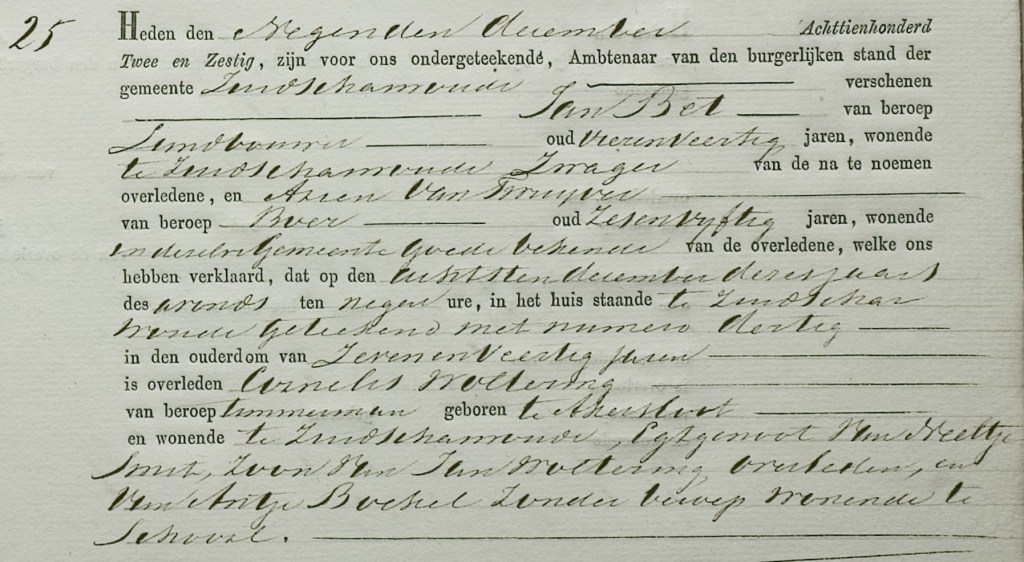
Cornelis died relatively young, at age 47, on December 8, 1862 in Zuid-Scharwoude. Leentje was nineteen; Antje was nine. Neeltje lived another 44 years after her husband’s death.

Cornelis’s death registration.

52W Mark IV – Week 17: Card K4 Cornelis Jan Bakker

Cornelis Jan Bakker (1855 – 1914)

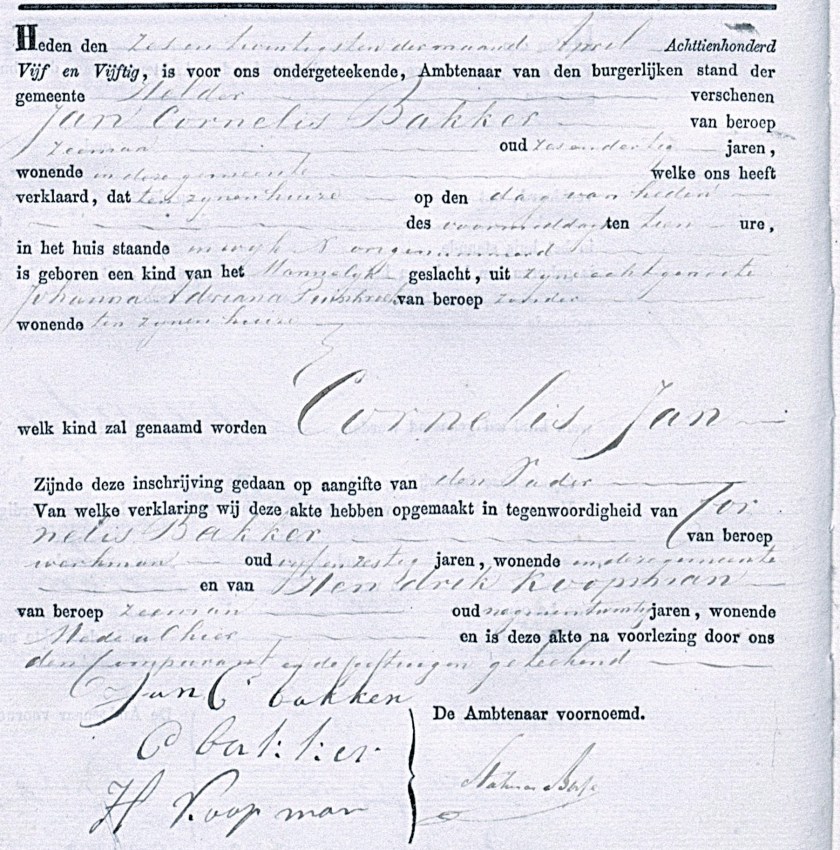
Cornelis Jan Bakker was born on April 26, 1855 in Den Helder, Noord Holland, the only son of Jan Cornelis Bakker and Johanna Adriana Puinbroek. Cornelis was only four when his father died. While Johanna remarried to a man named Pieter Dekker when Cornelis was six, the death of his father must have undoubtedly must have left a mark on his life. He remained an only child, as Johanna and Pieter never had any children that I could find.

Cornelis’s birth registration (Civil Register for Den Helder)

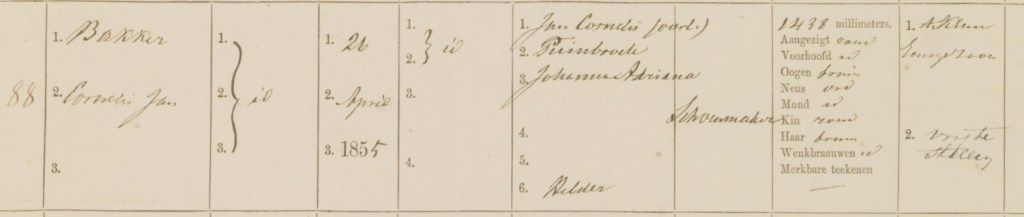
Cornelis spent his life in Den Helder, a port city in the north-west corner of the Netherlands and home of the Netherlands’ primary naval base for centuries. In 1875, Cornelis registered for mandatory military service in Den Helder but never served. The register shows that he was exempted from service because he was an only child.

Military Register showing Cornelis’s enrollment for mandatory military service and his exemption from service due to being an only child.

It should come as no surprise that Cornelis had a number of ancestors who were civilian sailors in Den Helder. Cornelis’ father and a maternal uncle were sailors, as were several other direct ancestors, along with his step-father and his father-in-law. In fact, Cornelis’s wife also had many sailors in her lineage.

Cornelis broke with that tradition. Around 1875, Cornelis began his work as a cobbler or a shoemaker, a trade he maintained for nearly four decades, up until his death in 1914. Three of Cornelis’s five sons became shoemakers, although one later gave up the trade to work in a bank.

On September 29, 1881, when he was 26 years old, Cornelis married Christina Ran in Den Helder. Christina was born in Den Helder on February 13, 1858 and, like Cornelis, spent her entire life in that city. Together, Cornelis and Christina had eleven children. While Cornelis and Christina remained rooted in Den Helder their entire lives, several of their children later moved further afield, including my great grandmother Elizabeth Bakker who ended up in Langedijk, about 30 kilometers to the south. Other children ended up in the provinces of Utrecht and Zuid Holland.

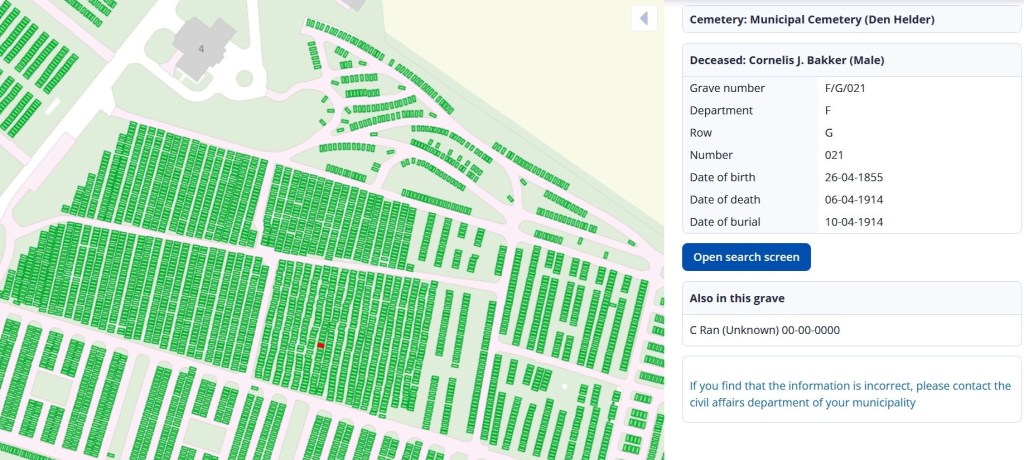
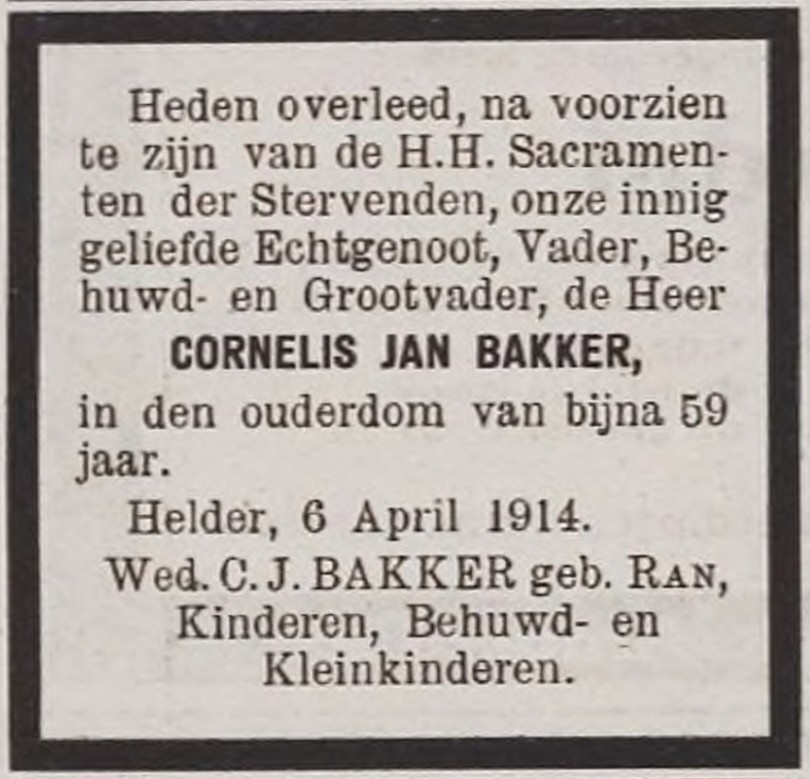
Cornelis died on April 6, 1914 at the age of 58 in Den Helder. He was buried in Den Helder, at the Begraafplaats Huisduinen (“Huisduinenen Cemetery”). The cemetery is now also known as Algemene Begraafplaats Den Helder (“General Cemetery of Den Helder”). Huisduinen is a village on the outskirts of Den Helder and was the original settlement centuries ago. When the harbour was built in Den Helder, its growth outpaced the original neighbouring village.

Map showing the location of Cornelis and Christina’s grave at Begraafplaats Huisduinen in Den Helder.

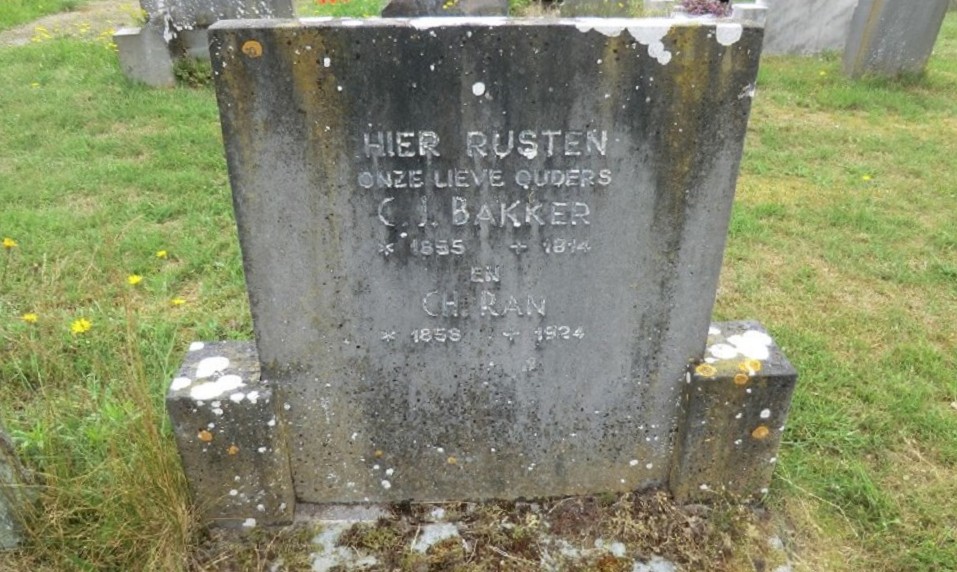
Graves in the Netherlands are usually leased, not purchased, and are routinely cleared after a few decades, so imagine my surprise when I discovered that Cornelis, along with his wife, is still interred in his original resting place! According to the Dutch version of Wikipedia, there are gravestones at Begraafplaats Huisduinen dating back to 1671 and that there are many centuries-old headstones. In fact, in 2023, many of the old graves and headstones were restored and renovated.

“Here rest our dear parents C. J. BAKKER (1855-1914) and CH. RAN (1858-1924)”

If I had known about this when I visited Den Helder many years ago, I would have loved to have visited the site!

Heldersche Courant, April 7, 1914, page 3

52W Mark IV – Week 10: Card V10 Jan Pater

Jan Pater (1826-1878)

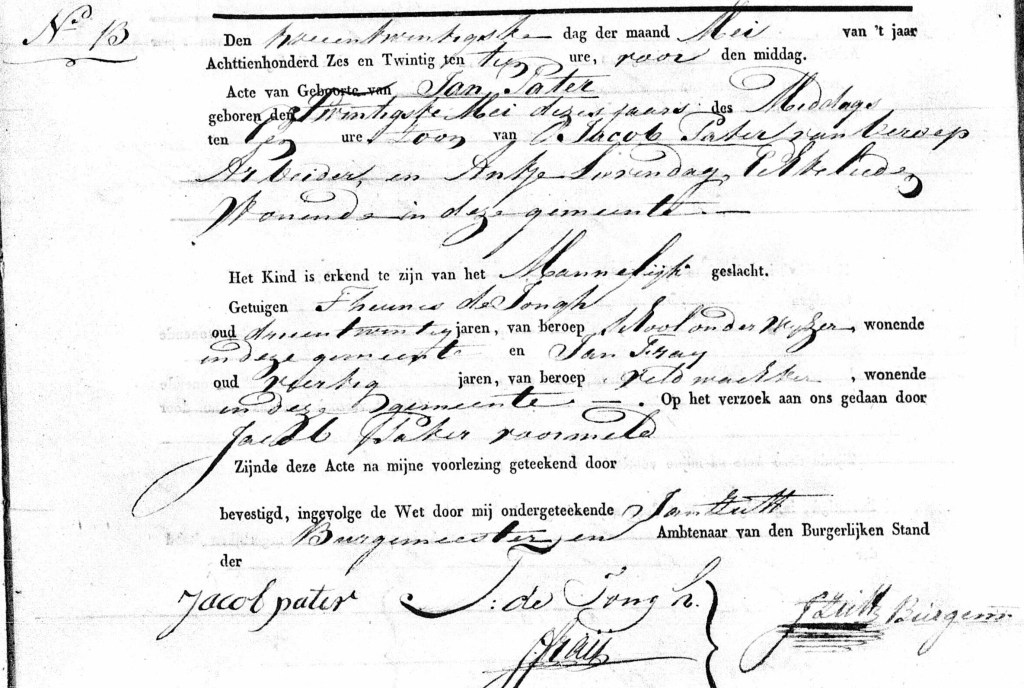
Jan Pater was born on May 20, 1826 in Sint Maarten, Noord Holland, the eldest of five children born to Jacob Janz Pater and Antje “Anna” Lievendag. Sometime between the time Jan was three and seven, the family moved a few kilometers south to the adjacent gemeente (municipality) of Harenkarspel. According to his registration of marriage, Jan lived in Harenkarspel and was working there as a labourer until shortly before he got married.

Jan’s birth registration.
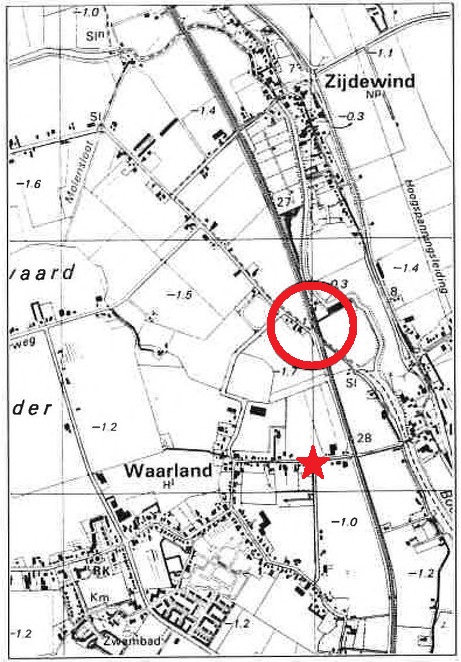
The circle shows where Jan lived with his wife and inlaws. The star is where my father was born.

Jan was 26 when he married Teetje de Groot on June 11, 1852 in Oude Niedorp. After they married, Jan and Teetje moved in with Teetje’s parents, Jan de Groot and Sijtje Sijbecarspel. They lived in Zijdewind, which at the time was part of gemeente Oude Niedorp.

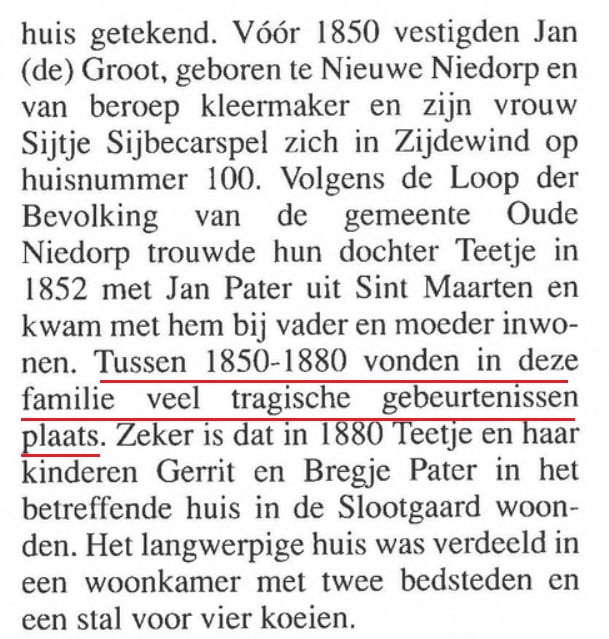
According to an article in Toendertoid: Stichting Waarland van Toen, “Many tragic events took place in this family between 1850 and 1880.” It then went on to describe the house they lived in, without providing any details about what happened.

Toendertoid, May 1994, page 12
WHAT HAPPENED?!?

Jan was a labourer almost his entire life, except for a brief period in 1872 when he was a “veldwachter”; literally, “field guard,” a kind of rural police or constabulary. The veldwachters originated as the “garde champêtre” during the Napoleonic era. They were very poorly paid, if at all, and largely relied upon other sources of income. There were few prerequisites to become a veldwachter and at Jan’s time it was much less than a professional police officer. What authority they had was limited to the municipality in which they served.

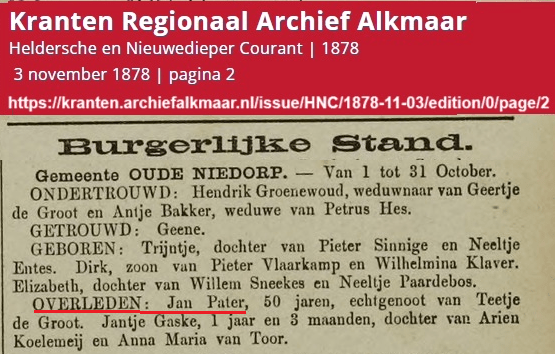
Jan was 46 when he was a veldwachter and he did not serve very long. It is not clear what qualification Jan had for the role. He was still described as a labourer when his daughter Maartje was born in March 1871. It was only the April 1872 death registration of his son, Jacob, that showed Jan as a veldwachter. Maartje died later that same year, in December, and her death registration recorded that Jan was a labourer at the time. Jan was still a labourer when he died in Zijdewind at age 52.

Burgerlijke Stand = Civil Register
Died: Jan Pater, age 50, husband of Teetje de Groot.