52W Mark III – Week 43: Lost Contact

This week’s prompt for the 52 Ancestors Challenge is “Lost Contact”. Losing contact is one way of losing a connection. Sometimes losing the connection might be necessary.

There are countless ways as to why a tree is such an excellent metaphor for genealogy. One comparison that might not be considered so often is that, like a tree, sometimes one’s family history might need some pruning.

As our research progresses over time and we add to our trees, we might discover that there are branches that no longer belong, which should never have been there in the first place. They might have been grafted to our trees early on, when we were new to genealogy, and did not realize that the connection was not supported by the evidence. There might be branches that seemed to be supported by the evidence that was available at the time, but new evidence comes to light that disproves the connection. When this happens, we have to cut that branch and end contact with the false connection.

I know that sometimes many genealogists have had a hard time making the cut. After all, until the connection was disproved, the individuals on the branch were considered family.

Over the years, I’ve made cuts now and again. Some small, some big. A few years ago I found a significant cut I had to make for my 6xG Grandfather, James Turner (1715-1773). James is on a branch of my tree for which I’ve had less interest than others over the years. He was the great grandfather of my 3xG Grandfather, Preston Thomas (1814-1877). While I’ve done quite a lot of research on Preston – and written about him here many times – I have not done much research on his lineage. Most of what I have is names and dates I gathered in the mid-90s during my earliest visits to the Family History Centre in Burnaby, and never really looked at again very seriously. It comes as no surprise to me when I have to prune some of the branches on Thomas’s line, including the parents of James Turner (which I wrote about on Week 8 of the 2023 52 Ancestors Challenge).

The other branches of my tree that I know need some more serious research and that might result in some pruning, or at least some revision, are the paternal lines of my maternal grandmother, Helen Burgess (1921-1984). I have great confidence in the information I have for Helen’s grandparents and her attachment to them. However, I have doubts about the lineage of her great grandfather Franciscus “Franz” Lerner (b. bet. 1835-1840 – d. 1876 or 1877) and her great grandfather Georg Jacob Anton (1843-1908).

My grandmother’s is a descendant of Germans from Russia, which I have written about here quite often. Those ancestors are my most difficult branches to research, for many reasons.

For Franz, I am confident in the identity of his paternal grandfather [Franz Ignaz Lerner (1759-abt 1816 or later)]. The main problem is identifying his father. Franz’s father is one of either two individuals:

  • Michael Lerner born 11 Jul 1793 in Malsch, Karlsruhe, Baden, wife Maria Eva Eberle born 1793 in Pleisweiler, Bergzabern, Pfalz (although possibly Eva Eberle), or
  • Bernard Lerner born 27 Feb 1798 in Malsch, Karlsruhe, Baden, wife Barbara Heil born abt 1799 in Niederlustadt, Germersheim, Pfalz.

As for Georg Jacob, he might not actually be Georg Jacob. It is possible he is actually simply just Jacob. As for Georg Jacob’s father, the name I have is Johannes Anton; however, he might actually have been Peter Johannes Anton. Not only are the names I have slightly off from some other indicators, the birthdates I have for both is in question. Interestingly, the identity of their spouses does not seem to be as dubious. This leads me to believe that there is no mistaken branch here; rather, it is simply a matter of properly identifying Georg Jacob and Johannes.

I will add that even when I prune a branch, I keep a record of it. If large enough, I create a separate database for it; if not, I keep notes in my research logs or in the notes for the child whose parents I ended up cutting. That way I don’t retrace my steps or fall into old traps. Moreover, should it turn out the information actually was correct, I have it handy and can graft the branch back onto my main tree.
52W Mark III – Week 15: School Days

I typically consider myself as a descendant of many, many farmers. However, I am always surprised to remember that I am also descended from many individuals for whom education was important. There are also several educators in my extended family, including a high school principal. One of my sisters was a school teacher before becoming a medical doctor. As well, my maternal grandmother, Helen Lerner, originally intended to become a school teacher until a nun steered her in another direction.

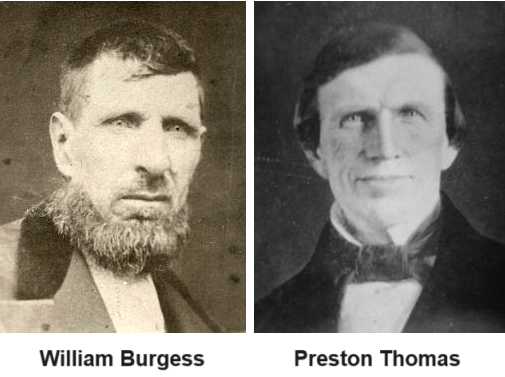
In particular, several of my direct ancestors were school board trustees. The earliest were my Gx3 grandfathers, William Burgess (1822-1904) and Preston Thomas (1814-1877). They served together on the first school board for the Lehi, Utah school district. The school district was created by the city of Lehi by resolution dated February 17, 1854. An election was held three days later, on February 20, 1854. Three school trustees were elected: William, Preston, and Daniel Collett.

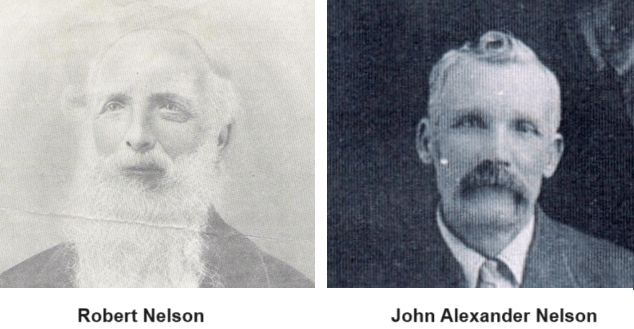
My Grandpa Burgess also had several other school trustees on his maternal line, the Nelson family. According to the 1880 US Census, his great grandfather (another of my Gx3 grandfathers), Robert Nelson (1818-1902) was a school trustee in Smithfield, Utah. Twenty-seven years later Robert’s son, John Alexander Nelson (my Gx2 grandfather) held the same office in Woolford, Alberta. John was one of the founders of the Woolford school board and was one of its first board members.

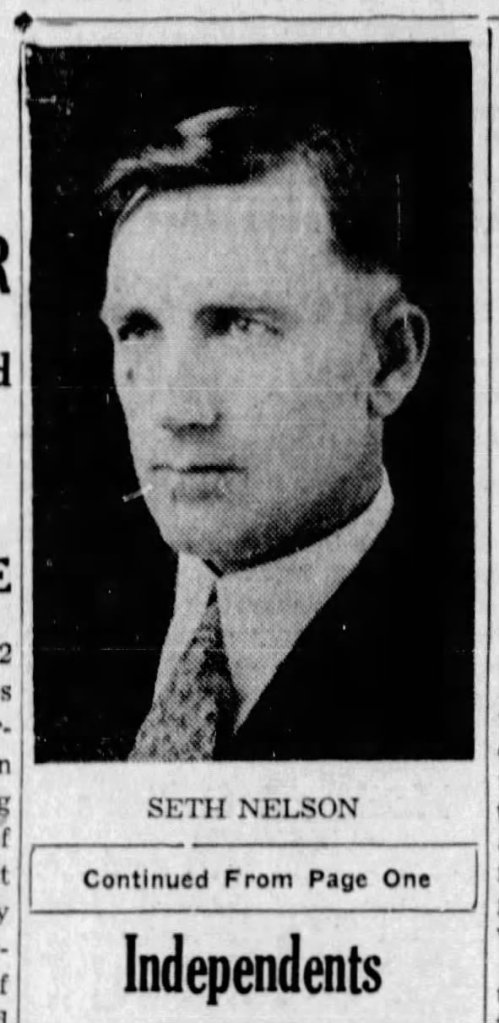
John’s son (my grandfather’s uncle), Seth Henry Nelson Q.C. (1891-1975), also served as a school board trustee in Cardston, Alberta. Seth was a school trustee for 15 years, from 1924 to 1939. Seth served as the Board’s Secretary for the last 10 years of his time in office. Following his last term as a school trustee, Seth made an unsuccessful run for a seat in the Alberta provincial legislature during the 1940 general election. Seth ran as an independent against the incumbent Social Credit candidate, Nathan Tanner. Tanner was a former Speaker of the legislature who was appointed to Cabinet in 1937. Despite running as an independent, it was a close race. Tanner defeated Seth in a two-way race, 2,160 votes to 1,808 (54.4% of the vote).

Education was also a facet of my wife’s side of the family, one of whom also served as a school trustee. Frank Eden (1839-1907), our children’s Gx3 grandfather, was a prominent Halifax, Nova Scotia merchant whose primary business was shoe manufacturing and sales. Frank served two non-consecutive terms as an alderman on the Halifax city council (1892-1893 and 1895-1896). Concurrent with both terms of office on city council, Frank served on the Halifax Board of School Commissioners.

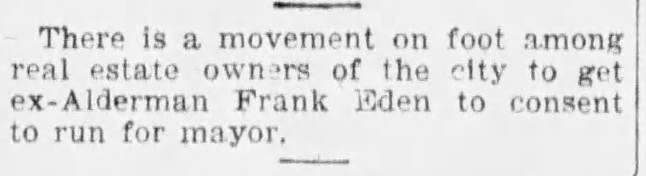
In 1902, there was an attempt to persuade Frank, who was still in the shoe industry, to run for Mayor of Halifax. As stated on page nine of the Halifax Herald, on January 1, 1902: “There is a movement on foot…to get ex-Alderman Frank Eden to consent to run for mayor.” As far as I’m concerned, all puns are intended.

52W Mark II – Week 44: Spirits

Egad, I almost ghosted this week’s 52 Ancestors Challenge, themed “Spirits”. I thought I had done this a week ago, but it turns out I only did so in my mind.

Initially I had hoped to take the theme in a more libatious direction and share an anecdote involving jenever, a Dutch liquor that is the forefather of gin. Unfortunately, once I began to write it, it became apparent that it was a rather boo-ring story.

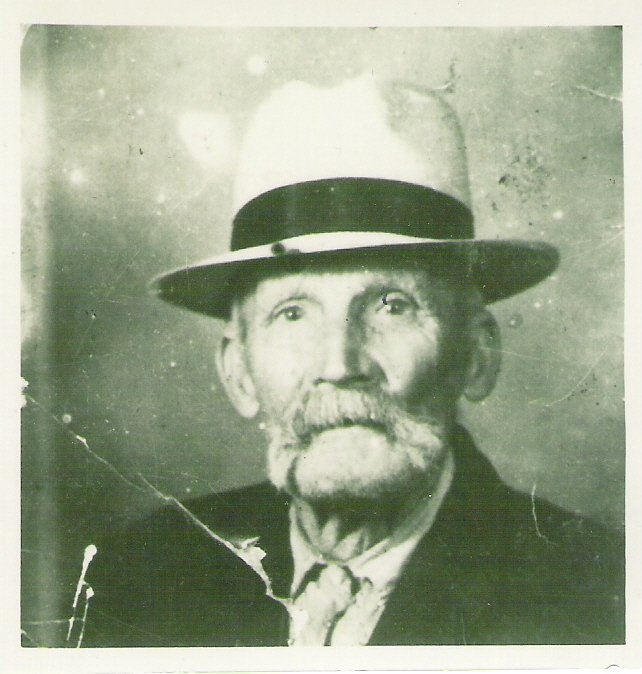
John A. Nelson

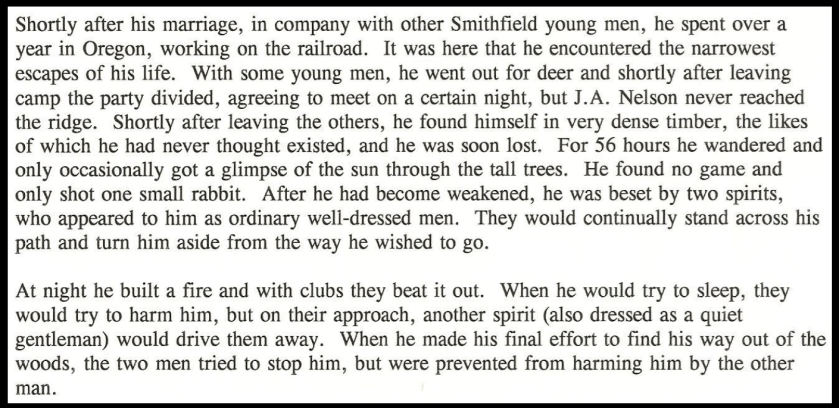
Thus I have turned to this well-worn oft-repeated anecdote about my great great grandfather, John A. Nelson (1854-1942), that I’ve seen innumerable times over the last thirty years. It’s attributed to his son Seth Henry Nelson (my mother’s great uncle, who I wrote about on Week 8 in 2022). While I’ve seen countless copies of it, I’ve never seen anything its provenance or that could be described as the original.

The tale relates to John’s encounter with two malevolent spirts and a third that may have been his protector. I’ll share it as written:

Needless to say, I don’t believe a word of it. Its greatest value may be that it tells me something I otherwise wouldn’t have known about John: he spent a year in Oregon working on the railroad. The only question is when.

The anecdote indicates that John was in Oregon for over a year shortly after his marriage to my great great grandmother, Ella Elizabeth Thomas, which occurred on January 9, 1879. Their first child, Maria (“Mimie”), was born in March 1880, so John did not leave for Oregon any earlier than June or July 1879. John and Ella’s second child, Ella, was born more than two years after Mimie, in June 1882. If John was away from home for more than a year shortly after marrying Ella, it could have occurred anywhere between late summer 1979 and the summer of 1881. However, without further evidence, I don’t have a ghost of a chance of figuring it out.

Ella Elizabeth Thomas and John Alexander Nelson

52W Mark II – Week 33: Strength

I am not a member of the Latter Day Saints (“Mormons”), but my maternal grandfather, Leo Burgess, was. In fact, his direct paternal line were Mormons almost since the beginning. The early members of the church were required to draw on their strength as they faced persecution, exile, and hardship.

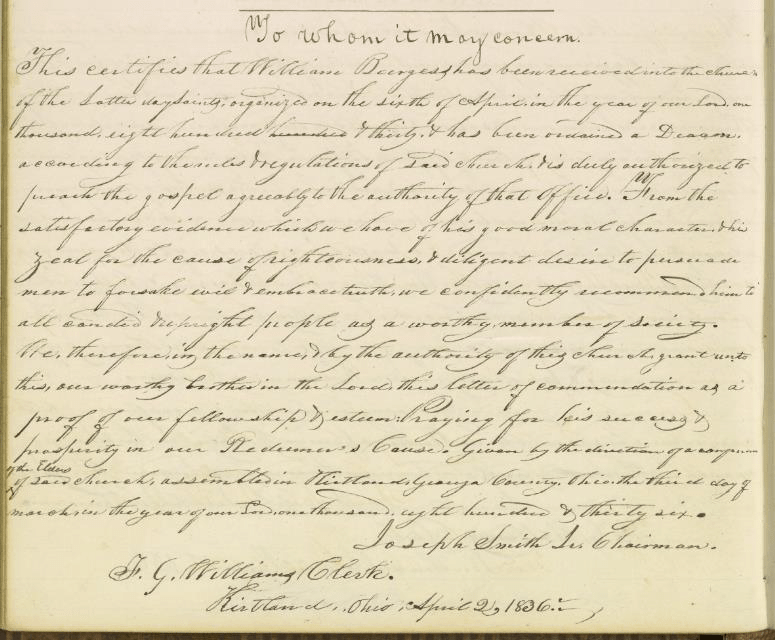
Most sources state that my Gx4 Grandfather, William Burgess (1794-1880) was baptised into the church in 1832, two years after it had been founded by Joseph Smith. However, the Kirtland Elders’ Certificates from the Joseph Smith Papers state that William joined the church and was ordained a deacon on April 6, 1830. All eight of my grandfather’s great grandparents had joined the church in the 1830s and 1840s.

“This certifies that William Burgess has been received into the church of the Latter-Day Saints, organized on the sixth of April, in the year of our Lord, one thousand, eight hundred hundred & thirty, & has been ordained a Deacon…

Joseph Smith Jr. Chairman.
F[rederick] G. Williams Clerk.
Kirtland, Ohio, April 2, 1836.”

Kirtland Elders’ Certificates, p. 84, The Joseph Smith Papers

While I am quite skeptical about much of the church’s dogma, I absolutely respect the strength of its early adherents, including many of my direct ancestors who were early members of the church. Many of them experienced and survived unnecessary suffering due to religious persecution. Several others endured an arduous – and for some,  deadly – journey from Illinois to Utah over the winter of 1846-1847.

Joseph Smith sought to create a “New Jerusalem”. He and his followers moved to Ohio and soon began building a settlement in Missouri. In 1833, church members were run out of Missouri and a failed banking venture crippled the Ohio settlement. The Mormons attempted a settlement elsewhere in Missouri, but were driven out upon an executive order of the governor, calling for them to be exterminated or expelled from the state. In 1939, the church regrouped in a new community, Nauvoo, Illinois, and began to build their Zion there.

Two years after Joseph Smith’s death in 1844, tensions with non-Mormons increased, such that the Mormons were driven out of their settlement once again. They upped stakes and began the migration to Utah. During the westward migration, over the winter of 1846-1847, about 2,500 church members encamped at Winter Quarters, which was just north of where Omaha, Nebraska came to be. The first settlers arrived in what is now Salt Lake City in July 1847, in what was still Mexican territory.

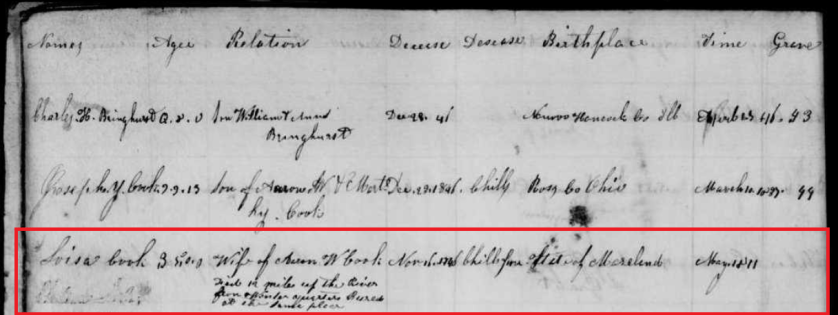
Many of the trekkers did not survive. There are varying accounts of the death toll at Winter Quarters. This is due, in part, to the lack of sufficiently complete and reliable records. It is also due to what was included in each account: some measure death only due to disease, others include deaths of all causes. The periods of time also vary: from a few months over the winter of 1846-1847, to longer periods of time, e.g.,1846 to 1848. Louisa Thomas, my 4x great grandmother, was one of those who perished at Winter Quarters. She died on November 16, 1846. An entry in the Winter Quarters sexton’s records shows that she died 19 miles up the river from Winters Quarters. Louisa’s daughter Charlotte, my Gx3 grandmother, was only nine at the time.

The entry for Louisa Thomas in the Winter Quarters sexton’s records, 1846-1848: “Loisa Cook. 36 years, 0 months, 0 days. Wife of Aaron W. Cook [her third husband]. Died 19 miles up the River from Winter quarters Bur[i]ed at the same place. [Died] Nov 16 1846. [Disease] chills fever. [Born] State of Mareland May 1811.”

To have survived long journeys to settle in new lands, religious persecution, and perilous migration took incredible strength – mental, physical, social, and spiritual. Their conviction and belief carried them through difficult times and experiences. For that I am grateful, because without their strength I would not have been.